
A Business Guide to Recycling Circuit Boards

Recycling circuit boards isn't just about checking a box for environmental compliance anymore—it's become a strategic move with serious financial and reputational weight. Companies that drag their feet on proper disposal are staring down steep penalties. But the smart ones? They're discovering a powerful way to boost their brand, recover value, and make a real difference.
For businesses here in Atlanta, what used to be a simple operational task has transformed into a chance for genuine community impact. Your old tech can house a veteran and grow a forest.
Why Circuit Board Recycling is a Modern Business Imperative
In the not-so-distant past, getting rid of old electronics was an afterthought, just another line item in the IT budget. Today, it’s a critical function tied directly to risk management, brand identity, and corporate responsibility. Circuit boards, the electronic heart of pretty much every device we use, are packed with a complex mix of hazardous materials and valuable precious metals. This creates a two-sided coin of risk and opportunity.
On one side, you have the liability minefield of improper disposal. Printed Circuit Boards (PCBs) contain nasty stuff like lead, mercury, and cadmium. If that ends up in a landfill, it can leach into our soil and groundwater. That's not just an environmental problem; it's a direct route to hefty fines and legal headaches for your company.
The High Cost of Negligence
A single compliance failure can stain a company's reputation for years. Picture this: an Atlanta business improperly dumps some old IT gear, and it's later found to contain sensitive client data. The fallout isn't just a regulatory slap on the wrist. You're looking at a catastrophic loss of customer trust, negative headlines in the Atlanta Journal-Constitution, and brand damage that takes years to repair. Suddenly, the cost of doing nothing far outweighs the investment in a secure, compliant recycling program.
But flip that coin over, and you'll find immense opportunity. Responsible recycling isn't just a cost center; it’s a value creator. The market itself tells this story. The global PCB e-scrap recycling market was valued at around $699.43 million in 2024 and is on track to nearly double to $1.37 billion by 2032.
By transforming an operational necessity into a brand asset, companies can turn retired technology into a powerful story of corporate citizenship and positive impact. It’s about more than just disposal—it’s about demonstrating your commitment to the community and the planet. Our tagline says it all: "Recycling That Restores Lives and Landscapes."
Turning Compliance into a Brand Advantage
Forward-thinking companies are looking past basic compliance and weaving their recycling efforts into their Environmental, Social, and Governance (ESG) goals. When an Atlanta-based company partners with a mission-driven recycler, its positive impact gets amplified exponentially. It's an easy ESG win.
Think about the story this creates for your business:
- Veteran Aid: Your company’s old servers and laptops help provide direct support to local veterans, literally turning e-waste into hope.
- Reforestation: Each recycling pickup contributes to planting trees, tangibly restoring natural landscapes and showing a real commitment to environmental stewardship.
- Local Impact: It proves you're invested in a "Greener Atlanta," strengthening community ties and building local pride.
This approach turns a mundane task into a compelling narrative for your annual CSR reports, social media feeds, and client conversations. You’re no longer just recycling electronics; you're a partner in restoring the community. To see just how much you stand to gain, you can learn more about the benefits of e-waste recycling in our detailed guide.
Choosing the right partner means your retired assets don't just disappear—they get a second life restoring lives and landscapes.
Preparing Your Circuit Boards for Secure Recycling
Before a circuit board ever makes it to a recycling facility, there's a crucial prep phase that has to be handled perfectly. This isn't just about boxing things up; it's the foundation of your company's data security and regulatory compliance. It all starts with the one step you absolutely cannot skip: data destruction. Get this wrong, and what started as a responsible recycling project can quickly become a massive liability.
The second a device is taken out of service, any data left on it is a ticking time bomb. Proper sanitization is non-negotiable if you want to protect your company, your clients, and your team from a potential breach. Just hitting 'delete' on a file is nowhere near enough—that data is often easily recoverable. A rock-solid data destruction plan is your first and most important line of defense.
Ensuring Complete Data Destruction
You’ve got a few proven methods for wiping data, and each has its place depending on your security policies and how sensitive the information is.
-
Software-Based Wiping: This is where specialized software overwrites every bit of data with random characters, sometimes making multiple passes. It’s a great option for hardware you might want to refurbish or resell because it leaves the device functional. The key is to use a program that meets recognized standards, like DoD 5220.22-M or NIST 800-88.
-
Degaussing: Think of this as a powerful magnetic blast that scrambles the data on traditional hard disk drives (HDDs) and magnetic tapes. It's incredibly fast and effective, but it also renders the drive completely useless afterward. Just be aware: degaussing doesn’t work on solid-state drives (SSDs) since they don't rely on magnetic storage.
-
Physical Shredding: When you need the absolute highest level of security, nothing beats physically destroying the media. We’re talking industrial shredders that turn circuit boards and hard drives into tiny, confetti-like pieces. For top-secret data or totally obsolete hardware, this is the go-to method.
My advice? The most secure approach is often layering these methods. For example, you can perform a software wipe and then physically shred the device. This creates a bulletproof process and a solid audit trail, giving you total peace of mind.
Logistics of Physical Preparation and Handling
Once you've verifiably destroyed the data, the focus shifts to physically prepping the circuit boards. Handling and sorting them correctly is vital for both safety and recycling efficiency. This is where good team training really pays off.
First things first, separate the circuit boards from other e-waste. Tossing them in a bin with bulky monitors or old printers can cause damage that makes recovering valuable materials much harder. Your team should be trained to spot and safely handle components that contain hazardous materials.
A lot of older boards have lead in the solder or mercury in switches. Anyone handling these needs to be wearing the right personal protective equipment (PPE), like gloves, to keep exposure to a minimum. A best practice is to set up a specific, well-ventilated area just for sorting and packing this kind of e-waste.
This simple diagram shows how smart prep work minimizes your risk while maximizing what you get back—both in materials and reputation.
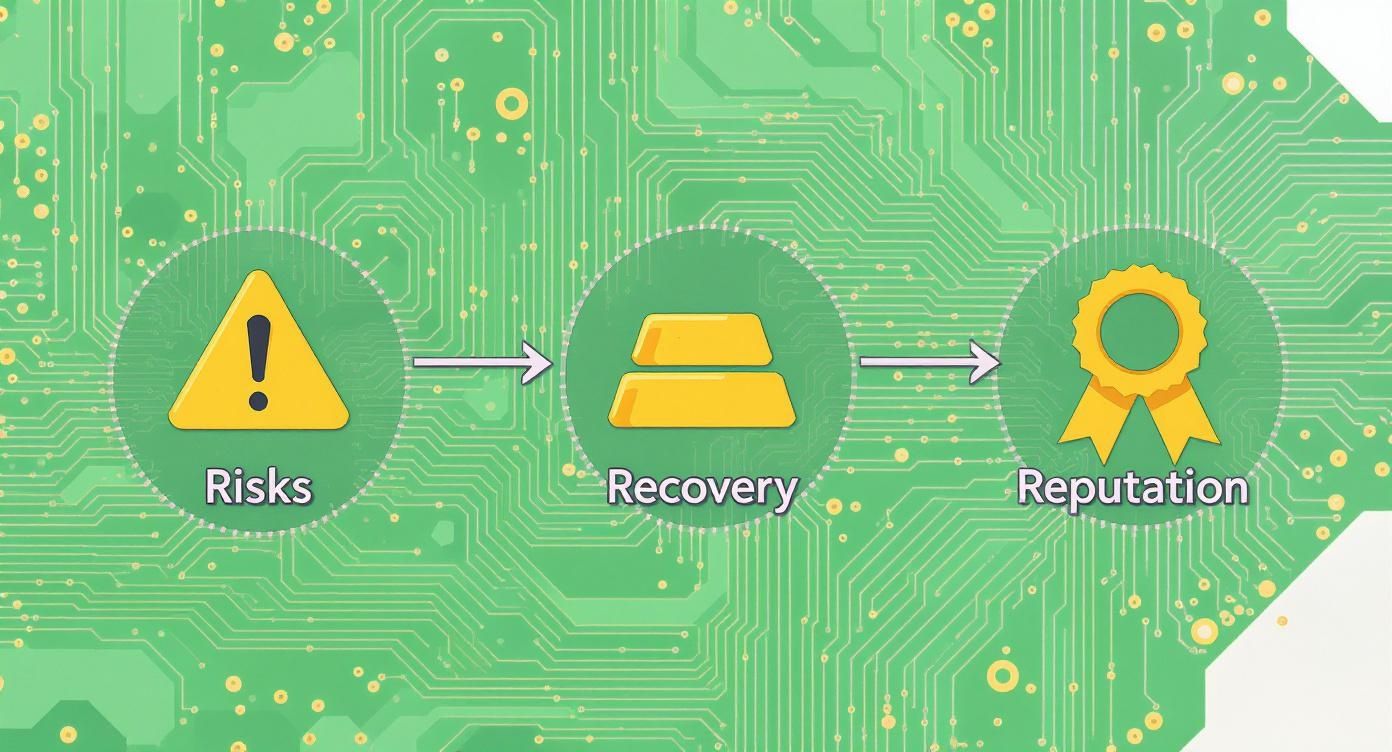
It’s a clear visual reminder: managing your risks through secure data destruction and safe handling directly leads to better recovery of valuable commodities and a stronger, more trustworthy corporate image.
Establishing a Secure Chain of Custody
A secure chain of custody is your documented, unbroken paper trail. It tracks your e-waste from the moment it leaves your building to its final, confirmed destruction or recycling. This paperwork is your proof that you did everything by the book.
Every pallet or container of circuit boards should be clearly labeled and inventoried. Your log should track details like the equipment type, serial numbers where possible, and the collection date. When your recycling partner shows up, make sure you get a signed receipt that officially transfers custody. This document is a cornerstone of your audit trail.
For a more detailed checklist that covers all sorts of electronics, take a look at our comprehensive guide to prepare your electronics for recycling for some extra tips. By carefully documenting every step, you build an unshakeable record that will satisfy any internal audit or regulatory check, protecting your business down the line.
Navigating E-Waste Regulations and Compliance
Stepping into the world of e-waste regulations can feel like trying to decipher a legal document in a foreign language. The alphabet soup of acronyms alone—RCRA, R2, e-Stewards—is enough to make any IT manager’s head spin. But getting a handle on these standards is about more than just avoiding fines; it’s about protecting your business from some serious liability.
The moment a circuit board is flagged for disposal, it gets tangled in a web of local, state, and federal rules. A misstep here doesn't just risk a penalty. It can create a chain of liability that leads straight back to your company, even long after that hardware has left your building.
Understanding Key E-Waste Standards
The rules for recycling circuit boards are there for two big reasons: to make sure hazardous materials are handled safely and that all data is completely destroyed. For businesses, a couple of voluntary certifications have become the gold standard for spotting trustworthy recycling partners.
-
R2 (Responsible Recycling): This certification looks at the entire journey of the electronics, from the moment they're picked up to their final destination. An R2-certified recycler is audited on everything from data security and environmental safety to worker health, ensuring your e-waste doesn't end up illegally shipped overseas or dumped in a landfill.
-
e-Stewards: Often seen as the most rigorous certification out there, e-Stewards enforces a strict zero-tolerance policy against exporting hazardous e-waste to developing nations. It gives you an extra layer of confidence that your circuit boards will be managed under the highest environmental and social standards possible.
Think of these certifications as a seal of approval. Honestly, partnering with a certified vendor is the single most effective move you can make to reduce your risk and ensure you’re working with a responsible downstream partner.
Creating a Bulletproof Audit Trail
When it comes to compliance, your best defense is always documentation. A solid audit trail gives you undeniable proof that you followed every single procedure correctly, from how you handled the equipment internally to its final disposition. This isn't just about stashing a folder of receipts; it’s about building a clear story of responsibility.
To really tackle the complex world of e-waste rules, businesses need to implement effective compliance risk management strategies that make documentation a part of every step.
Your paper trail absolutely must include:
- Detailed Inventories: Keep a log of every single device being recycled. If you can, include serial numbers.
- Chain of Custody Forms: These are the signed documents that track the transfer of your assets from your hands to your recycling partner’s.
- Certificates of Destruction: This is the official confirmation from your vendor that all data-bearing devices have been securely sanitized or physically destroyed. For data security compliance, this is your most important piece of paper.
A strong audit trail is your legal shield. If there’s ever an audit or, worse, a data breach traced back to improperly disposed-of equipment, this documentation is what will separate a compliant company from a negligent one.
Local Compliance for Atlanta Businesses
While federal laws like the Resource Conservation and Recovery Act (RCRA) set the baseline for hazardous waste across the country, states and even cities often have their own specific rules. For any company operating in Georgia, staying on top of local mandates is essential for smooth compliance when recycling circuit boards. We target local keywords like "Atlanta tech recycling" and "electronics recycling for veterans" to ensure we stay connected to our community's needs.
And these regulations are always changing. As global standards evolve, they often shape U.S. policies down the line.
For businesses right here in our community, it's critical to understand the nuances of Georgia's own regulations. Our team keeps a close watch on the legal landscape of electronics recycling in Atlanta to make sure our partners always stay fully compliant with every state and federal requirement. When you work with a locally-focused expert, you can be confident your recycling program is checking every single box.
How to Choose the Right E-Waste Recycling Partner
Picking a vendor to handle your old circuit boards is about a lot more than just getting equipment out of your storeroom. It's a decision rooted in trust.
You're handing over devices that may still hold sensitive company data. You're also trusting that partner to manage your legal compliance and, by extension, a piece of your brand's reputation. The right partner shields you from liability and amplifies your company's commitment to responsibility. The wrong one can open you up to a world of risk.
Finding that ideal fit means you have to look past the price sheet. It's about vetting their certifications, digging into their security protocols, and demanding a transparent process. Your goal shouldn't be to just dispose of old assets, but to find a partner who can help you turn them into a positive story of corporate citizenship—something that really matters here in Atlanta.

Core Credentials and Security Protocols
Before you even start talking about services, focus on the absolute must-haves: certifications and rock-solid data security. These form the bedrock of any trustworthy relationship.
First, check for top-tier industry certifications like R2 (Responsible Recycling) or e-Stewards. These aren't just logos for a website; they represent a commitment to the highest standards. It means the recycler is independently audited for environmental safety, data security, and ethical labor practices, guaranteeing your circuit boards won't end up illegally exported or dumped in a landfill.
Next, get granular about their data destruction methods. A reputable recycler will offer several sanitization options that meet federal guidelines like the NIST 800-88 standards. This should include:
- On-site physical shredding when you need maximum, verifiable security.
- Certified data wiping for any devices that might have a second life through refurbishment.
- Secure, witnessed destruction if your internal compliance policies require it.
No matter the method, they must provide a Certificate of Destruction for every single data-bearing device they process. This document isn't optional—it's the cornerstone of your audit trail and your legal proof that you’ve met your data security obligations.
When evaluating a potential partner, it's crucial to understand the standards they adhere to. Top-tier certifications like R2 and e-Stewards provide a framework for responsible electronics recycling, but they have different areas of emphasis.
Comparing E-Waste Recycler Certifications
| Certification | Key Focus Area | Data Security Standard | Environmental Standard |
|---|---|---|---|
| R2v3 | Full lifecycle management, including reuse and repair | Aligns with NIST 800-88 | Prohibits landfilling and incineration of hazardous e-waste |
| e-Stewards | Preventing illegal export of toxic e-waste to developing nations | Aligns with NIST 800-88 and international privacy laws | Strict prohibition on all toxic waste export and landfilling |
| NAID AAA | Secure data destruction | Focused exclusively on information destruction processes | Not an environmental standard |
Choosing a partner with certifications like R2 or e-Stewards ensures they're not just talking the talk; they're regularly audited to prove they walk the walk on both environmental and data security fronts.
Evaluating Service Models and Downstream Transparency
Once you’ve confirmed a recycler’s credentials, it’s time to see how their services fit your actual needs. A great partner offers more than just a pickup service; they provide end-to-end solutions.
Do they offer on-site de-installation? Can they securely pack and transport the equipment with their own fleet? Using their own logistics ensures a secure chain of custody from the moment the circuit boards leave your control.
Downstream transparency is just as important. You have a right to know exactly where your materials go after leaving your facility. A transparent partner can map out their entire process, showing how components are sorted, processed, and ultimately put back into the manufacturing supply chain. Don’t be afraid to ask them directly: "Can you prove our e-waste won't end up in a landfill?"
The right partner doesn't just take your e-waste; they provide a closed-loop, fully auditable solution. This protects your brand and ensures your retired assets are handled responsibly every step of the way.
Beyond Disposal: The Power of Impact Reporting
The best recyclers know that compliance is just the starting point. The real value is in turning your recycling program into a tangible asset for your ESG (Environmental, Social, and Governance) and CSR (Corporate Social Responsibility) initiatives.
Instead of a simple invoice, imagine getting a detailed Veteran Support Impact Report or a Plant-A-Tree Certificate after a pickup. We also provide partners with a digital "Recycled with Purpose" badge to display on their websites. This kind of documentation transforms a routine task into a powerful story you can share. Your company isn't just getting rid of old circuit boards; it's actively helping house a veteran or reforesting a community.
This is the kind of impact that resonates with employees, customers, and investors alike. It's perfect for your annual CSR reports, your LinkedIn posts, and your internal newsletters. It turns your e-waste program from a necessary cost into a brand-building opportunity.
When vetting potential e-waste recycling companies, make sure to ask them how they can help you tell a compelling story of positive change.
Turning E-Waste Recycling Into a Brand Asset
Let's be honest: recycling circuit boards is usually seen as a box-ticking exercise, a compliance task you just have to get done. But what if it could be more? The real magic happens when you stop seeing it as a back-office chore and start treating it as a cornerstone of your brand’s story.
This is where a necessary operational step becomes a powerful marketing asset. When you partner with a mission-driven recycler, you can transform that pile of retired IT equipment into a tangible narrative of community support and environmental stewardship.
Instead of just getting a basic disposal receipt, imagine receiving detailed impact reports you can actually share. Suddenly, the conversation shifts from "we got rid of old computers" to "we turned our old tech into hope." That’s a story that resonates—with employees, with customers, and with stakeholders. It shows your company’s commitment runs deeper than just the bottom line.
Launching a Recycle for a Cause Campaign
To really bring your recycling program to life, frame it as something bigger—a philanthropic initiative. A "Recycle for a Cause" campaign connects the simple, practical act of recycling with profound, emotional outcomes that people can get behind.
Powerful messaging is everything. Ditch the technical jargon and use taglines that tell a story:
- “Your old tech can house a veteran and grow a forest.”
- “Turning E-Waste into Hope.”
- “Recycling That Restores Lives and Landscapes.”
This kind of messaging turns retired circuit boards from hazardous waste into a resource for positive change. You can also align these campaigns with relevant holidays like Veterans Day, Earth Day, or Arbor Day. This creates timely, newsworthy events that amplify your impact and generate some fantastic PR for your Atlanta-based business.
By linking your e-waste disposal to dual causes—veteran aid and reforestation—you create a unique differentiator. It proves your company is invested not just in compliance, but in the well-being of the community and the planet.
Building Corporate ESG and CSR Partnerships
For your corporate partners, this approach is an easy win for their ESG goals. Companies are actively looking for ways to meet sustainability benchmarks, and a well-documented recycling program is a perfect fit. We can even publish case studies on LinkedIn showing how clients met CSR benchmarks.
Try offering corporate recycling drives with a clear value proposition: we offer free pickup for 50+ devices, followed by official documentation they can use for their reporting. We provide them with Plant-A-Tree certificates and Veteran Support Impact Reports tailored specifically for their CSR needs.
To add another layer of credibility, you can use our digital “Recycled with Purpose” badge. Partners can display this on their websites and in their annual sustainability reports, giving them visual proof of their commitment. It’s a simple tool that acts as a third-party endorsement of their responsible practices.
Leveraging Digital Marketing and Community Engagement
This mission-driven approach is a goldmine for digital content. Forget generic posts about recycling; start sharing the real stories your program makes possible. Think short, compelling videos showing USDA reforestation footage or testimonials from veterans who have received aid.
Use these stories in targeted ad campaigns with messages like, “Your company can turn e-waste into forests.” This kind of social proof is far more persuasive than a simple service pitch. On your website, you can reinforce this transparency with live impact counters showing stats like “1,245 veterans supported” or “3,700 trees planted.” We even offer a referral program: refer another business and we'll plant an extra tree in your name.
This strategy also builds credibility right here at home. By co-hosting recycling drives with local VFW chapters, environmental NGOs, or Atlanta-area schools and universities, you create genuine grassroots connections and generate positive local press.
The value locked within discarded electronics is immense. On average, one tonne of circuit boards can yield 165 grams of gold, worth thousands of dollars. Globally, around 1.2 million metric tons of PCB waste are generated annually, but only 34% is recycled in environmentally sound facilities. That highlights a massive opportunity for impact.
This entire strategy transforms a regulatory requirement into a dynamic brand-building exercise. To dive deeper into this concept, you might be interested in our article on how sustainable electronics recycling benefits your business beyond just ticking a compliance box.
Common Questions About Circuit Board Recycling
When it comes to handling old IT assets, most businesses run into the same handful of questions. The world of circuit board recycling can seem a little complicated from the outside, but once you get the basics down, it’s much easier to see the path forward—and why bringing in a professional partner is a smart move.
Here are some straightforward answers to the questions we hear most often from companies here in Atlanta.
What Makes Circuit Boards Hazardous Waste?
The short answer? Heavy metals. Circuit boards are classified as hazardous because they’re full of materials that are critical for making them work but can cause real environmental damage if they aren't handled properly.
You'll find several key culprits inside:
- Lead is a major component in the solder that holds everything together.
- Mercury often shows up in older boards, especially in switches and relays.
- Cadmium is used in some semiconductors and resistors.
If a circuit board gets tossed into a landfill, these toxins can seep into the soil and eventually poison the local groundwater. Proper recycling is all about safely isolating and recovering these materials, which keeps them out of the ecosystem and ensures your business is compliant with environmental laws like the Resource Conservation and Recovery Act (RCRA).
Is It Safe to Recycle Boards with Sensitive Company Data?
Absolutely—but with a huge caveat. It’s only safe if you work with a certified recycler who takes data destruction seriously. Your company’s data security is non-negotiable, and just hitting "delete" on a hard drive doesn’t even come close to cutting it.
A reputable recycling partner will guarantee your data is gone for good using verified methods that meet strict NIST 800-88 guidelines. This could mean physical shredding, powerful degaussing that scrambles magnetic data, or certified software wiping.
Once the job is done, you should always receive a Certificate of Destruction. Think of this as your official receipt and audit trail. It's the legal document that proves you did everything right to protect your sensitive information and officially clears you of any future liability.
Choosing a partner who provides this documentation isn't just a best practice; it's a fundamental part of your risk management strategy. It’s your proof of compliance and your peace of mind.
What Does It Cost to Recycle Circuit Boards?
The price tag for circuit board recycling can really swing depending on a few key factors. The total volume, the specific types of boards you have, and any extra services you need—like having a team come onsite to de-install servers or wanting to witness the shredding—will all play a role.
Here's a good rule of thumb: for larger quantities, say a corporate pickup of 50 or more devices, many recyclers will handle it for free. Why? Because the value of the precious metals recovered from the boards (like gold, copper, and palladium) is enough to cover the costs of collection and processing.
For smaller jobs or if you require specialized security services, you can expect a fee. The best approach is to always ask for a clear, itemized quote upfront so there are no surprises.
Why Do R2 and e-Stewards Certifications Matter?
Think of R2 (Responsible Recycling) and e-Stewards as the gold standard certifications in the electronics recycling world. If a company has one of these, it's the single best sign that you're dealing with a professional and ethical operation.
Choosing a certified recycler is critical because it's an independent guarantee that they follow strict rules covering all the bases:
- Data Security: Their processes for destroying data are regularly audited.
- Environmental Protection: They are banned from illegally exporting hazardous e-waste or dumping it in landfills.
- Worker Health and Safety: They have proven, safe procedures for handling all materials.
Working with a certified partner like Atlanta Green Recycling is your company’s best defense against the serious legal, financial, and reputational fallout that comes from letting your e-waste end up in the wrong hands.
Ready to turn your e-waste into a powerful story of community support and environmental action? Atlanta Green Recycling provides secure, certified, and mission-driven electronics recycling services for businesses across the metro area. Partner with us to ensure compliance and make a tangible impact. Schedule your pickup today.