
IT asset disposition Smyrna GA: IT Asset Disposition Smyrna

If you manage an office in Smyrna, you probably have a corner, closet, or server room that keeps collecting old technology. A few retired laptops sit beside outdated monitors. A stack of hard drives waits for “later.” Someone asks whether the equipment should be donated, recycled, wiped, sold, or thrown out, and the answer never feels simple.
That’s where IT asset disposition Smyrna GA becomes more than a disposal task. It’s the process of retiring business technology in a way that protects data, follows compliance rules, recovers value when possible, and keeps electronics out of the waste stream. For local companies, schools, clinics, and agencies, good ITAD turns a clutter problem into an organized business decision.
The part many managers miss is this. Old tech doesn’t just represent risk. It can also support your sustainability goals, your reporting needs, and your community impact. When handled well, retired equipment can move from “problem inventory” to documented compliance and visible social good.
The Hidden Opportunity in Your Smyrna Office's Old Tech
A common Smyrna scenario looks like this. Your team upgraded workstations last quarter, replaced a few front-desk PCs, and swapped aging networking gear during an office refresh. The new systems are running well, but the old equipment never really left.
Instead, it piled up.
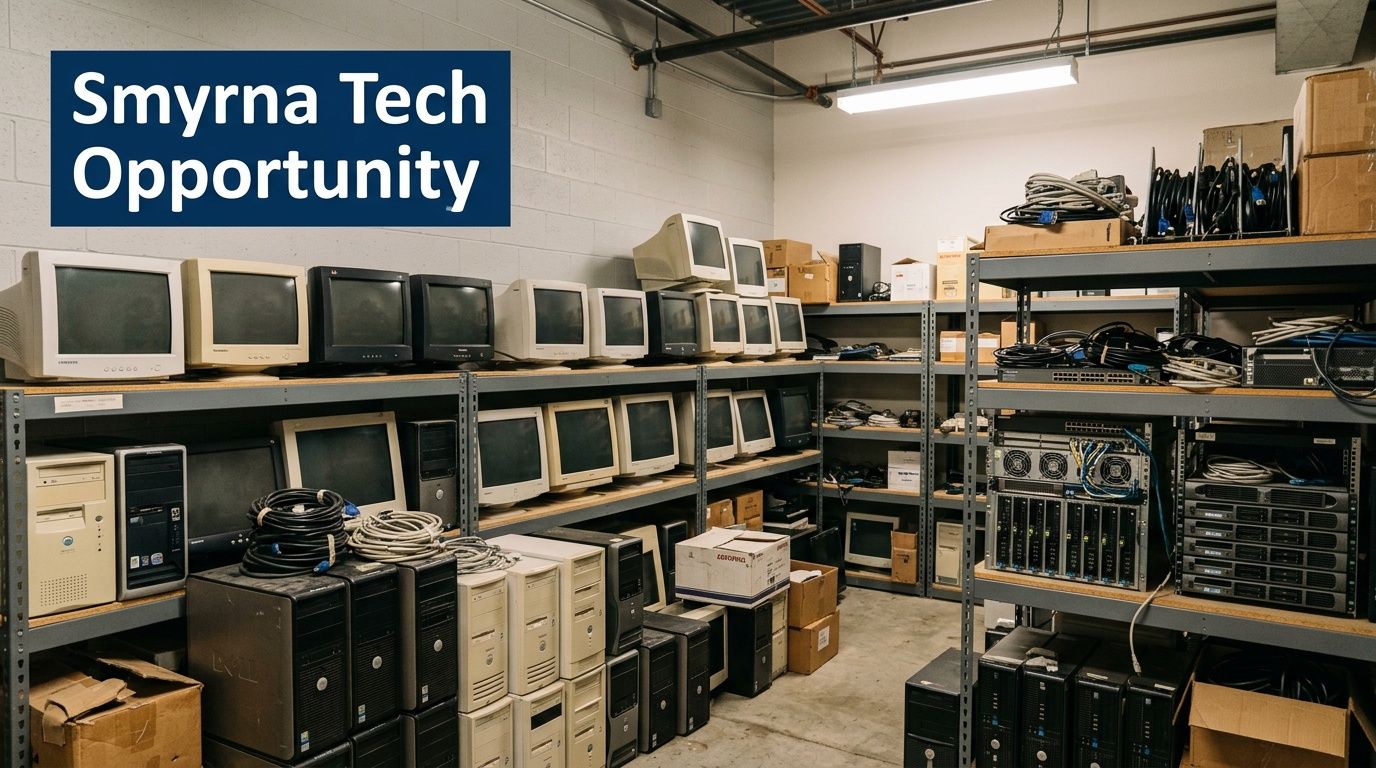
That pile creates three problems at once. First, it takes up space you need. Second, it may still contain company, employee, patient, or student data. Third, it puts off a decision that usually gets harder, not easier, with time.
Old equipment is rarely just junk
A retired laptop might still hold recoverable value. A decommissioned server might need formal sanitization before it leaves your building. A shelf of monitors and cables might belong in a recycling stream, not a dumpster.
That’s why ITAD is different from general junk hauling.
A qualified process usually includes:
- Asset review so you know what you have before anything leaves the building
- Data protection so drives are wiped, purged, or destroyed appropriately
- Logistics planning for pickup, packing, and chain of custody
- Value recovery when reusable devices or components still have resale potential
- Responsible recycling for materials that can’t be reused
If your goal is to recover some value from retired systems, this overview of old electronics for cash helps frame what types of assets may still be worth remarketing.
The bigger opportunity for Smyrna businesses
Many business managers think of retirement-stage IT as a cost center. That’s understandable. You’re dealing with surplus equipment, security concerns, and a project nobody put on the calendar early enough.
But there’s another way to look at it.
Practical rule: The best time to plan IT disposition is before the next hardware refresh, not after the storage room fills up.
For Smyrna organizations, especially those with ESG or CSR goals, responsible recycling can support a broader story. Your company isn’t only removing obsolete hardware. You’re showing customers, employees, and stakeholders that your operation handles technology responsibly and puts retired assets to better use.
That’s where a purpose-driven model stands out. Instead of treating electronics recycling like a hidden back-office task, you can connect it to local values, environmental stewardship, and community support. For businesses working with Atlanta Green Recycling, that can mean linking routine IT retirement to veteran aid and tree planting in a way that’s easier to explain in sustainability conversations.
What Exactly is IT Asset Disposition
Think of IT asset disposition like turning over a leased office at the end of a contract. You don’t just toss everything into a truck and walk away. You document what’s there, remove sensitive material, decide what can be reused, and make sure the property is left in a compliant condition.
IT asset disposition works the same way for technology.
U.S. businesses generate over 5 million tons of electronics annually, and Georgia’s tech sector is a significant contributor. In Smyrna, mission-driven providers such as Reworx Recycling have built models that divert electronics from landfills while handling data destruction in line with NIST 800-88 standards, as described in this overview of IT asset disposition companies.
The lifecycle of a typical ITAD project
A common assumption upon hearing “recycling” is that the process starts with a truck. It doesn’t. It starts with control.
Decommissioning and inventory
Your team identifies the devices leaving service. That may include laptops, desktops, monitors, phones, servers, networking gear, or storage media. Good inventory work prevents devices from disappearing into the process without records.Secure handling and transport
Once assets are tagged for retirement, they need controlled movement. That matters whether they’re going down the hall, across the parking lot, or to an off-site processing facility.Data destruction
This is the point many non-technical managers worry about most. For good reason. Deleting files isn’t the same as sanitizing media.Refurbishment and remarketing
Some devices still have useful life. If they can be securely processed and resold, they may offset part of the project cost.Recycling and documentation
Equipment that can’t be reused moves into approved recycling channels, and the organization receives records that support audit, environmental, and internal governance needs.
Why this confuses so many teams
“Disposition” sounds abstract. It can feel like legal language instead of an operational process.
A plain-English definition helps. ITAD means deciding, documenting, securing, and processing retired technology so your organization avoids data exposure and handles equipment responsibly.
Good ITAD answers four questions clearly. What do we have, where did it go, how was data handled, and what proof do we have?
If you want a simpler primer before evaluating vendors or workflows, this plain-language guide on what is IT asset disposition is a useful starting point.
What ITAD is not
It’s not:
- Just recycling
- Just wiping hard drives
- Just resale
- Just office cleanout labor
It’s the full end-of-life process for business technology.
Once you view it that way, decisions become easier. You stop asking, “How do I get rid of this stuff?” and start asking, “What handling method fits this asset, this risk level, and this reporting need?”
Navigating Data Security and Compliance in Georgia
If your retired devices ever held sensitive data, disposal becomes a security project, not a facilities task. That matters in Smyrna because local organizations often handle regulated information. Healthcare groups manage patient data. Schools hold student records. Government teams store internal files. Businesses keep payroll, contracts, and customer information.
When those devices leave service, the data risk doesn’t disappear just because the equipment is old.
The three NIST sanitization levels
NIST 800-88 defines three levels of media sanitization: Clear, Purge, and Destroy. The same source also notes that the average HIPAA violation fine reaches $1.5 million per HHS data. You can review those specifics in this Georgia-focused guide to end-of-life IT asset management.
Here’s what those levels mean in plain language:
Clear
This is software-based overwrite. It’s often appropriate when a device will stay in a controlled environment or move into a remarketing workflow after proper processing.
For a business manager, the takeaway is simple. “Delete” is not “clear.” A formal overwrite process is.
Purge
This is a stronger sanitization method. It can involve degaussing or cryptographic erase, depending on the media type.
Purge is often chosen when an organization wants stronger assurance that data can’t be practically recovered before equipment moves further down the chain.
Destroy
This is physical destruction, including shredding media to very small particles. It’s the choice for devices that should never be reused or that hold especially sensitive information.
Healthcare and government clients often gravitate toward this option when the risk tolerance is low.
Georgia compliance is not just about federal rules
A lot of ITAD content stops at HIPAA or general data security. That leaves out a local reality. Georgia also has electronics handling rules that affect how organizations should dispose of retired IT assets, especially if they want to avoid landfill issues and document responsible processing.
That’s one reason chain of custody matters so much. Your team needs records showing who handled the equipment, when it moved, what happened to the media, and what proof was issued at the end.
Where managers usually get stuck
The most common points of confusion are practical:
“Do we need wiping or shredding?”
It depends on the asset, the data sensitivity, and whether reuse is possible.“Can our maintenance team handle this?”
They may be able to stage equipment, but they usually can’t replace formal sanitization records.“What document proves the job was completed?”
That’s typically a certificate tied to the destruction or sanitization process.
If you need to understand what audit-friendly proof looks like, this overview of what is a certificate of destruction is worth reviewing before you schedule pickup.
A secure process is only half the job. The other half is documentation you can hand to compliance, legal, or leadership without guessing.
Security planning starts before pickup day
Organizations often wait until the cleanout date to think about asset risk. That’s late. A better approach is to classify assets before pickup, separate regulated devices from general electronics, and confirm the sanitization method in advance.
For teams that want to strengthen retention and backup practices before devices ever reach end of life, this guide on how to prevent data loss offers helpful context. It complements ITAD planning because secure disposal works best when it’s part of a broader data lifecycle discipline.
The short version is this. If your organization handles sensitive information, disposal cannot be informal. You need a process that matches the media type, the data risk, and the compliance environment in Georgia.
Choosing Your ITAD Service Model in Smyrna
Once you know retired devices need proper handling, the next question is operational. What kind of ITAD service model fits your business?
Some Smyrna companies need technicians to process assets at their location. Others prefer secure transport to a specialized facility. Some want maximum resale value. Others care most about documentation and minimal staff time.
Providers in the Smyrna area such as Iron Mountain and GreenTek Solutions have supported secure disposition practices for over a decade, and many offer free bulk pickups for 50+ devices. The same source notes that schools, hospitals, and data centers can see 20-40% ROI on retired gear through certified buyback programs, according to this Smyrna IT asset disposition page.
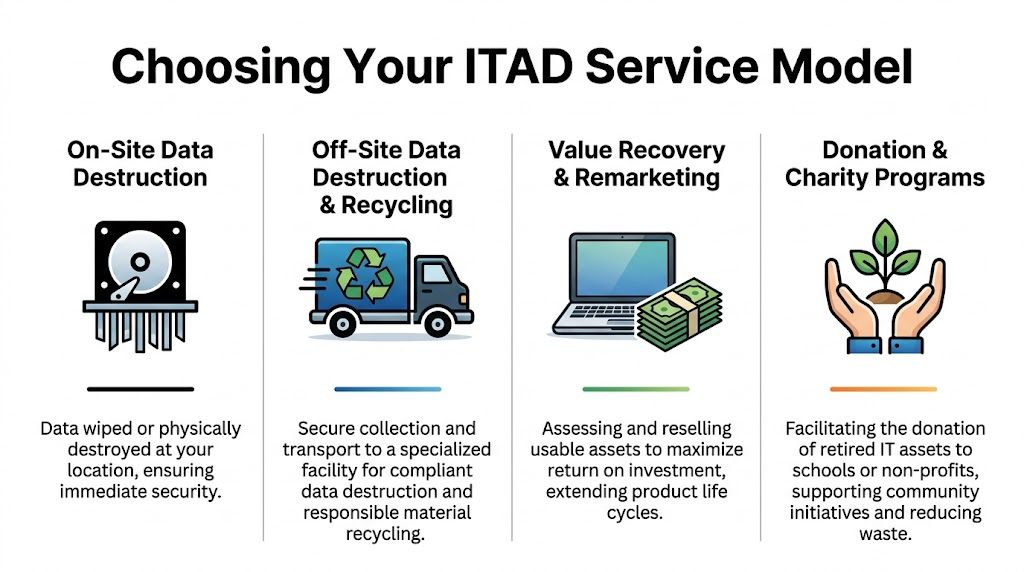
Four common service models
On-site data destruction
This model keeps the destruction step at your building. It’s often chosen by organizations with strict internal controls or highly sensitive media.
It works well when leadership wants direct visibility into the destruction event.
Off-site data destruction and recycling
Here, assets are packed, logged, and transported to a secure facility for sanitization, processing, refurbishment, or recycling.
This can be more efficient for larger mixed loads, especially when you’re handling equipment that needs different downstream paths.
Value recovery and remarketing
Some devices still have market value after proper sanitization. This model focuses on sorting usable assets from scrap so your organization can recover part of the hardware investment.
That matters during fleet refreshes, branch consolidations, and data center transitions.
Donation and charity programs
Some organizations want part of their ITAD plan tied to social impact. That can include donation pathways, sustainability documentation, or mission-based recycling.
This approach is especially useful for companies that want ESG reporting value, not just a cleared storage room.
On-site vs. off-site data destruction
The right choice usually comes down to risk tolerance, visibility, and operational convenience.
| Factor | On-Site Destruction | Off-Site Destruction |
|---|---|---|
| Security visibility | Your team can witness the process directly | Relies on documented chain of custody and facility controls |
| Operational disruption | May require scheduling space, access, and staff coordination | Usually easier for internal teams once assets are staged |
| Best fit for | Highly sensitive media, strict internal policies, leadership oversight | Larger mixed loads, standard enterprise workflows, broader recycling needs |
| Reuse potential | Physical destruction may limit remarketing opportunities | More flexibility for sorting wipeable, resalable, and scrap assets |
| Project scale | Often useful for targeted high-risk media | Often efficient for office cleanouts and larger decommissions |
A practical way to choose
Ask these questions:
- What kind of data was on the equipment?
- Does leadership require witnessable destruction?
- Are you trying to recover value from reusable devices?
- Do you need one-time pickup or ongoing service?
- Will the project include packing, de-installation, or room cleanout?
One option in the local market is Atlanta Green Recycling’s IT asset disposition service, which includes secure data destruction, bulk IT equipment removal, logistics support, and workflows suited to regulated industries.
If you want resale value, don’t destroy media before confirming whether the device can move through a compliant sanitization and remarketing path.
What service model fits common Smyrna organizations
A few examples make the choice clearer.
- A medical office may prefer on-site destruction for drives tied to patient systems.
- A school district may lean toward off-site processing if it’s retiring a broad mix of aging classroom devices.
- A data center or tech firm may need a blended model with inventory, de-installation, secure transport, and resale review.
- A corporate office move may prioritize pickup logistics and minimal downtime over hands-on witness requirements.
Good ITAD planning isn’t about picking the most aggressive option by default. It’s about matching the method to the assets, the audit burden, and the business objective.
Beyond Compliance Turning ITAD into an ESG Victory
Most organizations start ITAD because they have to. They need to clear space, reduce risk, or satisfy a compliance requirement.
That’s reasonable. But if that’s where the conversation ends, you leave value on the table.

Compliance can support a stronger story
Georgia’s Solid Waste Management Rules, Chapter 391-3-4, require certified e-waste handling to prevent landfill diversion, and fines can reach up to $25,000 per violation, according to this review of old computer hardware disposal requirements. That same source points out a gap many businesses feel. They don’t just want compliance. They want documentation that helps connect disposal decisions to ESG reporting.
That’s where the conversation changes.
Instead of treating old equipment as a hidden operations issue, you can treat it as visible proof that your company handles materials responsibly and supports meaningful outcomes beyond the loading dock.
Recycle for a cause
The most compelling ITAD programs connect operational discipline with human impact.
For a Smyrna business, that can sound like this: your old tech can help support a veteran and help grow a forest.
That message works because it’s concrete. It gives leadership, marketing teams, and HR something understandable to share. It also gives employees a reason to feel that the office cleanout they barely noticed did something worthwhile.
A purpose-driven model can support:
- Plant-A-Tree certificates for sustainability files and CSR summaries
- Veteran support impact reports that show social mission alignment
- Seasonal recycling drives tied to Veterans Day, Earth Day, or Arbor Day
- Digital recognition such as a “Recycled with Purpose” badge for websites or reports
If you’re building a sustainability case internally, this overview of the benefits of e-waste recycling helps connect disposal choices to broader environmental outcomes.
Why this matters to decision-makers
ESG work often gets stuck because teams are chasing large, slow projects. ITAD is different. It’s practical. You already have the assets. You already need to act. The reporting angle can be built into a process that should happen anyway.
Responsible IT retirement is one of the few operational tasks that can reduce risk, support compliance, and create a story your stakeholders can actually understand.
That’s why a dual-mission approach stands out. If your recycling partner can tie secure end-of-life handling to veterans and reforestation, ITAD becomes more than a closed ticket. It becomes a small but visible example of values in practice.
For many organizations, that’s an easier ESG win than launching a new initiative from scratch.
ITAD in Action Scenarios and Pricing in the Atlanta Metro
The easiest way to understand IT asset disposition Smyrna GA is to look at familiar situations.
A healthcare clinic in the Atlanta metro replaces patient check-in tablets and a few nurse-station PCs. The immediate concern isn’t scrap value. It’s whether those devices held protected health information and what proof the clinic will have after disposition. In that case, pricing usually depends on the number of assets, the data destruction method selected, and whether staff need on-site handling or can prepare equipment for pickup.
A school system upgrading a computer lab sees the project differently. The district may care about budget pressure, storage space, and whether some devices still have refurbishment value. Here, a transparent ITAD partner helps by separating reusable units from equipment that belongs in recycling streams. That distinction matters because value recovery can offset part of the project instead of treating every device like waste.
A startup moving from one office to another often has a mixed load. Old laptops, docking stations, monitors, a few networking components, and maybe some server hardware left from an earlier setup. The challenge is less about one regulation and more about logistics. Who disconnects what, how equipment gets packed, and whether the move schedule leaves any room for error.
Why pricing varies so much
Managers often ask for a flat rate before the asset list is clear. That’s understandable, but ITAD pricing usually depends on factors such as:
- Asset volume and whether the load is small, bulk, or enterprise-scale
- Equipment type, including standard desktops versus storage media or server gear
- Data destruction needs, especially if physical destruction is required
- Pickup complexity, including loading access, packing, and de-installation
- Value recovery potential from devices or components that can be remarketed
The cost issue most firms miss
Recent IDC reports on Southeast IT cycles found that 65% of firms overpay for ITAD by 15-20% due to unclaimed refurbishment value. The same source notes that rising copper prices can improve returns from server metals and other components, which makes transparent ROI calculations more important for businesses reviewing old infrastructure. That data appears in this summary of IT asset disposition and ROI factors.
The lesson isn’t that every load is profitable. It’s that many organizations make decisions too early. They assume disposal is pure cost when some of the equipment should be evaluated for resale, parts harvesting, or materials recovery first.
A better way to review quotes
When you compare ITAD pricing, don’t focus only on pickup cost. Ask:
- What assets are likely candidates for refurbishment?
- Which media require destruction rather than sanitization?
- Is the quote based on mixed loads or sorted categories?
- Will you receive documentation suitable for audits and internal reporting?
- Are logistics included, or billed separately later?
That approach gives you a real cost-benefit picture. It also helps you avoid the common mistake of picking the cheapest hauling option and discovering too late that there was no meaningful data process, no asset accounting, and no path to recover value.
Partner with Atlanta Green Recycling for a Purpose-Driven Solution
A strong ITAD program does three jobs at once. It protects data. It supports compliance. It keeps retired equipment moving through responsible channels instead of becoming an afterthought in storage.
For Smyrna organizations, that matters more than ever. Offices are refreshing laptops more often, healthcare groups have strict handling obligations, schools need simple bulk removal, and growing companies don’t have time to build a custom disposition process every quarter.
The opportunity is bigger than cleanup. When a recycling program also supports veterans and reforestation, a routine operational task becomes something leadership can stand behind publicly. That’s what makes a purpose-driven model worth considering. It turns retired hardware into documented action.
If your team is sitting on old laptops, hard drives, servers, or mixed office electronics, the next step is straightforward. Build an inventory, identify sensitive assets, decide whether you need on-site or off-site handling, and work with a provider that can document the result clearly.
A good partner should make the process simpler, not more complicated. You should know what left your site, how the data was handled, whether any value was recovered, and what environmental or community impact came from the project.
Frequently Asked Questions about ITAD in Smyrna
Do businesses in Smyrna need a large volume of equipment before scheduling pickup
Not always, but many local providers structure bulk service around larger loads. In the Smyrna market, some providers offer free bulk pickups for 50+ devices, which can be helpful for office cleanouts, lab upgrades, and data center transitions.
What kinds of equipment usually belong in an ITAD project
Most projects include laptops, desktops, monitors, servers, phones, storage devices, and networking gear. Some also include printers, accessories, and equipment from break rooms, reception areas, or training rooms if the goal is a full cleanout.
Should we choose wiping or shredding
That depends on the media, the sensitivity of the data, and whether the asset may be reused. If reuse is possible, sanitization may be appropriate. If risk tolerance is very low, physical destruction may make more sense.
What documentation should we ask for
Ask for inventory records, chain-of-custody support, and proof of data destruction or sanitization. Those records help with audits, compliance reviews, and internal reporting.
Can ITAD support ESG or CSR reporting
Yes. If your provider offers environmental and impact documentation, ITAD can support a broader sustainability narrative. That’s especially useful when your organization wants to show both responsible recycling and community benefit.
If your company needs a secure, organized way to handle retired technology, Atlanta Green Recycling can help you turn old IT equipment into a compliance-ready, sustainability-focused outcome. Schedule a conversation, review your asset list, and build a plan that protects data while putting retired tech to better use.