
Hard Drive Shredding Services Atlanta GA: Hard Drive

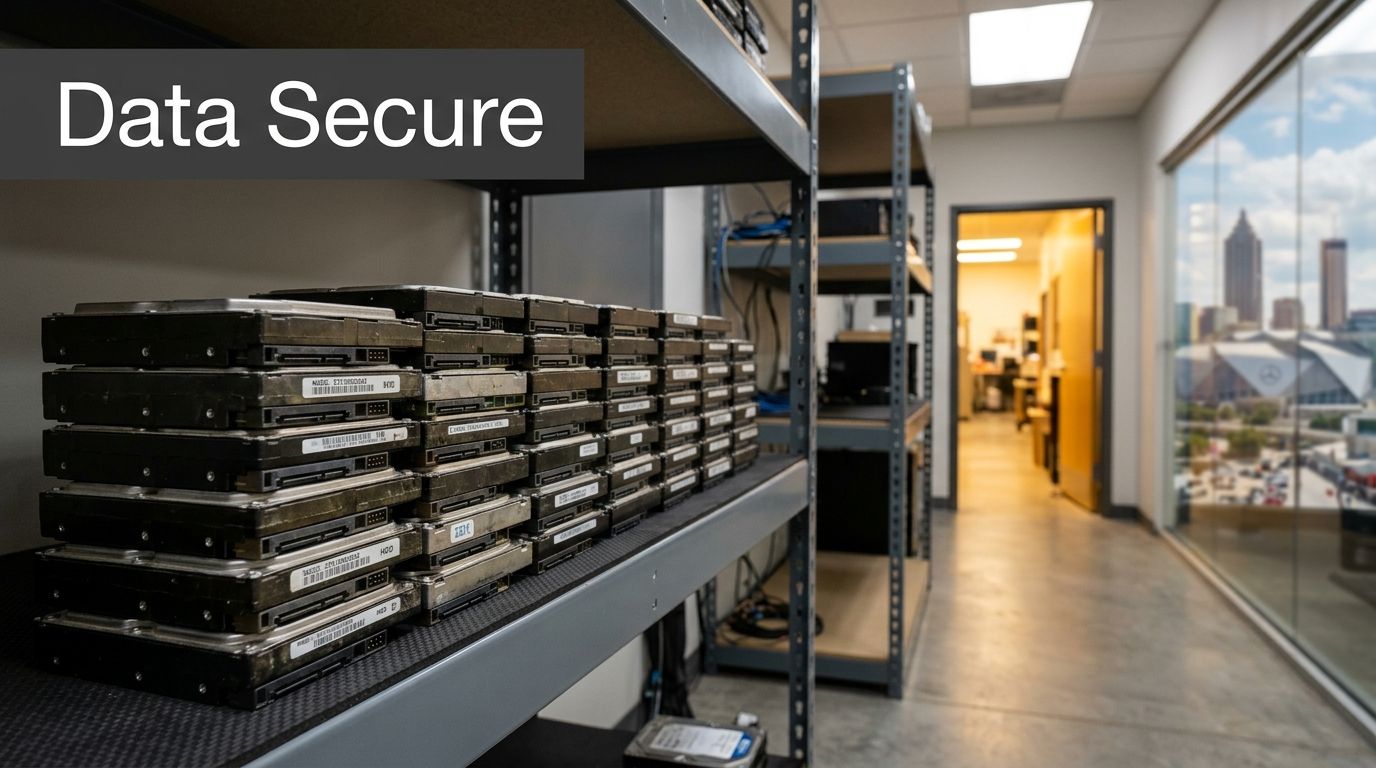
Old hard drives tend to pile up in the same places across Atlanta offices. A locked IT closet. A storage room after a server refresh. Shelves in a medical records department. Banker boxes left over from an office move. They look harmless, but they often hold years of customer files, employee records, financial data, and internal communications.
That’s the problem behind Hard Drive Shredding Services Atlanta GA. The risk usually isn’t active equipment. It’s retired equipment that nobody wants to touch because disposal feels complicated, regulated, and easy to get wrong.
For Atlanta businesses, secure destruction is no longer a niche task. The market itself reflects that pressure. The Atlanta hard drive shredding market is part of a global data destruction industry projected to grow from approximately $1.65 billion to $5.05 billion by 2035, while the average cost of a data breach in the U.S. reached $4.45 million in 2023 according to Atlanta hard drive shredding market data. Those two realities explain why more organizations are moving away from casual disposal and toward documented physical destruction.
Secure Your Data and Amplify Your Impact in Atlanta
A retired hard drive creates two jobs at once. One is obvious: destroy the data so it can’t come back. The other is often missed: handle the material responsibly so your disposal decision doesn’t undermine your sustainability goals.
That matters in Atlanta, where many organizations are balancing compliance requirements with public ESG commitments. Healthcare systems, financial firms, schools, logistics companies, and public agencies all need a disposal process they can defend in an audit. Increasingly, they also want a process they can include in sustainability and CSR reporting.
What businesses usually get wrong
Many teams wait too long. They postpone disposal because they’re still deciding whether drives might be reused, whether someone needs final signoff, or whether pickup logistics will disrupt the office. Meanwhile, the drives sit there as unmanaged risk.
Others focus only on destruction and ignore the broader value of the event. A hard drive purge can support audit readiness, simplify an office move, clear space in a data center, and contribute to an ESG narrative if the downstream recycling and impact reporting are handled well.
A practical approach usually includes:
- Inventory control: Know what media exists and who owns the list.
- Chain of custody: Make sure drives don't disappear between pickup and destruction.
- Proof: Keep documentation that satisfies legal, internal, and third-party review.
- Responsible recycling: Divert the remnants into proper downstream processing.
- Impact reporting: Turn a disposal event into something your leadership team can use.
Old drives aren't dormant assets. They're unclosed liabilities until someone tracks, destroys, and documents them.
Security and mission can work together
The strongest Atlanta programs now treat hard drive shredding as both a security control and a values decision. That’s where a dual-impact model stands out. Instead of treating e-waste as a pure cost center, businesses can connect secure data destruction to support for veterans and tree planting.
That shift changes internal buy-in. Facilities teams like the simplicity. IT likes the defensibility. Compliance likes the paperwork. Sustainability teams like having a concrete action they can report without stretching the story.
For many organizations, that combination is what finally gets old drives out of storage and into a managed process.
Why Wiping Is Not Enough The Case for Physical Destruction
Software wiping sounds reassuring because it feels clean and efficient. In practice, it only works when the device is functional, accessible, and fully verifiable. Retired drives often fail one or more of those conditions.
A paper analogy helps. If you write sensitive information on a sheet of paper in permanent ink, covering the page with a black marker might hide most of it. Running the paper through a shredder changes the situation entirely. One method tries to obscure. The other method eliminates reconstruction.
Where wiping and degaussing fall short
Wiping can be appropriate for devices that will stay in controlled reuse programs, but it depends on successful execution and verification. That’s a narrow lane. If a drive is damaged, partially readable, too old, or unreliable, confidence drops fast.
Degaussing has limits too. It applies to magnetic media, but it doesn't solve every modern storage scenario. It also doesn't offer the same visual certainty people want when stakes are high. If your team has ever wondered whether a sanitized drive could still be reconstructed under lab conditions, that concern usually disappears once the media is physically reduced to fragments.
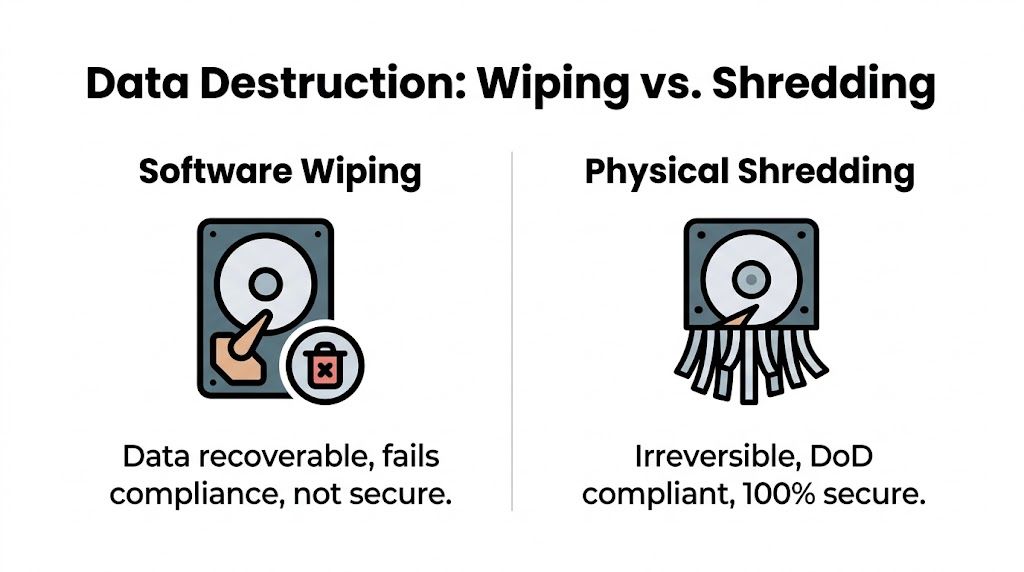
Hard drive shredding is considered the gold standard because it reduces drives to particles smaller than 2mm, making forensic recovery impossible, and that matters because 83% of data breaches in 2023 involved stolen or lost devices according to hard drive shredding security guidance.
The trade-off that matters
If your goal is reuse, wiping may still have a role in a broader ITAD program. If your goal is certainty, especially for failed drives, obsolete media, or highly sensitive information, physical destruction is the stronger answer.
That distinction matters when organizations confuse "data removed" with "risk removed." They’re not the same thing.
It's important to note:
| Method | Best fit | Main limitation |
|---|---|---|
| Software wiping | Reuse of fully working devices | Depends on successful verification |
| Degaussing | Certain magnetic media workflows | Less suitable for mixed modern media environments |
| Physical shredding | Final destruction of sensitive or nonfunctional media | Media can't be reused afterward |
Practical rule: If the device is broken, unknown, or too sensitive to defend later, destroy it physically.
If your team is also comparing disposal risk with the possibility of recovering business data before destruction, it helps to understand what specialized hard drive data recovery can and can't do. That decision should happen before the drive enters the destruction stream. Once shredding starts, recovery is no longer the objective.
For teams still weighing magnetic methods, this review of erasing hard drives with magnets and whether it actually works is useful because it clarifies where degaussing fits and where it doesn't.
Our Ironclad Onsite and Offsite Shredding Process
Security claims only matter if the process is disciplined. The strongest hard drive destruction programs build trust through visible controls at every handoff, not vague promises after the fact.
For Atlanta organizations, there are usually two practical options. You can witness destruction onsite with a mobile shredding setup, or you can move drives through a secured offsite chain of custody into a monitored destruction facility. Both can work well. The right fit depends on your environment, sensitivity level, and operational constraints.
What an auditable chain of custody looks like
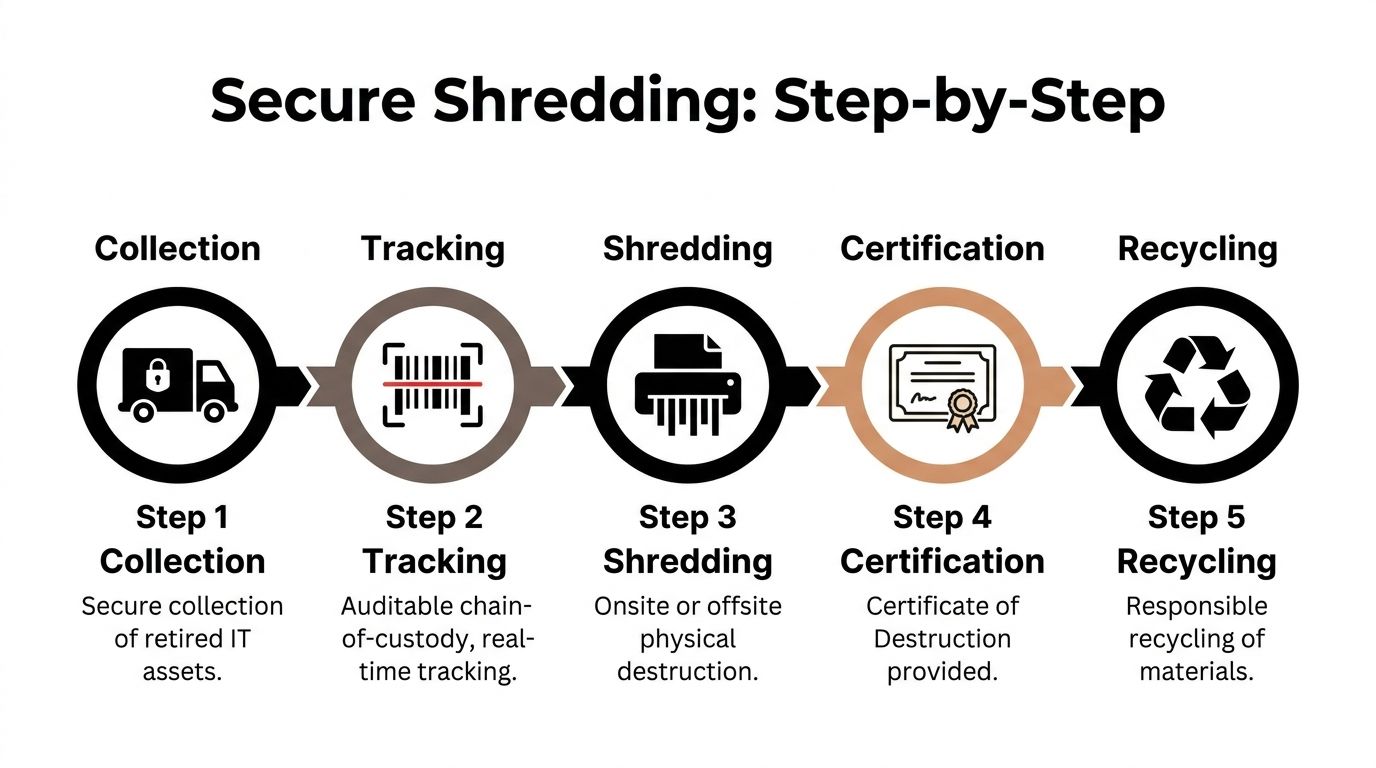
The core controls are straightforward, but they have to be executed in order. The process implements serialized tracking for every drive, secure transport in GPS-tracked vehicles, and 24/7 video surveillance at the destruction facility, followed by a Certificate of Destruction that supports HIPAA, FACTA, and GLBA compliance according to secure hard drive shredding chain-of-custody guidance.
In practice, that means:
- Collection starts with verification. Technicians match drives against inventory lists and scan serial numbers where required.
- Containers stay controlled. Media moves in locked, tamper-evident containers or directly into a witnessed destruction workflow.
- Transport is monitored. Vehicles are tracked, and custody stays documented during transit.
- Destruction is recorded. At an offsite facility, camera coverage supports the audit trail.
- Documentation is issued immediately. The certificate records what was destroyed, when, and by what method.
Onsite vs offsite hard drive shredding which is right for you
| Feature | Onsite (Mobile) Shredding | Offsite Shredding |
|---|---|---|
| Visibility | Your team can witness destruction in real time | You rely on documented custody and facility controls |
| Best use case | Highly sensitive media, executive preference, strict witness requirement | Larger loads, recurring programs, warehouse or data center clear-outs |
| Operational impact | Requires access, space, and scheduling coordination at your site | Usually simpler for bulk pickups and multi-location consolidations |
| Documentation | Certificate follows witnessed destruction | Certificate follows monitored facility destruction |
| Cost profile | Per-drive onsite service fees are common | Often more efficient for volume programs |
What works best in the field
Onsite shredding works well when leadership wants visual confirmation or when internal policy demands witnessed destruction. Hospitals, law firms, and government offices often prefer that level of direct observation.
Offsite shredding is often the smarter choice for data center decommissioning, office consolidations, and recurring enterprise pickups. It reduces on-premises disruption while preserving the controls that matter.
Witnessed destruction reduces debate. Serialized tracking and certificates reduce audit friction.
One provider serving this workflow is Atlanta Green Recycling's onsite shredding service, which combines pickup, mobile or offsite destruction paths, and documentation within a broader IT asset disposition process.
The mistake to avoid is mixing informal office cleanout habits with regulated media disposal. Once drives leave controlled custody without documentation, you’ve lost the strongest part of your defense.
Exceeding Compliance Mandates in Atlanta GA
Compliance language gets thrown around loosely in this industry. A lot of vendors list acronyms. Fewer explain what those acronyms require you to prove when an auditor, legal team, or procurement office asks for evidence.
For Atlanta organizations, hard drive destruction usually sits inside a bigger risk framework. Healthcare teams need to protect patient information. Financial institutions need to control customer data. Schools and public agencies need documented disposition practices. The question isn’t just whether a drive was destroyed. It’s whether your organization can show that the destruction method, custody, and records met the standard that applied at the time.

What these standards mean in practice
The most useful compliance benchmark for media sanitization is process alignment. The shredding process can align with NIST 800-88 and DoD 5220.22-M, with particle sizes that exceed federal expectations, making recovery impossible for organizations handling sensitive HIPAA or FACTA regulated information according to government-aligned hard drive shredding standards.
That translates into practical requirements such as:
- HIPAA environments: Patient data can't ride out the back door on retired drives from nursing stations, imaging systems, or old office PCs.
- FACTA workflows: Consumer information disposal has to be reasonable, secure, and defensible.
- GLBA contexts: Financial data handling requires disciplined controls around retirement and destruction.
- NIST-based procurement: Public sector and contractor environments often need methodical sanitization and documentation, not verbal assurance.
Documentation is part of compliance, not an afterthought
A lot of businesses focus on the destruction event and underestimate the paper trail. That’s backwards. In real audits, missing documentation creates almost as much trouble as weak destruction practices.
A sound file should include:
- Asset identifiers: Enough detail to connect destruction records back to your inventory.
- Dates and methods: When the media left your control, how it was handled, and how it was destroyed.
- Certificates: Proof that legal, internal, and customer-facing requirements were met.
- Retention discipline: Records stored where compliance, IT, and procurement teams can retrieve them quickly.
For teams that need to keep audit support organized, a formal certificate of destruction process is often the document that closes the loop between operations and compliance.
The easiest way to fail a disposal audit is to destroy the drive properly and document it poorly.
Why Atlanta businesses need more than a pickup vendor
The local need is especially strong in sectors where old equipment leaves service constantly. Healthcare refreshes endpoints. Universities retire labs. Agencies replace secure workstations. Data centers remove failed drives during maintenance and decommissioning.
Those organizations don’t just need someone to haul equipment away. They need a disposal partner whose workflow can hold up under legal review, procurement scrutiny, and internal governance. That’s the difference between a recycler and a compliance-ready process.
Turn Your E-Waste into a Powerful ESG Win
Most businesses still treat hard drive destruction as a back-office cleanup task. Secure it, document it, move on. That’s necessary, but it leaves value on the table.
The better approach is to connect responsible electronics recycling to a visible social and environmental outcome. A retired hard drive can stop being just a liability removed from your office. It can become part of your company’s ESG and CSR story.

Why this matters now
This isn’t just branding language. In Atlanta, sustainability expectations are becoming part of normal business reporting. 78% of Atlanta-area corporations prioritize sustainable e-waste in their 2026 sustainability reports, and a dual-impact model that combines secure recycling with impact certificates and CSR documentation fills a gap competitors aren't addressing, according to Atlanta sustainable e-waste and CSR reporting insights.
That creates a useful opening for companies that want an easy, credible ESG win without inventing a campaign from scratch.
From disposal event to impact story
A dual-impact model works because it gives one operational action several outcomes:
- Data security: Drives are removed from circulation and destroyed appropriately.
- Environmental benefit: Recovered materials are routed into responsible recycling streams.
- Veteran support: The transaction contributes to programs that assist veterans.
- Tree planting: The recycling event also supports reforestation efforts.
- Reporting value: Your sustainability team gets documentation it can use.
That’s the logic behind messaging such as "Your old tech can house a veteran and grow a forest." It’s memorable because it ties a routine business task to human outcomes people understand immediately.
What companies can do with the results
The strongest programs don't stop at pickup confirmation. They package the event into assets that communications and reporting teams can use.
Examples include:
| ESG asset | How it helps |
|---|---|
| Impact certificates | Supports CSR files and internal communications |
| Veteran support reports | Connects disposal activity to community benefit |
| Tree planting documentation | Strengthens sustainability narratives |
| Recycled with Purpose badge | Gives partners a visible mark for websites and reports |
A practical corporate program might involve a bulk pickup during an office refresh, followed by internal comms for employees, a sustainability note for leadership, and a digital badge that procurement or marketing can display.
Businesses don't need more abstract ESG language. They need documented actions with a clear chain from operations to impact.
Strong campaign ideas for Atlanta organizations
This approach also works well for community-facing initiatives:
- Veterans Day drives: Retire old office electronics and tie the campaign to veteran support.
- Earth Day events: Combine secure collection with tree-planting storytelling.
- School and university partnerships: Clear surplus devices while building a local civic narrative.
- Employee engagement programs: Turn one-time cleanouts into repeat participation.
For companies formalizing those efforts, corporate e-waste solutions with reporting support can help align secure disposal with sustainability documentation.
The key is authenticity. If you’re going to claim impact, document it carefully and present it in the same disciplined way you present chain of custody and destruction records. That’s what makes cause-based recycling credible instead of decorative.
Tailored Shredding Solutions for Atlanta's Key Industries
A generic disposal program usually breaks down when it meets real operating conditions. A hospital can’t handle media the same way a downtown law office does. A government agency won’t accept the same proof package as a startup moving out of a coworking suite. A data center can’t tolerate the same delays as a school district clearing storage over summer break.
The reason specialized Hard Drive Shredding Services Atlanta GA matter is simple. Every industry creates its own version of urgency, oversight, and logistics.
Healthcare environments
A healthcare facility often has media coming from more than one source at once. Desktop drives from admin offices, older storage from imaging systems, failed drives from servers, and miscellaneous backup media can all show up in the same retirement cycle.
The practical pain point is separation and traceability. Compliance teams don't want bulk disposal with vague labels. They want the ability to tie destruction back to internal asset records and retention practices. In those environments, witnessed handling, tight inventory matching, and fast documentation tend to matter more than flashy recycling claims.
Data center and enterprise moves
A data center decommissioning looks different. The challenge usually isn't one sensitive drive. It's the volume, timing, and coordination around many assets moving at once.
In those projects, the biggest operational risks are downtime, confusion during rack removal, and gaps between de-installation and final destruction. What works is a coordinated plan that handles packing, removal, transport, and destruction as one managed workflow. Teams that are already retiring servers often need a broader server disposal service for businesses in Atlanta GA because the drives are only one piece of the asset stream.
Government and education settings
Public agencies and educational institutions usually bring a heavier documentation burden. Procurement rules, internal signoffs, and public accountability all make informal disposal a poor fit.
What tends to work here is consistency. Standard pickup procedures. Repeatable custody records. Clear certificates. A process that can be explained to internal auditors without relying on verbal fill-ins from whoever happened to supervise the pickup that day.
What tailored service actually looks like
The strongest industry-specific programs adjust around questions like these:
- Who needs to witness destruction
- How serials must be logged
- Whether assets are removed from active environments
- What documentation format procurement or compliance expects
- How recycling and impact reporting fit into the final package
That’s why mature organizations stop buying "shredding" as a stand-alone task. They buy a workflow designed around their industry’s version of risk.
Simple Logistics and Transparent Pricing
A secure destruction program shouldn’t be hard to schedule. Most Atlanta businesses need a short path from "we have old drives" to "they're destroyed and documented."
The practical starting point is volume. A single box of drives may call for one solution. A campus refresh, office move, or data center cleanout may call for another. Pricing and pickup design should reflect that reality instead of forcing every customer into the same template.
What transparent pricing looks like
The market already gives a broad benchmark, with secure hard drive shredding commonly averaging $7 to $20 per drive in Atlanta according to the earlier cited market overview. But a useful quote goes beyond a range. It should explain whether you're paying for onsite witnessing, serial-level inventory work, transport, project complexity, or a bundled recycling program.
There’s also a clearer value model available for bulk clients. Some providers offer free pickup for 50+ devices and transparent per-drive onsite fees, which helps businesses avoid hidden travel charges. That clarity matters as demand has risen from recent Georgia requirements for certified destruction among state-funded entities, a trend described in Atlanta data security shredding pricing and demand guidance.
How to make scheduling easier
The fastest projects usually follow a simple sequence:
- Scope the media. Estimate device count, media type, and location.
- Choose onsite or offsite. Decide whether witnessed destruction is necessary.
- Confirm logistics. Loading dock, building access, contact person, and preferred pickup window.
- Align documentation needs. Serial reporting, certificate details, and any internal forms.
- Book the event. Once these basics are clear, execution gets much smoother.
If your organization has 50 or more devices, ask about bulk pickup options first. If you need witnessed shredding at your site, ask for a quote that separates the service elements clearly so finance and procurement can approve it without guesswork.
Atlanta Hard Drive Shredding FAQs
Do SSDs need a different destruction approach than HDDs
Yes. Traditional hard drives store data on magnetic platters, while SSDs store data on flash memory chips. That difference matters because methods like degaussing apply to magnetic media, not solid-state storage. In mixed environments, physical shredding is often the simplest way to handle both categories with one final, irreversible outcome.
What happens to the shredded material afterward
After destruction, the remnants move into electronics recycling streams. The security goal is finished first. Then the material recovery process begins. That combination is what makes a secure shredding program stronger than a simple trash-out or informal scrap pickup.
Is onsite shredding always better than offsite
Not always. Onsite is useful when your policy requires witnessed destruction or when leadership wants direct visual confirmation. Offsite is often more efficient for bulk enterprise projects, recurring pickups, and decommissioning work where secure transport and monitored facility controls already satisfy the requirement.
Can small businesses use hard drive shredding services too
Yes. You don't need to be a hospital or data center to need secure media destruction. Law offices, dental practices, accounting firms, architecture companies, and small professional services firms often hold highly sensitive data on a modest number of devices. The right service model depends more on data sensitivity and documentation needs than company size.
Should working drives be wiped or shredded
It depends on the end goal. If the drive is healthy and approved for controlled reuse, wiping may fit within a broader IT asset disposition plan. If the drive is obsolete, damaged, highly sensitive, or difficult to verify, shredding is usually the more defensible choice.
Do residential customers use the same process
The core security principles are similar, but many providers focus on business-to-business workflows because they rely on chain of custody, asset lists, and audit documentation. Residential customers should confirm accepted items, drop-off options, and whether certificates are available before arriving.
If your organization needs a practical path for secure media disposal, Atlanta Green Recycling provides business-focused electronics recycling, hard drive destruction, pickup logistics, and documentation support for Atlanta companies managing retired IT assets.