Find Hard Drive Destruction Near Me: Secure Disposal with a Purpose


Googling "hard drive destruction near me" is a great start, but let's talk about why this is one of a critical vendor relationships your business will have. It's simple, really: failing to securely destroy data exposes your company to massive financial penalties, legal headaches, and brand damage that you might never recover from. This isn't just about trashing old gear; it's about protecting your organization's future while making a tangible, positive impact.
Why Secure Hard Drive Destruction Is Not Optional
In a world where your data is your most valuable asset, retired hard drives aren't just obsolete hardware. They're ticking time bombs loaded with sensitive information.
Shoving old equipment in a storage closet or handing it over to the cheapest recycler you can find is a massive gamble. The risks go way beyond some abstract fear of a data leak—they lead to severe, tangible consequences that can cripple a company.
The financial fallout from just one data breach is staggering. Forget the immediate cleanup costs; we're talking about crippling regulatory fines, class-action lawsuits, and a long-term loss of customer trust that hits your revenue for years to come.
The Real-World Cost of a Data Breach
A data breach isn't just a PR problem; it's a direct blow to your bottom line. We've all seen the headlines, and they've hammered home the need for professional destruction services.
Just look at the Change Healthcare ransomware attack. The theft of sensitive patient data didn't just disrupt healthcare nationwide; it came with a jaw-dropping response cost of $2.87 billion. Events like this are a harsh reminder that cutting corners on data protection and disposal has devastating financial consequences.
That financial hit gets even worse when you factor in the loss of your company's hard-won reputation. Customers trust you with their financial records, their personal information, their health data. A breach shatters that trust in an instant, sending them straight to competitors who can prove their information is safe.
The biggest risk isn’t just the data you lose—it’s the trust that gets destroyed right along with it. Rebuilding a brand’s reputation after a major breach can take years, if it’s even possible at all.
Navigating the Maze of Strict Regulations
Data privacy isn't a suggestion anymore; it's the law, and these laws have teeth. A whole host of regulations dictate exactly how you must handle and dispose of sensitive information.
- HIPAA (Health Insurance Portability and Accountability Act): If you handle any protected health information (PHI), non-compliance can cost you up to $1.5 million per violation category, per year. Tossing a hard drive with patient records in a dumpster is a direct, and very expensive, violation.
- GDPR (General Data Protection Regulation): Doing business with EU citizens? The penalties are even harsher. Fines can skyrocket to €20 million or 4% of your company's global annual revenue—whichever is higher.
These regulations demand that data be made completely, utterly unrecoverable.
This is where a professional hard drive destruction vendor becomes essential. They provide the documentation—like a Certificate of Destruction—that proves you’ve met your legal obligations. It makes secure disposal a core piece of your overall IT asset disposition strategy by giving you a clear, auditable paper trail.
Ultimately, integrating secure destruction into your cybersecurity risk management frameworks is non-negotiable. Think of it not as an IT expense, but as a fundamental pillar of modern risk management, brand protection, and corporate responsibility.
Understanding Destruction Methods and Compliance Standards
So, you’ve decided to securely dispose of your old hard drives. Great first step. But what does "secure" actually mean in the real world? This is where a lot of businesses in Atlanta can get tripped up.
Not all destruction methods are created equal, and choosing the wrong one can leave your company just as exposed as if you did nothing at all.
It’s a common myth that a drill press is your best friend for data destruction. While drilling a few holes through a stack of old drives feels satisfyingly destructive, it's a false sense of security, especially for anyone dealing with regulated data. A drill bit only chews through a tiny fraction of the magnetic platters where your data lives.
Think about it: with today's recovery technology, forensic experts can often piece together huge amounts of data from the undamaged sections. That DIY approach just doesn't cut it when compliance auditors come knocking.
The choice is pretty stark when you lay it out. You either proactively manage and destroy the data on your retired assets, or you leave the door open to a potential breach.
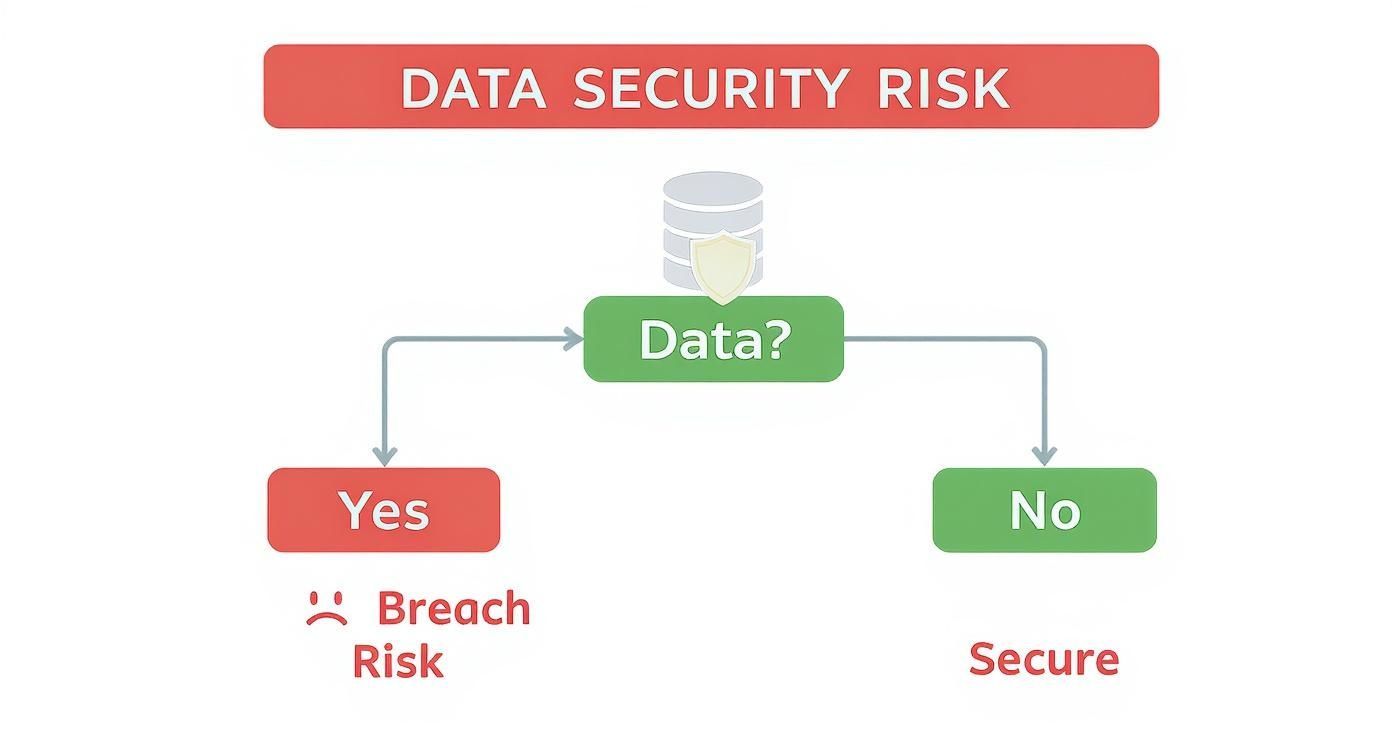
As the flowchart shows, the only path to genuine security is through deliberate, professional data elimination.
The Tools of the Trade: Key Destruction Methods
When you work with a professional vendor, they’ll typically use one of three core methods. Each offers a different level of security, and the right one depends on your media type and compliance needs.
- Shredding: This is the industry workhorse. An industrial-grade shredder grabs hard drives, SSDs, backup tapes, and other media and feeds them through powerful steel teeth. They get chewed up into small, mangled fragments. The final particle size is key—it's often dictated by specific compliance standards.
- Degaussing: For traditional spinning hard drives (HDDs) and magnetic tapes, degaussing is a fantastic option. It involves hitting the media with an incredibly powerful magnetic field, which instantly scrambles and erases the magnetic domains on the platters. Just be aware: degaussing is completely useless on Solid-State Drives (SSDs), since they don't store data magnetically.
- Pulverization: If you want the absolute highest level of security, this is it. Pulverization is exactly what it sounds like—the media is hammered, crushed, and obliterated until it's little more than dust and tiny fragments. Nothing survives this process.
It’s scary how much data can survive improper destruction. Some studies have shown that even after shredding a 1TB hard drive into 20mm pieces, up to 80% of the platter surface might remain untouched. That could leave hundreds of gigabytes of data potentially recoverable. It’s a sobering thought that highlights why sticking to proven standards is non-negotiable.
Matching the Method to Your Compliance Needs
This isn’t just about making data disappear; it’s about proving you did it right to meet legal and regulatory demands. Any credible vendor will tie their services directly to established government and industry standards. In the U.S., there are two main benchmarks you'll hear about:
- DoD 5220.22-M: An older Department of Defense standard, but one that’s still a common reference point. It lays out processes for overwriting, degaussing, and physically destroying media.
- NIST SP 800-88: This is the modern gold standard. The National Institute of Standards and Technology’s guidelines are the most current and comprehensive, defining three levels of sanitization: Clear, Purge, and Destroy. "Destroy" is the final word, ensuring data is gone forever.
A professional partner should be able to tell you exactly which standards their processes meet. For a closer look at the terminology and what it all means, our guide explains what data sanitization truly entails.
To make it easier, here’s a quick rundown of how the common destruction methods align with security and compliance requirements.
Hard Drive Destruction Methods and Compliance
| Destruction Method | Process Description | Data Recovery Risk | Meets Compliance Standards |
|---|---|---|---|
| Shredding | Industrial shredders cut media into small fragments. Particle size is key. | Very Low to Nil | NIST SP 800-88, DoD 5220.22-M, HIPAA, FACTA |
| Degaussing | A powerful magnetic field erases data on magnetic media like HDDs and tapes. | Nil (for magnetic media) | NIST SP 800-88, DoD 5220.22-M, NSA/CSS |
| Pulverization | Devices are hammered and crushed into tiny particles, turning them to dust. | Nil | Exceeds all major standards, including NIST and DoD |
Armed with this knowledge, you can start asking the right questions. You’ll be able to confidently vet local Atlanta providers and ensure the service you’re paying for delivers the absolute, verifiable data security your organization needs.
How to Choose a Local Atlanta Destruction Partner
Finding the right local partner for hard drive destruction isn't just about a quick Google search. This is the most critical step you'll take to protect your organization's sensitive data, and it demands more than a simple price comparison. You need to really dig in and vet vendors in the Atlanta area to make sure they meet the toughest standards for security, compliance, and even ethical practices. Think of it less like hiring a service and more like bringing on a trusted partner to handle your most valuable digital assets.
A great place to start is by looking for industry-leading certifications. These aren't just fancy logos for a website; they are hard-earned proof that a vendor subjects themselves to rigorous, third-party audits for data security and environmental responsibility.
Must-Have Certifications for Your Atlanta Partner
When you're looking at potential vendors, two certifications should be non-negotiable.
-
NAID AAA Certification: This is the undisputed gold standard for secure data destruction. It's a comprehensive verification that a company’s hiring practices, employee training, operational security, and the destruction process itself meet the highest possible industry benchmarks. A partner with a NAID AAA certification guarantees a secure chain of custody from the second your assets leave your sight.
-
R2 (Responsible Recycling) Certification: This one is all about protecting the environment and ensuring worker safety. An R2 certified recycler guarantees that every last scrap of shredded material is managed responsibly. This prevents hazardous e-waste from poisoning our landfills and makes sure valuable materials are recovered and put back to use.
Choosing a vendor who holds both of these certifications gives you total peace of mind. You get ironclad data security on one hand and proven environmental compliance on the other—a powerful combination for any organization's risk management and corporate social responsibility (CSR) programs.
Scrutinizing the Chain of Custody
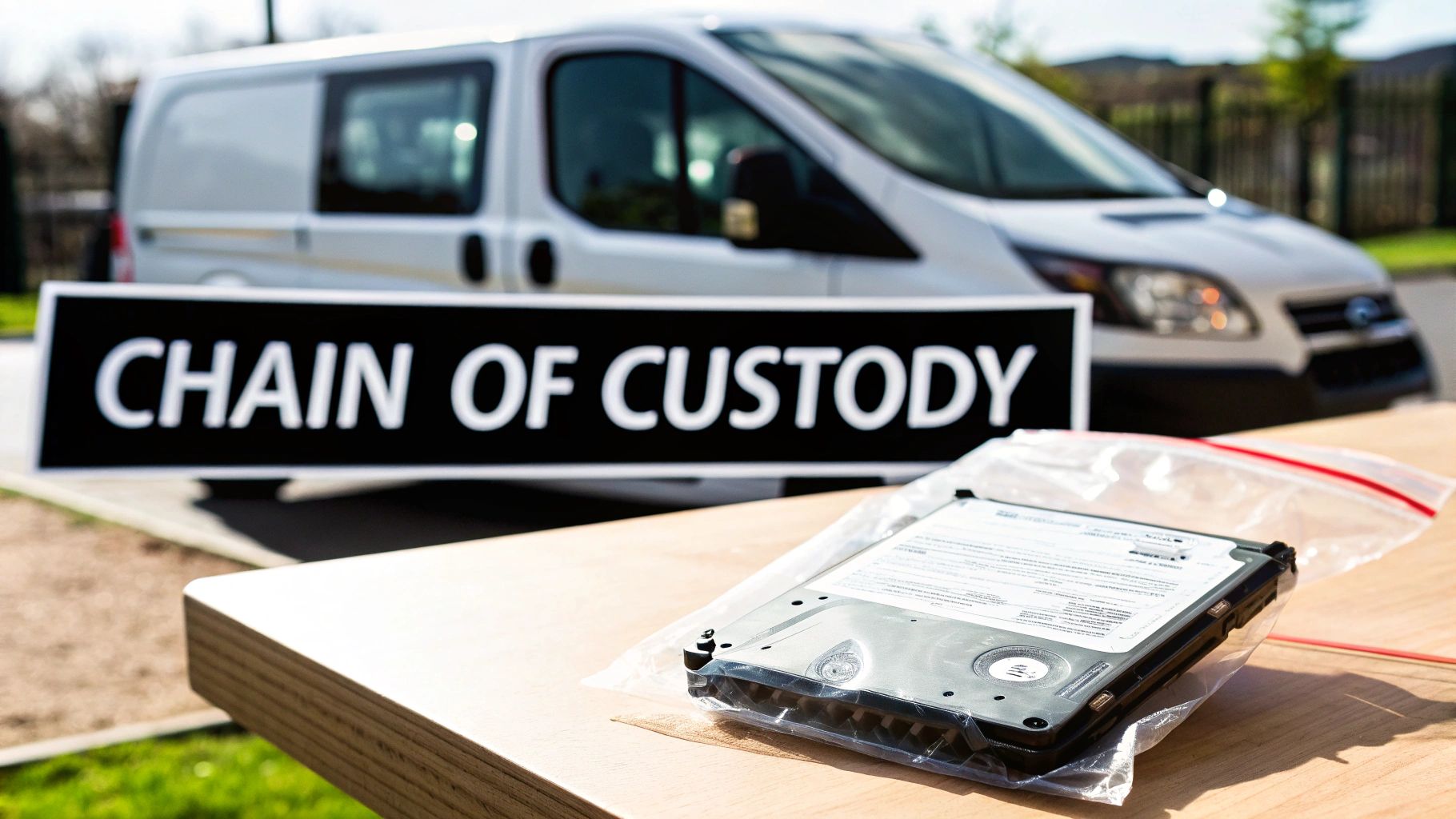
The chain of custody is the unbroken, documented trail that follows your hard drives through every single step of the destruction process. One weak link in this chain can blow a massive hole in your security. Any reputable vendor should be able to walk you through a transparent and fully documented process without hesitation.
This means secure, GPS-tracked vehicles for transport, locked and sealed containers for your media, and strict check-in procedures at their facility. It also means that every single employee who might handle your assets has been background-checked and thoroughly trained. When you're vetting potential electronic waste disposal companies, ask for a detailed breakdown of their chain-of-custody protocol. A partner worth their salt will have it ready.
Your legal proof of compliance rests entirely on the integrity of the chain of custody. A detailed Certificate of Destruction is the final piece of this puzzle, providing an auditable record that confirms your organization has fulfilled its due diligence.
Onsite vs. Offsite Destruction: Which is Right for You?
Another key decision is where the destruction actually happens: at your location (onsite) or at the vendor’s secure facility (offsite).
-
Onsite Destruction: This is exactly what it sounds like. A mobile shredding truck comes right to your Atlanta office. You can stand there and physically watch your drives get turned into tiny pieces, which offers the absolute highest level of assurance. This is almost always the top choice for businesses in heavily regulated fields like healthcare and finance.
-
Offsite Destruction: The vendor securely transports your drives in locked containers back to their facility for destruction. While you don't get to see it happen in person, a NAID AAA certified vendor will provide things like video verification and a complete audit trail to prove the job was done right. Offsite services are typically more cost-effective, especially if you have a large number of drives.
Ultimately, the choice comes down to your own organization's security policies, specific compliance needs, and budget.
The Differentiator: A Partner with a Purpose
In today's market, just being compliant is the bare minimum. The best partners go a step further and find ways to turn your disposal needs into a positive story you can share. A vendor’s commitment to a social mission, like supporting veterans or local environmental causes, can be a huge differentiator.
When you partner with a company that ties its work to a greater good, you transform a routine compliance checklist item into a meaningful boost for your company's ESG (Environmental, Social, and Governance) goals. Imagine a "Recycle for a Cause" campaign where you can tell your team and your customers, "Our old tech is helping house a veteran and grow a forest."
This isn't just about feeling good; it provides tangible benefits. A mission-driven partner can provide Impact Reports and Plant-A-Tree certificates that you can use in your official CSR documentation and marketing materials. It creates a compelling narrative that connects with employees, customers, and stakeholders, turning your hard drive destruction program into a genuine brand-building opportunity. When assessing potential partners, understanding their visibility through common SEO strategies for local removal services can also help identify reputable and accessible providers in the Atlanta market.
What to Expect During the Destruction Process
Hiring a professional service for hard drive destruction shouldn't feel like a black box. Once you've picked a certified Atlanta partner, the entire process should be transparent, secure, and documented from the moment your assets leave your sight until you have proof of their destruction. Let's walk through what that actually looks like.
The whole procedure is built around maintaining an unbroken chain of custody, where every single touchpoint is logged and verified. This isn't just for show; it's what gives you an ironclad audit trail to prove due diligence and satisfy tough regulatory requirements. And it all starts with getting your devices ready.
Preparing Your Devices for Pickup
Proper prep work on your end is the first, crucial link in that chain of custody. Before the technicians show up, you’ll want to round up and inventory all the media you need destroyed. This goes beyond just old computer hard drives—think SSDs, backup tapes, retired servers, and any other device that holds data.
A simple spreadsheet is your best friend here. For each item, you should log:
- Asset Tags: Your company’s unique ID for the equipment.
- Serial Numbers: The manufacturer's serial number on the drive or device itself.
- Device Type: A quick description like "HP EliteBook SSD" or "Seagate Backup Tape."
This list becomes your baseline manifest. You'll use it to cross-check the vendor's paperwork later, making sure every single asset is accounted for. Once inventoried, keep all the devices in a locked, secure spot until pickup.
The Secure Transportation and Check-In Workflow
On the scheduled day, uniformed and background-checked technicians will arrive to handle the collection. This is where you can immediately tell you're working with a professional, NAID AAA certified company.
They’ll carefully place your devices into sealed, tamper-evident containers. You'll sign off on a transfer of custody form that matches your inventory list. From there, the containers are loaded onto a secure, GPS-tracked vehicle and taken directly to the destruction facility.
Once they arrive at the plant, the containers are opened, and every single device is checked in against the manifest you created. This double-verification step is non-negotiable—it confirms that everything that left your office arrived safely for destruction, with no gaps or questions.
The Certificate of Destruction is way more than a receipt. It’s your legal proof of compliance. This document is what proves your organization met its obligations under laws like HIPAA and FACTA, and it’s the cornerstone of your audit trail.
Witnessing the Destruction and Receiving Final Proof
Seeing is believing. The actual destruction event is the most definitive part of the process. For businesses needing the absolute highest level of assurance, you can often arrange to witness it. Whether you're on-site at the facility or watching via a secure video feed, you get to see your hard drives fed into an industrial shredder and turned into tiny, irrecoverable pieces of metal.
After the shredding is done, the final—and most important—step is the paperwork. Your vendor will issue a formal Certificate of Destruction. This is the legally recognized document providing ultimate proof that your data is gone forever.
It will detail:
- A serialized list of everything destroyed, cross-referenced with your original inventory.
- The exact date and location of the destruction.
- The specific method used (e.g., shredding to a 5/8" particle size).
- The signature of an authorized official from the facility.
This certificate officially closes the loop on the chain of custody. It’s the document you file away to prove compliance in any future audit. To see what goes into this critical final step, you can learn more about our commitment to secure hard drive shredding and the guarantees we stand behind. It's this transparent process that provides true peace of mind and proves absolute accountability.
Turn E-Waste into a Positive Impact Story
Let's be honest, secure data disposal is a necessity, but it often feels like just another line item on the expense report. It doesn't have to be. When you start searching for "hard drive destruction near me," you have the opportunity to find partners who can turn this compliance task into a powerful force for good.
This is about reframing a routine IT process into a compelling story of community support and environmental stewardship—one that directly aligns with your company's Corporate Social Responsibility (CSR) and Environmental, Social, and Governance (ESG) goals. It's a story your employees, customers, and stakeholders can genuinely get behind.

Launching a "Recycle for a Cause" Campaign
Imagine turning your stacks of old hard drives and servers into tangible, positive outcomes. A "Recycle for a Cause" campaign does exactly that. By partnering with a vendor that has a dual-impact mission—like supporting veterans and funding reforestation—you create an immediate, human connection to what you're doing.
The messaging becomes incredibly powerful: "Your old tech can house a veteran and grow a forest."
Suddenly, the act of recycling is transformed from a simple disposal task into an act of direct community and environmental support. You can even align these efforts with specific times of the year for maximum impact.
- Veterans Day Drives: Organize a company-wide collection event to honor service members.
- Earth Day & Arbor Day Initiatives: Focus on the environmental aspect, tying device recycling to tree-planting efforts.
These seasonal campaigns are perfect for boosting internal morale and generating positive external PR, showcasing your company's real commitment to making a difference.
Partnering for ESG and CSR Wins
For corporate leaders, finding straightforward ways to meet ESG benchmarks is always a top priority. A mission-driven electronics disposal partner offers an easy win. You can set up corporate recycling drives where the vendor handles all the logistics, often including free pickup for a certain number of devices.
In return, you get the documentation you need to fuel your sustainability reporting:
- Veteran Support Impact Reports: Detailing how your retired assets contributed to veteran aid programs.
- Plant-A-Tree Certificates: Quantifying the number of trees planted on your company's behalf.
- "Recycled with Purpose" Digital Badges: A certification you can display on your website and in CSR reports as social proof of your commitment.
This approach makes your company an active participant in a much larger story. The demand for these kinds of secure and responsible services is skyrocketing. The global market for hard drive destruction services was valued at around USD 1.65 billion and is projected to hit USD 5.05 billion by 2035, a surge driven by security concerns and the need for eco-friendly e-waste solutions. You can read more about the growth of the hard drive destruction market to see just how big this is getting.
Engaging Customers and Building Brand Advocates
This mission-driven model isn't just for internal reporting; it’s a powerful tool for customer engagement. When individuals and businesses choose your services, they become part of the story.
"Recycling that restores lives and landscapes." This simple tagline reframes the entire transaction. It’s not just about disposal; it's about restoration and hope.
By providing personalized impact certificates—"You planted 3 trees and helped 1 veteran"—you transform a one-time customer into a true brand advocate. They have a tangible, shareable result of their decision, which fosters loyalty and encourages word-of-mouth referrals. It's about creating a community around a shared positive mission, and it's a key part of what makes responsible Atlanta electronic recycling a true win-win for everyone involved.
Answering Your Top Hard Drive Destruction Questions
When you start digging into "hard drive destruction near me," you'll find a handful of questions pop up again and again. Getting solid, no-nonsense answers is key to staying compliant, managing your budget, and making a decision you can stand behind.
Here are the questions we hear most often from businesses right here in Atlanta.
What’s the Real Cost for Hard Drive Destruction in Atlanta?
Let's be clear: there's no single price tag for hard drive destruction. The final number really boils down to a few things: how many drives you have, the destruction method you choose (like shredding vs. pulverization), and whether the work happens at your place (onsite) or theirs (offsite).
Bringing a mobile shred truck to your facility is the gold standard for peace of mind, but it’s a premium service because of the logistics involved. Offsite destruction is usually easier on the wallet.
Most vendors will quote you a per-drive price, typically somewhere between $5 and $15 per drive. But don't get hung up on that initial number—volume discounts are a big deal in this business. Always ask for a custom quote based on your exact inventory to get the true picture.
Is a Certificate of Destruction Actually a Legal Document?
You bet it is. In fact, think of it as one of the most important tools in your compliance arsenal. A Certificate of Destruction is your official, legally recognized proof that you’ve met your data privacy duties under laws like HIPAA, FACTA, and GDPR.
This certificate is your best defense in an audit. It creates a bulletproof paper trail detailing the what, when, where, and how of the destruction process, complete with a serialized list of every single device. It's what shields your organization from liability.
Any vendor worth their salt will provide this as a standard part of their service. If they don't, that's a major red flag.
Can't I Just Drill Holes in My Hard Drives Myself?
It seems like a quick and dirty solution, but drilling holes is nowhere near secure enough for business data. A drill bit only chews up a tiny fraction of the magnetic platters where your data lives. For a determined data thief with the right recovery tools, the rest of that information is still fair game.
More importantly, this DIY approach leaves you with zero legal proof that the data was properly destroyed. It won't pass muster with NIST guidelines or satisfy HIPAA requirements, leaving you exposed.
What Happens to the Shredded Bits and Pieces?
Once your drives are turned into a pile of unrecognizable metal fragments, the process isn't over. A truly responsible partner makes sure those materials get a second life, which is where certifications like R2 (Responsible Recycling) come into play.
That jumble of shredded aluminum, steel, and circuit boards gets shipped off to certified downstream partners. There, the valuable commodities are meticulously sorted and recovered to be used in new manufacturing. This keeps hazardous e-waste out of our landfills, protects the local environment, and puts your old tech back to work.
Ready to turn your e-waste into a powerful story of security and social impact? Atlanta Green Recycling offers NAID AAA certified hard drive destruction that not only protects your data but also supports veterans and reforestation efforts. Schedule your secure pickup today and receive a personalized impact report. Learn more at https://www.greenatlanta.com.