Your Guide to a Hard Drive Certificate of Destruction

Think of a hard drive certificate of destruction as the official death certificate for your sensitive data. It’s more than just a receipt; it’s a formal, legally defensible document that serves as undeniable proof that your data has been permanently and securely destroyed.
This document is the final, crucial step in the IT asset lifecycle and your primary defense in an audit. For businesses all over Atlanta—from healthcare clinics in Midtown to financial firms in Buckhead—it’s what proves you’ve met your compliance obligations.
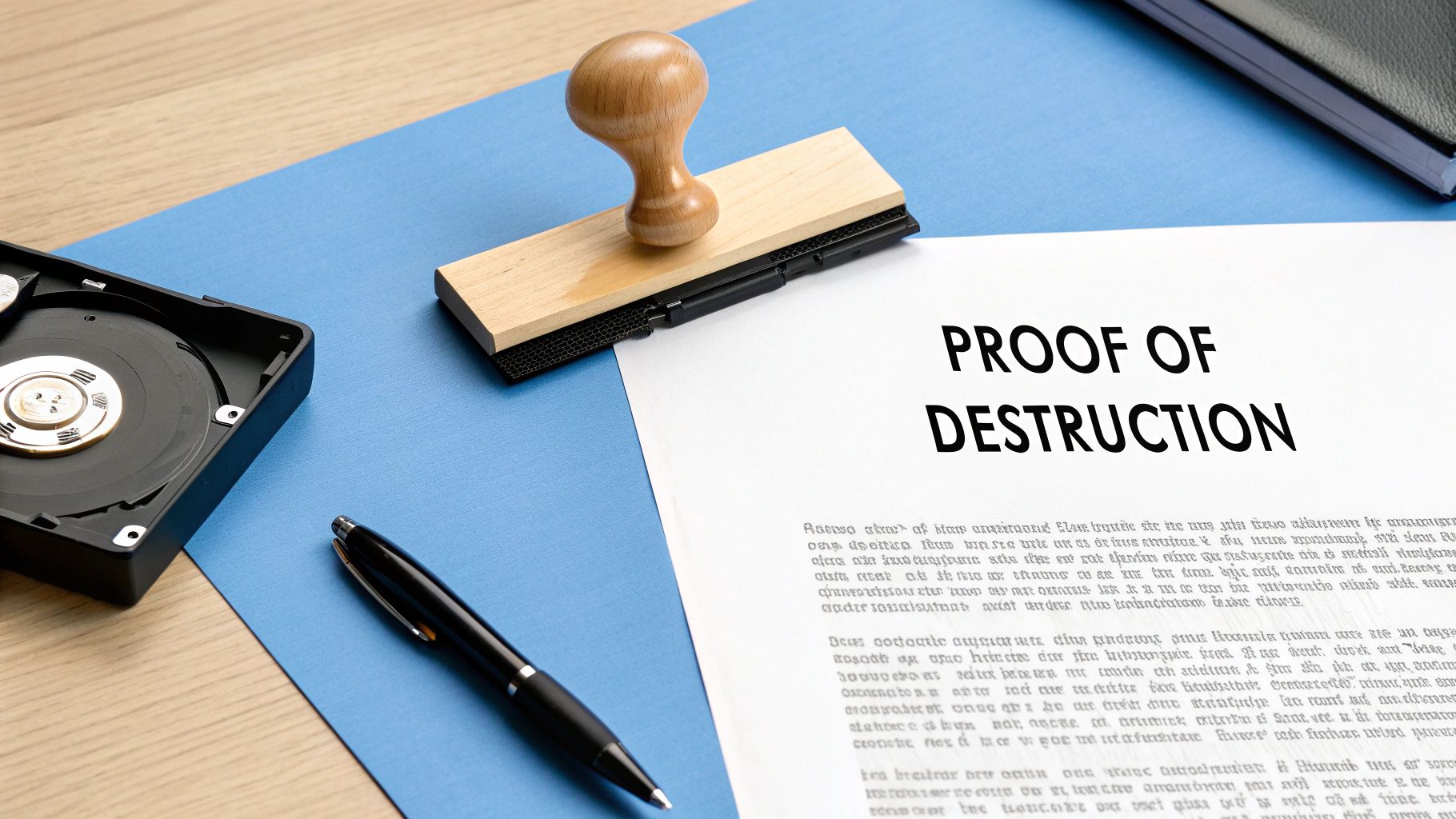
Without it, you have no verifiable way to show you complied with data privacy laws after a device has left your control. A certificate of destruction bridges the gap between disposing of old hardware and proving you did it responsibly.
More Than Just a Receipt
A standard recycling slip might show you dropped off some old equipment, but it won’t hold up under scrutiny. It just doesn't have the details needed for legal and regulatory compliance.
An audit-proof certificate, on the other hand, is packed with specific, non-negotiable information that creates an unbreakable chain of custody. It must include:
- A unique serial number for every single hard drive destroyed.
- The exact date and location of the destruction.
- The specific method used, such as physical shredding or degaussing.
- A transfer of custody statement signed by an authorized representative.
Simply wiping a drive isn't enough anymore. Data recovery tools are becoming incredibly powerful, which is why only physical destruction truly guarantees that information can never be retrieved. A proper certificate documents this absolute finality. You can learn more about the differences in our guide that explains what is data sanitization.
Turning a Compliance Task into a Community Win
At Atlanta Green Recycling, we believe that responsible data destruction should do more than just check a box. When you work with us, you're not just getting a certificate—you're making a real difference.
Your old tech can house a veteran and grow a forest. Every device we process contributes directly to supporting local veterans and planting trees, transforming a necessary compliance task into a powerful act of corporate social responsibility.
A hard drive certificate of destruction from us is backed by a dual mission. It gives you the peace of mind that your data is gone for good while reflecting your company’s commitment to our community and environment. It's a simple, powerful ESG win for any Atlanta business.
Why This Certificate Is a Non-Negotiable Security Tool
In a world running on data, just saying you destroyed it isn't enough. Failing to prove it is a massive financial and reputational gamble. A hard drive certificate of destruction is what turns your data disposal from a potential liability into a documented, secure, and defensible business practice. Think of it less like paperwork and more like an insurance policy for your data security.
For any organization in Atlanta, whether you're a hospital handling patient records or a law firm managing sensitive case files, the stakes couldn't be higher. Without that piece of paper, an audit or a data breach investigation can leave you completely exposed. This certificate is your first line of defense, providing a clear, traceable record that proves you met your legal and ethical duties.
The High Cost of Non-Compliance
Let's be blunt: regulators don't care about verbal promises. They demand cold, hard proof. Not having a detailed certificate of destruction can unleash consequences that are far more painful than a simple slap on the wrist. The financial penalties alone can be absolutely crippling.
This certificate is your legal fortress against the sky-high fines that come with privacy breaches. Just look at HIPAA—a violation can saddle an organization with fines up to $1.5 million per year for each violation category. A simple oversight in your hard drive disposal process can quickly spiral into a financial catastrophe. Without a certificate that lists every single serial number, auditors have no way to trace your assets, and you have no way to defend your actions.
It all boils down to a critical point: in the eyes of regulators, if you can't prove you destroyed it, you didn't. This can also cause irreversible damage to your brand, shattering customer trust that might have taken you years to build.
Building an Unbreakable Audit Trail
An audit trail is simply the story of your compliance, told through documentation. A certificate of destruction is the final, and maybe most important, chapter in the life of your IT assets. It’s the tangible proof of your diligence and your commitment to protecting sensitive information.
A solid certificate creates a clear and defensible record by:
- Tracking Individual Assets: Every hard drive is identified by its unique serial number. No ambiguity, no questions.
- Confirming the Method: It clearly states the destruction technique used—like shredding or degaussing—confirming you met standards like NIST 800-88.
- Establishing a Timeline: The document locks in the precise date and location of destruction, cementing the chain of custody.
This level of detail takes your data disposal out of a murky gray area and puts it into black-and-white. When an auditor comes knocking, you can hand them a document that holds up under the toughest scrutiny. Our team provides this level of documentation for all our secure data destruction services, making sure you're always ready for an audit.
"Your company can turn e-waste into forests." This isn't just a tagline for us; it’s how we operate. When you partner with Atlanta Green Recycling, your certificate of destruction becomes more than just a compliance checkbox—it’s a statement about your company's values.
Choosing a partner who gets the nuances of compliance documentation is everything. At Atlanta Green Recycling, we provide serialized certificates that not only protect your business but also boost your ESG goals. Every device we recycle helps support local veterans and contributes to reforestation projects. This turns a routine security task into a powerful story of positive impact, transforming your old tech into a force for good right here in the Atlanta community. Your certificate reflects both your commitment to security and your dedication to making a real difference.
Anatomy of an Audit-Proof Certificate
Let’s be clear: not all certificates are created equal. A simple receipt from a recycler won’t cut it during an audit, but a properly structured hard drive certificate of destruction is your ultimate proof of compliance. For IT managers and compliance officers, knowing the difference is everything.
Think of this document as a legal affidavit for your data. Its strength is in the details. A vague or incomplete certificate leaves you wide open to risk, while a comprehensive one acts as a shield against crippling regulatory fines and legal headaches. This is your playbook for making sure your documentation is absolutely airtight.
This flowchart shows just how much value is packed into that one piece of paper. It's the barrier standing between your organization and major risks like compliance failures and brand damage.
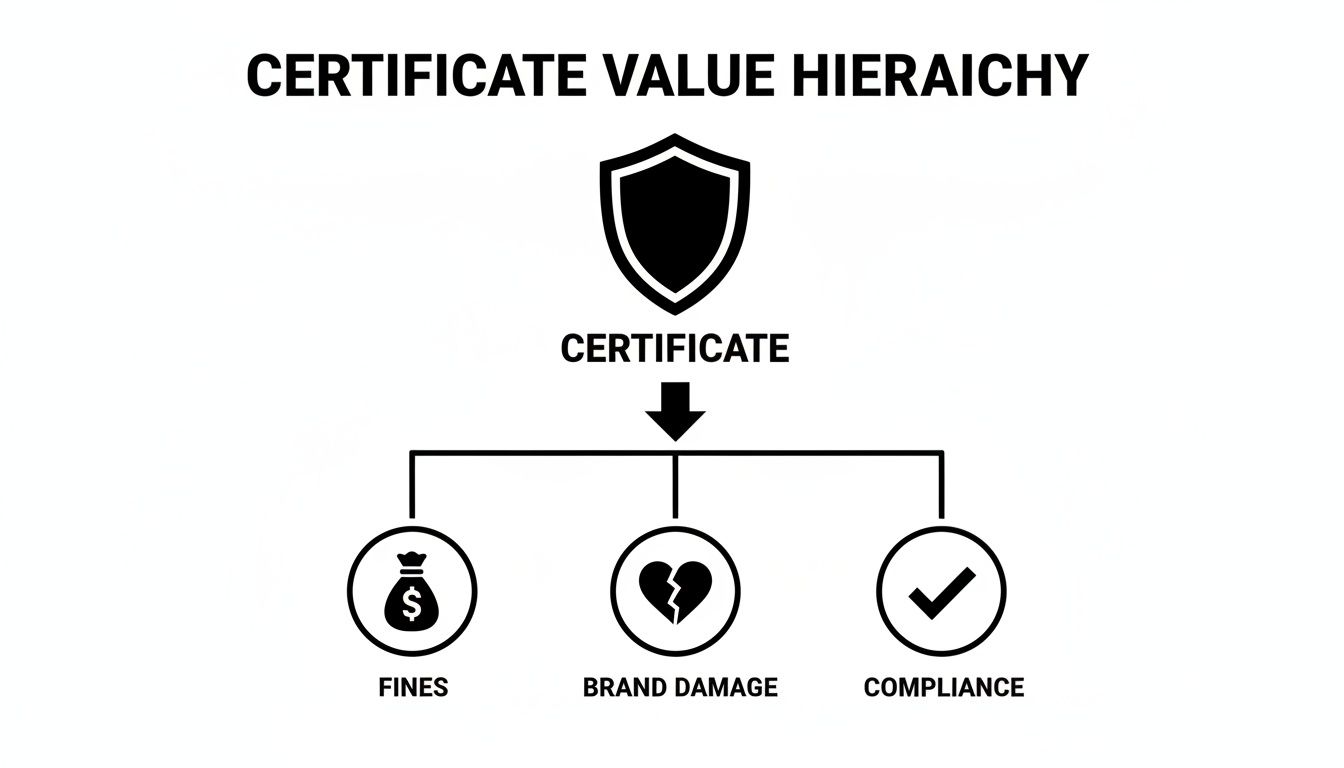
As you can see, this single document is what stands between your business and some severe financial and reputational fallout.
What to Look For: Core Components of a Compliant Certificate
To be considered truly audit-proof, your certificate needs several key pieces of information that create a complete, transparent record. If even one of these is missing, an auditor could invalidate the whole document.
Use this checklist to verify your certificate contains all the necessary components to be considered audit-proof and legally defensible.
| Component | What It Is | Why It's Critical for Compliance |
|---|---|---|
| Unique Transaction ID | A specific reference number linking the certificate to your service order and internal records. | Creates a clear, traceable link between your records and the vendor's actions. |
| Client & Vendor Info | Full legal names, physical addresses, and contact details for both your company and the vendor. | Establishes exactly who was involved in the transaction, leaving no room for ambiguity. |
| Transfer of Custody | A signed statement confirming when and where liability for the assets was transferred. | Legally documents the moment the vendor took responsibility for your data-bearing devices. |
| Date & Location | The exact date and physical address where the destruction service was performed. | Verifies when and where the destruction took place—essential for proving onsite services. |
| Itemized Serial Numbers | A detailed, serialized list of every single asset that was destroyed. | The absolute cornerstone of a defensible audit trail. It proves which specific devices were destroyed. |
| Method of Destruction | A clear description of the technique used (e.g., shredding, pulverizing) and the standards met. | Confirms the process aligns with federal guidelines like NIST 800-88 or DoD requirements. |
These details are the foundation of the document’s credibility. They prove who did what, when they did it, and exactly which assets were involved.
Why Serialized Reporting is Non-Negotiable
Beyond the basics, the most critical element of an audit-proof certificate is the serialized inventory list. If you get a certificate that just says "100 hard drives destroyed," that's a massive red flag. For compliance purposes, that document is effectively useless.
A legitimate hard drive certificate of destruction must provide an itemized list of every single asset destroyed, identified by its unique manufacturer serial number. This granular detail is the cornerstone of a defensible audit trail.
This list, often an appendix or attached report, is an inseparable part of the certificate. It eliminates any doubt about which specific devices were processed, allowing you to match the certificate directly to your internal IT asset management records. It’s the only way to prove to an auditor that a specific laptop or server containing sensitive data was properly destroyed.
Destruction Method and Compliance Standards Matter
Finally, the certificate must explicitly state the method of destruction. Vague terms like "securely processed" are not going to fly.
The document should specify the exact technique used, such as:
- Physical Shredding: The device was mechanically shredded into small, irrecoverable fragments.
- Degaussing: High-powered magnets were used to completely erase the magnetic field on the drive platters.
- Pulverization: The hard drive was physically crushed and pulverized into dust and tiny pieces.
The certificate should also reference the compliance standards the process meets, like NIST 800-88 or DoD 5220.22-M. This confirms that the destruction method aligns with strict federal guidelines for data sanitization. This kind of thorough documentation is a key part of a larger strategy for what is IT asset disposition, ensuring a secure and fully documented end-of-life for all your equipment.
How Destruction Methods Impact Your Certificate
The physical act of destroying a hard drive and the document that proves it are joined at the hip. The method your vendor uses isn’t just a technical detail—it’s the core component of your hard drive certificate of destruction that tells an auditor everything they need to know about your security protocol.
Frankly, seeing "shredded" versus "wiped" on a certificate makes a world of difference during an audit. Think of your certificate as the story of your data’s end-of-life. The destruction method is the climax of that story. If the method is weak or can't be verified, it leaves plot holes that regulators can easily poke through.
This is exactly why your certificate must clearly state how each drive was destroyed. It’s the technical proof that backs up the legal promise you’re making. It confirms the method is verifiably secure and lines up with federal standards.
Degaussing vs. Shredding: Documenting the Difference
Two of the most common and secure methods you'll see on a certificate are physical shredding and degaussing. Each one provides a different, permanent path to data erasure, and your certificate will reflect the specific technique used—a critical detail for meeting standards like NIST 800-88.
- Degaussing: This technique uses an incredibly powerful magnetic field to instantly scramble the magnetic platters inside a hard drive where data lives. The certificate will note "Degaussing," often listing the equipment model used, confirming the data was rendered unrecoverable without physically obliterating the drive. You can learn more about this in our guide on erasing hard drives with magnets.
- Physical Shredding: This is the most visually definitive method. An industrial shredder literally grinds the hard drive into tiny, confetti-like metal fragments. Your certificate will state "Physical Shredding" or "Pulverization," giving you absolute proof that the device is not just unreadable but physically gone.
While both are highly effective, physical shredding provides a tangible finality that many organizations prefer for their most sensitive data. The choice often comes down to internal security policies and the specific type of media being destroyed.
The Power of Onsite Destruction and Witness Verification
Where the destruction happens is just as important as how it's done. Your certificate gains an extra layer of indisputable authority when it documents onsite destruction. This is when a mobile shredding truck comes directly to your Atlanta facility, allowing you or your team to witness the entire process from start to finish.
“Your old tech can house a veteran and grow a forest.” This is our philosophy at Atlanta Green Recycling. When we perform onsite shredding, you're not just watching hard drives being destroyed; you're witnessing the first step in a process that supports local veterans and plants new trees.
When you choose an onsite service, your certificate of destruction gets a powerful addition. It will explicitly state that the destruction was performed at your location and might even include a clause for witness verification.
This simple detail completely eliminates any questions about the chain-of-custody between your office and a disposal plant. It creates the strongest possible audit trail because your sensitive data never left your sight before it was rendered unrecoverable. It turns a routine compliance task into a secure, transparent, and impactful event for your organization.
Choosing the Right Data Destruction Partner in Atlanta
Picking a vendor to handle your company’s sensitive data is one of those decisions that carries serious weight. The partner you select is literally on the front line, protecting your business from massive compliance failures, and their hard drive certificate of destruction is the only real proof you have when the auditors come knocking. Go with the wrong one, and you could be left completely exposed, even with what looks like a valid document in your hands.
In Atlanta’s bustling market, you have to look past the sales pitch and zero in on tangible proof—proof of security, compliance, and total accountability. A truly professional partner doesn’t just smash hard drives; they provide a bulletproof, auditable trail from the moment your assets leave your sight. That’s why it’s so critical to do your homework, which includes conducting a thorough third-party risk assessment of any potential vendor's security and processes.
Red Flags to Watch For
When you're vetting potential partners, you need a sharp eye for the warning signs. A vendor that cuts corners on their process or documentation is gambling with your organization's future.
Stay far away from any provider that:
- Offers Generic Certificates: If a certificate just says "50 drives destroyed" without an itemized list of every single asset by its unique serial number, it's essentially worthless in an audit. This is a huge red flag.
- Lacks Key Certifications: Always look for credentials like NAID AAA or R2 Certification. These aren't just fancy logos for a website; they represent intense, third-party audits confirming a vendor's commitment to security, proper procedures, and environmental responsibility.
- Cannot Demonstrate Chain of Custody: Your partner has to be able to map out every single step of the journey, from secure, GPS-tracked trucks to access-controlled facilities and technicians who have passed rigorous background checks.
These aren't just minor details. They are the absolute bedrock of a secure data destruction service.
Beyond Compliance An ESG Partnership
Choosing a local Atlanta partner gives you benefits that go way beyond a simple compliance checklist. It’s a chance to connect a necessary security task with your company’s bigger Environmental, Social, and Governance (ESG) goals. A partner's mission can completely change how you think about getting rid of old IT gear.
Recycling That Restores Lives and Landscapes. At Atlanta Green Recycling, this is more than just a tagline. It’s our promise that your old hardware can become a genuine force for good.
When you work with us, your secure data destruction process does more than just shield your business from risk. It becomes a real, measurable contribution back to the community, helping us support local veterans and fund reforestation projects. We help you turn a security line item into a positive story for your CSR reports.
Data breaches from carelessly tossed hard drives aren't just far-fetched horror stories; they happen all the time, pushing certified destruction from a "nice-to-have" to a boardroom-level priority. Just look at the 2021 HealthReach breach in Maine, where patient records were exposed from improperly handled drives, leading to millions of dollars in damages and fines.
Choosing Atlanta Green Recycling means you not only sidestep these disasters but also actively make a positive local impact. Our detailed certificates and transparent process give you total peace of mind, and our mission gives your decision a deeper sense of purpose. See how we stack up against other IT asset disposition companies serving the Atlanta area.
Turning Compliance into a Force for Good
A hard drive certificate of destruction is your company’s armor, protecting it from some serious legal and financial heat. But what if that piece of paper could do more? What if it could tell a story?
Getting this document is usually just a box to check on a long to-do list. But choosing the right partner for your data destruction can completely change the game. Suddenly, a routine compliance task becomes a powerful part of your brand’s narrative and a major win for your ESG goals.

This shift from a pure security mindset is happening at the perfect time. The demand for secure data destruction is absolutely exploding. The global market, which was valued at USD 1.5 billion in 2023, is on track to hit USD 3.6 billion by 2032. This isn’t surprising when you consider the tough regulations like HIPAA and CCPA that demand proof of every single shredded drive.
From Audit-Proof to Impact-Driven
Picture your next big audit. Instead of just handing over a standard, serialized certificate, you also present a detailed Impact Report. This report doesn't just show compliance; it shows exactly how your old IT assets helped support local Atlanta veterans or contributed to reforestation efforts.
This is how you transform a dry compliance check into a compelling story for your stakeholders, customers, and sustainability reports.
At Atlanta Green Recycling, we make this transformation easy. We arm businesses with:
- Veteran Support Impact Reports: Official documentation for your CSR records, detailing how your e-waste helped local veterans.
- Plant-A-Tree Certificates: Proof of the exact number of trees planted in your company's name, perfect for your annual sustainability reporting.
- "Recycled with Purpose" Eco-Badge: A digital badge for your website and marketing materials that instantly signals your commitment to making a real-world difference.
Aligning Security with Social Responsibility
This approach completely reframes the value you get from your data destruction service. It’s no longer just an operational cost; it’s a strategic investment in your brand’s reputation and your connection to the community. To make sure you’re hitting all the right notes, using a comprehensive compliance checklist can be a huge help in turning your obligations into opportunities.
“Your old tech can house a veteran and grow a forest.”
This isn't just a tagline; it's the heart of our "Recycle for a Cause" campaign. We connect the simple act of recycling old electronics to tangible, human outcomes that your employees and customers will actually care about.
It’s what sets us apart in the Atlanta market. We even host corporate recycling drives with free pickup for 50+ devices, so it couldn't be easier to get involved. By choosing a partner with this dual mission, your hard drive certificate proves more than compliance—it proves your company is committed to making a real, local impact.
Frequently Asked Questions
Let's tackle some of the most common questions we hear about hard drive certificates of destruction. Getting the practical side right is just as important as understanding the theory behind secure data disposal.
How Long Should We Keep a Certificate of Destruction?
Think of it this way: forever. While regulations like HIPAA have a minimum retention period of six years, the best practice is to hold onto these certificates indefinitely. You just never know when an audit or legal question might pop up, and being able to produce that proof years down the road is invaluable.
An archived hard drive certificate of destruction is your long-term insurance policy. It serves as permanent, legally defensible proof that your organization fulfilled its data protection duties for a specific asset.
Is a Standard Recycling Receipt Enough for an Audit?
Not even close. A generic recycling receipt is completely insufficient for a compliance audit and will get you into hot water fast. It’s the formal certificate of destruction that’s mandatory, mainly because it contains critical details a simple receipt leaves out.
A compliant certificate has to include:
- A complete, itemized list of every single asset, identified by serial number.
- The specific destruction method used (like shredding or degaussing).
- The exact date and physical location where the destruction took place.
- A verified and unbroken chain of custody.
This is why you always need to work with a certified data destruction specialist—it’s the only way to get documentation that’s genuinely audit-proof.
Does a Certificate for a Bulk Pickup List Every Drive?
It absolutely must. Any compliant certificate for a bulk pickup has to come with a detailed, itemized inventory of every single asset that was destroyed. This usually comes as an appendix or an attached report listing the unique serial number for each individual hard drive.
If you get a certificate that just gives a total quantity, like "100 drives destroyed," consider that a massive red flag. That kind of vague summary will not pass a serious compliance audit. Granular, serialized tracking isn't just a nice-to-have; it's the very core of a defensible security strategy.
Ready to turn your compliance needs into a positive impact for Atlanta? Atlanta Green Recycling provides audit-proof certificates of destruction that not only protect your business but also support local veterans and reforestation efforts. Schedule your secure electronics pickup today and receive documentation that tells a powerful story of corporate responsibility. Learn more and get started at Atlanta Green Recycling.