Choosing an Ewaste Recycling Center Your Business Can Trust


Your old office equipment isn't just taking up space—it's a bundle of risks and opportunities. Choosing the right e-waste recycling center is so much more than a cleanup task; it's a strategic move that protects your data, your reputation, and your bottom line. Done right, this partnership transforms an obligation into a powerful asset for your brand.
Why Your E-Waste Partner Is a Critical Business Decision
That stack of outdated laptops and servers in your storage closet represents a significant turning point for your business. Handled correctly, it becomes a testament to your corporate responsibility. Handled poorly, it can become a source of seven-figure fines, data breaches, and lasting reputational damage.
The choice of an e-waste partner is far from a simple disposal task—it's a high-stakes business decision that directly impacts your security, compliance, and brand image. Think of it less like hiring a junk removal service and more like selecting a critical business partner for a key operational function. The principles are the same: you need trust, transparency, and proven expertise.
Beyond the Loading Dock
The moment your electronics leave your facility, you are placing immense trust in your chosen vendor. A single improperly wiped hard drive could expose sensitive customer data or internal financial records, leading to severe legal and financial consequences.
And it’s not just about data. If your equipment is illegally dumped instead of responsibly recycled, your company could face steep environmental penalties. This is why the entire process, known as IT Asset Disposition (ITAD), is so critical. A professional e-waste recycling center doesn’t just haul away old tech; they manage a secure chain of custody from start to finish. You can explore a deeper dive into what is IT asset disposition to understand the full scope of this essential service.
From Liability to Asset: Recycling That Restores
A strategic partnership transforms this entire process from a liability into a powerful asset. Instead of just meeting the minimum legal requirements, a mission-driven partner can help you achieve tangible Environmental, Social, and Governance (ESG) goals. This is where your choice has a ripple effect.
When your retired assets are processed by an organization that supports community causes, like veteran aid or reforestation, your e-waste becomes a source of positive impact. This provides compelling content for your CSR reports and resonates deeply with today's socially conscious consumers and employees under a clear brand message: “Recycling That Restores Lives and Landscapes.”
By choosing a partner that provides detailed impact reports and clear documentation, you are not just disposing of equipment—you are building your brand's legacy. This proactive approach turns a regulatory headache into a story of corporate citizenship, protecting your bottom line while making a genuine difference.
The Journey of Your Retired Electronics
Ever wonder what really happens after your old office computers and servers get hauled away? It's not just a simple pickup. The process is more like a high-security transport mission for your data and hardware, where every single step is tracked, documented, and locked down.
This unbreakable line of accountability is called the chain of custody. It’s a documented trail proving that from the moment your equipment leaves your control to its final recycling, nothing gets lost, mishandled, or compromised. Understanding this workflow is your key to asking the right questions and spotting a truly secure e-waste partner versus one that just talks a good game.
The journey starts the second a recycling team steps into your facility. Secure logistics are everything. This means trained staff, GPS-tracked trucks, and locked containers to block any unauthorized access while your assets are on the road. It's the first and most critical link in that chain of custody.
From Your Office to Secure Processing
Once the truck arrives at a certified recycling facility, the real work begins with a detailed inventory. Every single device—from a massive server down to a single keyboard—is scanned and logged by its serial number. This creates a master list confirming exactly what was received and tying each piece of hardware back to your company.
This isn't just about counting stuff; it's about total accountability. This inventory list is the foundation for all the paperwork that follows, including the certificates of recycling and data destruction you'll need for your records. Without this step, there’s no way to prove every device was handled correctly.
This infographic breaks down the key checkpoints you should look for when evaluating a partner's security, compliance, and overall impact.
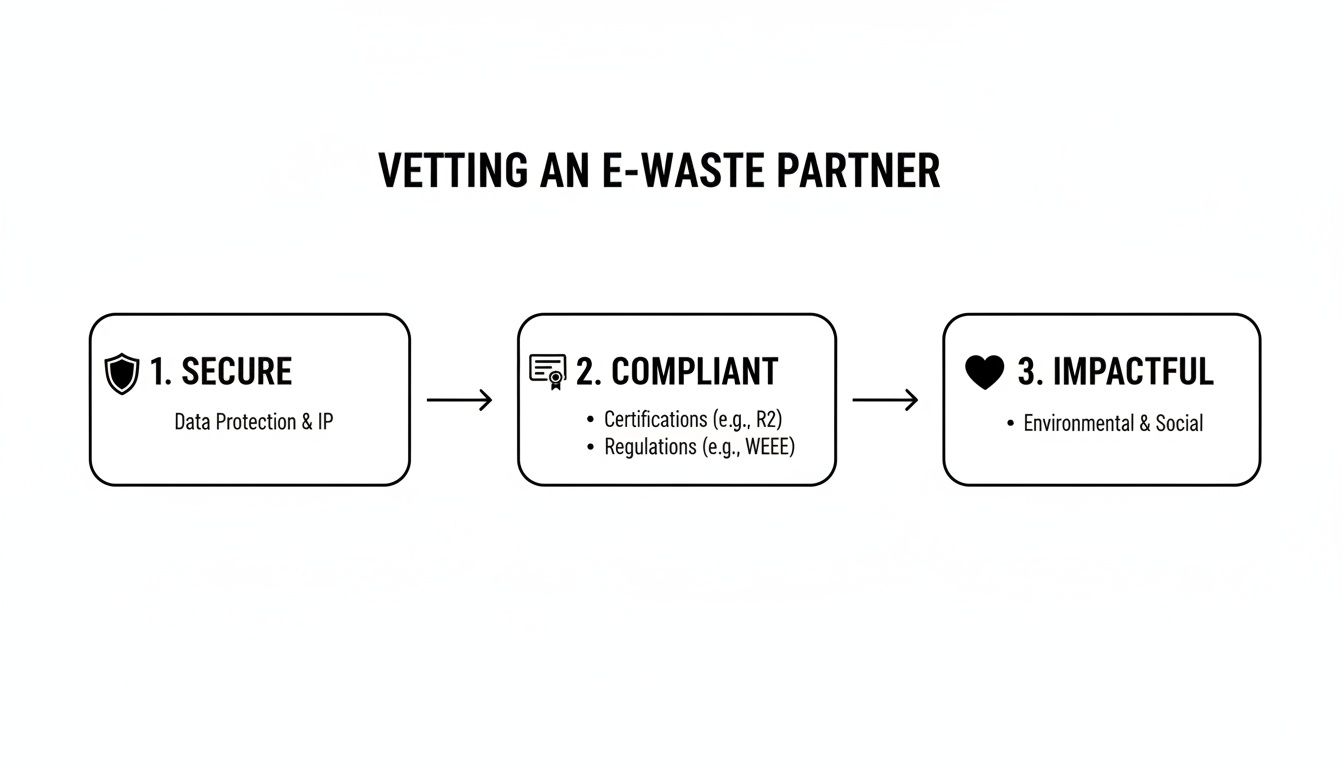
As you can see, a trustworthy e-waste recycling center builds its entire process on a foundation of security, validates it through compliance, and proves its worth with measurable, positive impact.
The Final Step: Data Destruction and Material Recovery
With everything accounted for, the most sensitive operation can start: data destruction. For any devices that have resale or reuse potential, this means wiping the hard drives clean according to intense government standards like NIST 800-88. This isn't a simple "delete"—it's a multi-pass process that overwrites every bit of the drive with random data, making the original information impossible to recover.
For older equipment, non-working devices, or hardware containing highly sensitive data, there's only one surefire method: physical destruction. Massive industrial shredders grind hard drives, servers, and other electronics into tiny, mangled fragments. This is the ultimate guarantee that your data can never be pieced back together.
“An essential part of recycling electronics is data destruction. This ensures that any personal or sensitive information is securely erased. This is similar to how businesses shred confidential paper documents to protect information. In today’s digital age, destroying data on hard drives is just as important.”
Once the data is verifiably gone, the final stage is all about recovering the raw materials. The shredded or dismantled parts are sorted into different streams—metals, plastics, circuit boards, glass. These materials are then sent off to specialized processors and smelters to be put back into the manufacturing supply chain. You can dive deeper into what happens to recycled electronics in our guide on the topic.
This is where responsible recycling truly comes full circle. Instead of piling up in a landfill, your old tech becomes a source of valuable resources, reducing the need to mine for new materials and minimizing environmental damage. Every step, from secure pickup to final material recovery, is designed to protect both your business and the planet.
Decoding Certifications and Data Security Mandates
When you dive into the world of e-waste, you’ll quickly run into acronyms like ‘R2’ and ‘e-Stewards’. These aren't just industry jargon; they're your guarantee that an e-waste partner handles your old equipment responsibly and securely.
Think of these certifications as a critical vetting tool. They’re what separate a legitimate ewaste recycling center from a potential liability. They signal a deep commitment to the highest standards for environmental safety, worker protection, and most critically, data security.

It’s like hiring a licensed contractor to build your office. You wouldn't risk working with someone uncertified, and the same logic applies here. Trusting an uncertified vendor with your company's devices is a huge gamble.
What's the worst that could happen? Your old hard drives, full of sensitive information, could wind up on an overseas black market. Or the hazardous materials inside your equipment could be illegally dumped, with a trail leading straight back to your company. That means steep fines and a public relations nightmare.
These certifications aren't handed out lightly. They require tough, ongoing audits by third-party inspectors to ensure the recycler is following a strict set of rules.
Key Certifications to Look For
When you're evaluating a potential recycling partner, two names stand out as the gold standard. Seeing these logos is a non-negotiable sign of a trustworthy and compliant operation.
- R2 (Responsible Recycling): The R2 standard covers the entire lifecycle of an electronic device, from collection to final disposition. It sets strict requirements for environmental health, worker safety, data security, and tracking all materials downstream. An R2-certified facility has proven it manages everything responsibly.
- e-Stewards: Developed by the environmental watchdog group Basel Action Network, the e-Stewards certification is famous for its incredibly strict environmental rules. It completely forbids exporting hazardous e-waste to developing nations and demands total accountability for all toxic materials.
A certified partner doesn't just promise security; they prove it through independent verification. This documentation is your shield against liability, demonstrating due diligence and a commitment to compliant IT asset disposition.
The Gold Standard for Data Destruction
Beyond the facility itself, the single most important piece of the puzzle is how they handle your data. This is where a specific government mandate, NIST 800-88, becomes essential.
Published by the National Institute of Standards and Technology, this is the U.S. government's definitive guide to media sanitization. It’s the playbook everyone in the security world follows.
The NIST 800-88 guidelines lay out precise methods for clearing, purging, and physically destroying data on hard drives and other storage media. A recycler who follows these protocols ensures your data isn’t just deleted—it’s forensically unrecoverable. For a closer look at what this involves, check out the essentials of data sanitization and see why it’s so critical.
This level of security is simply not optional. The financial and reputational damage from a single data breach can be catastrophic, easily wiping out any savings you thought you were getting from a cheaper, uncertified vendor.
Your Audit-Proof Paper Trail
A professional e-waste recycling center will always provide an audit-proof paper trail, closing the loop on your compliance duties. This documentation is your legal proof that you did everything right.
You should always demand these three documents:
- Chain of Custody Documentation: A detailed log that tracks your assets from the moment they leave your control to their final processing.
- Certificate of Data Destruction: This is a legally binding document. It lists the serial numbers of every single hard drive that was sanitized or destroyed, confirming it was handled according to standards like NIST 800-88.
- Certificate of Recycling: A final report confirming that all your non-data-bearing equipment was recycled in an environmentally compliant way.
This isn't just bureaucratic paperwork. It’s your definitive proof of compliance and your best defense if an auditor ever comes knocking.
Turning E-Waste Into Your Next Big ESG Win
Let's stop thinking of e-waste as just a disposal problem and start seeing it for what it really is: a cornerstone of your corporate story. When you choose the right e‑waste recycling center, you’re not just getting rid of old equipment. You're turning a compliance headache into a powerful asset for your Environmental, Social, and Governance (ESG) and Corporate Social Responsibility (CSR) reports.
Partnering with a mission-driven recycler gives you a real advantage here. Instead of a simple receipt, you get a story—a narrative that truly connects with your customers, employees, and investors. It transforms a routine operational task into an authentic showcase of your company's values.
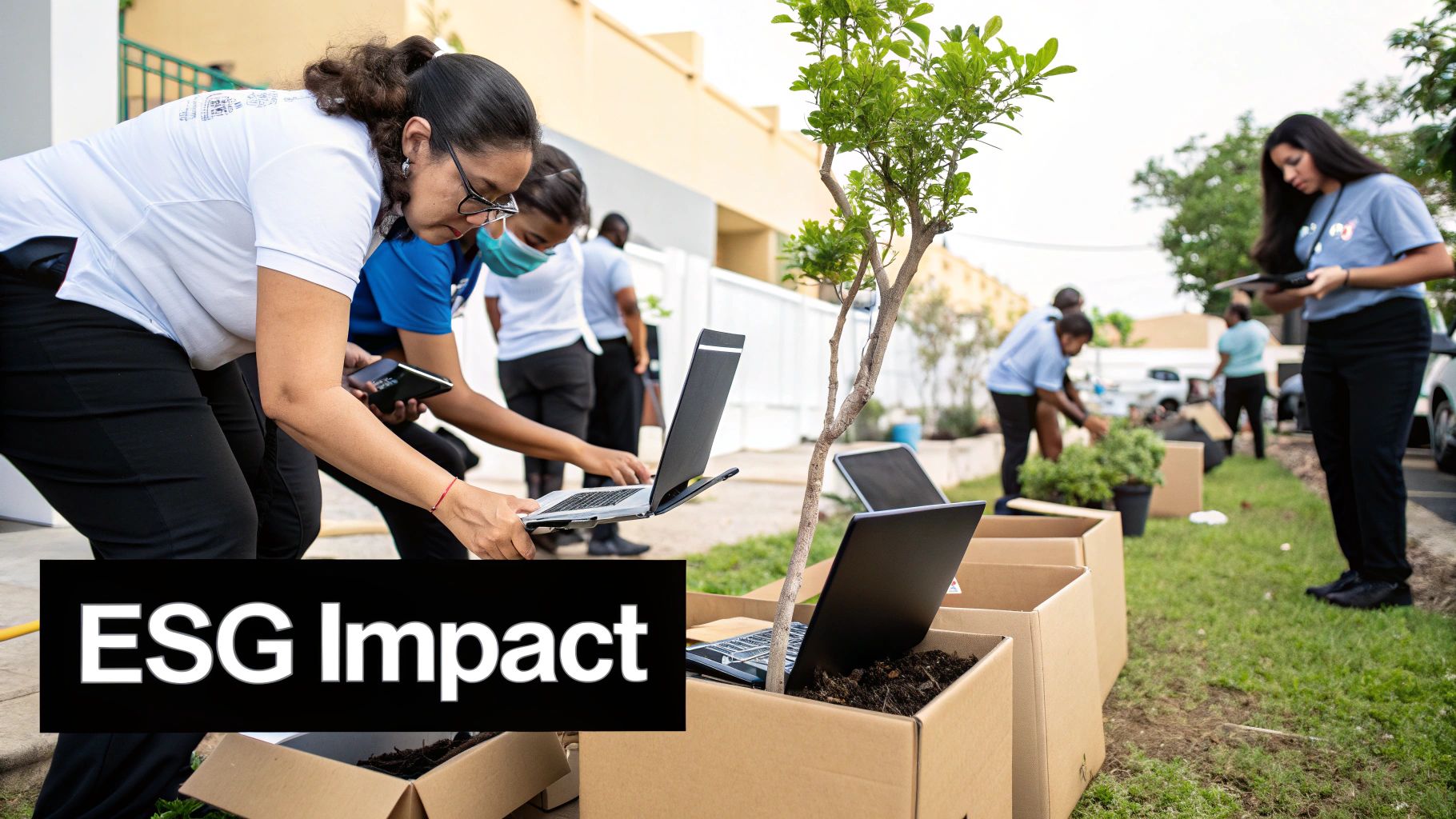
Launching “Recycle for a Cause” Campaigns
Imagine putting out a message like, “Your old tech can house a veteran and grow a forest.” That’s the kind of impact a "Recycle for a Cause" campaign delivers. It connects the simple act of recycling to a tangible, emotional outcome that goes far beyond generic sustainability claims.
This kind of storytelling sets you apart in a crowded market. It’s a narrative your marketing team can build on, your employees can rally behind, and your leadership can highlight in the annual report. You can even create seasonal drives around holidays like Veterans Day, Earth Day, and Arbor Day for timely PR and community engagement.
The scale of the e-waste problem is massive, which means the opportunity for impact is, too. In 2022, the world generated a staggering 62 million tonnes of electronic waste, but only 22.3% was properly collected and recycled. That gap leaves around $62 billion in recoverable resources sitting in landfills and underscores just how much good we can do.
Documenting Your Impact for ESG and CSR
A true mission-driven partner doesn’t just recycle your assets; they deliver proof of the positive impact you’ve made. This documentation is what turns your recycling program into measurable, reportable ESG wins.
Instead of just another transaction, you get tangible reports detailing the community and environmental benefits your old tech has created. That’s how you build real trust and transparency.
Key Documents for Your ESG Reporting:
- Veteran Support Impact Reports: These reports quantify the direct aid provided to veterans, drawing a straight line from your e-waste to social good.
- Plant-A-Tree Certificates: For every batch of electronics recycled, you can get official certificates documenting the number of trees planted in your company's name.
- Live Impact Counters: A forward-thinking partner can even provide live stats for your website, showing metrics like “1,245 veterans supported” and “3,700 trees planted” for real-time social proof.
This level of detail moves your sustainability efforts from a vague promise to a verifiable achievement. For businesses looking to go even further, exploring other eco-friendly product initiatives can round out your e-waste strategy and build a more complete sustainability profile.
The Power of an “Eco-Badge”
To make your commitment unmissable, a mission-driven recycler can offer a digital “Eco-Badge.” Think of it as a certification mark—something like “Recycled with Purpose”—that you can proudly display on your website, in email signatures, and across your sustainability reports.
This simple visual cue does a lot of heavy lifting:
- It Instantly Communicates Your Values: It shows customers and potential partners that you prioritize responsible, impactful business practices.
- It Boosts Brand Reputation: The badge acts as a third-party endorsement of your commitment to social and environmental causes.
- It Enhances Employee Pride: It gives your team a tangible symbol of their employer's positive impact on the community.
By turning your e-waste into a visible and documented asset, you create a powerful cycle. You handle compliance, strengthen your brand, and contribute to meaningful causes all at once. This approach elevates your e‑waste recycling center from a simple vendor to a vital partner in your corporate citizenship journey. You can explore the broader benefits of e-waste recycling to see how these advantages ripple throughout your organization.
Choosing Your Atlanta E-Waste Recycling Partner
With so much on the line—from data security to environmental compliance—picking the right e-waste recycling center is one of the most critical vendor decisions your Atlanta business will ever make. This isn't just about hauling away old equipment. The right partner becomes a true extension of your company, bolstering your security, compliance, and even your marketing efforts.
This is where you move from theory to action. To properly vet local providers, you need a solid framework of questions that cuts right through the sales pitches and gets to the heart of what matters: security, accountability, and a verifiable positive impact.
Let's walk through a checklist to help you evaluate potential partners and make sure your final choice clicks perfectly with both your operational needs and your company's core values.
Logistics and Operational Capability
Before you even get to the high-tech stuff like certifications, start with the basics of logistics. A partner's day-to-day process tells you a lot about their professionalism and whether they can handle the specific demands of a corporate client. A sloppy or disorganized pickup process is often a red flag for bigger problems under the surface.
Key Questions to Ask:
- Do you offer complimentary pickup for corporate clients? Most recyclers who focus on B2B services will waive pickup fees if you have a minimum number of devices (usually around 50+), since the value of the assets covers their costs.
- Is your logistics fleet company-owned and GPS-tracked? This is a huge chain-of-custody question. Company-owned trucks mean far greater control and security compared to relying on third-party couriers.
- What is your process for onsite de-installation and packing? If you have a big project like a data center decommissioning, you need a team that can handle everything safely and efficiently from start to finish.
Data Security and Destruction Protocols
This is, without a doubt, the most critical part of your evaluation. One mistake here can spiral into a catastrophic data breach, complete with massive legal liabilities. You absolutely have to find a partner who treats your data with the same paranoid level of security that you do.
A vendor’s data destruction process is non-negotiable and must be backed by documentation. Vague promises of "secure wiping" just don't cut it; you need to see proof of specific, verifiable standards.
Demand total clarity on their sanitization methods. A true professional will be completely transparent about their process and will be happy to show you proof of their capabilities.
Key Questions to Ask:
- Do you adhere to NIST 800-88 guidelines for data sanitization? This is the industry gold standard. Don't just accept a "yes"—ask them to walk you through their process for both data wiping and physical destruction.
- Can you provide a Certificate of Data Destruction for every single data-bearing device? This piece of paper is your legal proof of compliance. It needs to be detailed, listing the serial number for every hard drive that was sanitized or destroyed.
- Is your facility secure, with controlled access and surveillance? The physical security of their building is just as important as the digital security of your data.
Compliance, Certifications, and Reporting
Certifications like R2 and e-Stewards are your peace of mind. They act as a third-party guarantee that a vendor meets the industry's highest environmental and safety standards. This is what separates the real professionals from the risky, unvetted outfits.
Beyond the certifications, their ability to provide rock-solid documentation is crucial for your own internal audits and external reporting. A compliant partner makes your job easier by giving you a clean, auditable paper trail for every single asset you hand over. This documentation is your shield against any potential regulatory headaches down the road.
To give you a head start, our team put together a guide to some of the top-rated e-waste recycling companies serving the Atlanta area, so you can begin your search with a pre-vetted list.
Impact and ESG Contribution
Finally, in a world where corporate values are front and center, think about how a partner can help you tell a powerful ESG story. A mission-driven recycler can turn a routine disposal task into a fantastic demonstration of your company's commitment to doing good. This is a huge differentiator that delivers value far beyond the basic service.
Key Questions to Ask:
- What kind of documentation will we receive for our ESG and CSR reports? Look for partners who go beyond a basic recycling certificate. Ask if they can provide detailed Impact Reports, Plant-A-Tree certificates, or other metrics you can actually quantify.
- Can you help us run a "Recycle for a Cause" campaign? A great partner will be proactive, offering ideas and support for community engagement, like co-hosting recycling drives or creating marketing materials.
- Do you offer a digital "Eco-Badge" or other branding assets? The ability to slap a badge on your website or in your reports instantly turns your responsible recycling into a visible—and valuable—brand asset.
Your Top Questions About Corporate E-Waste Recycling, Answered
When you're ready to choose an e-waste recycling center, a few key questions always come up. We get it. You need to be sure about security, cost, and compliance. Here are some straightforward answers to the questions we hear most from Atlanta businesses.
What Kind of Electronics Can Our Business Actually Recycle?
Just about everything with a plug or a battery. A certified, business-focused recycling center is equipped to handle the full range of your IT assets. We’re talking desktops, laptops, servers, monitors, printers, networking gear like routers and switches, and of course, all your company mobile phones and tablets.
A good partner will be upfront about what they can and can't take. Some older items, like bulky CRT monitors, contain hazardous materials and might need special handling, so it’s smart to ask about those specifically. Transparency is key—a reputable recycler will never leave you guessing about what’s accepted or if any special processes are needed.
How Do I Know Our Company's Sensitive Data is Gone for Good?
This is the big one, and it all comes down to trust and proof. Your data security is only as good as the recycler you choose. A certified partner will give you a documented chain-of-custody from the moment your assets leave your office to the point of final destruction, all while following strict standards like NIST 800-88.
The single most important document you must receive is a Certificate of Data Destruction. This is your legal proof that your data was completely and permanently destroyed, shielding you from any future liability.
This certificate isn’t just a piece of paper; it’s your audit trail. It should detail the serial numbers of every single data-bearing device that was processed. Without it, you have no verifiable evidence that your confidential information was handled properly.
What Are We Looking at for Cost?
It might be less than you think. In fact, for many businesses, it’s free. Most corporate e-waste recyclers offer free pickups for qualifying loads (usually around 50 items or more). How? Because modern business electronics—especially servers, laptops, and networking hardware—contain valuable components that can be recovered and resold, offsetting the costs of logistics and recycling.
Always ask for a clear, transparent quote. While certain items with hazardous materials might have a small, disclosed fee, you should never be surprised by hidden charges. A trustworthy partner will lay out all the costs, if any, right from the start.
What Kind of Paperwork Should We Expect to Receive?
A professional recycling partner provides documentation that serves two crucial purposes: proving your compliance and telling your sustainability story.
For your internal records and legal peace of mind, you should always get:
- An itemized asset list: This confirms every single device that was picked up.
- A Certificate of Data Destruction: As mentioned, this is your non-negotiable proof that all data was wiped clean.
But a truly great partner—one that’s mission-driven—can give you so much more for your ESG and CSR reports. Look for a center that provides compelling impact reporting you can share with your customers, team, and stakeholders.
Examples of Meaningful Impact Reporting:
- Veteran Support Reports: See exactly how your old tech created training and employment opportunities for veterans.
- Plant-A-Tree Certificates: Get official documentation of the trees planted in your company’s name as a direct result of your recycling efforts.
- Eco-Badge Certification: Receive a digital badge, like "Recycled with Purpose," to display on your website and social channels, making your commitment visible to everyone.
This kind of reporting elevates a simple operational task into a powerful statement about your company's values. It gives you tangible proof of your commitment to doing good, turning an obligation into a story you can be proud of.
Ready to turn your retired IT assets into a powerful story of security and social good? The team at Atlanta Green Recycling offers certified data destruction, free corporate pickups, and detailed impact reporting that supports your ESG goals. We help Atlanta businesses recycle with purpose, turning old tech into hope for veterans and new life for forests. Schedule your free pickup with Atlanta Green Recycling today.