Your Guide to Secure, Impact-Driven Electronic Recycling in Atlanta

For most Atlanta businesses, that pile of old IT equipment is just a headache. It's a line item on a compliance checklist, a task to be managed and forgotten. But what if that routine chore could be a genuine strategic advantage?
This guide reframes electronic recycling in atlanta from a simple cost of doing business into a powerful opportunity—one that can boost your brand, smash your ESG goals, and create a real impact right here in our community. We're not just recycling; we're “Recycling That Restores Lives and Landscapes.”
From Compliance Task to Strategic ESG Opportunity

Let's be clear: managing retired IT assets is a serious responsibility. One wrong move, like tossing an old hard drive into a dumpster, can expose your company to devastating data breaches and heavy environmental fines. That single device could hold a goldmine of sensitive client or financial data, creating a massive liability that sticks around long after the trash is hauled away.
This guide goes beyond the basics of disposal. We'll show you how to build a rock-solid system for your company's end-of-life electronics. After covering the hidden risks, we'll pivot to the incredible upside of taking a mission-driven approach. You’ll see how the right partner can transform retired laptops, servers, and phones into measurable support for our veterans and crucial reforestation projects.
A Dual-Impact Model for Atlanta Businesses
What if you could turn your old tech into a story people actually care about? A "Recycle for a Cause" initiative gives you a clear, powerful message: “Your old tech can house a veteran and grow a forest.” This isn't just about recycling anymore; it's about turning e-waste into hope and transformation.
By choosing a mission-driven recycling partner, your organization can hit several strategic targets at once:
- Strengthen ESG and CSR Reports: Get tangible proof of your impact. We're talking Veteran Support Impact Reports and Plant-A-Tree certificates that look great in any annual sustainability report.
- Elevate Your Brand: A digital “Recycled with Purpose” badge on your website and marketing materials immediately signals your commitment to doing good. This builds deep trust with customers and stakeholders who demand ethical practices.
- Rally Your Team and Community: Imagine co-hosting recycling drives with local VFW chapters or environmental NGOs, or aligning with holidays like Veterans Day and Earth Day. These events generate positive PR and foster a powerful sense of shared purpose.
This simple shift in thinking turns a necessary expense into a strategic investment. Every device you recycle becomes a verifiable data point for your environmental and social governance goals, proving a commitment that resonates with modern consumers and investors.
This journey starts by seeing your old electronics not as a burden, but as a resource. For businesses ready for a smarter approach to electronic recycling in atlanta, this guide provides the roadmap for turning compliance into a competitive edge. The next sections will walk you through auditing your inventory, vetting a certified partner, and locking down ironclad data security.
Auditing Your E-Waste and Vetting a Certified Partner
Before you can responsibly recycle a single piece of old tech, you need a clear picture of what you actually have. For any Atlanta business, the starting point for a secure electronics recycling plan is always a thorough inventory of your end-of-life assets. This goes way beyond just counting old monitors; it’s a foundational step for security, logistics, and total compliance.
Begin by creating a detailed manifest of every device headed for retirement. This list should cover everything from servers and employee laptops to mobile phones, networking gear, and even peripherals like printers and keyboards. For each item, you’ll want to log its asset tag, serial number, and general condition. This audit is the bedrock of a secure chain of custody and gives a potential recycling partner the details they need to give you an accurate quote and logistical plan.
Choosing a recycler isn’t like picking any other vendor. The stakes are much, much higher. A single misstep—like going with an uncertified recycler—can open your company up to massive data breach risks and environmental liabilities. You don't just need a disposal service; you need a true partner.
Finding a Credible and Certified Partner
In the world of electronic recycling in Atlanta, certifications aren't just for show; they are your proof of responsible and secure handling. The two gold standards to look for are R2v3 (Responsible Recycling) and e-Stewards. These certifications guarantee that a vendor’s entire process meets strict environmental and data security protocols.
A partner with R2v3 or e-Stewards certification is regularly audited on everything from their data destruction methods to how they track recycled materials downstream. This verification is your assurance that old electronics won't be illegally dumped overseas or tossed in a local landfill, and that your sensitive company data is managed with the highest level of security. It's a critical detail that many businesses unfortunately overlook. For a deeper look, check out our guide on what to consider when evaluating different IT asset disposition companies.
When you select a certified partner that also has a dual-impact mission, you do more than just meet operational needs. You turn a simple compliance task into a powerful story about community support and corporate responsibility.
To help you through the vetting process, we've put together a checklist of what to look for when evaluating potential e-waste recycling partners.
Vendor Vetting Checklist for Secure Electronic Recycling
| Vetting Criteria | What to Look For | Why It Matters for Your Business |
|---|---|---|
| Industry Certifications | Active R2v3 or e-Stewards certification. Verify their certificate number. | These non-negotiable standards prove the vendor adheres to strict protocols for data security, environmental protection, and employee safety. It's your primary shield against liability. |
| Data Destruction Standards | Adherence to recognized standards like NIST 800-88 or DoD 5220.22-M. They should offer multiple destruction options (wiping, degaussing, shredding). | This confirms they can completely and verifiably destroy the sensitive data on your hard drives and devices, protecting you from a costly data breach. |
| Chain-of-Custody | A detailed, unbroken chain-of-custody process from pickup to final disposition. | You need to know where your assets are at all times. This documentation provides a transparent audit trail, ensuring no device goes missing. |
| Certificates and Reporting | Issuance of a Certificate of Data Destruction and an Impact Certificate (Recycling, Veteran Support, Tree Planting) for every project. | These documents are your official legal proof of compliance and social impact. They are essential for internal audits, ESG reports, and demonstrating due diligence. |
| Downstream Transparency | Clear policies on where raw materials are sent after processing. A responsible partner can trace all downstream vendors. | This ensures your electronics are truly recycled and not just shipped to another facility that may engage in irresponsible practices. It protects your brand and the environment. |
Using a structured checklist like this moves the conversation beyond just price and focuses on the true value and security a partner provides.
Key Questions to Ask Potential Vendors
Once you have a shortlist of certified vendors, it's time to dig in. Asking sharp, specific questions is how you separate a real partner from a simple pickup service.
Here are the critical questions to pose to any provider you're considering:
- "Can you provide a complete chain-of-custody document for our assets?" This documentation should track your equipment from the moment it leaves your facility to its final disposition, ensuring nothing gets lost.
- "What data destruction standards do you follow?" Listen for mentions of standards like DoD 5220.22-M or NIST 800-88. A quality partner will have clear, documented options for data sanitization, degaussing, or physical shredding.
- "Do you provide a Certificate of Data Destruction and a Certificate of Recycling? What about Impact Reports?" These documents are your non-negotiable proof of compliance and are invaluable if you're ever audited or reporting on ESG initiatives.
- "Are you R2v3 or e-Stewards certified?" Don't just take their word for it. Ask for their certification number and verify it online. This is an absolute must for any business that takes security and sustainability seriously.
- "How does your program support veterans and tree planting?" A mission-driven partner should be able to clearly explain how your e-waste translates into tangible outcomes and how they report on that impact.
By asking these pointed questions, you shift the conversation from cost to value. A low-bid, uncertified vendor might save a few dollars upfront but can create millions in liability. A certified, mission-driven partner protects your data, ensures compliance, and provides a compelling ESG narrative.
Mastering Secure Data Destruction and Sanitization
A data breach can be catastrophic, destroying brand trust and inviting hefty fines in an instant. For any Atlanta business handling sensitive information, simply deleting files or reformatting a hard drive isn't just insufficient—it's a dangerous myth.
Real security is about permanent, verifiable data sanitization. This isn't just about superficial deletion; it's a non-negotiable process that makes information completely and permanently unrecoverable. Without it, your old devices are just liabilities waiting to happen.
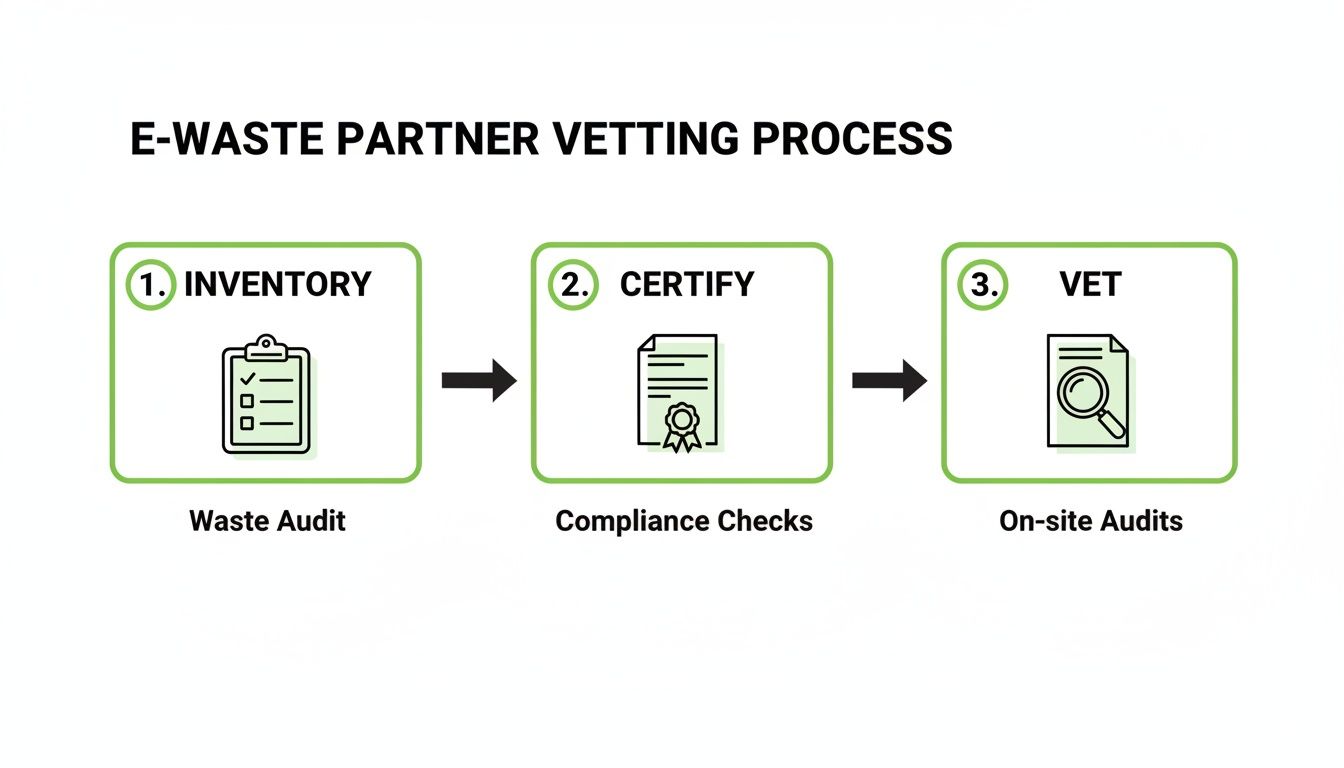
Vetting a partner to handle this process is the crucial first step. It starts with inventory, then verifying certifications, and finally, a deep dive into their specific procedures.
Meeting DoD and NIST Compliance Standards
When you're in a regulated industry, the standards for data destruction are not a suggestion—they're a requirement. Two of the most recognized benchmarks come directly from the U.S. government:
- DoD 5220.22-M: The Department of Defense standard involves overwriting data with specific patterns across multiple passes. This makes the original information virtually impossible to recover using standard tools.
- NIST 800-88: This more modern framework from the National Institute of Standards and Technology outlines three levels of sanitization—Clear, Purge, and Destroy—offering flexibility based on the media type and your security needs.
Following these standards isn't just a best practice; it's essential for complying with data privacy laws like HIPAA, Sarbanes-Oxley (SOX), and the Gramm-Leach-Bliley Act (GLBA). If you want to get into the technical weeds, you can learn more about what data sanitization entails in our detailed guide.
On-Site vs. Off-Site Destruction: A Practical Comparison
So, how does the actual destruction happen? You have two main options, and the right choice really boils down to your company's security policies, risk tolerance, and logistics.
On-Site Data Destruction
This is exactly what it sounds like. The destruction equipment comes right to your Atlanta facility. A mobile shredding truck, for example, allows your team to physically watch every hard drive and storage device get shredded to pieces before it even leaves your property.
- Key Benefit: Unbeatable security and peace of mind. The chain of custody is as short as it gets—you witness the destruction firsthand.
- Best For: Healthcare providers protecting patient data, financial firms with sensitive client records, and government contractors handling classified information.
Off-Site Data Destruction
With this option, your IT assets are securely packed and transported in a locked, GPS-tracked vehicle to a certified destruction facility. The entire process is managed under a strict, fully documented chain of custody from start to finish.
- Key Benefit: It's more convenient and cost-effective, especially for large-scale projects like a full office cleanout or data center decommissioning.
- Best For: Large corporate tech refreshes involving hundreds of devices or situations where bringing a shredding truck on-site just isn't practical.
No matter which path you take, the end result has to be the same: total data eradication, verified by documentation. A certified partner provides an unbroken audit trail, whether the destruction happens at your curb or at their facility.
The Certificate of Data Destruction: Your Proof of Diligence
The final, and perhaps most critical, piece of the puzzle is the Certificate of Data Destruction. This document is far more than a simple receipt. It is your official, legally defensible proof that you did your due diligence to protect sensitive information.
Think of it as your shield in an audit or legal inquiry. A proper certificate should be detailed and auditable, including:
- A unique serial number for the job
- A complete inventory of destroyed devices, down to their individual serial numbers
- The date and location where destruction took place
- The exact method used (e.g., shredding, degaussing)
- A statement confirming compliance with standards like NIST 800-88
Without this certificate, your electronic recycling in Atlanta program has a massive compliance hole. It's the final link that closes the chain of custody loop, transferring liability from you to your certified partner and giving you complete peace of mind.
From Pickup to Decommissioning: Handling the Logistics
Once your data is secure, the next piece of the puzzle is actually getting the old equipment out of your building. Moving sensitive IT assets can feel like a huge headache, but when you work with a professional partner, the logistics of electronic recycling in Atlanta become just another smooth, predictable part of your project plan.
Whether you're doing a simple office refresh or a massive data center takedown, it all starts with scheduling. A good recycler will always work around your schedule to keep your business running without a hitch. This could mean arranging a pickup after hours or over the weekend, ensuring your day-to-day workflow isn't disrupted at all.
What to Expect on Pickup Day
When our professional logistics team arrives at your Atlanta office, they won't just pull up in a truck. They'll have a clear plan, all the right gear, and a laser focus on security. Their first step is always to verify the inventory list you prepared against the actual assets being removed.
This simple cross-check is a vital step in maintaining a secure chain of custody. After everything is verified, the team gets to work professionally packing and transporting your equipment.
Here’s a quick look at what that involves:
- Secure Packing and Palletizing: Your equipment is carefully packed and stacked onto pallets, then tightly shrink-wrapped. This prevents any damage and makes sure no small parts get lost along the way.
- Professional Loading: Our crew does all the heavy lifting. They use proper equipment to safely load everything onto the truck without leaving a single scuff on your facility's walls or floors.
- Documented Transit: All assets are transported directly to our processing facility in a secure, GPS-tracked vehicle. This creates an unbroken chain of custody from your door right to ours.
Planning a Full Data Center Decommissioning
A data center decommissioning is a whole different ballgame compared to a standard office cleanout. These are complex projects that demand tight project management and careful coordination between your IT staff, facilities team, and your recycling partner.
A successful decommissioning project typically breaks down into a few key stages:
- Systematic Disconnection and De-racking: Our technicians will methodically power down and disconnect every server, storage array, and piece of networking gear.
- On-site Asset Tagging: Before anything is moved, every single component is inventoried and tagged right there on-site. This guarantees a perfect match with your initial audit.
- Coordinated Removal: The logistics team works hand-in-hand with your people to efficiently remove the de-racked equipment, often in planned phases to clear the data center floor systematically.
For a project of this scale, your recycling partner is more of a project manager than a hauler. We help you map out the entire process from start to finish, ensuring every piece of hardware is accounted for and handled exactly to your security and compliance standards.
Understanding the Costs of Electronic Recycling
One of the first questions we always get from Atlanta businesses is, "So, what's this going to cost?" A transparent partner will give you a clear, itemized breakdown right from the start. Many of our services are actually free, while a few specific ones might carry a fee.
Complimentary Services:
For most corporate clients, the service is completely free. We offer complimentary pickup for bulk quantities, which usually means projects with 50 or more qualified items like laptops, servers, or networking gear. In these cases, the value we recover from the assets is enough to cover all the logistics and processing costs. You can learn more about our free electronic recycling pickup service.
Services with Potential Fees:
Certain items require very specialized handling due to hazardous materials, which can lead to a disposal fee. These typically include:
- CRT Monitors: Those old, bulky tube monitors contain leaded glass. Processing them safely and in an environmentally sound way is a costly, specialized process.
- Specialized On-site Services: If you need premium services, like having a mobile hard drive shredder brought to your location for witnessed destruction, there's typically an associated cost.
- Consumer-Grade Items: Pickups that consist mostly of low-value, consumer-grade electronics might not qualify for our free service.
In the end, our goal is to make the physical side of electronic recycling in Atlanta completely seamless for you. By understanding the logistics, planning ahead for complex projects, and having a transparent view of the costs, you can be confident your retired IT assets are being moved securely and efficiently.
Turning E-Waste into Tangible ESG and CSR Wins

For many Atlanta businesses, managing old electronics is just another line item on the IT budget—a compliance task to be checked off. But what if that same process could become a cornerstone of your brand’s reputation?
When you partner with a mission-driven recycler, you're not just disposing of hardware. You’re turning a cost center into a powerful story for your Environmental, Social, and Governance (ESG) and Corporate Social Responsibility (CSR) goals. It's time to stop talking about disposal and start communicating real impact.
The key is to reframe the entire conversation. Instead of simply "recycling old tech," you can now tell a compelling story about “Turning E-Waste into Hope.” This approach ties the practical act of recycling to tangible, human outcomes that truly resonate with customers, employees, and investors alike.
Connect Your Recycling to a Cause
One of the most effective ways we've seen clients do this is through cause-based marketing. The message is simple but incredibly powerful: “Your old tech can house a veteran and grow a forest.” That emotional hook is what separates your brand from competitors who only talk about data security and compliance.
Here are a few ways to bring that to life:
- Host Seasonal Drives: Center donation drives around key dates like Veterans Day, Earth Day, or Arbor Day. These events create fantastic PR opportunities and give a natural call to action for both your internal teams and the broader Atlanta community.
- Create Impact Counters: Add a live tracker to your website or internal dashboards. Watching numbers climb for things like “1,245 veterans supported” or “3,700 trees planted” provides constant, transparent social proof of your company's commitment.
- Tell a Visual Story: Short videos are perfect for this. Showcasing real-world footage of veteran support programs or USDA reforestation efforts funded by your donations creates a connection that words alone can't match.
Make It an Easy ESG Win
For corporate leaders, ESG goals aren't just a talking point; they're a board-level priority. A dual-impact partnership for electronic recycling in Atlanta offers a straightforward and verifiable win. You can position your program as a ready-made solution for companies looking to meet their sustainability and social benchmarks.
Consider offering corporate recycling drives with free pickup for 50+ devices. The real value comes afterward when you provide two key assets for their reporting:
- A Plant-A-Tree Certificate detailing the exact number of trees planted in their company's name.
- A Veteran Support Impact Report summarizing how their recycled assets directly contributed to veteran aid programs.
These aren't just feel-good documents. They are concrete data points for annual sustainability and CSR reports, providing auditable proof that your company’s actions are creating measurable environmental and social good.
To make the connection even clearer, we've outlined how specific recycling actions translate directly into reportable ESG metrics.
How Your E-Waste Recycling Translates to ESG Impact
This table provides a clear guide for Atlanta corporations to connect their recycling activities with measurable outcomes for ESG reporting.
| Your Recycling Action | Environmental (E) Impact | Social (S) Impact | Governance (G) Impact |
|---|---|---|---|
| Securely recycling devices | Diverts hazardous e-waste from landfills and prevents soil/water contamination. | Demonstrates community leadership and responsible corporate citizenship. | Establishes a formal, documented policy for end-of-life asset management. |
| Donating a portion of recycling proceeds to tree planting | Directly funds reforestation, quantifies carbon offsets, and supports biodiversity. | Creates a positive brand story that engages eco-conscious employees and customers. | Provides clear metrics for sustainability reports (e.g., number of trees planted). |
| Using proceeds to support veteran housing programs | Turns obsolete assets into funding for critical social needs, helping at-risk communities. | Fosters employee pride and improves retention by linking work to a tangible social cause. | Shows stakeholders the company's commitment to social responsibility beyond its core business. |
| Receiving data destruction and impact certificates | Creates a verifiable chain of custody for all recycled assets and their resulting impact. | Protects community and customer data, preventing breaches that harm individuals. | Provides auditable documentation for compliance with data privacy and environmental laws. |
By tracking these actions, you're not just recycling—you're building a comprehensive ESG program backed by verifiable data.
To amplify this, we also provide a digital “Recycled with Purpose” eco-badge. Partners can place this on their websites and in sustainability reports to immediately signal their commitment. To see how this fits into a bigger picture, you can learn more about the broader benefits of e-waste recycling.
Keep Your Community and Customers Engaged
The final step is to turn one-time recyclers into long-term advocates for your brand. This happens through consistent and meaningful engagement, where every interaction is a reminder of the good they helped create.
Start by automatically emailing personalized Impact Certificates after every pickup. A simple, direct message like, “Thank you, your contribution helped plant 3 trees and support 1 veteran,” transforms a routine transaction into a moment of shared purpose.
You can also build a community around your cause with these simple tactics:
- Start a Referral Program: Reward companies or individuals who refer new partners by planting an extra tree in their name.
- Share an Impact Newsletter: Send out monthly updates with real stories of the veterans you’ve helped and show visual progress on reforestation projects.
- Publish on LinkedIn: Post case studies showing how specific Atlanta-based clients used your services to hit their ESG targets. This acts as both social proof and a clear roadmap for other local businesses.
By weaving these strategies together, your electronic recycling in Atlanta program becomes more than a service—it becomes a core part of your brand identity, defined by purpose, action, and genuine community impact.
Your E-Waste Recycling Questions Answered
When you're responsible for your company's old tech, you're bound to have questions. You need to know your data is safe, the process is compliant, and the logistics make sense. We get it.
Here are the straightforward answers to the questions we hear most from Atlanta businesses about getting started with our dual-impact recycling programs.
What Types of Electronics Do You Actually Recycle?
We handle the full range of corporate IT assets, specializing in complete office and data center cleanouts. If it was part of your company's tech infrastructure, chances are we can take it.
We routinely process:
- Data Center Hardware: Servers, networking gear, storage arrays, and UPS systems.
- Office Equipment: Computers, laptops, LCD/LED monitors, and peripherals like keyboards and mice.
- Communications Devices: Business phones, mobile devices, and all the associated cabling.
While we can’t accept household appliances or loose consumer batteries, the best first step is always to just ask. Send us your inventory list, and our team will quickly confirm what we can take and help you find the right disposal path for anything we can't.
How Can We Be Certain Our Sensitive Data Is Destroyed?
This is the most critical question, and for us, data security is everything. We know protecting your company's sensitive information is absolutely non-negotiable.
Our data destruction methods meet or exceed strict DoD and NIST standards, which ensures your information is gone for good and completely unrecoverable. We offer the flexibility of on-site destruction right at your Atlanta facility or secure processing at our own.
For every single project, we issue a formal Certificate of Data Destruction. This is your official, auditable proof of compliance with regulations like HIPAA, SOX, and GDPR. It’s the document that protects your company from liability and gives you total peace of mind.
What Is the Cost for Electronic Recycling in Atlanta?
For most of our corporate partners, the service is completely free. We provide complimentary pickup for qualifying bulk quantities, which is typically 50 or more items such as laptops, servers, or networking equipment.
There are only a few situations where a fee might apply:
- Items with Special Handling: Older, hazardous equipment like CRT monitors requires a very specific and costly disposal process.
- Premium On-site Services: If you need specialized services like on-site hard drive shredding, this may involve a fee to cover our team and equipment.
We're big believers in total transparency. You’ll always get a clear, upfront quote before we begin, so there are absolutely no surprises. You can also learn more about which electronics are accepted at different recycling points in our guide on where to recycle electronics.
How Does This Program Specifically Support Veterans and the Environment?
This is what makes our work so unique. We built our entire model around a dual mission: we don't just recycle old electronics, we transform them into real, tangible good for our community and our planet.
A portion of the value we recover from your retired IT assets goes directly to funding programs that provide critical support and aid to veterans. At the same time, we partner with certified reforestation organizations to plant trees in your company's name, helping to restore vital ecosystems.
After your pickup is complete, you’ll receive a personalized Impact Certificate. This document outlines your exact contributions—the number of veterans you've helped support, the number of trees planted—giving you a powerful story to share in your ESG and CSR reports. Your e-waste becomes a genuine testament to your company's commitment to doing good.
Ready to turn your old IT equipment into a powerful force for good? Partner with Atlanta Green Recycling for secure, compliant, and impactful electronic recycling. We make it easy for Atlanta businesses to protect their data, meet sustainability goals, and support our community's veterans and environment with every device. Schedule your free pickup and get your transparent quote today at https://www.greenatlanta.com.