
E-Waste Recycling in Duluth That Restores Lives and Landscapes

Figuring out how to handle electronics disposal in Duluth can feel like a headache, but it's a huge deal for our community's environmental health. This guide is here to cut through the confusion and give you a clear, straightforward path for responsible e-waste recycling in Duluth. Whether you're dealing with one old laptop or an entire office full of outdated IT gear, you'll get the practical advice you need to get the job done safely.
The Growing Pile of E-Waste in Duluth
It’s no secret that discarded electronics, or e-waste, are one of the fastest-growing types of waste on the planet, and Duluth is right there in the mix. From old TVs and computers to smartphones and kitchen gadgets, these items are packed with both valuable materials we can recover and hazardous stuff that can seriously harm our local environment if it ends up in a landfill.
Getting this right is about more than just clearing out clutter; it's a fundamental part of being a good steward for our community and the environment. Proper recycling ensures that harmful elements like lead and mercury stay out of our soil and water. At the same time, it allows us to reclaim precious metals, which means less need for destructive mining practices.
What This Looks Like Locally
The scale of the problem really hits home when you look at the numbers. To get a sense of local impact, we can look at the state average, which sits around 46 pounds of e-waste per person annually. That adds up fast.
This is why facilities like the Western Lake Superior Sanitary District (WLSSD) Materials Recovery Center on Rice Lake Road are so important. They are on the front lines, accepting computers, TVs, tablets, and all sorts of accessories to keep hazardous materials out of our local landfills. For a deeper dive, you can always check out the state's latest findings on e-waste generation.
When you choose to recycle your e-waste the right way, you're doing more than just tossing old tech. You're taking an active role in a circular economy—one that conserves resources, protects our health, and helps build a cleaner future for the Northland.
We built this guide to give you the knowledge you need to make smart, informed decisions. We'll walk through everything from securing your personal data before recycling to finding the best local options for your specific items. The goal is to make e-waste recycling in Duluth an easy, accessible, and positive step for every single resident and business.
To give you a quick snapshot of the local situation, here are some key facts about e-waste in our area.
Duluth E-Waste Quick Facts
| Metric | Statistic or Information |
|---|---|
| Average E-Waste Per Person | Approx. 46 pounds annually in Minnesota |
| Key Local Drop-Off Facility | WLSSD Materials Recovery Center |
| Common Hazardous Materials | Lead, Mercury, Cadmium, BFRs |
| Common Recoverable Materials | Gold, Silver, Copper, Palladium |
| Data Security Concern | High – Data destruction is critical for businesses and individuals |
| Primary Local Regulation | Minnesota Electronics Recycling Act |
These numbers highlight why a structured approach to recycling isn't just a good idea—it's essential for protecting our local environment and keeping sensitive data secure.
Getting Your Electronics Ready for Safe Disposal
Before you hand over that old company laptop or stack of office phones, a little prep work is in order. This isn't just about being tidy; it's about protecting sensitive business data and making the e-waste recycling process here in Duluth as smooth as possible. Think of it as a final sign-off before your old gear starts its new life as recycled materials.
The absolute first thing you need to tackle is data. Your devices are packed with information—client lists, financial records, employee details, proprietary documents. Just handing them over as-is is a massive security risk you can't afford to take.
Secure Your Digital Footprint First
Start by creating a complete backup of any data you need to hang onto. You can use a cloud service or simply transfer everything to an external hard drive. Once you're confident you've saved what you need, it's time to wipe the device completely clean.
For mobile devices like phones and tablets, a factory reset is your go-to move. This reverts the device to its original out-of-the-box state, clearing your apps, files, and settings. You'll usually find this option buried in the "Settings" menu.
Computers, on the other hand, need a more robust approach. A factory reset is a good first step, but determined individuals can sometimes still recover sensitive files. For business computers holding critical information, your best bet is to use professional data destruction software. These tools overwrite the hard drive multiple times, making the original data virtually impossible to get back.
We break down all these methods in our complete guide to prepare your electronics for recycling, which gets into the nitty-gritty of both personal and business-level data destruction.
This simple flowchart shows how data security is the essential first step in the process.
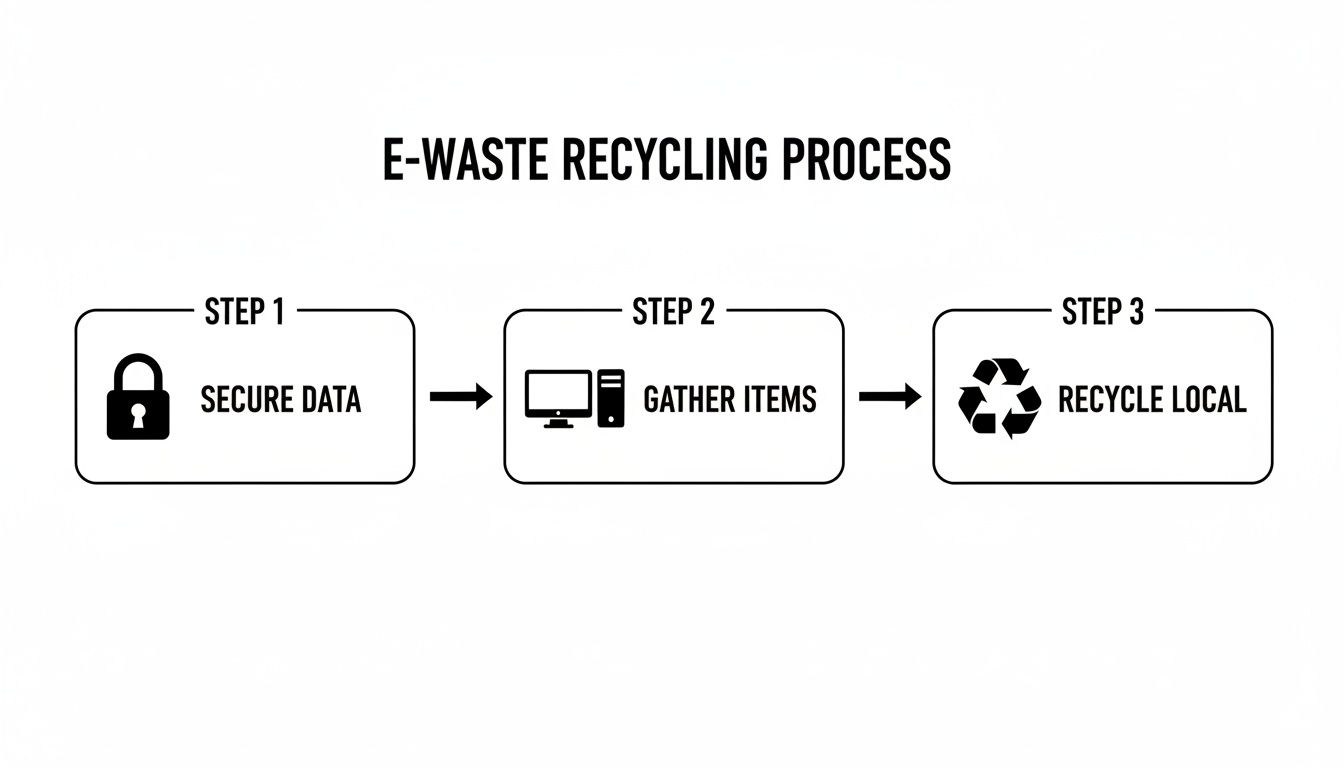
As you can see, securing your data comes before you even start gathering the physical items for recycling.
Organize Your Items for a Smooth Handoff
With your data securely wiped, it's time to get the physical gear ready. This simple step helps recycling centers like the WLSSD facility work more efficiently and ensures you're not leaving anything important behind. An organized pickup is a fast pickup.
We recommend creating a quick inventory of what you're recycling. This is especially useful for businesses that need to track assets for their books, but it also helps homeowners get a sense of any potential fees for items like monitors or TVs.
Next up, round up all the accessories that go with each device. We're talking about:
- Power Cords and Chargers: These contain valuable copper and should always be recycled with the device.
- Keyboards, Mice, and Webcams: Keep these peripherals with their corresponding computers.
- Remote Controls: Don't forget the remote for that old conference room TV.
- Manuals and Discs: Not critical, but it helps to keep everything bundled together.
Use a few zip ties or rubber bands to keep cords from turning into a tangled mess. If you have a large batch of equipment, it's a good idea to box up each workstation (computer, keyboard, mouse, cords) together. It's a small organizational step that makes a huge difference on our end.
Finding the Right Recycling Option in Duluth
Alright, you’ve got your old electronics sorted and ready to go. Now, where do you take them? Finding the best spot for e-waste recycling in Duluth really depends on what you have, how much of it there is, and what’s most convenient for you. Luckily, the city and surrounding area have some solid, reliable options.
For most folks and small businesses in the area, the main destination is going to be the Western Lake Superior Sanitary District (WLSSD).
The WLSSD Materials Recovery Center
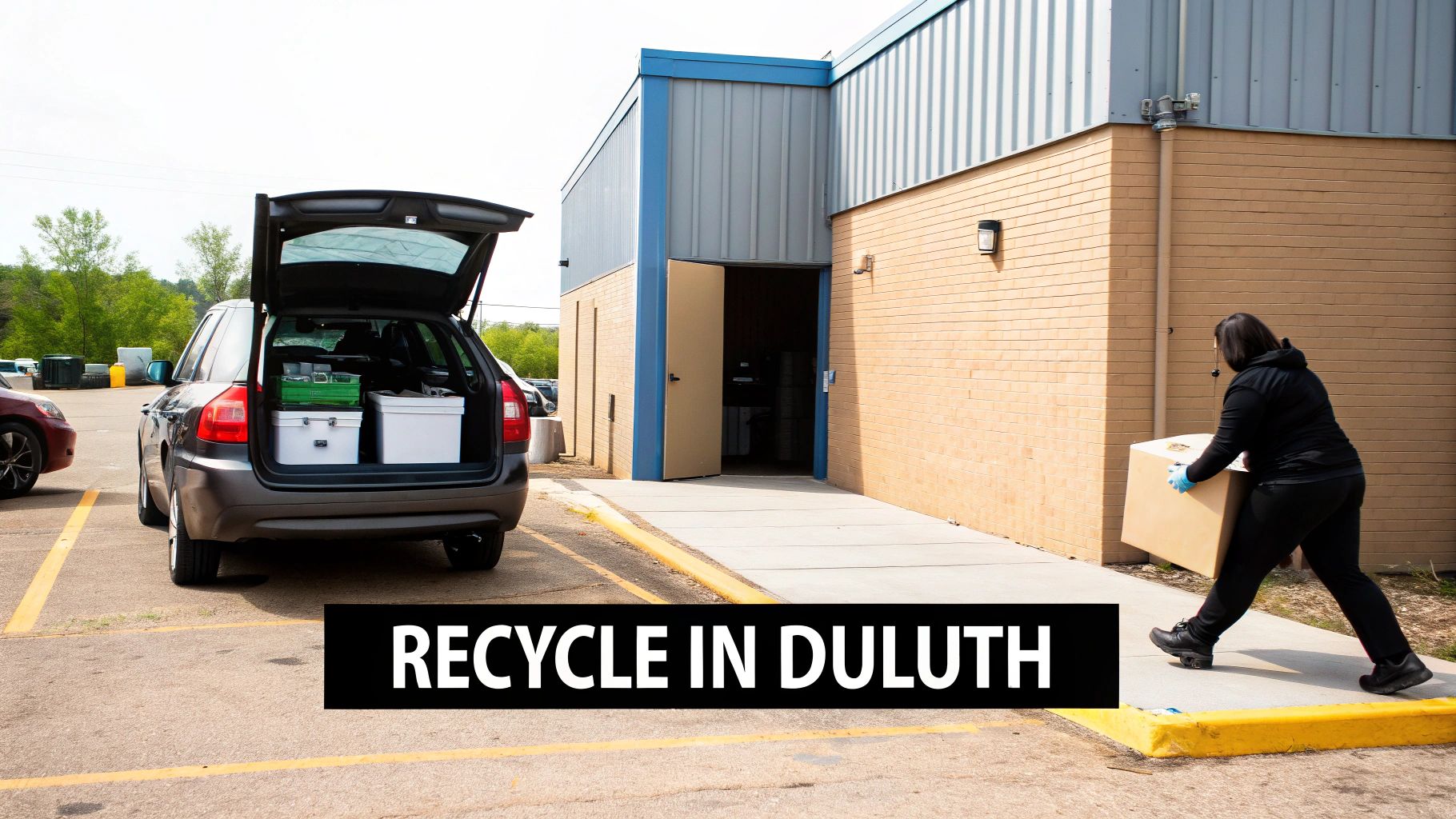
If you’ve ever had to get rid of anything more than your standard household recycling, you’re probably familiar with the WLSSD facility on Rice Lake Road. It’s our community’s central hub for all kinds of materials, and they run a tight ship when it comes to e-waste. They make sure all the hazardous stuff is handled safely and valuable materials get recovered.
Here's the essential info you need before heading over:
- Location: 4587 Rice Lake Road, Duluth, MN.
- Accepted Items: They take just about everything. Computers, monitors, TVs, printers, phones, keyboards—you name it. Even small things like random cords and mice are welcome.
- Fee Structure: While many smaller items are free to drop off, you can expect to pay a fee for larger, more complex electronics like TVs and old CRT monitors. These fees are necessary to cover the intensive labor and cost of safely dismantling them. It’s always smart to check the official WLSSD website for their current fee schedule before you load up the car.
- Operating Hours: Public drop-off hours can vary, especially with the seasons. A quick look online or a phone call can save you from showing up to a closed gate.
Using a certified facility like WLSSD is a bigger deal than you might think. Minnesota as a whole generates a staggering 266 million pounds of e-waste every year, but we only manage to recycle about 23.7% of it. That means an estimated $2.8 billion in valuable metals is just sitting in our landfills. On a global scale, the problem is even bigger: of the 53.6 million metric tons of e-waste produced, only 17% is properly recycled. Every local effort truly makes a difference. You can discover more about the global e-waste challenge and its huge economic impact.
Retailer Take-Back Programs
For smaller gadgets, you don't always need to plan a special trip to a disposal facility. Many of the big national retailers right here in Duluth have excellent take-back programs that make recycling super convenient.
Best Buy is a fantastic example. Their program is one of the most comprehensive out there, and they'll take a huge variety of old tech, even if you didn't buy it from them in the first place. This is the perfect solution for things like:
- That tangled mess of old charging cables
- Old cell phones and tablets
- Laptops, keyboards, and mice
- Video games and consoles
These programs are great for managing the constant trickle of outdated tech we all accumulate. It makes doing the right thing as easy as running your usual errands.
Pro Tip: I keep a small box in my garage labeled "Dead Tech." Whenever a cable, mouse, or old phone bites the dust, it goes in there. Once the box is full, I can drop it all off at Best Buy or WLSSD in one simple trip instead of letting it clutter up my drawers.
Community Collection Events and Mail-In Programs
Beyond the year-round drop-off spots, always keep an eye out for special collection events. Local non-profits, community groups, and sometimes the city itself will host e-waste drives, especially around Earth Day in the spring. Co-hosting recycling drives with veteran groups like VFW chapters or environmental NGOs is a powerful way to engage the community. They’re usually well-publicized and are a great way to clear out your old electronics while supporting a good cause.
If you have highly specialized or valuable equipment, a certified mail-in program might be your best bet. These services are particularly helpful for businesses with proprietary hardware or for anyone with unique items that local spots might not be equipped to handle. They provide secure packaging and a documented chain of custody all the way to the recycling plant. To see what's out there, you can explore various specialized services and other options in our guide on where to recycle electronics. Choosing the right channel is key to ensuring your old technology is handled the right way.
Why Your Old Tech Deserves a Better Fate
When an old office printer finally gives up or a server becomes obsolete, the easiest path often seems to be the nearest dumpster. But that convenience comes with a steep, hidden cost—one that affects the health of our local Duluth environment and wastes an incredible amount of valuable resources.
Your old electronics are far more than just plastic and glass. They contain a cocktail of hazardous materials that have no business being in a landfill, where they can cause serious, long-term problems.
The Unseen Environmental Dangers
Improperly disposed electronics can leach a host of toxic substances directly into the ground. Over time, these materials find their way into our groundwater, threatening local ecosystems and potentially our drinking water.
Some of the most common culprits lurking inside your old tech include:
- Lead: Found in the glass of older CRT monitors and on circuit boards, lead is a potent neurotoxin.
- Mercury: Used in flat-screen displays and some batteries, mercury can cause severe damage to the nervous system and kidneys.
- Cadmium: A common component in rechargeable batteries and semiconductors, cadmium is a known carcinogen.
Choosing responsible e-waste recycling in Duluth creates a firewall between these hazardous materials and our environment. Certified recyclers are equipped to safely extract and contain these elements, preventing them from ever causing harm. For a deeper dive, check out this breakdown of the environmental impact of electronic waste.
Unlocking the Treasure Within Your Tech
Beyond the risks, your discarded electronics hold a surprising amount of value. Buried inside circuit boards and connectors are small but significant quantities of precious metals. The process of recovering these materials is often called "urban mining," and it’s a critical part of a sustainable future.
Think about it: every fleck of gold or sliver of silver recovered from a recycled device is metal that doesn't have to be extracted from the earth. Traditional mining is an energy-intensive and environmentally destructive process. Urban mining closes the loop.
This isn't a small-scale effort; the numbers are staggering. A 2023 pilot study on electronic waste in Minnesota revealed that while the state produces an estimated 266 million pounds of e-waste each year, only 23.7% is captured for recycling. That leaves a potential $2.8 billion worth of valuable metals sitting in landfills.
Every device you recycle is a direct contribution to resource conservation. It reduces our reliance on new mining, saves energy, and cuts down on the greenhouse gas emissions associated with manufacturing new components from scratch.
Connecting Local Actions to Global Impact
So, what does this mean for you here in Duluth? It means every time you schedule a pickup for your business's outdated IT assets, your impact ripples far beyond our city limits. Through our partnerships, your old tech can help house a veteran and grow a forest.
That old server from your office isn't just waste; it’s a repository of valuable commodities.
- Gold and Silver: Used in tiny amounts on circuit boards for their excellent conductivity.
- Copper: Found in wiring, connectors, and heat sinks.
- Palladium: A rare metal used in capacitors and other small components.
- Aluminum and Steel: Make up the cases and frames of most devices.
When you multiply these small amounts by the thousands of devices recycled each year, the collective benefit is immense. Your decision to recycle responsibly here in Duluth directly supports a global circular economy, helping build a more sustainable supply chain for the next generation of technology. It’s a simple action with a powerful, lasting effect.
Corporate E-Waste Solutions for Duluth Businesses
For businesses, schools, and healthcare facilities across Duluth, managing old electronics is a different ballgame than a residential drop-off. When your organization is swapping out 100 workstations or clearing out an entire server room, the challenges around logistics, data security, and compliance stack up fast. This is exactly where bringing in a professional e-waste recycler becomes less of a convenience and more of a strategic necessity.
A professional service turns a complex, risky task into a smooth, documented process. We offer businesses free pickup for 50+ devices, turning an operational headache into an easy ESG win for your company. Imagine pulling your IT staff off their jobs to wipe drives, load heavy equipment, and burn hours driving to a drop-off. A specialized partner handles it all, from on-site data destruction to asset tracking and transportation.
Moving Beyond Drop-Offs to a Strategic Partnership
While facilities like WLSSD do a great job for residents, businesses in Duluth have a whole different set of needs. Professional e-waste recycling services are built from the ground up to handle these corporate requirements, offering a range of services that a public drop-off simply can't match. This kind of partnership ensures your business stays compliant, keeps its data secure, and operates in an environmentally responsible way.
Here’s what a professional partnership really brings to the table:
- Bulk Pickups and Logistics: We’re talking scheduled, on-site removal of any amount of equipment, whether it’s a single office cleanout or a full data center decommissioning.
- Certified Data Destruction: This is the big one. Services that meet tough regulatory standards like HIPAA, FACTA, and GLBA, making sure your sensitive corporate and client data is gone for good.
- Detailed Documentation: You get official Certificates of Destruction and Recycling, giving you a clear paper trail for audits and compliance records.
- Asset Tracking: We can track assets by serial number from the moment they leave your facility to their final disposition, providing an unbroken chain of custody.
Bolster Your Company's ESG and CSR Profile
In today's world, a real commitment to environmental, social, and governance (ESG) principles can set you apart. Having a formal e-waste policy is a concrete way to strengthen your corporate social responsibility (CSR) profile. It tells your clients, partners, and employees that your organization takes data security and environmental stewardship seriously.
Properly managing e-waste helps your company:
- Hit Sustainability Goals: When you recycle with us, we deliver Plant-A-Tree certificates and Veteran Support Impact Reports for your CSR documentation.
- Reduce Risk: Professional data destruction wipes out the risk of a devastating—and expensive—data breach from a forgotten hard drive.
- Strengthen Brand Reputation: Showing you're committed to responsible practices can help you attract top talent and customers who care about corporate ethics. Partners can even display our “Recycled with Purpose” digital badge.
To make the choice clearer, we've put together a quick comparison of the two main approaches for e-waste recycling in Duluth.
Comparing DIY vs. Professional E-Waste Recycling for Businesses
Deciding how to handle your company's retired electronics comes down to balancing internal resources against risk and compliance. A public drop-off might seem straightforward for a couple of items, but the equation changes quickly as volume and data sensitivity increase. Here’s a breakdown of what to expect from each option.
| Feature | DIY Drop-Off (e.g., WLSSD) | Professional Recycling Service |
|---|---|---|
| Data Security | Relies on your internal team to wipe devices; no formal certification. | Certified data destruction (wiping/shredding) with auditable proof. |
| Logistics | You are responsible for packing, transporting, and unloading all equipment. | Scheduled, on-site pickup with professional packing and removal services. |
| Volume Handling | Best for small quantities; impractical for large-scale IT upgrades. | Designed for bulk disposals, including entire office or data center clear-outs. |
| Compliance | No formal documentation provided for your audit trail. | Issues Certificates of Destruction and Recycling to meet regulatory needs. |
| Asset Management | No tracking or inventory services are offered. | Provides serialized asset tracking and reporting for internal records. |
| Cost | Fees are charged per item (e.g., monitors, TVs) plus internal labor costs. | Often cost-neutral or even value-positive through IT asset remarketing programs. |
By working with a certified recycler, your business can turn a compliance headache into a clear ESG win. You get the confidence that your data is secure, your legal duties are covered, and your old tech is being handled responsibly.
Ultimately, choosing a professional service is an investment in security, efficiency, and your company's reputation. For any business managing more than just a handful of devices, a dedicated partner is the smartest path forward.
For a deeper dive into managing large-scale disposals, check out our full guide on IT asset disposition in the Duluth area.
Common Questions About E-Waste Recycling in Duluth
When it comes to e-waste recycling, a lot of questions pop up. It doesn't matter if you're a homeowner finally clearing out that drawer of old phones or a business managing a major IT hardware refresh—getting clear answers is the key to doing it right.
Here are a few of the most common questions we get about e-waste recycling in Duluth.
What Happens to My Data When I Recycle Electronics?
This is, without a doubt, the number one concern we hear, and for good reason. The security of your personal or company data hinges on the steps you take before that old device leaves your hands.
Public drop-off sites like the WLSSD are great for the physical recycling part, but they make it clear that data security is your responsibility. They strongly recommend you wipe all your personal devices clean before you bring them in.
For any business or individual with sensitive information, this is where professional recyclers come in. We offer certified data destruction, using methods like multi-pass wiping or even physical shredding that meet tough government and industry standards.
The real value of professional services is peace of mind. You get official documentation, like a Certificate of Destruction, which serves as your legal proof that the data was securely and permanently destroyed.
Are There Free E-Waste Recycling Options in Duluth?
While "free" is always nice, responsible e-waste recycling is a complex and labor-intensive process. The small fees you see at facilities like WLSSD are necessary to cover the real costs of safely dismantling electronics and properly managing hazardous materials like lead and mercury.
That said, you can still find some free options for certain items:
- Retailer Programs: Big box stores like Best Buy often have programs where you can drop off smaller electronics—think cables, keyboards, and old cell phones—at no cost.
- Community Events: Keep an eye on the calendar for city-sponsored or non-profit collection drives. They sometimes offer free recycling for specific types of electronics.
When you're dealing with larger quantities, need guaranteed data security, or have business-level needs, investing in a professional service is the most secure and efficient way to go. You can learn more by checking out these common e-waste questions answered in our comprehensive guide.
Can My Business Schedule an E-Waste Pickup?
Yes, absolutely. This is one of the main things that separates a consumer drop-off from a professional recycling partner. Certified e-waste management companies that serve the Duluth area specialize in commercial logistics and will schedule on-site pickups that work for you.
This kind of service is perfect for things like:
- Large-scale office cleanouts
- Systematic IT hardware upgrades
- Decommissioning data centers or server rooms
The entire process is designed to handle bulk equipment safely and securely, all with minimal disruption to your day-to-day operations.
What Are the Biggest E-Waste Recycling Mistakes to Avoid?
A few common missteps can cause some serious headaches. The most critical mistake is simply failing to wipe your data before recycling. This exposes you, your employees, or your customers to totally unnecessary security risks.
Another big one is "wishcycling"—tossing old electronics into your regular curbside recycling bin. This contaminates the entire recycling stream. Even worse, it's a fire hazard. Those lithium-ion batteries can and do ignite at sorting facilities.
Finally, always vet your recycler. Be wary of uncertified operators who might offer a suspiciously low price. They could be exporting your e-waste illegally, which causes massive environmental damage in other countries and leaves your data completely exposed. Stick with trusted, certified professionals to make sure the job is done right from start to finish.
Ready to ensure your company's retired IT assets are handled securely, responsibly, and in full compliance? Atlanta Green Recycling offers comprehensive, turnkey solutions for businesses, from on-site data destruction to certified recycling with a full audit trail. Let us help you turn your e-waste challenges into an ESG success story. Schedule your business pickup today.