Corporate computer recycling: Boost ESG and Security for Your Business


Getting rid of old corporate computers used to be a simple IT cleanup task. Today, it’s a strategic business decision that directly impacts your brand, security, and bottom line. With technology upgrades happening faster than ever, the mountain of electronic waste is growing, creating both a compliance headache and a massive opportunity for companies to stand out, especially here in Atlanta.
Why Computer Recycling Is A Core ESG Strategy
A well-planned computer recycling program is far more than just clearing out a storage closet. It’s a visible, tangible commitment to sustainability that resonates with customers, investors, and your own team. Think about it: properly managing your e-waste keeps hazardous materials like lead and mercury out of local landfills and water supplies. This is a huge factor in the "Environmental" pillar of ESG (Environmental, Social, and Governance) reporting.
There's a whole world of positive impacts that come from this simple act. You can learn more about the environmental and social upsides by exploring the many benefits of e-waste recycling.
Turning E-Waste Into A Brand Asset
For Atlanta companies, partnering with a local recycling provider can take this impact to the next level. Instead of seeing recycling as just another operational cost, you can reframe it as a way to do good in the community. What if your old servers and laptops could help fund local veteran support programs or even contribute to reforestation projects right here in Georgia? This approach turns your IT asset disposal into a powerful story you can share with messaging like, “Your old tech can house a veteran and grow a forest.”
It's not just recycling; it's a narrative that fits perfectly into:
- Annual ESG and CSR Reports: Give your stakeholders concrete data on your company’s positive community and environmental footprint with Veteran Support Impact Reports.
- Marketing and PR Campaigns: Connect with your audience on an emotional level. A "Recycle for a Cause" drive around Earth Day or Veterans Day is a perfect example. Pitch stories to outlets like the Atlanta Journal-Constitution about your dual-impact model.
- Employee Engagement Initiatives: Show your team that their company is making a real-world difference. This is a huge morale booster.
The global electronic waste recycling market is expected to hit a massive USD 80,432.8 million by 2025. This growth is fueled almost entirely by corporations phasing out old tech. With North America making up 37% of that market, the sheer scale of corporate IT disposal is impossible to ignore. You can find the full research on the growing e-waste market here.
The New Standard For Corporate Responsibility
At the end of the day, a thoughtful corporate computer recycling program isn't just a "nice-to-have" anymore—it's essential. When you work with a partner who provides detailed impact reports, like certificates for trees planted or summaries of veteran support, you transform a routine task into a strategic asset. By targeting keywords like “Atlanta tech recycling” and “corporate sustainability electronics disposal,” you not only find the right service but also signal your commitment to modern corporate citizenship.
You’re not just getting rid of old equipment. You're investing in your community, protecting the planet, and building a brand that stands for something more than just profit.
Building Your Corporate ITAD Program
Shifting your company's approach to old technology from a simple cleanup job into a structured program requires a real blueprint. A solid IT Asset Disposition (ITAD) program is about more than just logistics; it’s a strategic framework that shields your data, keeps you compliant, and reinforces your brand's commitment to corporate responsibility. The idea is to build a repeatable, auditable process that your team can run like clockwork.
Your very first move should be to establish a formal internal policy. This document needs to be the single source of truth for how your organization handles retired electronics. It should clearly map out asset lifecycle stages, assign specific roles and responsibilities, and set the bar for data security and environmental disposal. A well-written policy eliminates guesswork and ensures everyone knows their part in protecting company assets.
To get a better handle on the basics, it’s worth exploring what IT asset disposition really means.
Conducting A Thorough Asset Inventory
Before you can get rid of anything, you have to know exactly what you have. A detailed asset inventory is the bedrock of any successful ITAD program. This isn't just a quick count—it means creating a meticulous log of every single device heading for retirement, capturing crucial details needed for tracking and documentation down the line.
Your inventory spreadsheet or system should track:
- Asset Type: (e.g., laptop, desktop, server, monitor, mobile phone)
- Serial Number: The unique identifier for each device.
- Asset Tag: Your company’s internal tracking number.
- Location: The department or office where the asset was last used.
- Condition: (e.g., functional, non-functional, damaged)
Getting this initial data capture right is absolutely critical for maintaining a secure chain of custody. It guarantees that every device is accounted for from the second it leaves your control until its final disposition is confirmed in a report.
Establishing Data Destruction Protocols
Let's be clear: the biggest risk in corporate computer recycling isn't the hardware—it's the sensitive data living on it. Your ITAD policy must mandate strict data destruction protocols that are aligned with recognized industry standards. For any business in a regulated field like healthcare or finance, this isn't just a good idea; it's non-negotiable.
The gold standard for data sanitization is the NIST 800-88 "Guidelines for Media Sanitization." This framework provides proven methods for clearing, purging, and physically destroying data to make it completely unrecoverable. Your program needs to specify exactly which method is required for different types of data-bearing devices.
This visual really captures how a simple cleanup task can evolve into a strategic ESG initiative and, ultimately, a powerful brand asset.
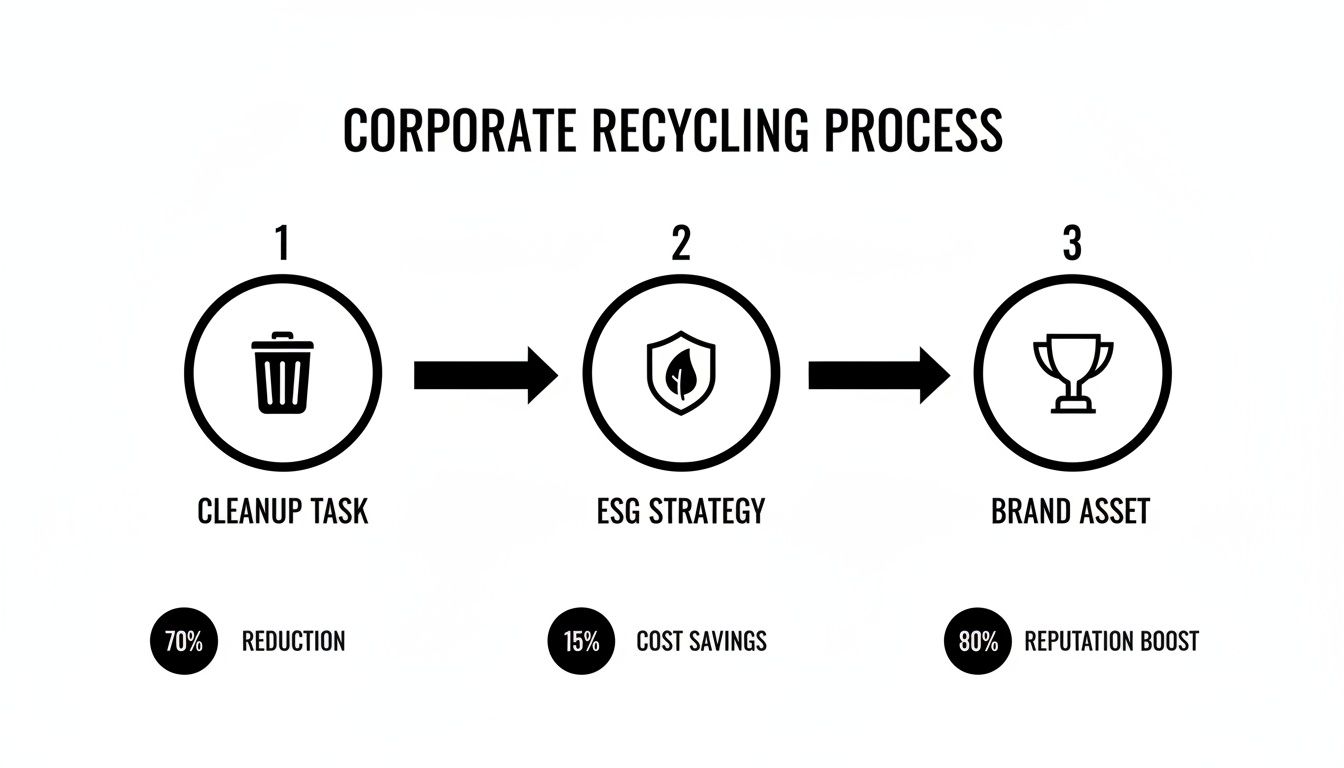
The key takeaway here is that a structured program elevates recycling from a necessary cost to a value-generating activity that polishes your corporate image.
Managing Logistics And Scheduling
With your policy, inventory, and data protocols locked in, the final piece of the puzzle is logistics. At the end of the day, your program has to be practical for your team to actually use. Think through the different scenarios your business will face and plan for them.
For a huge office refresh involving hundreds of devices, scheduling a bulk pickup with your recycling partner makes the most sense. This allows for a single, coordinated effort where assets are de-installed, inventoried on-site, and securely transported all at once. For more routine, smaller-scale disposals, an on-demand service might be a better fit, letting you clear out equipment as it hits its end-of-life without waiting for a massive pileup.
To tie it all together, the entire process can be broken down into a few essential stages.
Key Stages of a Corporate Recycling Program
This table summarizes the core components needed to build a program that is secure, compliant, and efficient.
| Stage | Key Actions | Primary Goal |
|---|---|---|
| Policy Creation | Define rules for asset retirement, data security, and vendor selection. | Establish a compliant and consistent framework. |
| Asset Inventory | Log all devices for disposal with serial numbers and asset tags. | Create a complete and auditable record. |
| Data Sanitization | Execute data wiping or physical destruction per NIST standards. | Mitigate data breach risks and ensure security. |
| Logistics | Schedule secure pickup and transportation of assets. | Ensure a secure and documented chain of custody. |
| Documentation | Receive Certificates of Destruction and Recycling from your partner. | Provide proof of compliance for audits and ESG reports. |
By building a program around these foundational components, Atlanta businesses can navigate the complexities of corporate computer recycling with confidence. The result is a secure, compliant, and streamlined workflow that not only protects your company but also demonstrates a genuine commitment to environmental and social responsibility.
Choosing The Right E-Waste Partner In Atlanta
Picking a partner for your corporate computer recycling is so much more than a simple logistics call—it’s a decision that directly impacts your brand’s reputation and data security. The right vendor isn't just a pickup service; they are a vital extension of your risk management strategy. For businesses here in Atlanta, that means finding a local partner who can turn your retired IT assets into a secure, compliant, and powerful ESG win.
Making the wrong choice can have devastating consequences, from crippling data breach fines and brand damage to steep environmental penalties. When you're vetting potential partners, it’s absolutely critical to implement effective strategies for third-party risk management. This isn't just corporate jargon; it's about protecting your organization from liabilities you might not even see coming.
Non-Negotiable Certifications
First things first: your search should only include recyclers holding top-tier industry certifications. These aren't just fancy logos for their website; they are your best defense against compliance failures and environmental negligence. The two big ones you need to demand are R2 (Responsible Recycling) and e-Stewards.
- R2 Certification: This standard covers the entire lifecycle of electronics, ensuring everything from worker health and safety to data security and responsible handling of materials downstream. An R2-certified partner gives you peace of mind that your e-waste won't be illegally exported or dumped in a landfill.
- e-Stewards Certification: Often seen as the most stringent standard out there, e-Stewards has a zero-tolerance policy for exporting hazardous electronic waste to developing countries and using prison labor. It truly represents the gold standard in environmental protection.
Insisting on at least one of these certifications is the fastest way to weed out unqualified vendors. It ensures your company's recycling efforts are genuinely doing good.
A Secure And Documented Chain Of Custody
The moment your equipment leaves your building, you need an unbroken, documented trail proving where it went and how every single piece was handled. This is what we call the chain of custody. A trustworthy partner provides detailed documentation at every step, from the initial pickup all the way to final disposition.
This process should start the moment they walk through your door. Their team should perform a serialized asset inventory on-site, handing you a receipt before the truck even pulls away from your loading dock. That initial document is your first piece of evidence that the transfer of custody was secure and accounted for.
Key Takeaway: An undocumented chain of custody is a massive red flag. Without a clear paper trail, you have no verifiable proof that your sensitive data was destroyed or that your assets were recycled in compliance with the law. That leaves you dangerously exposed during an audit.
Turning Compliance Into A CSR Win
Beyond just security and compliance, the best e-waste partners in Atlanta offer something more: a way to transform your recycling program into a compelling ESG story. You should be looking for vendors who provide detailed impact reporting that goes far beyond a standard certificate of destruction. This is an easy win for your company’s ESG and CSR benchmarks.
Imagine getting documentation you can plug directly into your annual CSR report. This could look like:
- Plant-A-Tree Certificates: Tangible proof of your company’s contribution to reforestation efforts.
- Veteran Support Impact Reports: Summaries detailing how the value recovered from your assets helped support local veterans.
- Eco-Badge Certification: A digital badge like “Recycled with Purpose” that you can proudly display on your website and in sustainability reports.
This level of reporting turns a vendor relationship into a true strategic partnership. Your corporate computer recycling program stops being a cost center and becomes a powerful, measurable tool for building your brand's reputation. Finding the right local partner is key, and our guide to the top e-waste disposal companies in Atlanta can help you pinpoint vendors who deliver on these high standards.
When your partner provides this kind of value, your ITAD program becomes a source of authentic, positive stories that resonate with customers, employees, and investors.
Navigating Data Security And Compliance
When it comes to corporate computer recycling, the biggest liability isn't what you pay for pickup. It's the mountain of sensitive data sitting on all those retired hard drives. A single data breach can spiral into crippling financial penalties, drawn-out legal fights, and an irreversible loss of your customers' trust.
That's why navigating the maze of data security and compliance has to be your number one priority. The goal here isn't just to check a box; it's to turn compliance from a headache into a powerful asset that proves your commitment to protecting your stakeholders.
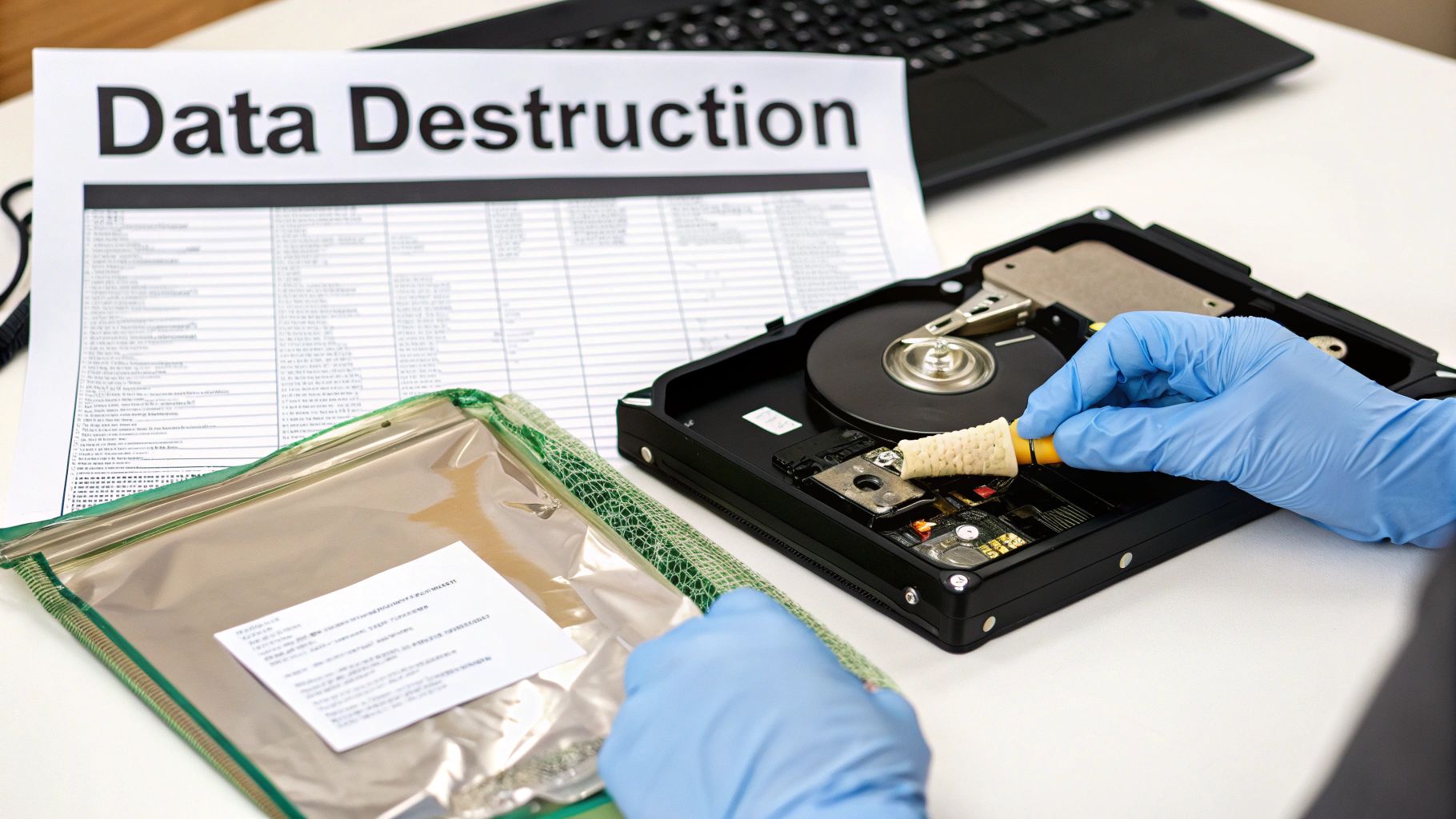
This journey starts with a clear understanding of the specific rules that apply to your business. If you're in healthcare, HIPAA sets non-negotiable standards for protecting patient information. Almost every business, however, falls under the Resource Conservation and Recovery Act (RCRA), which governs how hazardous e-waste is managed. Here in Atlanta, you also need to be up-to-speed on Georgia's specific e-waste laws designed to prevent environmental harm.
Choosing The Right Data Destruction Method
Not all data destruction techniques are created equal. The best choice really hinges on how sensitive your data is and what your industry's compliance standards demand. A good ITAD partner won't just offer one option; they'll walk you through the solutions to find the right fit for your assets.
You'll generally encounter three main methods for data sanitization:
- Data Wiping (or Sanitization): This is a software-based approach that overwrites all the data on a hard drive with random characters, effectively making the original files impossible to recover. It’s a fantastic option for newer, still-functional drives that have remarketing potential, which is great for the circular economy.
- Degaussing: This method uses an incredibly powerful magnet to scramble the magnetic field on a hard drive, wiping all the data in an instant. It's fast and effective, but it also makes the drive completely unusable afterward. This is best for media you have no intention of reusing.
- Physical Shredding: When you need the absolute highest level of security, nothing beats physical destruction. Industrial-grade shredders grind hard drives, SSDs, and other storage media into tiny, mangled pieces, offering a 100% guarantee that no data can ever be recovered.
Of course, a solid ITAD strategy also requires a grasp of core security principles. Understanding concepts like What is Encryption at Rest is crucial, as it provides a fundamental layer of security for any data stored on your devices before they even leave your facility.
The Importance Of Documentation
Here’s a truth I’ve learned over the years: proof of compliance is just as critical as the act of compliance itself. In the event of an audit, meticulous documentation is your best friend. It provides the undeniable proof that you've met every legal and ethical responsibility.
Your recycling partner absolutely must provide a Certificate of Data Destruction for every single data-bearing device they handle for you.
This is a legally binding document and should clearly list:
- The unique serial number of each device or hard drive.
- The specific method used for destruction (e.g., NIST 800-88 Purge, physical shred).
- The date the destruction took place.
- A clear statement confirming compliance with standards like NIST 800-88.
This certificate is what officially closes the loop on an asset's lifecycle. It confirms your company’s sensitive data was managed securely and responsibly from the moment it left your hands. It shifts your entire security posture from being reactive to proactive, building the kind of trust that clients, partners, and regulators value.
To make sure your internal processes are sound, take some time to learn the fundamentals of data sanitization and see how it fits into a secure ITAD framework. When you prioritize secure data destruction and insist on thorough documentation, you’re not just recycling—you’re making security a core part of your brand.
Turning Your Recycling Program Into A Powerful ESG Story
So, you've got a secure and compliant corporate computer recycling program in place. Great. But the work isn't over—in many ways, it's just beginning. The real value comes from turning this operational task into a powerful Environmental, Social, and Governance (ESG) story that actually resonates with your customers, investors, and employees.
Your recycling efforts are a goldmine for authentic marketing content. This isn't just about feeling good; it's about building tangible brand value. When you partner with a provider who offers a dual-impact model—like supporting veterans and planting trees—you elevate a routine IT task into a compelling narrative of positive change.

Weaving Your Impact Into Your Brand Narrative
The key is making your impact visible and verifiable. Vague promises of "being green" just don't cut it anymore. Today's stakeholders demand transparency and real data. A strategic partner should give you the tools to make this storytelling seamless and powerful.
Imagine adding a live impact counter to your company website with real-time stats like “1,245 veterans supported” or “3,700 trees planted.” This kind of dynamic data provides undeniable social proof and constantly reinforces your commitment to the community. It's a simple but incredibly effective way to show, not just tell.
Corporate giants like Dell have set the gold standard in computer recycling, having processed over 635 million pounds of electronics through their R2-certified programs. On the flip side, global e-waste hit a staggering 62 million metric tons in 2022, but only 22.3% was properly handled. That leaves hazardous materials like lead and mercury from corporate servers to leach into soil and water.
This data really underscores the urgent need for responsible corporate action and positions your company as a leader in finding a solution.
Activating Your Story Through Cause-Based Marketing
The most effective ESG stories are active, not passive. You can build momentum and get people involved by launching cause-based marketing campaigns tied directly to your recycling program. This approach doesn't just amplify your message—it invites your community to be part of the mission.
Here are a few actionable ideas to bring your story to life:
- Launch a “Recycle for a Cause” Campaign: Use powerful, emotionally resonant messaging like, “Your old tech can house a veteran and grow a forest.” Create short videos showing veterans receiving aid or USDA reforestation footage to share on social media.
- Align with Seasonal Drives: Plan special corporate recycling drives around key dates like Earth Day, Veterans Day, or Arbor Day. These are perfect opportunities for PR pushes and engaging employees or the local community.
- Co-host Community Recycling Drives: Partner up with local veteran organizations like VFW chapters, or environmental nonprofits to host collection events. This builds grassroots credibility and strengthens your local ties.
These campaigns transform your recycling program from a behind-the-scenes operation into a visible, public-facing initiative that builds brand loyalty.
Certifying Your Commitment and Building Partnerships
Documenting your impact is crucial for both internal reporting and external marketing. A good recycling partner should provide official documentation you can use to bolster your CSR reports and marketing materials, formalizing your efforts with the proof stakeholders need.
And if your office is also dealing with non-electronic clutter, it's worth exploring a comprehensive junk clean-up service that aligns with responsible disposal practices.
Look for a partner who provides:
- Plant-A-Tree Certificates: Official certificates detailing the number of trees planted in your company’s name.
- Veteran Support Impact Reports: Detailed summaries that quantify the support generated for veteran aid programs through your e-waste.
- An “Eco-Badge” Certification: A digital badge, maybe something like “Recycled with Purpose,” that you can display on your website, email signatures, and sustainability reports to certify your commitment.
By making your recycling program a cornerstone of your ESG strategy, you create a powerful, authentic story that sets your brand apart. You’re not just disposing of old computers; you’re restoring lives and landscapes, one device at a time.
Answering Your Questions About Corporate Recycling In Atlanta
Even with a great plan in place, some practical questions always pop up when you’re getting ready to recycle your company’s old computers. For businesses here in Atlanta, those questions usually revolve around the real-world stuff: cost, data security, and the actual logistics of getting it done. Let's tackle some of the most common ones I hear.
What Does Corporate Computer Recycling Actually Cost A Business In Atlanta?
Honestly, the price tag is often much lower than companies expect—and sometimes, there’s no cost at all. The final number really depends on what kind of equipment you have, how much of it there is, and the level of data destruction you need.
Many certified Atlanta recyclers, for instance, offer free pickups if you meet a minimum quantity (usually around 50 or more devices). Why? Because they can recover value from the raw materials inside your old tech, which helps offset their operational costs. This is an excellent opportunity for businesses to run corporate recycling drives as an easy ESG win.
Of course, specialized services like on-site hard drive shredding or creating detailed, serialized asset reports will typically come with a fee. When you’re looking at quotes, it’s crucial to weigh those costs against the astronomical financial risks of a data breach or a fine for improper disposal. A transparent partner will always give you a clear, itemized quote upfront, so there are no surprises down the line.
How Can We Guarantee Our Sensitive Company Data Is Destroyed?
This is the big one, and the answer should be non-negotiable. Your recycling partner must provide a Certificate of Data Destruction for every single data-bearing device they handle. This isn't just a piece of paper; it's your legal proof that your data was sanitized according to rigorous standards like NIST 800-88.
For the highest level of assurance, nothing beats physical destruction (shredding). It’s the gold standard for a reason.
Reputable recyclers will even let you witness the destruction process, either in person at their facility or via a secure video feed. This gives you irrefutable proof that your sensitive company information, client records, and proprietary data are gone forever, closing any potential security gaps.
That level of transparency isn't just for peace of mind. It’s a core part of building a secure and fully auditable IT asset disposition program.
We Have A Mix Of Desktops, Servers, Laptops, And Monitors. Can One Service Handle It All?
Absolutely. A full-service IT Asset Disposition (ITAD) partner is built to handle the entire spectrum of corporate electronics. A certified recycler in Atlanta can process everything in one go—from heavy-duty servers and networking gear to laptops, monitors, printers, keyboards, and mobile devices.
When you're vetting a potential partner, just confirm they can process all your different asset types. It’s also a smart move to ask about their downstream process. This ensures every single component, right down to the potentially hazardous materials in older monitors, is managed responsibly and in full compliance with environmental regulations.
What Documentation Should We Expect After Our Electronics Are Recycled?
Proper documentation is your ultimate proof of compliance and due diligence. It’s what protects you during an audit and gives you the hard data needed for sustainability reporting. After every pickup, you should expect to receive a comprehensive documentation package.
At a minimum, this package should always include:
- A detailed inventory of all collected assets, including serial numbers for traceability.
- A Certificate of Data Destruction to confirm secure data sanitization.
- A Certificate of Recycling to verify environmentally sound processing methods.
Better yet, if you partner with a recycler that has a social mission, you should also expect to receive impact reports. Documents like Plant-A-Tree certificates or summaries of veteran support are incredibly valuable assets. You can use them directly in your company’s ESG and CSR reports, turning a routine compliance task into a powerful story for your brand.
Ready to implement a secure, compliant, and impactful corporate computer recycling program for your Atlanta business? At Atlanta Green Recycling, we offer certified data destruction and responsible electronics disposal that supports local veterans and reforestation efforts. Schedule your free corporate pickup today!