Circuit Board Recycling: Turning E-Waste into Hope in Atlanta


Circuit board recycling is the key to recovering precious metals and other valuable materials from discarded electronics, making sure hazardous waste stays out of our landfills. For any Atlanta business, this process turns old, obsolete IT gear from a liability into a real asset, hitting both environmental and corporate responsibility goals. Our mission is built on a simple premise: Recycling that restores lives and landscapes.
The Untapped Value in Your Retired Technology
Take a look at your company's storage room. If it’s filled with old servers, laptops, and networking equipment, you probably just see clutter—a headache waiting to be dealt with. But if you shift your perspective, you'll see those retired assets for what they really are: miniature "urban mines," each one packed with a surprising amount of valuable resources.
Those intricate green boards are dense with precious metals like gold, silver, palladium, and copper. When that equipment ends up in a landfill, those materials are gone for good. Worse, hazardous elements like lead and mercury can seep into the soil and water. Proper circuit board recycling is how we unlock that hidden value and prevent contamination.
From E-Waste to Powerful Asset
By committing to responsible electronics disposal, Atlanta businesses can transform a simple compliance task into a major strategic advantage. This is about more than just clearing out old equipment; it's about making a tangible impact that resonates with your customers, employees, and investors. The payoff goes far beyond just getting an empty storage closet back.
Smart e-waste management supports your business in several key areas:
- Brand Reputation: Showing a real commitment to sustainability builds trust and polishes your public image.
- ESG Performance: Recycling provides solid, measurable data for your Environmental, Social, and Governance (ESG) reports, proving your company’s positive impact.
- Data Security: Securely destroying old devices is non-negotiable for protecting sensitive corporate and customer information from breaches.
- Community Impact: When you partner with us, your old tech can directly support important local causes. We turn your e-waste into aid for veterans and fund local reforestation efforts, a powerful story for keywords like “electronics recycling for veterans.”
Turning e-waste into hope, responsible recycling transforms potential environmental hazards into opportunities for positive change. It’s a practical way for your organization to contribute to a circular economy, where resources are reused instead of discarded.
This guide will lay out a clear path for Atlanta companies to navigate the entire process, from figuring out what to do with old computer components to scheduling a pickup. We’ll dive into how your retired IT assets can become a powerful tool that generates value for your business, your community, and the environment. This isn't just a chore—it's a core part of being a modern, responsible company. For more specifics on handling individual parts, check out our guide on what to do with old computer components.
How Circuit Boards Are Responsibly Recycled
Ever wonder what actually happens to a circuit board after it leaves your Atlanta office? It’s easy to picture it just being tossed somewhere, but responsible circuit board recycling is a precise, multi-stage journey that transforms potential e-waste into incredibly valuable resources. It all hinges on a secure chain of custody, where every device is carefully dismantled and processed to pull out every last bit of value—all while making sure your data is completely destroyed.
That journey starts the second our trucks pull up to your facility. We stick to a strict protocol that accounts for every single asset, from your door to our final processing line. You get total transparency and peace of mind.
This graphic breaks down the simple but powerful value chain, turning old technology back into raw materials.
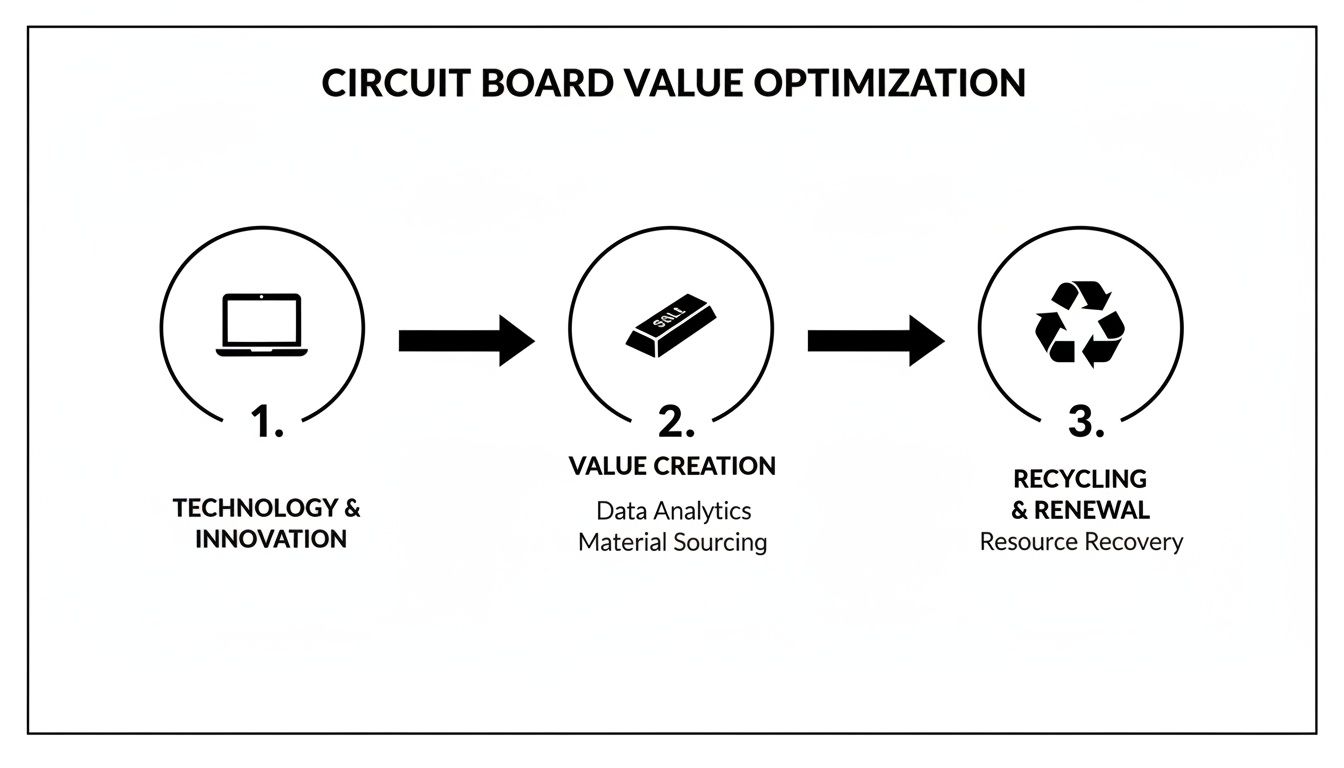
As you can see, recycling is the critical link that completes the loop in a circular economy, converting retired tech back into the building blocks for new innovation.
Stage 1: Secure Logistics and Manual Sorting
First things first, we get your retired electronics to our secure facility. This is where trained technicians start the manual sorting process, which is absolutely crucial for both safety and efficiency. Think of it as triage for electronics.
Our team categorizes every device by type—laptops, servers, desktops, networking gear, you name it. During this phase, they’re also on the lookout for any hazardous components like batteries or old mercury-containing switches. These are carefully removed by hand to prevent any contamination down the line.
This initial sort ensures that different materials are channeled into the correct recycling streams, setting the stage for a much more effective recovery process.
Stage 2: Precise Depopulation
Once everything is sorted, the circuit boards undergo what we call depopulation. This isn't just smashing things apart; it’s a careful, almost surgical process of removing valuable and reusable components from the board itself. Our technicians use specialized tools to detach items like integrated circuits (chips), processors, and capacitors.
Why bother? Because these small components often contain the highest concentrations of precious metals like gold, silver, and palladium. Popping them off early preserves their value and stops them from getting lost or damaged during the shredding phase. It’s a lot like a jeweler carefully removing gems from a ring before melting down the gold band.
This methodical approach ensures that the most valuable parts of your old electronics are captured intact, maximizing the economic and environmental returns from the recycling process.
This careful work also separates materials that need different kinds of processing, further refining the recycling stream. You can dive deeper into this by reading about what happens to recycled electronics in our dedicated guide.
Stage 3: Mechanical Shredding
With the high-value components removed, the bare circuit boards are ready for the heavy machinery. They’re fed into powerful shredders that grind them down into small, uniform fragments, usually just a few millimeters in size. This step is essential for liberating the different materials that are fused and layered together on the board.
By breaking everything down, we dramatically increase the surface area and make it possible to separate the metallic elements from the non-metallic ones. The output is a composite mix of fiberglass resin, copper, and trace amounts of other metals, ready for the final step.
Stage 4: Advanced Material Separation
The last stage is where the real magic—or "urban mining"—happens. We use advanced separation techniques to isolate the valuable commodities from that shredded mixture. Depending on the material, a few different methods come into play:
- Magnetic Separation: Powerful magnets pull out all the ferrous metals, like iron and steel.
- Eddy Current Separation: This clever technique uses electrical currents to repel non-ferrous metals like copper and aluminum, separating them from the plastic and fiberglass.
- Hydrometallurgy: This is a sophisticated chemical process that uses aqueous solutions to leach and recover the most precious metals—gold, silver, and palladium—from the remaining concentrate.
This intricate final step is what allows us to reclaim raw materials that can be funneled right back into the manufacturing supply chain. The end result is a truly closed-loop system where old technology provides the building blocks for the new, all while protecting your data and our environment.
Protecting Your Data and Ensuring Compliance
When it comes to getting rid of old IT assets, the biggest headache for any organization isn't about finding storage space or figuring out logistics—it's data security. Think about it. A single hard drive that's not properly wiped can leak a universe of sensitive information, opening the door to massive liability. For Atlanta's booming healthcare, finance, and education sectors, that risk is a serious, ever-present threat.
This goes way beyond just protecting company secrets. We're talking about safeguarding customer data, patient records, and financial details from getting into the wrong hands. A breach can trigger crippling financial penalties, legal battles, and do irreparable harm to your brand's reputation. That’s why any responsible circuit board recycling program has to start with an ironclad commitment to secure data destruction.
Essential Data Destruction Methods
Just hitting 'delete' on a file doesn't cut it. Data can often be recovered from formatted drives with surprising ease. To truly make information vanish forever, you need professional-grade data destruction methods. These techniques generally fall into two main camps: software-based sanitization and good old-fashioned physical destruction.
The right choice really boils down to your company's security policies, how sensitive the data is, and what the law requires.
- DoD 5220.22-M Sanitization: This is a software-based approach where the entire hard drive is overwritten multiple times with patterns of ones and zeros. The process effectively scrambles the original data, making it practically impossible to piece back together. It's a great option for drives that might be refurbished and given a second life.
- Physical Shredding: For the highest level of security, nothing beats physical demolition. We feed hard drives, servers, and other data-storing devices into industrial shredders that grind them into tiny, unrecognizable bits of metal. This method provides absolute certainty that the data is gone for good.
A Certificate of Destruction is your non-negotiable proof of compliance. This formal document serves as an auditable record, detailing the specific assets destroyed, the method used, and the date of destruction. It is your ultimate defense in the event of a compliance audit or legal inquiry.
Navigating the Regulatory Landscape
Compliance isn't just a good idea; it's a legal must. Several key federal regulations dictate how data privacy and disposal must be handled, and ignoring them can lead to severe consequences. Atlanta businesses, especially those in highly regulated fields, have to know their obligations.
Understanding the maze of regulations, including the finer points of Mastering Safety Data Sheet Compliance, is crucial when you're dealing with e-waste. Working with a certified recycler who lives and breathes these rules is the only sure-fire way to protect your organization.
Key regulations you need to know:
- HIPAA (Health Insurance Portability and Accountability Act): This sets the gold standard for protecting sensitive patient health information. Healthcare providers must ensure all patient data on retired medical devices and servers is completely destroyed.
- FACTA (Fair and Accurate Credit Transactions Act): This requires businesses to destroy consumer information gathered from credit reports to help prevent identity theft.
- GLBA (Gramm-Leach-Bliley Act): This mandates that financial institutions protect the privacy of consumer financial information, a rule that extends all the way to the disposal of their IT equipment.
These rules are a big reason why the secure recycling market is growing. The global PCB recycling market, which stood at $646 million in sales, is on track to hit $1.064 billion by 2031. This growth is fueled by directives like the EU's WEEE, which now demands an 85% minimum recycling rate for circuit boards.
Choosing the Right Data Destruction Method
Picking the right level of security for your retired electronics is a critical business decision. The table below breaks down the most common methods to help you make an informed choice that fits your specific needs. Our team is always here to provide in-depth guidance on security and data destruction to help you navigate these options with confidence.
Comparing Data Destruction Methods for Corporate IT Assets
| Method | Process | Security Level | Best For |
|---|---|---|---|
| Data Wiping/Sanitizing | Software overwrites drive sectors multiple times with random data. | High | Functional hard drives intended for resale or reuse; meeting DoD 5220.22-M standards for compliance. |
| Degaussing | Exposes media to a powerful magnetic field, erasing all data. | Very High | Magnetic tape media and older hard drives; renders the drives unusable. |
| Physical Shredding | Industrial shredders grind media into small, irrecoverable fragments. | Highest | End-of-life hard drives, SSDs, and devices containing highly sensitive data; guarantees permanent destruction. |
| Disintegration/Smelting | Devices are pulverized into dust or melted down at extreme temperatures. | Absolute | Top-secret government or military data; situations requiring the most extreme level of data security. |
By partnering with a certified e-waste recycler, Atlanta businesses can ensure their circuit board recycling process is not only good for the planet but also fully compliant and secure—protecting their most valuable asset: their data.
Transforming E-Waste into an ESG Win
Meeting compliance standards is one thing, but responsible circuit board recycling offers something much more valuable: a compelling story for your brand. In today's market, stakeholders—from investors and partners all the way to your customers—expect companies to show a real, boots-on-the-ground commitment to sustainability. Handling e-waste the right way is a tangible, visible way to elevate your company's Environmental, Social, and Governance (ESG) profile from a checkbox item to a powerful narrative.
This simple shift in perspective turns your retired IT assets from a disposal problem into a strategic tool for building corporate value. When you team up with the right partner, you can transform old circuit boards into measurable wins that strengthen your brand and connect with your community on a deeper level.
More Than Recycling: A Dual-Impact Model
What if your old tech could do more than just avoid a landfill? Our unique approach to Atlanta electronics recycling is built on a dual-impact mission that seriously amplifies your ESG efforts. We connect the simple, necessary act of recycling with profound, real-world outcomes for both the environment and our local community.
We operate on a simple yet powerful premise: “Your old tech can house a veteran and grow a forest.”
That’s not just a nice slogan; it’s the heart of our "Recycle for a Cause" campaign. A portion of the value we recover from your circuit boards and IT assets directly funds two critical initiatives: providing essential aid to veterans and supporting local reforestation through tree planting. It turns a standard operational task into a cause-based initiative your entire team can get excited about and rally behind, especially for those searching for "corporate sustainability electronics disposal" solutions.
Turning Actions into ESG Assets
To make your positive impact crystal clear and easy to report, we provide tangible assets designed specifically for your CSR and sustainability documentation. We believe in transparency and making it easy for you to show everyone the good you're doing. For companies involved in financial reporting, a solid grasp of SFDR Sustainability Financial Disclosures really underscores why transparent and responsible e-waste practices matter so much.
Our corporate partners receive a full suite of materials to validate their efforts:
- Veteran Support Impact Reports: These documents detail precisely how your contribution has directly assisted local veterans, giving you concrete social metrics for the "S" in ESG.
- Plant-A-Tree Certificates: We quantify the environmental side of your contribution, certifying the exact number of trees planted in your company’s name.
- "Recycled with Purpose" Eco-Badge: A digital badge you can proudly display on your website and in sustainability reports to signify your partnership in our dual-impact mission.
This growing focus on corporate responsibility is reflected in major market trends. The global circuit board recycling machine market was recently valued at $2,231 million and is projected to expand significantly. This growth is fueled by the sheer volume of e-waste from our rapid tech upgrade cycles. As businesses play a larger role in handling IT assets, demonstrating a clear ESG return becomes a key way to stand out.
By partnering with us, you don't just dispose of electronics—you create a verifiable story of restoration. Every server rack and box of old laptops becomes a measurable contribution to restoring both lives and landscapes right here in the Atlanta community.
Ultimately, this approach makes your circuit board recycling program an effortless and authentic win. It moves far beyond basic compliance to generate goodwill, engage your employees, and build a stronger, more respected brand.
Getting Your Business Ready for a Smooth E-Waste Pickup
Let's be honest, organizing a corporate e-waste pickup can feel like another logistical headache. But for IT and facilities managers in Atlanta, a little bit of prep work can make the entire process surprisingly easy and efficient. By following a few simple steps, you can get your retired assets packed up and ready to go, knowing that everything is accounted for and your data is completely secure.
Think of this as your game plan. It’s a straightforward playbook to turn a routine operational task into an easy win for your company.
Step 1: Get a Quick Count of Your Assets
Before you pick up the phone, you need a rough idea of what you’re getting rid of. Don't worry, you don't need a painfully detailed audit. A simple spreadsheet listing the types and approximate counts of your devices is all it takes.
For example, your list might just look like this:
- Laptops: ~75 units
- Desktop PCs: ~40 units
- Servers (various models): 12 units
- Networking Gear (switches, routers): 3 pallets
- Monitors & Peripherals: ~100 assorted items
This quick tally gives a recycler everything they need to know. It helps them figure out the right size truck and team to send out and allows them to give you an accurate quote if one is needed. Plus, it gives you a baseline record for your own internal tracking.
Step 2: Pick One Spot for Everything
To make pickup day as fast and painless as possible, designate a central spot for all the equipment. This should be a secure but easy-to-reach area, like a storage room, a corner of your warehouse, or an empty office near a loading dock.
Gathering everything in one place saves the pickup team from having to hunt through multiple floors or offices. This not only saves a ton of time but also keeps the disruption to your daily operations at a minimum. Just make sure the area is clear and there's a safe path for moving heavy bins or pallets.
Step 3: Confirm What's Accepted and Schedule the Pickup
Next up, double-check what items your recycling partner can actually take. Any reputable recycler will handle a huge range of IT assets, from big data center gear down to the smallest office peripherals. Generally, this includes:
- Servers and networking equipment
- Laptops, desktops, and tablets
- Hard drives and other data-storage devices
- Printers, keyboards, and mice
- Cables, cords, and power supplies
Once you've got your inventory and everything is consolidated, you're ready to schedule. For businesses here in Atlanta, qualifying for an electronic recycling free pick up is often surprisingly simple, usually just requiring a minimum of 50 devices. This makes responsible "Atlanta tech recycling" a genuinely cost-effective choice for most corporate IT refresh cycles.
A little bit of planning ahead often means you can eliminate any direct costs for logistics. This turns your e-waste disposal from a necessary expense into a pure value-add for your company's ESG goals.
Step 4: Know Your Paperwork
Finally, you need to know what documentation to expect. A professional e-waste partner provides clear paperwork to create a secure and transparent chain of custody. This is your proof that everything was handled by the book.
When the team arrives, they should give you a chain of custody form or a bill of lading to sign, which officially transfers responsibility for the assets. After everything has been processed, you should receive two key documents:
- A Certificate of Recycling: This confirms that all your e-waste was processed in line with environmental regulations.
- A Certificate of Destruction: This is the big one—your legally defensible proof that all data on your hard drives and media was securely and permanently destroyed.
These documents aren't just for your files; they are vital for compliance audits and are crucial components for your company’s sustainability and ESG reports.
Finding the Right E-Waste Partner in Atlanta
Choosing a recycling partner is a whole lot more than just picking a vendor. It's a critical decision that has a direct impact on your data security, your legal compliance, and even your company’s reputation.
The right partner doesn’t just haul away your old gear. They become a trusted extension of your team, making sure your assets are handled correctly and turning a simple disposal process into a powerful statement about your company's values. For businesses here in Atlanta, that means digging deeper than a basic quote to find a partner who guarantees a secure and responsible outcome.
What to Look for When Vetting a Recycler
Before you hand over a single piece of your company's retired IT equipment, you need to make sure your chosen recycler meets some non-negotiable standards. These are the foundations of secure, ethical, and compliant circuit board recycling.
- Top-Tier Certifications: The first thing to ask about is R2 (Responsible Recycling) or e-Stewards certifications. Think of these as the gold standard in our industry. They’re proof that a vendor follows incredibly strict rules for environmental safety, worker health, and data security.
- A Transparent Chain of Custody: Your partner must be able to show you a clear, unbroken paper trail for your assets—from the moment they leave your building until they are fully processed. This documentation is your auditable proof that everything was handled by the book.
- A Proven Local Track Record: Go with a partner who has deep roots right here in the Atlanta community. Look for local testimonials and case studies that show they know how to work with businesses just like yours.
The stakes are only getting higher. The market for Printed Circuit Board (PCB) e-scrap recycling, which was already at $699.43 million, is expected to skyrocket to $1,371.12 million by 2032. This boom is fueled by the constant need for hardware upgrades in IT and telecom. You can discover more insights about this growing market and the regulations that are putting North America at the forefront.
Case Study: An Atlanta Healthcare Provider's Challenge
To see what this looks like in the real world, let’s talk about a local Atlanta healthcare provider that was in the middle of a massive IT refresh. They were retiring hundreds of devices—PCs, servers, you name it—and all of them contained sensitive patient data protected under HIPAA.
The Challenge: They were juggling two huge concerns. First, they needed absolute certainty that every bit of patient data would be completely destroyed. A data breach would be catastrophic, leading to massive fines and a loss of patient trust. Second, they didn’t want this to be just another expense; they wanted the disposal process to reflect their commitment to corporate social responsibility.
The Solution: They came to us, and we put together a comprehensive plan. Our team started by establishing a secure chain of custody, documenting every single asset from pickup to final processing. To give them total peace of mind, we performed on-site physical shredding for all their hard drives and data-bearing devices, handing them a Certificate of Destruction to satisfy their HIPAA compliance auditors.
But we didn't stop there. We helped them turn a standard disposal project into a genuine ESG win. By recycling with us, they received a detailed Veteran Support Impact Report and a Plant-A-Tree Certificate. This documentation gave them a tangible way to show how their old technology helped house local veterans and reforest Georgia's landscapes—a powerful, authentic story for their annual sustainability report. They didn’t just check a compliance box; they turned their e-waste into hope.
Still Have Questions? Let's Clear Things Up.
Diving into the world of corporate electronics disposal can feel a little complicated. We get it. To make things clearer, here are some of the most common questions Atlanta businesses ask us and our straightforward answers.
What’s the Bottom Line? How Much Does Corporate Circuit Board Recycling Cost in Atlanta?
For most businesses we work with, responsible recycling is surprisingly affordable—and often, it costs nothing at all. In fact, we offer complimentary pickups for qualifying bulk disposals. This usually means a collection of 50 or more devices like laptops, servers, or PCs.
If there is a cost, it all comes down to the specific mix of equipment you have, what level of data destruction you need, and the current market value of the materials we can recover. No matter what, you'll always get a transparent, upfront quote from us. We make sure our solutions work for the planet and your budget.
How Can We Be Sure Our Sensitive Data Is Gone for Good?
Data security isn't just a feature; it's the absolute foundation of our entire process. The moment your equipment leaves your facility, we establish a secure chain of custody and document every single step. Our team provides fully certified data destruction, from data wiping that meets DoD 5220.22-M standards to physical shredding for total peace of mind.
Once the job is done, we issue an official Certificate of Destruction. This isn't just a piece of paper—it's your auditable, legally defensible proof that your data was permanently destroyed in full compliance with regulations like HIPAA and FACTA.
Your trust is everything to us. We handle your data with the same rigorous security we'd demand for our own.
What Kind of Documentation Can We Expect for Our ESG and CSR Reports?
We know that modern corporate reporting needs more than just a receipt. You need to tell a compelling story about your company's positive impact. That's why we provide a complete documentation package designed to do just that.
You’ll receive:
- A Certificate of Recycling that details all the materials successfully diverted from landfills.
- A Certificate of Destruction for every single data-bearing device.
- A Veteran Support Impact Report that quantifies your direct contribution to our social mission.
- A Plant-A-Tree Certificate to showcase your commitment to environmental restoration.
These documents are designed to slot directly into your annual CSR and ESG narratives, turning a routine operational task into a measurable, reportable victory. We make it easy to show the world how “your old tech can house a veteran and grow a forest.”
Ready to turn your company's retired IT assets into a force for good? Partner with Atlanta Green Recycling for secure, compliant, and genuinely impactful circuit board recycling. Schedule your corporate pickup today and join our mission to restore lives and landscapes. Learn more and get started with us at GreenAtlanta.com.