
Atlanta Access Control: A Guide to Modern Business Security for 2026

For any business in Atlanta, access control is simply about managing who gets in and what they can touch—both in the real world and in your digital one. It’s everything from the keycard that unlocks your office door to the password that opens a secure server. This is the bedrock of modern business security.
Your Guide to Atlanta Access Control Systems
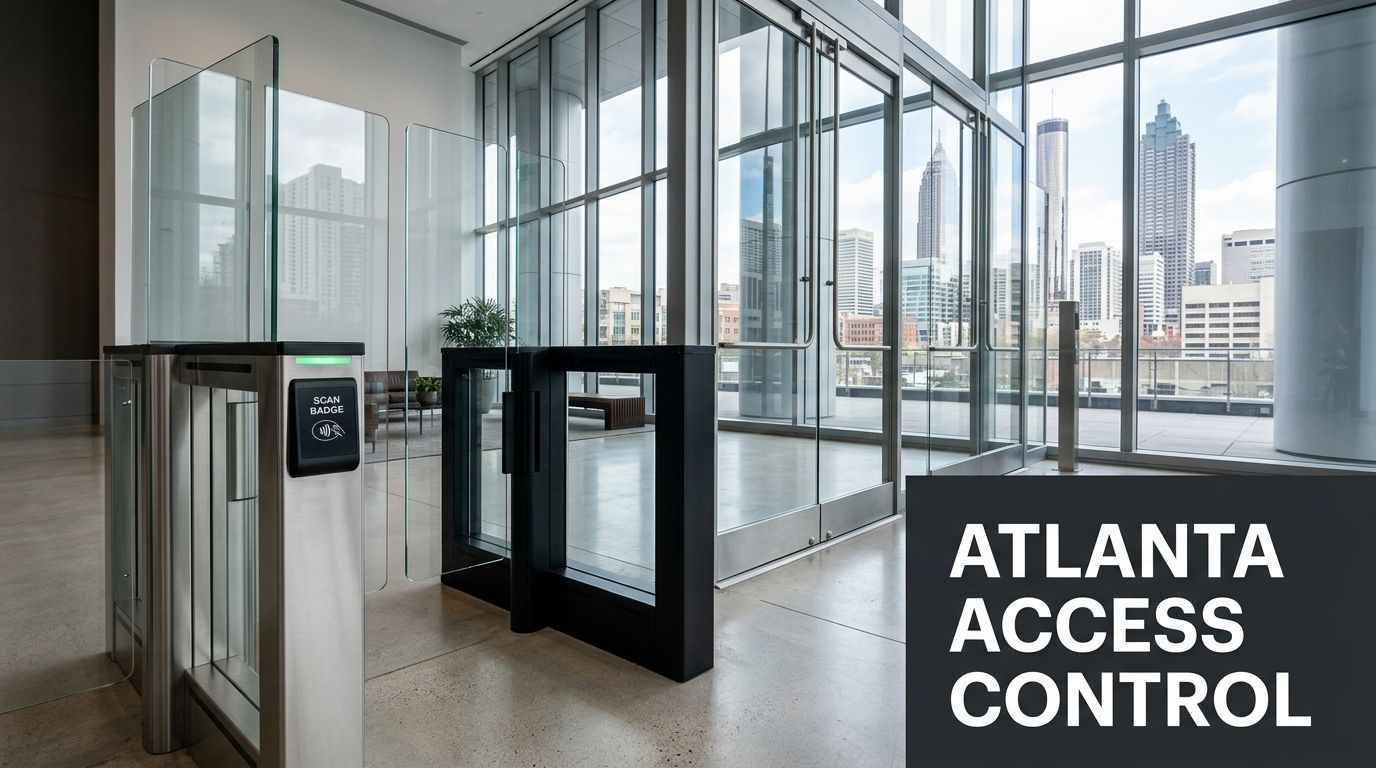
Think of access control as your company’s digital bouncer and physical security guard, all rolled into one smart system. It's not just about keeping the wrong people out. It’s a strategic tool that protects everything from physical inventory in a warehouse to sensitive client data on your network.
In a bustling economic hub like Atlanta—home to giants in tech, healthcare, and logistics—a rock-solid access control plan isn't a luxury; it's a necessity. It’s what governs entry to high-rise offices in Midtown, secures patient records at hospitals near Emory, and protects priceless intellectual property in Alpharetta’s data centers.
Physical vs. Logical Access Control
To build a truly secure environment, you first have to understand the two pillars of Atlanta access control. They work in tandem to create a complete security shield for your organization.
Here’s a quick breakdown of how these two types of controls work and why they are both critical for protecting your Atlanta-based operations.
Access Control Fundamentals for Atlanta Businesses
| Control Type | What It Protects | Common Atlanta Use Case |
|---|---|---|
| Physical | Your buildings, rooms, servers, and physical assets. Anything you can touch. | Using a keycard to enter an office in Buckhead or a biometric scanner to access a secure server room in a data center. |
| Logical | Your networks, files, software, and databases. The intangible, digital assets. | Requiring a password and multi-factor authentication (MFA) to log into a healthcare provider's patient records system. |
This table shows that physical and logical controls are two sides of the same security coin. You absolutely need both.
Physical Access Control: This is the one most people think of first. It’s all about tangible barriers—locked doors, security gates, and turnstiles. Technologies like keycards, smartphone credentials, and biometric scanners (think fingerprints or facial recognition) are used to grant or deny access to a physical space.
Logical Access Control: This is the digital side of the house, governing access to your networks, applications, and sensitive files. Passwords, multi-factor authentication (MFA), and specific user permissions are all forms of logical access control. They ensure an employee can only see and interact with the data they actually need for their job.
Key Takeaway: A security breach can happen just as easily from an unlocked server room door (a physical failure) as it can from a stolen password (a logical failure). Real security means you have to protect both fronts without compromise.
But the story doesn't end when you install a new system. The entire lifecycle matters. As your organization upgrades its technology, you’re left with a pile of old hardware. This guide will walk you through the whole process, from setup to the most critical final step: securely destroying the data on and disposing of those retired access control components. You can learn more about this crucial final step in our complete guide to data security.
Why Access Control Is a Non-Negotiable for Atlanta Businesses
Think access control is just about a locked door and a key? Think again. For any Atlanta organization today, managing who can get to what—whether it's an office building or a sensitive digital file—is no longer a simple security measure. It's a foundational piece of your operational integrity and the trust you build with clients.
Atlanta is a major league player in finance, healthcare, and technology, which puts local companies in a high-stakes game. We're talking about massive volumes of sensitive information, from patient records protected by HIPAA to financial data under PCI DSS rules. A single slip-up, whether it’s a malicious attack or just an honest mistake, can have devastating consequences.
Protecting More Than Just Property
A modern access control system isn't just guarding your physical inventory. It’s standing watch over your most valuable assets, which are often the ones you can’t see. A truly robust system protects:
- Your Data: It’s the gatekeeper for your confidential client lists, proprietary business strategies, and priceless intellectual property.
- Your People: It creates a safe work environment by ensuring only authorized individuals are on-site and leaves a clear record of who was there and when.
- Your Reputation: Nothing builds trust like a demonstrated commitment to security. It shows clients, partners, and your own team that you take their safety and privacy seriously.
A Tool for Operations and Compliance
Far from being a barrier, a well-designed Atlanta access control system actually helps your business run smoother. It automates who gets in and out, getting rid of the old headaches that come with managing physical keys. Even better, it creates an undeniable digital log of every single access event.
This audit trail is your business's "black box" recorder. If a security incident happens or an auditor comes knocking, this log provides clear, time-stamped proof of who went where and when. It’s your key to proving due diligence.
The truth is, having a solid plan for access control for business security is a must to truly protect your facilities and information.
And with hybrid work now the norm, the old idea of a secure office "perimeter" is gone. Your team is accessing company networks from home, coffee shops, and everywhere in between. An integrated strategy that covers both physical and digital access is the only way to close these new security gaps and keep your organization safe. Without it, you’re leaving your most critical doors wide open.
Choosing the Right Access Control Technology
Picking the right access control technology for your business can feel like a monumental task, but it doesn't have to be. It all comes down to understanding a few core ideas, much like knowing which keys belong on your master ring. The first step is simply deciding on the "rules" for who gets access and when. These rules are defined by different control models.
Think about it this way: who gets to decide which doors can be opened? In Discretionary Access Control (DAC), the owner of a resource—whether a file or a physical room—makes that call. While flexible, this approach can quickly become disorganized as a company grows. On the other end of the spectrum is Mandatory Access Control (MAC), a rigid, top-down system where security clearances dictate access, typically reserved for government or military applications.
For the vast majority of Atlanta businesses, the best fit is Role-Based Access Control (RBAC). This is by far the most popular and practical model. Permissions are tied to a person's job function, meaning the sales team can access sales software, and the finance team can get into financial records. It’s organized, easy to scale, and keeps everything secure.
Matching Hardware to Your Needs
Once you have your rules in place, you need the right hardware to enforce them. Each technology serves a different purpose, and the best choice for any Atlanta organization will hinge on its unique environment and security demands.
- Traditional Keycards and Fobs: These are the dependable workhorses of access control. They are cost-effective to deploy, simple to issue to new hires, and already familiar to just about everyone. They are an ideal fit for general office access, like you might find at a creative agency in Midtown.
- Biometric Scanners: By using fingerprints, facial recognition, or iris scans, biometric systems provide a significantly higher level of security. Why? Because they confirm who you are, not just what you're holding. A data center in Alpharetta or a healthcare facility within the Emory medical complex would lean on biometrics to safeguard their most sensitive areas.
- Mobile Credentials: This is the modern approach, turning an employee's smartphone into their secure key. It delivers incredible flexibility, enabling remote access management and a frictionless experience for users. This is a perfect match for fast-paced tech companies and co-working spaces. You can learn more about integrating these systems in our guide to smart building tech.
The Booming Market for Atlanta Access Control
The push to adopt these newer, more secure technologies is fueling tremendous growth in the industry. As a major business hub, Atlanta is a key part of the North America access control market, which is projected to climb from USD 3.88 billion in 2025 to an estimated USD 5.84 billion by 2030. This expansion is driven by security upgrades across commercial real estate, data centers, hospitals, and schools—all scrambling to meet stricter regulations and protect their critical assets. You can discover more about this market growth on MarketsandMarkets.com.
As they navigate modern solutions, Atlanta businesses can benefit from understanding how a unified global unified login system can simplify user access while strengthening security across all these different technologies.
Ultimately, choosing the right Atlanta access control technology is a strategic business decision. It's about finding the right balance between your security requirements, user convenience, and budget to build a system that not only protects your organization today but can also adapt to whatever comes next.
Staying Compliant with Secure Data Destruction
An access control system's job isn't over just because you've unplugged it. Its role in your organization’s security and compliance story extends all the way to its final moments. Modern systems are much more than just fancy door openers; they are powerful compliance tools that create invaluable audit trails.
Think of these audit trails as a digital diary, meticulously logging who accessed what area and at what exact time. For any Atlanta business handling sensitive information under regulations like HIPAA, PCI DSS, or CJIS, these logs are not just helpful—they're essential. They act as your proof of due diligence, showing an auditor that you took every necessary precaution to safeguard sensitive zones and the data within them.
The Data Lurking in Your Old Hardware
When it’s time to upgrade your Atlanta access control system, what do you do with the old equipment? It’s a surprisingly common mistake to see retired keycard readers, control panels, and servers as just harmless plastic and metal. But these devices can be a hidden liability, often retaining access logs, user credentials, and network configurations. In the wrong hands, this is a ready-made toolkit for a breach.
Simply tossing old access control components into a recycling bin is a direct path to a potential data breach and severe compliance penalties. The chain of custody for your security doesn't end at your door; it extends until the data is verifiably destroyed.
This process chart shows the typical journey of selecting a new access control system, a journey that always ends with the retirement of the old one.
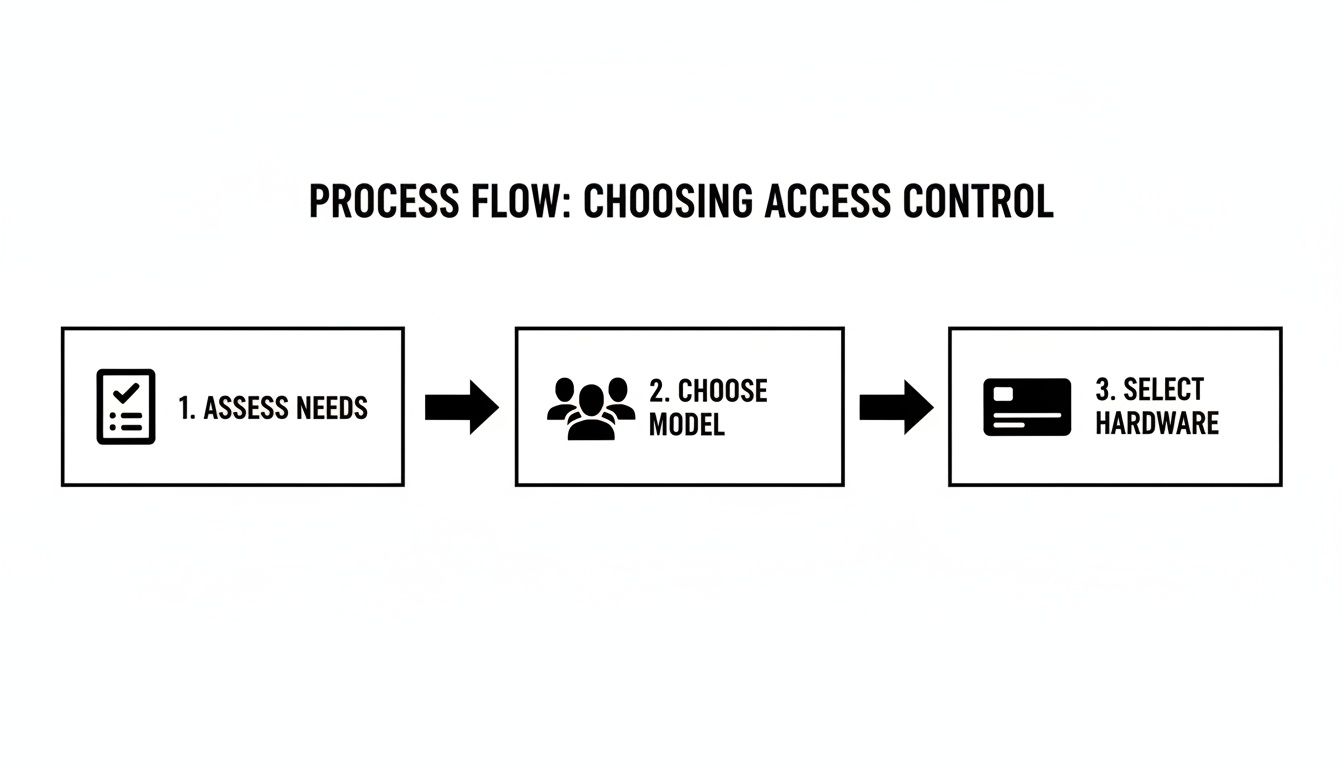
What this really highlights is that the "Select Hardware" phase kicks off an equally important disposal phase. Secure data destruction isn't an afterthought; it’s a critical part of the upgrade cycle itself.
The Absolute Need for Certified Disposal
The pressure to get this right is only growing. Atlanta is a key player in the US access control market, which is expanding at a 9.0% CAGR through 2030. As the North American market barrels toward a projected USD 5.84 billion—pushed by security demands in healthcare and government—the pace of upgrades is accelerating. This creates a constant, churning river of obsolete readers, locks, and controllers, all potentially loaded with sensitive data.
This is why partnering with a certified e-waste disposal provider isn’t just a good idea; it’s a core compliance mandate. A certified partner guarantees that every data-bearing component is destroyed according to strict, auditable standards. They provide a certificate of destruction, a document that officially closes the security loop and shields your organization from crippling fines and reputational ruin.
To ensure your company is protected, explore our services for secure data destruction and see how we can help you manage this critical responsibility.
Choosing Your Atlanta Secure E-Waste Partner
Choosing the right partner to handle your company's retired access control hardware is just as important as picking the system in the first place. This isn't merely about hauling away old equipment; it's a final, critical step in securing your organization against future liability and ensuring your security chain of custody remains intact from start to finish.
The very first filter you should apply is for top-tier industry certifications. A vendor without R2v3 or e-Stewards certification should be a non-starter. These certifications are the gold standard, your assurance that a provider meets the highest benchmarks for data security, environmental responsibility, and worker safety. Think of them as the absolute baseline for any company serious about secure Atlanta access control disposal.
Key Criteria for Vendor Selection
Once you've filtered for certifications, it's time to dig deeper into a potential partner's operational security. You need documented proof of their methods to feel confident that your retired assets won't become a source of liability down the road.
When evaluating potential vendors, insist on getting clear answers to these non-negotiable points:
Documented Chain of Custody: From the second a piece of hardware leaves your building, you need an unbroken record of its journey. A reputable partner must provide a detailed paper trail that tracks each individual asset from your door to its final destruction.
On-site Data Destruction Services: For the highest level of security, the data should be destroyed before the equipment ever leaves your facility. Ask if they offer on-site shredding or degaussing for hard drives and other media that might be hiding inside your old access control units.
Secure, GPS-Tracked Logistics: How does the equipment travel from your office to their processing facility? A trustworthy partner will use their own fleet of secure, GPS-tracked vehicles, guaranteeing your assets are fully monitored every step of the way.
To help narrow down your options, reviewing a list of the top-rated IT asset disposition companies is an excellent place to start your research.
A Vendor Vetting Checklist for Secure E-Waste Disposal
Choosing a partner to dispose of your sensitive hardware requires a sharp eye for detail. This table outlines the key criteria to use when evaluating vendors in Atlanta, helping you protect your organization's security and compliance posture.
| Criteria | Why It Matters for Security & Compliance | What to Ask For |
|---|---|---|
| Certifications | R2v3 and e-Stewards are non-negotiable industry standards that prove a vendor meets strict data security and environmental protocols. | "Can you provide copies of your current R2v3 and/or e-Stewards certifications?" |
| Chain of Custody | Provides a legal, auditable trail for every asset, proving secure handling from pickup to final disposition and limiting your liability. | "Show me a sample of your chain of custody documentation and asset tracking report." |
| Data Destruction Methods | You need proof that data is 100% irrecoverable. On-site services offer the highest level of security by destroying data before it leaves your control. | "What data destruction methods do you use? Do you offer on-site shredding? Can you provide a Certificate of Data Destruction?" |
| Facility Security | A secure, monitored facility prevents theft or unauthorized access to your assets while they await processing. | "What security measures are in place at your facility? (e.g., 24/7 surveillance, access controls, employee background checks)" |
| Logistics and Transportation | Secure transport prevents asset loss or data breaches in transit. GPS tracking provides real-time verification and peace of mind. | "Do you use your own trucks? Are they GPS-tracked and operated by background-checked employees?" |
| Insurance Coverage | Adequate data breach and liability insurance protects your company in the unlikely event that something goes wrong. | "What are your data breach and general liability insurance coverage limits? Can you provide a Certificate of Insurance?" |
By systematically going through these questions, you can confidently distinguish between a basic hauler and a true security partner.
Beyond Security to Social Impact: An Easy ESG Win
In the current business environment, responsible disposal can become a powerful part of your brand's story. The right partner can help you turn e-waste from a compliance headache into a verifiable social good, aligning perfectly with your company's Environmental, Social, and Governance (ESG) goals.
“Recycling That Restores Lives and Landscapes.”
This is the very essence of cause-based recycling. By choosing a partner with this kind of dual mission, a routine hardware refresh is transformed into a compelling narrative. Imagine receiving a report that not only confirms your data was destroyed but also details how many trees were planted or veterans were helped as a direct result of your decision.
This approach turns a simple compliance task into a meaningful act of corporate social responsibility. Look for a partner who can provide "Impact Certificates" and "Veteran Support Impact Reports" that you can use for your own ESG and CSR documentation, proving your commitment to making a positive difference. Partners may even offer a "Recycled with Purpose" digital badge for your website to showcase your commitment to corporate sustainability electronics disposal.
Recycling That Restores Lives and Landscapes

When you upgrade your Atlanta access control system, you’re left with a pile of old hardware. For most, it’s just another compliance task on the to-do list. But what if it could be something more? This is where security meets social responsibility, turning routine e-waste into a powerful force for good.
Instead of your security lifecycle ending with a simple disposal ticket, you can close the loop with a positive, measurable impact.
Our "Recycle for a Cause" mission transforms this final step. We connect your responsible electronics disposal directly to two vital causes: supporting our nation's veterans and restoring our nation's forests. Your retired access control units, servers, and readers become part of a story of hope and renewal.
Turning E-Waste into Hope and Forests
Partnering with us means you do more than just securely destroy data and meet compliance standards. It’s a straightforward and effective way to elevate your company's ESG (Environmental, Social, and Governance) profile. We provide the certified data destruction and secure pickups you require, plus something more:
- Veteran Support: A portion of the value from your recycled electronics directly aids programs that provide housing, wellness, and other critical support for veterans.
- Reforestation Efforts: For every qualifying pickup, we fund the planting of trees, helping restore vital ecosystems across the country.
This dual-impact model turns a logistical necessity into a powerful narrative. The global access control market is projected to hit USD 29.77 billion by 2030, and that rapid growth means Atlanta businesses are constantly upgrading systems. This creates a surge in e-waste that can be harnessed for good. You can explore the research on ResearchandMarkets.com to see just how quickly this sector is expanding.
“Your old tech can house a veteran and grow a forest.”
We provide comprehensive documentation, including Impact Certificates and Veteran Support Impact Reports. These documents don’t just prove secure, compliant disposal—they quantify your positive contribution, making them perfect for your CSR reports.
By choosing this path for your outdated Atlanta access control equipment, you complete your security lifecycle with a final step that is compliant, secure, and profoundly impactful. You can learn more by reading about recycling in Atlanta on our website.
Frequently Asked Questions About Access Control
When it comes to securing your business, a lot of questions pop up. It's a critical part of protecting your people and your data, so it's natural to want to get it right. Let's tackle some of the most common questions we hear from Atlanta business owners and IT managers.
How Do I Know Which Access Control System Is Right for My Business Size?
For most businesses, we find that Role-Based Access Control (RBAC) is the best place to start. It’s incredibly scalable and just makes sense. Instead of managing permissions for every single person, you assign them based on job roles like 'Sales,' 'IT Admin,' or 'Executive.'
As your team grows or changes, you simply move people between roles, and their access rights update automatically. A smaller office might get by just fine with simple keycards, but a larger facility with valuable data or equipment will likely need something more robust, like multi-factor authentication.
Is Cloud-Based Access Control Secure for an Atlanta Business?
Absolutely. Modern cloud-based systems from trusted providers are incredibly secure. In many ways, they're more secure than trying to manage everything on-site yourself.
They bring some huge advantages to the table, like remote management, automatic security updates, and powerful data encryption. This is a game-changer for Atlanta companies with several locations or those embracing a hybrid work model. You can manage who has access to what, from anywhere, without the headache of maintaining physical servers.
What Happens if We Just Throw Away Our Old Access Control Card Readers?
Just tossing old hardware in the bin is one of the biggest security mistakes you can make. It might seem harmless, but controllers and readers can hold a surprising amount of sensitive data—think access logs or even network credentials.
This kind of improper disposal can easily lead to a data breach. It also puts you at risk for serious non-compliance fines under regulations like HIPAA.
Key Takeaway: You should always work with a certified e-waste partner who provides a Certificate of Data Destruction. This document is your official proof that the chain of custody was handled securely and compliantly, protecting your organization from any liability down the road.
Ready to turn your retired security hardware into a force for good? Partner with Atlanta Green Recycling and ensure your e-waste disposal is secure, compliant, and impactful. Learn more at https://www.greenatlanta.com.