
Absolute Risk Reduction Meaning: A Practical Guide


A patient reads a headline over breakfast: a new treatment “cuts risk by 50%.” That sounds huge. It sounds like an easy yes.
Then the questions start. Fifty percent of what? Does that mean half of patients are protected? Half of bad outcomes disappear? Or is the benefit smaller than the headline makes it sound?
That confusion is common in medicine. It affects patients choosing treatments, students learning how to read trials, and clinicians trying to explain options clearly. If you want the plain-English answer to absolute risk reduction meaning, you are asking a practical question: How many people benefit?
Beyond the Headlines of Medical News
A medical headline often gives you the most dramatic number first. Relative changes sound exciting, and they fit into news stories, social posts, and brief conversations in clinic hallways.
But a patient does not make decisions in relative terms. A patient wants to know what happens in real life. If a drug lowers risk, how much lower is it for people?

That is where absolute risk reduction, or ARR, becomes useful. It strips away the drama and tells you the difference in event rates between two groups. One group gets the treatment. The other does not. ARR tells you the gap between them.
Why headlines confuse people
Consider how people hear medical news:
- A headline says the benefit is large. The wording focuses on a relative drop in risk.
- The baseline risk is missing. Without that starting point, the number can sound bigger than it feels in practice.
- The timeframe is unclear. A reduction over a short period means something different from the same reduction over a longer period.
A reader trying to judge a study needs context, not marketing language. That is true whether you are reading a journal abstract or skimming local health coverage such as updates collected in City of Atlanta news.
Key idea: ARR answers the question, “How many fewer people had the bad outcome because of the treatment?”
What makes ARR worth learning
ARR is not a classroom formula. It helps with treatment conversations, informed consent, and shared decision-making. It also protects you from overreacting to impressive-sounding percentages.
When readers search for absolute risk reduction meaning, they want one thing. They want a number they can picture. ARR gives them that.
What Is Absolute Risk Reduction A Clear Definition
A patient asks a simple question after hearing about a new treatment: “How much will this lower my chance of a bad outcome?” Absolute risk reduction is the measure that answers that question in plain terms.
The plain-language definition
Absolute Risk Reduction, or ARR, is the difference in risk between two groups. One group does not get the treatment. The other group does. ARR tells you how many fewer people have the outcome in the treatment group compared with the control group.
Clinicians usually write those two risks as:
- CER, the Control Event Rate
- EER, the Experimental Event Rate
The formula is short:
ARR = CER – EER
That means you subtract the treatment group risk from the control group risk.
What ARR measures
ARR works like comparing two lines at a clinic check-in desk. If 20 out of 100 people in one line have a problem, and 12 out of 100 in the other line have the same problem, the practical question is simple. How many fewer people were affected in the second line?
The answer is 8 out of 100. That gap is the absolute risk reduction.
This is why ARR matters in treatment decisions. It turns a study result into something a clinician can discuss and a patient can picture. Instead of hearing that a treatment “reduces risk,” you can ask, “How many people like me avoid the outcome?”
How it differs from related terms
Students often confuse ARR with other risk terms because the names sound similar. The easiest way to sort them out is to focus on the question each one answers.
| Term | What it means |
|---|---|
| Absolute risk | The chance of an event in one group |
| Absolute risk reduction | The difference in event rates between two groups |
| Relative risk reduction | The percentage drop compared with the starting risk |
That distinction changes real decisions. A relative change can sound dramatic. An absolute change tells you the size of the benefit in people, not just in percentages.
Clear terminology matters in every field that depends on accurate interpretation. The same habit of defining terms carefully shows up in topics like data sanitization in information handling, where the label matters less than what the process changes.
Takeaway: ARR tells you the number of people helped by an intervention, which makes it far more useful for clinical conversations than a headline-friendly percentage alone.
Calculating Absolute Risk Reduction Step by Step
A clinician reads a trial over lunch. The paper says the treatment lowered risk from 20% to 12%. The calculation takes seconds. The harder part is turning that result into a treatment decision a patient can use.
Step 1 Identify the risk in each group
Start with the two event rates:
- The event rate in the control group
- The event rate in the treatment group
Use the same teaching example introduced earlier:
- Control risk = 20%
- Treatment risk = 12%
These percentages are the share of people in each group who had the outcome being studied.
Step 2 Label them correctly
In evidence-based medicine, these are often written as:
- CER, the Control Event Rate
- EER, the Experimental Event Rate
So in this example:
- CER = 20%
- EER = 12%
The labels can make ARR sound more technical than it is. They are just shorthand for “risk without the intervention” and “risk with the intervention.”
Step 3 Subtract the two risks
Now use the formula:
ARR = CER – EER
Plug in the numbers:
ARR = 20% – 12% = 8%
That 8% is an absolute difference, not a relative one. It is the size of the gap between the two groups.
Step 4 Translate the result into people
This step matters most in practice.
An ARR of 8% means that, in a group of 100 similar patients, about 8 fewer people would have the bad outcome with treatment than without it.
That phrasing helps both clinicians and patients. It shifts the question from abstract percentages to a clearer decision frame: “How many people like me are likely to benefit?”
A vaccine study is interpreted the same way. If you want a related example in a different context, this guide on what vaccine efficacy means helps show why absolute numbers matter alongside headline percentages.
A quick visual check
A waiting room example works well here.
- Without treatment, 20 out of 100 patients have the outcome.
- With treatment, 12 out of 100 patients have the outcome.
The treatment changes the outcome for 8 people out of 100. ARR works like counting how many chairs in the “bad outcome” row are now empty after treatment is offered.
A second worked example
Real trials often give raw counts instead of clean percentages. Suppose a study reports:
- 165 events out of 1000 in the control group
- 133 events out of 1000 in the treatment group
First convert each to a risk:
- Control risk = 16.5%
- Treatment risk = 13.3%
Then subtract:
ARR = 16.5% – 13.3% = 3.2%
In plain language, that means about 3.2 fewer people out of every 100 experienced the outcome with the intervention.
The arithmetic stays simple even when the numbers are less tidy. What changes is how impressive the benefit feels. An ARR of 3.2% may still matter a great deal if the outcome is severe, the treatment is safe, and the patient values even a modest reduction in risk.
Practical habit: After you calculate ARR, say it out loud as “X fewer people out of 100,” then ask whether that benefit is large enough to justify the treatment’s cost, burden, and side effects.
ARR vs RRR The Critical Difference
A parent hears that a medicine “cuts risk by 40%” and assumes the benefit must be large. In clinic, the next question is the one that changes the conversation: 40% of what starting risk?
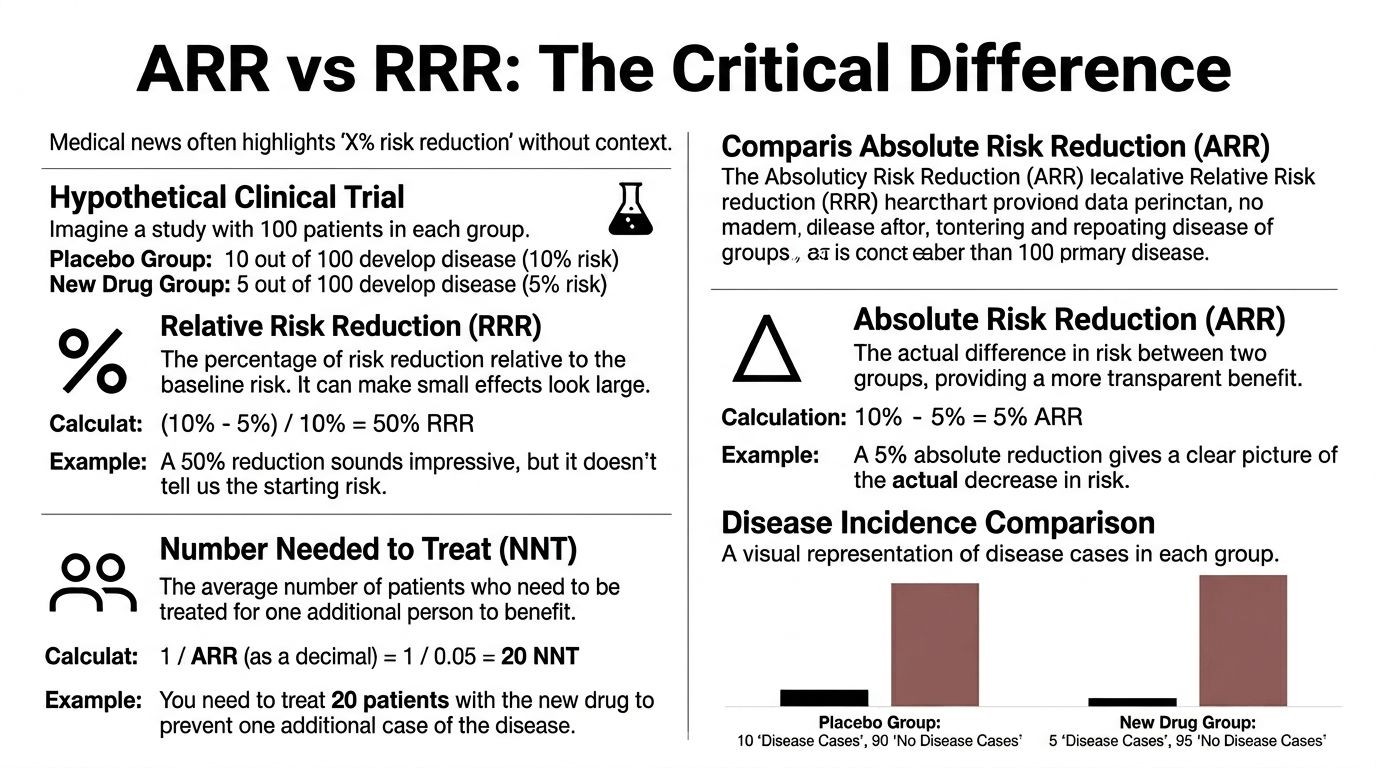
The same trial can produce two very different messages
Use the same example as before:
- Control risk = 20%
- Treatment risk = 12%
The absolute risk reduction is 8%. In plain language, 8 fewer children out of 100 have the bad outcome with treatment.
The relative risk reduction uses that same drop but compares it with the starting risk. An 8-point drop from a starting risk of 20% equals an RRR of 40%.
Both figures are correct. They answer different questions.
- ARR asks: How many people are helped?
- RRR asks: How large is the drop compared with where we started?
That difference matters because patients do not experience “relative percentages.” They experience real outcomes. A treatment either prevents an event for a certain number of people, or it does not.
Why relative framing can sound larger than the lived benefit
RRR often grabs attention because the number is larger. A 50% reduction sounds dramatic. Yet if the starting risk falls from 2 in 100 to 1 in 100, the practical benefit is 1 fewer event per 100 people.
That is the job of absolute and relative measures of risk reduction. They describe the same result from different angles, but only one angle tells a clinician or patient how many people are likely to benefit in real terms.
A simple way to remember it helps. RRR is the headline. ARR is the head count.
ARR is the form that helps with treatment choices
Suppose two drugs each advertise a 50% relative risk reduction.
- Drug A lowers risk from 20% to 10%
- Drug B lowers risk from 2% to 1%
The relative result is identical. The absolute result is not.
Drug A has an ARR of 10%. Drug B has an ARR of 1%. If you are deciding whether side effects, cost, monitoring, or inconvenience are worth it, those differences matter.
This is why trial results can sound more impressive in news coverage than they feel in the exam room. A more pertinent question is not only “Did risk go down?” It is “How much benefit will people like this patient see?”
That same confusion comes up in vaccine reporting. If you want a parallel example, this guide on what vaccine efficacy means shows why a strong-looking percentage still needs baseline risk and context before it becomes useful at the bedside.
ARR also leads directly to NNT
ARR connects to Number Needed to Treat, or NNT, which turns a percentage into a planning tool.
Using the example above:
- ARR = 8%
- Convert to decimal: 0.08
- NNT = 1 / 0.08 = 12.5
Clinicians round that to about 13 people treated for 1 person to benefit.
That is a much easier discussion to have with a patient. A clinician can say, “If we treat about 13 people like you, one avoids this outcome.” Then the patient can weigh that benefit against harms, costs, and personal priorities.
Bottom line: RRR describes the size of the drop relative to baseline. ARR shows the practical difference in people, which is usually the more useful number for shared decisions.
Interpreting ARR for Clinical Decisions
A number by itself is not a decision. It becomes meaningful when you place it in context.
There is no universal good ARR
Students ask whether an ARR is “good” or “bad.” That is the wrong first question.
A modest ARR may matter a great deal if the outcome is severe, irreversible, or frightening. A larger ARR may feel less impressive if the condition is mild or short-lived. Clinicians weigh the size of benefit against side effects, burden, cost, and patient preferences.
A thoughtful decision always includes the patient’s baseline risk. That is one reason the phrase risk reduction matters more when attached to context than when presented as an isolated number.
Questions that make ARR useful
When you see an ARR in a paper or hear it in clinic, ask:
- What is the outcome? Preventing death, hospitalization, or a mild symptom are not equivalent.
- Over what period? Benefit over a short period and benefit over a longer period carry different implications.
- What harms come with treatment? A small absolute benefit may still be worth it if harms are low. The reverse can also be true.
- Who was studied? A result in a high-risk group may not translate to a lower-risk patient.
ARR helps shared decision-making
Good counseling sounds like this: “Out of 100 people like you, this treatment may help a small number avoid the outcome, but it also brings these tradeoffs.”
That kind of conversation is grounded in ARR. It is concrete. Patients can picture it. They can compare benefit against inconvenience and adverse effects.
Clinical habit: Use ARR to frame benefit, then place that benefit beside harms, burden, and patient goals.
Common Misunderstandings and Limitations of ARR
A treatment can sound impressive on paper and still offer only a small practical benefit for the person sitting in front of you. That is where ARR often gets misunderstood. It turns a study result into a concrete difference in outcomes, but only if you keep the surrounding context attached.
Baseline risk changes the meaning
ARR works like the distance between two points. If the starting risk is high, the gap between treated and untreated groups can be large. If the starting risk is low, the gap can be small, even when the treatment changes risk by a similar proportion.
Here is the common mistake. A clinician reads a trial done in a high-risk group, then assumes the same absolute benefit will appear in a lower-risk patient. It usually will not.
That matters in real decisions. A patient with many risk factors may gain a noticeable absolute benefit from treatment. A healthier patient may hear the same headline about risk reduction but experience a much smaller change in actual odds. This is the same habit used in a good business sustainability strategy. You do not judge an intervention by its label alone. You judge it by the starting conditions, the likely return, and the tradeoffs.
Timeframe can change the whole interpretation
ARR is incomplete without a time horizon.
A 2 percent absolute reduction over one month means something very different from a 2 percent reduction over five years. Patients often hear the number and assume it applies indefinitely. Researchers do not mean that unless the study followed patients indefinitely.
This is one reason study summaries can mislead. If the duration is buried in the methods section, the benefit can sound larger or more durable than it really is.
ARR is only one piece of the decision
ARR tells you how much the outcome rate differed between groups. It does not tell you whether the treatment was easy to take, expensive, poorly tolerated, or acceptable to the patient.
It also does not tell you how certain the estimate is. A small ARR from a precise, well-conducted trial may be more useful than a larger ARR from a weak study with wide uncertainty.
Clinicians should read ARR beside questions like these:
- What harms came with treatment?
- How burdensome was the regimen?
- How precise was the estimate?
- Does this study population match my patient?
- Would this benefit matter to this patient, given their goals and values?
Three mistakes that lead to bad interpretation
- Applying ARR from one population to a very different one
- Ignoring how long it took for the benefit to appear
- Treating ARR as the final answer instead of one input in a larger choice
ARR is most helpful when you translate it into a practical conversation. How many people like this patient are likely to benefit, over what period, and at what cost or burden? Once you ask those questions, ARR stops being just a formula and becomes a tool for treatment decisions.
Your Quick Reference and Reporting Checklist
When you need a fast refresher, keep the formulas and the questions together. That is the easiest way to turn absolute risk reduction meaning into a practical reading skill.
Key formulas at a glance
| Metric | Formula | What It Tells You |
|—|—|
| ARR | CER – EER | The actual difference in risk between control and treatment |
| RRR | (CER – EER) / CER | The proportional drop in risk compared with baseline |
| NNT | 1 / ARR (using ARR as a decimal) | How many patients must be treated for one to benefit |
Reporting checklist for any study
Use this short checklist when reading a paper, abstract, or news summary.
- Identify the two event rates. Find the control event rate and the treatment event rate first.
- Calculate or locate the ARR. If the article gives a relative figure, stop and look for the absolute difference.
- Translate the result into people. Try saying it as “X fewer people out of 100.”
- Look for NNT when relevant. It makes the practical meaning easier to grasp.
- Check the timeframe. A benefit measured over one period should not be mentally stretched into another.
- Match the study group to the patient in front of you. Results may not transfer across populations.
- Weigh harms and burden. Benefit never stands alone.
If you work in healthcare operations, public institutions, or regulated organizations, this same habit of turning metrics into decisions also matters in broader planning and business sustainability strategy.
Best use of ARR: Pair it with context, not hype.
Frequently Asked Questions About Risk Reduction
Can absolute risk reduction be negative
Yes. If the treatment group has a higher event rate than the control group, the intervention increased risk rather than reduced it. People call that absolute risk increase.
Why do media reports prefer relative risk reduction
Relative numbers sound more dramatic and fit better in a headline. They are shorter, punchier, and easier to market. The tradeoff is that they can leave readers with an inflated sense of benefit.
What is a good ARR value
There is no single cutoff. A “good” ARR depends on the outcome being prevented, the patient’s baseline risk, the treatment’s harms, and the patient’s goals.
Is ARR or NNT better
Neither replaces the other. ARR gives the direct absolute difference. NNT converts that difference into the number of people who need treatment for one person to benefit. Together they are easier to use than either alone.
For more plain-language articles that unpack technical topics, browse the Atlanta Green Recycling blog.
If your organization in Atlanta is upgrading equipment, clearing storage rooms, or planning an IT refresh, Atlanta Green Recycling helps businesses handle electronics responsibly with secure data destruction, pickup logistics, and compliant e-waste recycling. Their mission-driven model also supports veteran aid and tree planting, which gives companies a practical way to align routine device disposal with broader community and sustainability goals.