
Certified Electronics Recycling Company Atlanta GA

A server comes out of a Midtown office closet. The easy mistake is to treat it like scrap. The smarter move is to treat it like a risk item, a compliance record, and, if you choose the right partner, a chance to support veterans and restore forests at the same time.
That’s the frame for choosing a Certified Electronics Recycling Company Atlanta GA. For Atlanta businesses, old IT equipment isn’t just clutter. It can carry regulated data, hazardous components, and public reporting implications that reach legal, operational, and ESG teams all at once.
Your Guide to Responsible E-Waste Recycling in Atlanta
A familiar scenario plays out in Atlanta offices every quarter. IT finishes a refresh, Facilities wants the storage room back, Procurement wants a clean disposition record, and Legal asks one simple question late in the process. Who can prove where every device went?
The first place recycling programs fail is not at pickup. It fails at scoping. Teams hand over a mixed pile of laptops, loose drives, phones, network gear, and accessories without deciding what needs serialized tracking, what can be remarketed, and what requires destruction. Once that decision is skipped, the paperwork usually gets thin fast, and thin paperwork becomes an audit problem later.
A responsible e-waste program starts with three practical questions:
- Which assets contain data or could still hold data.
- Which assets need item-level tracking and a documented chain of custody.
- Which records will your IT, compliance, finance, and ESG teams need six months from now, not just on pickup day.
That last point gets missed often. Atlanta companies do not usually struggle to find someone willing to haul equipment away. They struggle to get records that hold up under internal review. A pickup receipt is not the same as an inventory report, downstream accountability, or a certificate of destruction for retired electronics.
Certification helps, but choosing the right recycler still requires operator discipline. Businesses that are already focused on understanding various business certifications usually make better recycling decisions because they know a credential only matters if the underlying process is documented, repeatable, and auditable.
There is also a business upside beyond risk control. Retired electronics can support a visible CSR outcome if your recycling partner connects secure disposition to a real mission. In Atlanta, that can mean turning an ordinary cleanout into a program that supports veterans and funds reforestation. That is a stronger story for employees, customers, and ESG reporting than “we cleared out old equipment.”
Handled well, electronics recycling stops being a last-minute cleanup task. It becomes a controlled business process with compliance value, security value, and a social return your company can stand behind.
Why "Certified" Matters for Your Atlanta Business
A facilities director in Atlanta once told me the pickup itself looked fine. Pallets were wrapped, the truck was branded, and the driver had a clipboard. Two weeks later, legal asked for destruction records, procurement wanted proof of downstream handling, and nobody could get a straight answer. That is usually when companies learn the difference between a hauler and a certified electronics recycler.
Certification is an early filter for process control. If your retired devices include laptops, phones, servers, monitors, or network gear, you need a recycler that can show audited procedures, current credentials, and records that stand up to internal review.
What certification actually tells you
For most Atlanta businesses, R2v3 is the first standard to verify. It covers how a recycler manages used electronics across data-bearing assets, worker safety, environmental practices, and downstream vendors. SERI, the organization behind the R2 Standard, outlines those requirements in its R2 Standard overview.
That matters for a simple reason. Risk usually does not show up at the loading dock. It shows up later, when your team needs to prove what was collected, how it was processed, and where materials went after they left your site.
| Feature | Certified Recycler (R2/e-Stewards) | Uncertified Recycler |
|---|---|---|
| Process controls | Audited operating procedures | Practices may vary by job or crew |
| Downstream management | Qualified vendor oversight and documentation | End destinations may be unclear |
| Environmental handling | Standards-based handling of hazardous components | Greater chance of improper processing |
| Reporting | Detailed records for compliance and internal files | Generic receipts are common |
| Procurement risk | Easier to vet and defend internally | Harder to justify after an incident |
Why procurement, compliance, and ESG teams should care
A certified recycler helps your company reduce three business risks at once.
First, procurement gets a cleaner approval decision because the vendor can point to a recognized standard instead of broad claims about being "green."
Second, compliance teams get documentation that supports audit trails and policy enforcement. That includes asset-level reporting where appropriate, downstream accountability, and a usable certificate of destruction for retired electronics.
Third, ESG and CSR teams get a recycling program they can discuss with confidence. If the recycler also ties disposition work to measurable social outcomes, the program carries more value than a one-time office cleanout. It becomes part of how the company handles waste, security, and community impact in the same decision.
Certification alone does not solve everything. A weak operator can still hide behind a credential if your team never asks for sample reports, scope details, or proof that the certified process applies to the services you are buying. That is why experienced buyers review the paperwork before the first truck arrives.
If you need a broader refresher on how certifications function across business categories, this guide to understanding various business certifications is useful context.
What to request before approving a recycler
Ask for these items up front:
- Current certification information that matches electronics recycling services, not a vague statement about quality control.
- Sample audit-ready records so your team can see what inventory, destruction, and settlement documentation will look like.
- Downstream handling details for reuse, recycling, and disposal channels.
- Clear scope language on what happens to batteries, drives, monitors, and other higher-risk equipment.
- A point-by-point explanation of chain of custody from pickup through final processing.
A good recycler answers those questions without hesitation. If the answers are vague before pickup day, the risk is already on your side of the table.
Ensuring Total Data Security During E-Waste Disposal
For most businesses, data security is the deciding issue. Environmental handling matters, but the fastest way to turn retired equipment into an executive problem is to let storage media leave your control without a defensible destruction process.
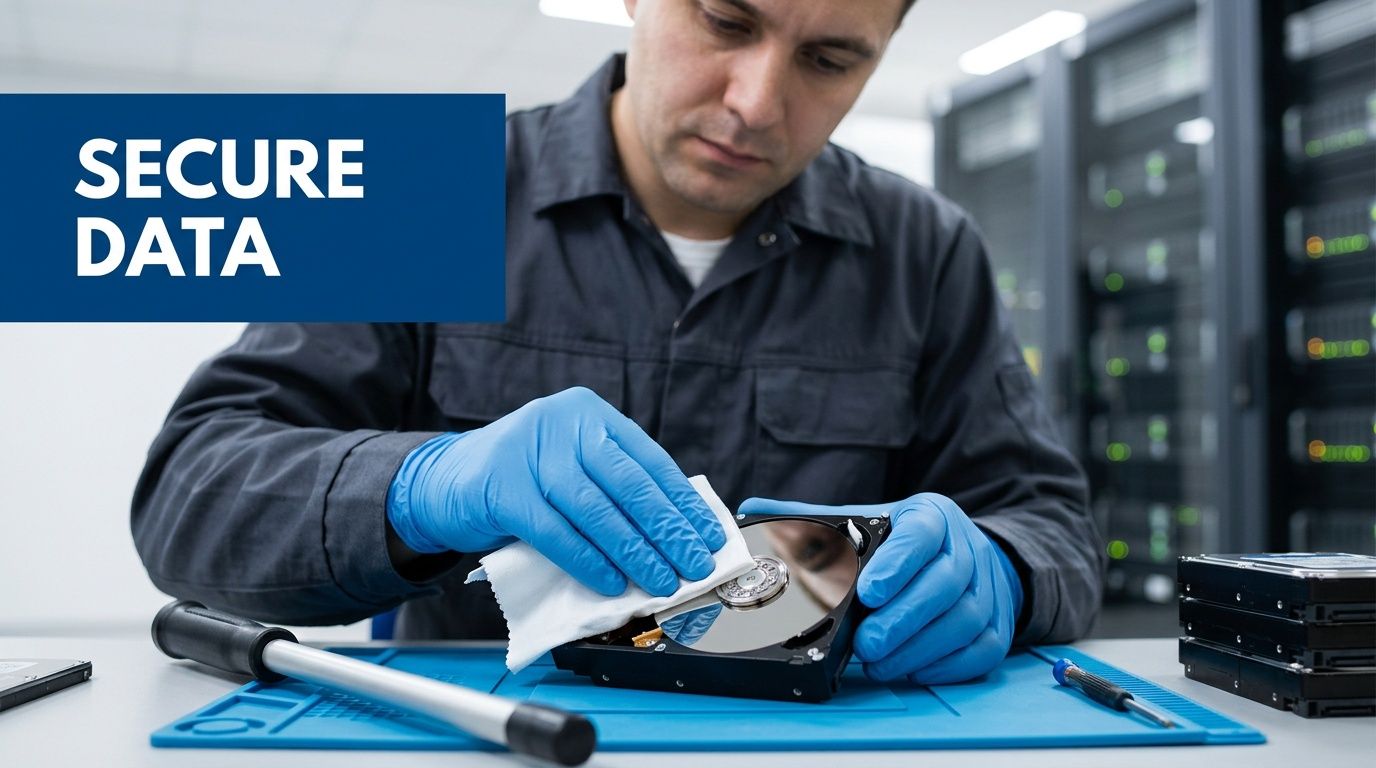
Wiping, degaussing, and shredding aren't interchangeable
Businesses often lump all destruction methods together. They shouldn't.
Software wiping is used when an asset may be remarketed or reused. The point is to sanitize the media while preserving device value. For organizations with refresh cycles and redeployment plans, this can make sense when the process is controlled and documented.
Degaussing disrupts magnetic media. It has a place, but only for certain media types. It isn't a universal answer.
Physical shredding destroys the media itself. If a device is obsolete, damaged, or too sensitive for reuse, shredding is the cleanest risk decision. Healthcare, legal, finance, and public sector teams often prefer this route for obvious reasons.
What a defensible process looks like
A sound disposal workflow usually includes:
- Asset identification before anything moves, including devices people forget about, such as printers, backup units, and embedded storage.
- Controlled pickup and logging so handoff is documented from the start.
- Method selection based on device condition, data sensitivity, and reuse policy.
- Proof of destruction or sanitization retained in a form that supports audits and internal reviews.
One provider in this market, Atlanta data destruction services, offers hard drive wiping to DoD sanitization standards as well as physical shredding for obsolete or nonfunctional media. That mix is what businesses should look for. Not every asset needs the same end-of-life treatment.
What doesn't work
Deleting files doesn't work. Reformatting doesn't work. Letting equipment sit in an unsecured storage room while someone decides what to do with it doesn't work either.
If your policy says data must be protected until destruction, that protection has to extend through pickup, transport, processing, and documentation. A verbal assurance at the loading dock isn't a control.
For HIPAA-regulated organizations, school systems, and government agencies, this isn't just an IT housekeeping issue. It's a records and liability issue. The recycler you choose should make your legal position stronger, not weaker.
Turnkey Electronics Recycling Services for Atlanta Companies
Most businesses don't need a recycler. They need an operator that can take over a messy, time-sensitive project without creating more internal work. That's what turnkey service should mean in practice.

Onsite logistics and secure removal
The first failure point in most recycling projects isn't the recycler's warehouse. It's the pickup itself. Equipment is scattered across departments, nobody has palletized anything, and facilities wants the loading area cleared by a set time.
A competent provider handles de-installation support, packing, staging, and transportation with a clear chain of custody. If your team has to guess what goes in which pile, the process isn't turnkey.
Internal IT asset policies are important. For companies tightening controls before a refresh or relocation, these IT Asset Management Best Practices offer a useful planning framework.
Data center decommissioning
Data center work is a different category from ordinary office cleanouts. These projects involve racks, servers, network gear, storage media, and often compressed timelines tied to lease obligations, migration milestones, or facility transitions.
Good decommissioning work requires:
- Sequenced removal so active dependencies aren't disrupted during tear-down
- Asset segregation between redeployable equipment, resale candidates, and destroy-only media
- Audit-ready records that can be reconciled against internal inventories
- Logistics discipline because high-volume moves create easy opportunities for mistakes
A vendor can sound capable in a sales call and still struggle when the job moves from conference room to server room. Ask how they manage labeling, packing, transport, and exception handling before you sign anything.
Bulk IT asset disposition and emerging e-waste
Office refreshes generate more than desktops and monitors now. Businesses are dealing with batteries, peripherals, mixed-use devices, and specialty equipment that doesn't fit old recycling playbooks.
One issue that's becoming harder to ignore is emerging e-waste. According to First America’s Atlanta recycling overview, lithium-ion batteries and solar panels are projected to see a 50% volume increase by 2028, and certified handling for these items remains a gap among many standard recyclers. That matters for modern facilities, schools, healthcare groups, and firms adopting backup power or energy infrastructure.
A full-service ITAD partner should be able to tell you, plainly:
- what they accept,
- what requires special handling,
- what gets wiped versus destroyed,
- and what records you'll receive at closeout.
For businesses comparing options, IT asset disposition services in Atlanta GA is one example of a provider page that outlines bulk removal, secure handling, and business-focused disposition workflows. The standard to apply is straightforward. If the provider only talks about "junk removal" language, keep looking.
Recycling With Purpose Turning E-Waste into Hope and Habitats
A few programs get employee attention long after the bins are gone. One Atlanta office cleanup stands out for a simple reason. Staff did not talk about pallets, serial numbers, or loading docks afterward. They talked about what the recycling supported.
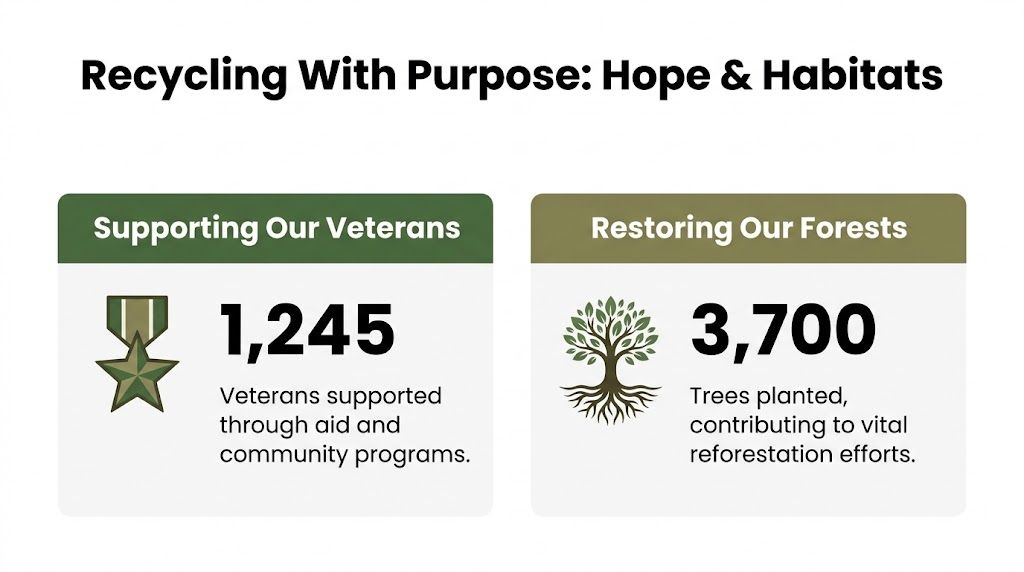
That distinction matters for companies trying to turn a routine disposal project into something employees, customers, and community partners will remember. Certified recycling already addresses environmental handling and downstream accountability. A purpose-driven model adds a second layer. It connects retired electronics to visible community outcomes, in this case support for veterans and reforestation.
Why the mission works
The mission only adds value if the recycling operation is credible first. If collection controls are weak or downstream processing is unclear, the social message starts to look like marketing cover. Companies should treat the social component as an extension of good recycling practice, not a substitute for it.
Recovery performance is part of that credibility. The Institute of Scrap Recycling Industries' electronics recycling overview explains that electronics recycling returns significant volumes of metals, plastics, and glass back into manufacturing supply chains. That is what gives reforestation and veteran-support messaging real substance. The equipment is not just being removed from the office. It is being processed in a way that supports material recovery and reduces waste.
There is also a practical communications advantage. Employees and clients understand two outcomes immediately. Help veterans. Plant trees. That is easier to share internally than a generic statement about environmental responsibility.
How to make it tangible
Cause-based recycling programs work best when the proof is visible and the message stays specific. Vague claims get ignored. Documented participation and clear impact markers get used in town halls, recruiting, customer updates, and CSR reporting.
Good examples include:
- Recycle for a Cause messaging tied directly to veteran support and reforestation
- Seasonal collection events around Veterans Day, Earth Day, and Arbor Day
- Impact certificates that participants can include in CSR files or internal communications
- Published campaign metrics such as 1,245 veterans supported and 3,700 trees planted when those figures are part of the provider's documented program
The social mission should sit on top of disciplined recycling operations. When both are in place, internal participation rises and the company has a stronger story to tell outside the building.
Why this matters for brand trust
Procurement may approve a recycler based on chain of custody and documentation. Employees judge the effort on whether it felt worthwhile. Both views matter.
That is why purpose-driven recycling has strategic value. It gives operations, HR, sustainability, and marketing one project that serves different goals without pulling in different directions. For companies evaluating corporate e-waste solutions for Atlanta organizations, this kind of alignment is often more useful than another generic claim about being environmentally friendly.
An Easy ESG Win for Atlanta's Corporate Leaders
A CFO usually asks two questions before approving any sustainability program. How much staff time will this take, and what can we show for it at the end? Certified electronics recycling answers both if the provider is set up for business use, not just household drop-offs.
The strongest programs fit into work your company already has to do. Retire old laptops. Clear storage rooms. document chain of custody. close out assets. Then add reporting that supports ESG disclosure, employee communications, and community relations without creating a second project for your team to manage.

What a corporate-ready program should include
A business-ready recycling program should cover more than pickup and a generic receipt. It should give Atlanta companies documentation that stands up to procurement review and messaging that does not overstate the impact.
Look for:
- Corporate recycling drives with clear intake rules, site logistics, and pickup windows that do not disrupt operations
- Disposition records that help IT, compliance, and facilities close the loop on retired equipment
- Impact documentation such as tree-planting or veteran-support reporting that can be used in CSR files
- Shareable recognition like a digital “Recycled with Purpose” badge for sustainability pages or recruiting materials
- Executive summaries that translate a recycling event into business outcomes, including risk reduction, material recovery, and social impact
The trade-off is straightforward. A low-cost hauler may remove equipment quickly, but if reporting is thin or the social claim is vague, the project has little value outside facilities cleanup. A certified partner with disciplined documentation and a defined mission gives leadership a result they can defend internally and communicate externally.
A practical example
An Atlanta company replacing office equipment rarely needs a big campaign. It needs a controlled process.
A useful structure is simple: scheduled pickup, documented destruction or recycling, records for internal review, and an impact summary that communications can use without stretching the facts. That approach keeps the project grounded in compliance first, then turns it into a credible ESG asset.
For teams building the internal case, this overview of the business benefits of e-waste recycling helps connect equipment disposition to risk management, sustainability goals, and brand trust.
A good ESG program fits existing operations, produces defensible records, and ties environmental action to a social purpose people can understand.
Schedule Your Purpose-Driven Recycling Pickup Today
The right recycling decision does more than clear out old equipment. It protects sensitive data, supports compliance, and gives your organization a credible sustainability story that people can understand.
A Certified Electronics Recycling Company Atlanta GA should help you do all three without adding administrative friction. That means documented handling, secure destruction options, practical pickup logistics, and a mission that turns retired tech into something constructive.
“Recycling That Restores Lives and Natural Areas” works because it captures the full business case. Your company reduces risk. Your team supports responsible material recovery. Your obsolete devices can also contribute to veteran aid and reforestation.
If your office, school, healthcare facility, agency, or data center has equipment ready for disposition, schedule a pickup, confirm accepted items, and ask for the reporting package before the first box leaves the building.
Frequently Asked Questions
Practical questions usually come down to scope, records, and internal approval. Here are the ones buyers ask most often.
| Question | Answer |
|---|---|
| What does certified e-recycling usually cost? | Pricing depends on the mix of equipment, pickup logistics, labor needs, and whether assets require wiping, shredding, or de-installation. The right way to evaluate cost is against risk reduction, documentation quality, and internal time saved, not haul-away price alone. |
| What items can a business recycler accept? | Most business-focused providers handle common IT assets such as computers, servers, networking gear, drives, monitors, and related electronics. Some also handle specialty items and emerging e-waste categories. Always confirm accepted items in writing before pickup. |
| Do all devices need physical shredding? | No. Some assets can be sanitized for reuse, while others should be physically destroyed based on condition, policy, and data sensitivity. The decision should follow a documented method, not convenience. |
| What paperwork should we expect after service? | Businesses should expect chain-of-custody support, destruction or processing documentation, and closeout records suitable for compliance and internal audits. Ask to see examples before the job starts. |
| Can this support ESG or CSR reporting? | Yes, if the recycler provides environmental and social-impact documentation in a format your company can retain and reference. This is especially useful for annual reporting, employee communications, and community engagement. |
| How do impact certificates work? | In a purpose-driven model, certificates can be issued after the recycling event to document contributions tied to initiatives such as veteran support and tree planting. Confirm timing and format with the provider in advance. |
A last piece of advice. Don't wait until storage rooms are full and the move date is locked. The best outcomes happen when IT, facilities, compliance, and sustainability align before pickup day.
If you're looking for a business-focused partner, Atlanta Green Recycling provides electronics recycling, secure data destruction, and turnkey IT asset disposition for Atlanta organizations, along with a mission-driven model centered on veteran support and reforestation.