
Electronics Recycling Best Buy: Business E-Waste in 2026

The closet usually starts the same way. A stack of retired laptops. A few monitors from the last office refresh. Docking stations nobody wants, tangled power cords, old phones from departed employees, and maybe a couple of hard drives that should have left the building months ago.
For many Atlanta IT managers, the first instinct is practical. Search electronics recycling best buy, load the gear into a few cars, and get it out of sight. For a household cleanout, that can make sense. For a business, especially one handling customer records, patient data, legal files, or financial information, that simple answer often creates a more complicated risk.
The core decision is not whether to recycle. It is: which recycling model fits the assets you are disposing of. Retail drop-off and business-grade IT asset disposition solve different problems. If you choose the wrong one, convenience disappears fast.
Your Office E-Waste Problem A Tale of Two Recycling Paths
An office manager in Buckhead or Midtown usually does not call this an e-waste strategy problem. They call it “that storage room mess.”

What sits in that room is more than clutter. It can include devices with cached credentials, saved spreadsheets, HR records, browser sessions, internal emails, and regulated data. Once a business recognizes that, the conversation changes from “Where can we drop this off?” to “How do we move this securely, document it, and finish the job without creating a compliance headache?”
The fast answer many teams consider
Best Buy comes to mind because it is visible, familiar, and easy to understand. For a few personal devices, the model is straightforward. You bring items in, follow store rules, and complete the drop-off.
That appeals to busy office teams. It feels responsible. It also feels immediate, which matters when space is tight and an executive wants the old equipment gone before the next move, audit, or upgrade cycle.
A lot of Atlanta organizations start there for the same reason they search for business electronics recycling in Atlanta. They want a clear path, not another project.
The two paths are built for different outcomes
The problem is that consumer recycling and corporate asset disposition are not versions of the same service. They are different operating systems.
One is built around public drop-off, household quantities, and broad convenience. The other is built around scheduled logistics, inventory control, data destruction, and documentation.
That difference matters most in these situations:
- Office refreshes: Replacing a floor of laptops and monitors creates volume quickly.
- Moves and consolidations: Assets have to leave on a timeline, often with chain-of-custody concerns.
- Regulated environments: Healthcare, education, finance, legal, and government teams need proof, not assumptions.
- Data center and server retirements: Heavy equipment and storage media need specialized handling.
If the devices came from a business environment, the right question is not “Can someone take them?” It is “Can someone take them with documented control from pickup through final processing?”
That is where the tale splits. One path is convenient for a few consumer items. The other is designed to protect the business that owned them.
Understanding Consumer vs Corporate E-Waste Solutions
Best Buy’s recycling program deserves credit for scale. Best Buy has recycled over 2 billion pounds of electronics and appliances since 2009, establishing it as the nation's largest retail collector of e-waste. This volume is collected as up to three items per household per day according to Best Buy’s corporate recycling program information. That tells you exactly what the model is optimized for: consumer access at national retail scale.
That is not a flaw. It is a design choice.
What the consumer model does well
Retail recycling works well when the user is an individual with a small number of items and limited need for documentation. The strengths are obvious:
- Accessible locations: A store network is easier to reach than a specialized processor.
- Simple household use case: One person, a few devices, quick handoff.
- Familiar process: Consumers know how a store works.
This is why searches around electronics recycling best buy are so common. The retailer solved a real public access problem.
What the corporate model is built to handle
Business recycling has a different job. It is not just disposal. It is risk-managed retirement of IT assets.
A business-grade model generally has to answer questions a retail counter does not:
- Which devices were removed from service?
- Who handled them at each stage?
- Was data wiped or physically destroyed?
- Can the company prove what happened during an audit?
- Can pickup happen onsite, on schedule, and without breaking operations?
Those are not edge cases for businesses. They are the core workflow.
A useful way to think about it is this: the corporate side is closer to IT asset disposition than casual recycling. The work includes security, logistics, reporting, and environmental processing.
For a deeper look at where the retail option fits and where it does not, this page on whether Best Buy recycles computers is useful because it frames the service from the business user’s perspective.
The mismatch businesses run into
The consumer model assumes low complexity. Businesses usually bring high complexity.
A company does not just have “old electronics.” It has retired endpoints, failed drives, surplus peripherals, network gear, backup devices, and possibly assets tied to internal controls or regulated records. Even when a retail option accepts part of that mix, the business still has to manage transport, staging, proof, and responsibility.
A retailer can be the right answer for a household cable box or an unused keyboard. It is rarely the complete answer for a company that needs defensible data handling.
That is the central difference. Consumer recycling is about access. Corporate e-waste disposition is about control.
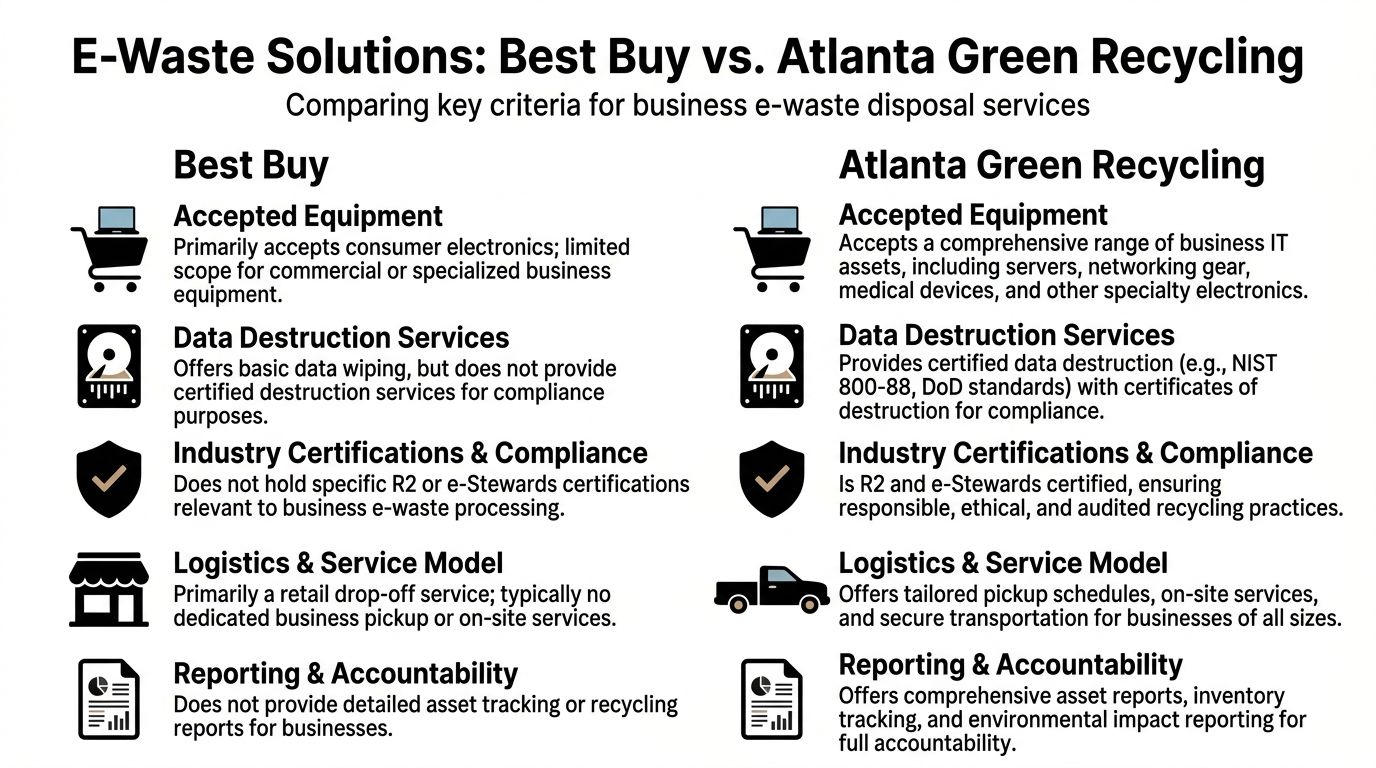
Best Buy vs Atlanta Green Recycling A Detailed Comparison
For an Atlanta business, the practical question is not which option sounds greener. It is which option fits the way business assets leave service.
Here is the side-by-side view.
| Criterion | Best Buy (Consumer Retail) | Atlanta Green Recycling (B2B Certified) |
|---|---|---|
| Service model | Retail drop-off built around household participation | Scheduled business service designed for organizational asset retirement |
| Volume handling | Up to three items per household per day in most participating stores | Built for bulk pickups, office refreshes, and larger decommissioning projects |
| Logistics | Customer transports assets to the store | Onsite pickup, packing, removal, and business-oriented logistics |
| Data destruction | Consumer-facing processing through certified partners | Documented wiping and physical destruction workflows for business needs |
| Chain of custody | Limited fit for audit-heavy environments | Designed around traceability and documented handoff |
| Compliance fit | Better for consumers than regulated business environments | Better aligned with healthcare, government, education, and enterprise controls |
| Reporting | Limited business reporting expectations | Asset tracking and compliance-ready documentation |
| ESG story | Broad recycling participation | Recycling tied to veteran support and tree planting impact |
Volume and workflow fit
A retail model works when the quantity is small and the user can self-transport. That breaks down quickly in a business setting.
A department cleanout rarely consists of three harmless items. It is usually a mixed batch spread across desks, closets, and server rooms. The work includes boxing, lifting, moving, sorting, and tracking. Once you assign staff time to that, “free and convenient” looks different.
A business recycler starts at the opposite end. The pickup is planned around the volume, the building, the loading constraints, and the internal handoff process.
Data destruction standards
Here, the gap becomes serious. Best Buy’s partners are R2 certified, but that industry-backed standard may not meet the needs of regulated industries. The Trellis analysis notes concerns around guaranteed DoD sanitization standards and documented chain of custody for corporate clients in this review of how Best Buy makes money recycling electronics.
For a business, “the device was recycled” is not enough. You need to know what happened to the data-bearing media.
In regulated environments, secure disposal means documented sanitization or destruction. Anything less leaves your team relying on trust when auditors expect records.
That is why enterprise-focused providers put data destruction at the center of the service, not as an implied step.
Chain of custody and documentation
A retail drop-off model is public-facing by design. That means it is not built around individualized asset logs, serialized intake controls, or the kind of audit packet a compliance officer may request later.
Business workflows need a paper trail. A custody record matters because many devices do not stop being risky when they are powered off. They stop being risky when the company can prove what happened to them.
This is one reason many Atlanta organizations look specifically for IT asset disposition companies instead of generic recycling options. They are not buying disposal alone. They are buying a controlled process.
Pickup and operational burden
Getting equipment to a store sounds simple until the devices are in cubicles on three floors, some are still mounted, and several managers want a signoff before anything leaves.
A business service can coordinate with facilities, IT, office operations, and security. That avoids the common retail workaround where employees use personal vehicles, make multiple trips, and keep informal notes that are hard to reconcile later.
That matters even more during moves, closures, and lease-end events.
Fees and practical economics
Retail recycling often has item-based fees and acceptance rules. That can be fine for a one-off TV or monitor. It is less useful when an office has mixed categories and the goal is to clear everything in one controlled event.
The hidden cost in retail is usually labor. Staff time disappears into sorting, carrying, driving, waiting, and documenting after the fact.
Compliance posture
Not every business needs the same level of control. But once your organization handles patient, financial, legal, educational, or government data, the threshold changes. Then the right provider is the one that can support policy, audit, and risk management requirements.
ESG and brand value
There is another difference that retail programs usually cannot offer. A mission-driven B2B recycler can convert disposal into a documented sustainability and social impact story.
That matters for companies building ESG reporting, internal culture campaigns, Earth Day activations, Veterans Day partnerships, and procurement narratives. If your retired equipment can support veterans and tree planting, the recycling event becomes more than back-office cleanup. It becomes evidence of values in action.
Why Atlanta Businesses in Regulated Industries Need More
For a hospital system, law office, school district, financial firm, or public agency, retired devices are not low-risk scrap. They are former data containers.

That changes the standard. In these settings, the baseline is not “recycle responsibly.” The baseline is retain control until the organization has proof that data-bearing assets were handled according to policy.
Healthcare and patient data
Healthcare teams in Atlanta work under relentless scrutiny around protected information. A retired workstation from admissions, imaging, billing, or nursing can contain cached records or access paths that make casual disposal unacceptable.
The problem is not only the hard drive itself. It is also the lack of an audit-ready trail if someone asks later what happened, when it happened, and who authorized it.
Legal and financial records
Law firms and finance teams have a different profile, but the same exposure. Devices may store client files, contract drafts, tax records, deal documents, or communications protected by internal policy and external obligations.
A retail handoff creates uncertainty. Even if the program is environmentally credible, uncertainty around documentation is a weak point. Compliance teams do not want “probably handled correctly.” They want records.
The unanswered question many businesses ask
One of the clearest signs of the gap is that common business questions such as whether Best Buy offers secure hard drive wiping for HIPAA compliance often go unanswered in consumer-facing FAQs, as noted on Best Buy’s recycling service page. That tells business users something important. The program is not written around enterprise compliance scenarios.
If you have to infer the answer for a regulated workflow, the service probably is not built for that workflow.
What regulated teams need
The requirements tend to look like this:
- Documented intake: Assets are identified before they leave the company’s control.
- Secure transport: Devices move through a managed handoff, not an improvised errand.
- Certified destruction or sanitization: The media treatment matches policy.
- Proof for auditors: The organization can produce records later without rebuilding the event from memory.
- Operational coordination: Pickup, de-installation, and timing fit the business environment.
If your compliance officer would ask for a certificate or a custody record, a consumer retail program is the wrong default.
For organizations that need audit support, a formal certificate of destruction is often the dividing line between general recycling and defensible IT asset disposition.
In practice, that means regulated industries need more than a place that accepts electronics. They need a provider that understands why the electronics matter before they become scrap.
A Simple Decision Framework for Your E-Waste
Most companies do not need a long committee debate. They need a short, defensible process.
Start with these questions.
How many devices are you moving
If the answer is a small handful of low-risk items, a retail option may be workable.
If the answer is an office refresh, a move, or anything that fills carts and closets, retail becomes awkward fast. Best Buy’s model includes a three-item daily cap and consumer-focused fees such as $29.99 for a TV. A typical office refresh of 50 devices would require over two weeks of daily drop-offs, according to this breakdown of Best Buy recycling limits and fees.
That is not just inefficient. It invites inconsistent handling.
Do the devices contain sensitive data
This should be the first hard stop.
If laptops, desktops, servers, or drives ever touched employee, customer, patient, student, or financial information, use a certified business process. Do not rely on assumptions about what might happen after drop-off.
Do you need documentation later
Ask yourself what happens if one of these groups requests proof:
- Internal audit
- Compliance or legal
- Cybersecurity leadership
- A client with vendor requirements
- A regulator
If the answer is “we would need records,” choose a provider that treats documentation as part of the service, not as an afterthought.
Does pickup matter operationally
For many offices, this is the hidden issue. If your team has to unplug, box, carry, drive, unload, and repeat, the disposal plan is now consuming staff time that should be spent elsewhere.
That is why good disposal planning belongs inside broader asset governance. This guide to IT Asset Management Best Practices is useful because it frames retirement as part of lifecycle control, not a last-minute cleanup task.
A practical rule of thumb
Use this quick filter:
- Few items, no sensitive data, no audit need: Retail may be adequate.
- Business devices with any data exposure: Use a certified business recycler.
- Bulk equipment, office closures, or infrastructure retirements: Use a pickup-based business process.
- Any uncertainty about compliance: Choose the path with formal controls.
The safest decision is usually the one you can explain clearly to your security lead six months later.
If your team needs a formal framework for end-of-life handling, reviewing what IT asset disposition includes helps turn this from a one-off disposal event into a repeatable business policy.
Recycle with Purpose Turn E-Waste into an ESG Win
Most companies now understand that electronics should stay out of landfills. That is the minimum standard.
The stronger opportunity is to turn retired tech into something your company can stand behind in a sustainability report, an employee update, or a community impact campaign.
Compliance can also tell a better story
A mission-driven recycling model does more than remove risk. It gives the business a concrete narrative: old devices were handled securely, diverted responsibly, and tied to visible community benefit.
That is useful for ESG teams, procurement leaders, HR, and communications departments because the disposal event no longer disappears into back-office operations. It becomes a measurable act of corporate citizenship.
Why transparency matters
Questions around downstream transparency still follow the e-waste industry. As noted in reporting on retailer recycling and export concerns, watchdog groups estimate that a high percentage of U.S. e-waste risks improper export. The same discussion highlights a mission-driven alternative with verifiable impact including 1,245 veterans supported and 3,700 trees planted in this ERI-related discussion of Best Buy e-waste recycling and transparency concerns.
Those two impact numbers are powerful because they are specific and visible. They give CSR-minded companies something retail recycling usually does not: a human outcome and an environmental outcome tied to the act of disposal.
What a purpose-driven business program can unlock
For Atlanta companies, this creates several practical uses:
- Veterans Day campaigns: Position electronics collection as support for veteran housing and aid.
- Earth Day and Arbor Day drives: Connect office cleanouts to tree planting and reforestation messaging.
- Employee engagement: Staff participation rises when the recycling event has a cause attached to it.
- Client-facing ESG proof: Procurement teams and sustainability leads can point to a documented initiative rather than generic disposal.
A phrase like “Your old tech can house a veteran and grow a forest” works because it translates a technical service into human language.
The strongest differentiator retail cannot match
A big-box retailer can offer convenience. It usually cannot offer an ESG package that includes impact counters, purpose-based certificates, or a branded “Recycled with Purpose” identity that companies can use in internal reports and external communications.
That matters more than many IT managers expect. Once legal, sustainability, and leadership teams see the disposal program as both risk control and community impact, budget approval gets easier and participation gets broader.
The best recycling program is not only secure and compliant. It also gives your company a result people can understand without reading an asset ledger.
That is where the best business e-waste programs separate themselves. They do the technical work properly, then turn that work into something meaningful.
Frequently Asked Questions for Atlanta Businesses
Is Best Buy a good option for business electronics recycling
Sometimes, but only in a narrow use case. If you have a few low-risk items and do not need formal documentation, retail drop-off can be practical. For company-owned devices, mixed loads, or anything tied to sensitive data, a business-focused process is usually the safer fit.
Can a retail recycling program handle office cleanouts
It can handle pieces of an office cleanout. It is not usually the best operational model for the whole event. Businesses often underestimate the time required to sort, transport, and track equipment outside a managed pickup workflow.
What is the biggest risk with using a consumer recycling option for business devices
The biggest risk is not environmental. It is loss of control over data handling and documentation. If your company may later need proof of sanitization, destruction, custody, or asset disposition, informal transport and consumer intake create avoidable exposure.
Which Atlanta businesses should avoid the retail route
Any organization in healthcare, legal, finance, education, government, or enterprise IT should be cautious. The same applies to data centers, firms with remote worker equipment returns, and companies closing or relocating offices.
Does secure recycling always mean physical shredding
No. The right method depends on the media type, the business policy, and the compliance requirement. Some assets can be sanitized and documented. Others should be physically destroyed. The key is that the process is defined, controlled, and provable.
When should an IT manager involve procurement or legal
Early. Bring them in before the equipment leaves the building if your organization has vendor standards, customer security obligations, or audit requirements. Disposal is part of governance, not just facilities cleanup.
Can recycling support ESG and CSR goals in a meaningful way
Yes, if the provider can document both environmental handling and community impact. Cause-based programs tied to veteran support and tree planting give companies a stronger internal and external story than generic recycling alone.
What should I ask any e-waste vendor before approving them
Use a short list:
- How is data destroyed or sanitized
- What documentation is provided
- How is chain of custody maintained
- Can you handle pickup and onsite logistics
- What reporting will we receive
- How do you support our sustainability goals
If the answers are vague, keep looking.
If your company needs a secure, documented, Atlanta-focused alternative to consumer retail drop-off, Atlanta Green Recycling helps businesses retire IT assets with compliant data destruction, pickup logistics, and a mission-driven model that supports veterans and tree planting. For organizations that want electronics recycling to reduce risk and create real community impact, it is a practical next step.