
The 2026 Guide to Data Center Georgia Decommissioning: Secure, Compliant & Mission-Driven Solutions

Welcome to the heart of the South's digital revolution. The data center Georgia market, especially around Atlanta, isn't just growing—it's exploding. This boom, driven by massive AI and hyperscale demands, brings a serious challenge to the surface: how to handle the constant flow of retired IT assets with security and purpose.
Decommissioning in Georgia's Exploding Data Center Market

With Georgia's tech infrastructure expanding at a breakneck pace, what used to be a standard operational task—decommissioning—has morphed into a major logistical and security puzzle for IT leaders.
When you're retiring thousands of servers, drives, and network devices, a solid plan isn't just a nice-to-have. Without one, you're facing a potential nightmare of sky-high costs, compliance penalties, and even data breaches.
This guide is your blueprint for navigating a decommissioning project right here in the Peach State. We'll show you how to turn a source of stress into a strategic, manageable workflow. By putting security, compliance, and your corporate mission first, you can pull off a seamless project that protects your data and elevates your brand.
The Scale of Georgia's Data Center Boom
The numbers behind Georgia's data center surge are truly something to behold. Metro Atlanta just shattered records with nearly 3,968 megawatts (MW) of data center capacity currently under construction.
This explosive growth means a constant flood of retiring IT assets is on the horizon. Frequent hardware refreshes and rapid buildouts are creating a huge demand for secure data wiping that meets DoD standards and certified destruction.
But this is about more than just getting rid of old equipment. It's a strategic end-of-life process. With the right partner, your obsolete tech can be recycled to restore lives and landscapes.
Recycling That Restores Lives and Landscapes. A decommissioning project is a critical moment to fortify your data security, demonstrate environmental stewardship, and enhance your corporate social responsibility (CSR) profile by turning e-waste into hope.
Imagine your old servers funding veteran support programs and planting new forests. Our website features live impact counters showing stats like "1,245 veterans supported" and "3,700 trees planted," offering transparent proof of our dual mission. You can learn more about how a strategic partnership works in our guide to data center services in Georgia.
Your High-Level Decommissioning Roadmap
Every successful project starts with a foundation of clear, well-defined phases. While the details of your project might be unique, the core process is remarkably consistent. Getting a handle on these stages is the first step toward a smooth execution.
To help you get started, we've outlined the essential stages in a decommissioning project. Think of this as a high-level map to guide your initial planning.
Data Center Decommissioning Core Phases at a Glance
| Phase | Key Objective | Critical Action Items |
|---|---|---|
| Strategic Planning & Asset Inventory | Define scope, goals, and create a complete asset list. | Identify all hardware, create serialized inventory, set project timeline. |
| Data Security & Compliance | Ensure all data is sanitized according to regulations. | Choose data destruction method (wipe, degauss, shred), confirm compliance. |
| Logistics & Onsite Execution | Safely de-install, pack, and transport all assets. | Coordinate de-racking, palletize hardware, manage secure transport. |
| Asset Disposition & Recycling | Responsibly recycle equipment and generate social impact. | Partner with a certified R2v3 recycler, track assets to final disposition. |
| Documentation & Impact Reporting | Obtain auditable proof and showcase your ESG contribution. | Secure Certificates of Data Destruction, Recycling, and Impact Reports. |
This framework gives you a clear path forward. By tackling each phase with a qualified ITAD partner, you can confidently manage the complexities of a major data center Georgia decommissioning, ensuring complete security and a positive community impact.
Before you even think about unplugging a single server in your data center in Georgia, there's a critical conversation we need to have: data security and the maze of compliance rules that come with it. For any business in the Atlanta metro area and beyond, this isn't just about checking a box. It's the essential first step to sidestepping a data breach, avoiding hefty fines, and protecting the reputation you've worked so hard to build.
The second you earmark a piece of hardware for decommissioning, it becomes a liability. Every single hard drive, SSD, and backup tape is a ticking time bomb if it’s not handled correctly. This is where a deep understanding of federal and industry-specific standards becomes your best asset. A solid data destruction plan is your proof of diligence and your shield during an audit.
Getting a Handle on Data Sanitization Standards
When it comes to wiping data securely from old IT assets, two standards really set the bar: NIST 800-88 and DoD 5220.22-M. They might sound overly technical, but the concepts are pretty straightforward and absolutely vital for keeping sensitive info safe.
NIST 800-88 (Purge): This is the gold standard today. It’s a method of wiping data that's forensically sound, overwriting every bit of data with random characters. The original information becomes impossible to get back, even with advanced lab tools. This is the go-to if you're thinking about remarketing the hardware, as it keeps the asset’s value intact.
DoD 5220.22-M (Clear): This is an older, but still very respected, standard. You might hear it called a "DoD wipe," and it involves a three-pass overwriting process. It's a very effective way to sanitize data, though most experts now lean on NIST 800-88 as the more definitive method, especially for newer drives.
Deciding which one to use really comes down to how sensitive your data is and what you plan to do with the hardware afterward. But when you absolutely, positively cannot risk data recovery, nothing beats physical destruction.
For organizations handling highly sensitive information, physical destruction isn't just an option; it's a necessity. The process guarantees that data can never be recovered because the media it was stored on no longer exists in a readable form.
This is where bringing in a certified partner is a game-changer. We dive deep into how to make your data completely irrecoverable in our guide to comprehensive IT asset destruction. A professional ITAD vendor can handle both sophisticated data wiping and on-site shredding, giving you a serialized Certificate of Data Destruction—the official, auditable proof that you’ve met your compliance duties.
Georgia’s Industry-Specific Compliance Rules
Beyond the general standards, many Georgia businesses operate under strict, industry-specific data laws. A misstep here can bring on some serious penalties. For any data center Georgia decommission project, you've got to be aware of regulations like these:
HIPAA (Health Insurance Portability and Accountability Act): If you're in healthcare—a provider, insurer, or a business associate—HIPAA is non-negotiable. Any device that has ever touched Protected Health Information (PHI) has to be sanitized or destroyed following very specific protocols. A single breach can lead to fines in the millions.
GLBA (Gramm-Leach-Bliley Act): Financial institutions, from the big banks to the investment firms in Atlanta's financial district, live by GLBA. The law demands they protect consumer financial data, making secure data destruction a required part of any equipment's retirement plan.
SOX (Sarbanes-Oxley Act): For publicly traded companies, SOX compliance is a must. It governs how corporate financial records are handled and reported. Making sure your ITAD process is buttoned up is a key part of staying on the right side of SOX.
There's no room for error when it comes to these requirements. The only way to ensure a fully compliant decommission is to work with a certified ITAD partner who knows the lay of the land in Georgia. They bring the expertise and, just as importantly, the documentation you need to turn a complex headache into a secure and streamlined process.
Executing Secure Data Destruction and Asset Logistics
The plan is set. Now comes the moment where strategy meets the physical world of servers, racks, and hard drives. This is the hands-on phase, and it’s all about making sure every single byte of sensitive data is verifiably destroyed and every piece of hardware is tracked from your facility to its final destination.
Getting this part right is everything. A single misplaced hard drive or a poorly documented shredding job can unravel the entire project, creating massive security holes and guaranteed audit failures. For any data center Georgia operator, a professional, disciplined approach here isn't just a good idea—it's non-negotiable.
Choosing the Right Data Destruction Method
Before you wipe or shred a single drive, you need to be crystal clear on your organization's data retention policy. This policy is your roadmap, telling you exactly what information must go and when.
Once you know what to destroy, you’ve got three main options. Each one strikes a different balance between security, cost, and the potential to recover some value from your old assets.
To help you decide, we've broken down the most common techniques. Think about your specific security needs, budget, and what you plan to do with the hardware afterward.
Choosing Your Data Destruction Method
| Method | How It Works | Best For | Compliance Level | Key Consideration |
|---|---|---|---|---|
| Data Wiping (NIST 800-88 Purge) | Software overwrites every sector of a drive with random data, making the original data forensically unrecoverable. | Drives that will be resold or reused, as it preserves the hardware. | High (Meets DoD and NIST standards) | Requires functional drives and can be time-consuming for large volumes. |
| Degaussing | A powerful magnetic field is used to instantly and permanently erase all data from magnetic media like HDDs and tapes. | Rapidly sanitizing large quantities of magnetic hard drives and tapes. | Very High (Renders drive unusable) | Ineffective on Solid-State Drives (SSDs) and destroys the drive. |
| Physical Shredding | Industrial shredders pulverize drives and other media into small, irrecoverable fragments. | The ultimate security for failed drives, SSDs, and highly sensitive data. | Absolute (Highest level of security) | Completely destroys the asset, eliminating any potential for resale value. |
Looking at the options, you can see how the right choice depends entirely on the asset.
In my experience, most projects end up using a hybrid approach. It’s often the most practical path. You might wipe functional, high-value servers to resell them, while physically shredding older, failed, or extremely sensitive drives to ensure absolute data elimination.
Onsite vs. Offsite: The Chain of Custody Advantage
After picking your method, the next big question is where the destruction happens. Offsite services can seem cheaper upfront, but onsite destruction delivers a level of security and peace of mind that’s hard to beat.
When a certified vendor brings a mobile shredding truck directly to your data center in Georgia, you can witness the entire process yourself. This simple act eliminates the single biggest risk in decommissioning: transporting live data over public roads. For any organization dealing with HIPAA or GLBA regulations, this visual proof is your golden ticket for compliance.
This flowchart can help you map out the initial decision-making process for different data types.
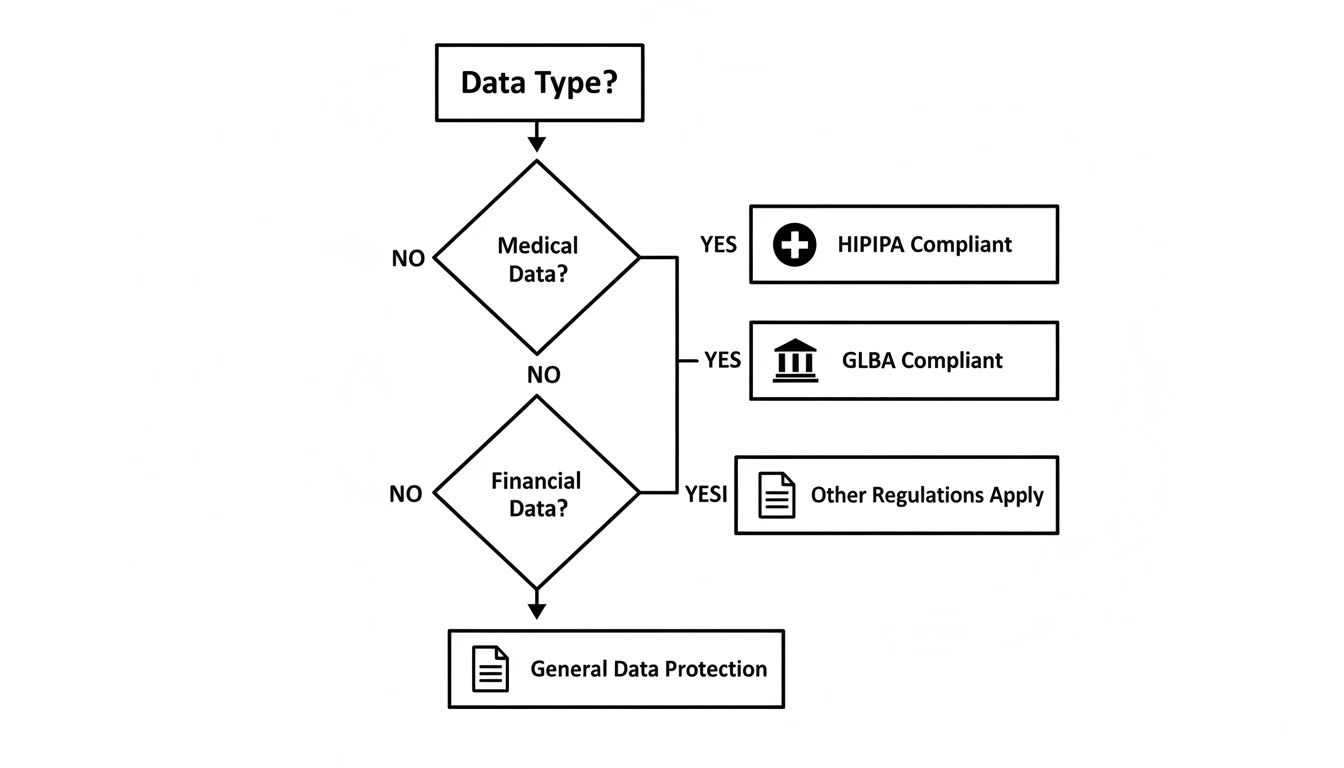
Think of the graphic as a starting point—it quickly guides you toward the right compliance framework based on the information your equipment holds.
Key Takeaway: The single greatest security advantage in any decommission is minimizing the movement of live data. Onsite shredding ensures your data never leaves your premises intact.
Maintaining an Auditable Chain of Custody
The moment a server is unplugged, a strict chain of custody must begin. This isn't just a suggestion; it's a core requirement for a defensible and auditable process. It all comes down to creating a detailed, serialized inventory of every single asset.
Here's what that looks like in the real world:
- Serialized Inventory: First, every asset—server, HDD, switch, you name it—gets a unique serial number and barcode tag.
- Scan at Every Touchpoint: As equipment is de-installed, moved to a pallet, and loaded for transport, it gets scanned. Every single time.
- Secure Transport: If assets have to be moved offsite, they travel in locked, GPS-tracked vehicles. No exceptions.
- Final Documentation: At the end, you receive a Certificate of Data Destruction and a Certificate of Recycling. These documents list every serial number, giving you definitive proof that each asset was handled exactly as planned. We also provide Impact Certificates, showing exactly how many trees you planted and veterans you helped.
This meticulous tracking ensures there are no "ghost assets" that vanish without a trace. You can see how this all fits together by taking a look at our complete data center decommissioning process. It’s this level of detail that holds up under the toughest audit and gives you total confidence in your project's security and integrity.
Mastering the Logistics of Your Decommissioning Project
Once your data security strategy is locked in, the project moves from the whiteboard to the data center floor. This is where the rubber meets the road—the physical work of de-installing, packing, and moving potentially thousands of sensitive IT assets.
Frankly, this phase is all about coordination. One small mistake can lead to damaged equipment, security holes, or even unexpected downtime for your core business. Solid project management is what keeps everything on track, ensuring the physical teardown happens without a hitch.
De-Installation and Packing Best Practices
The real work starts at the rack. Every single server, switch, and storage array needs to be carefully disconnected and removed. This isn't just about yanking cables; it's a precise task to avoid damaging the equipment or the facility's infrastructure.
After that, the focus immediately shifts to secure packing.
- Server Handling: Each server should be pulled from its rack, placed inside an anti-static bag, and then packed snugly into custom server boxes or secure, padded bins.
- Rack Transport: If you're moving entire racks, they have to be thoroughly shrink-wrapped and secured. Any shifting during transit can cause major damage.
- Palletizing: All assets need to be professionally palletized. This means stacking them securely and shrink-wrapping the entire pallet. Crucially, every pallet must be labeled to match your master inventory list.
This level of detail matters. Poorly packed gear isn't just at risk for physical damage—which kills any resale value—it also turns the pickup process into a disorganized mess.
Tip: Label everything twice. Put one label on the asset itself and another on the outside of the box or wrap. It sounds redundant, but it's a lifesaver if an outer label gets torn off. This simple step guarantees every piece of equipment is tracked from the moment it's powered down.
Coordinating Secure Transport and Pickup
This is where your collaboration with an ITAD partner becomes absolutely critical. Your provider should show up with the right team and the right tools—plenty of dollies, pallet jacks, and the correct lift-gate trucks to handle the sheer volume of assets.
For any organization with a data center in Georgia, the actual transport of assets is a huge security checkpoint. That journey from your loading dock to the disposition facility is a potential weak link in your chain of custody. This is exactly why you want a partner that operates its own fleet of GPS-tracked, secure vehicles. It adds a non-negotiable layer of security and accountability.
A well-coordinated pickup is fast and efficient, minimizing disruption. The ITAD team should work seamlessly with your staff to clear the space quickly so you can get on with whatever is next for your facility. We even offer free pickup for businesses recycling 50+ devices.
To see how these logistical steps plug into the larger project, our comprehensive data center migration checklist provides a full framework to ensure no detail gets missed. Getting the logistics right means your decommission project finishes securely, on schedule, and on budget.
Choosing Your Georgia ITAD Partner to Boost ESG Goals

After you've mapped out the logistics of your decommission, you’ll face what is arguably the most impactful decision of the entire project: choosing your IT Asset Disposition (ITAD) partner. This choice goes so much deeper than just hunting for the lowest price. It's a strategic move that directly shapes your company's security posture, compliance record, and even your public image.
In the bustling data center Georgia market, the right vendor can turn this operational headache into a powerful win for your Environmental, Social, and Governance (ESG) reports. A mission-driven partner looks beyond simple recycling, transforming your retired tech into a story of real community impact.
And the need for these services is exploding. Georgia is bracing for 285 new data centers—a staggering 176% surge—meaning the demand for responsible IT retirement is about to go through the roof. This boom has IT managers scrambling for partners who target keywords like "electronics recycling for veterans," "Atlanta tech recycling," and "corporate sustainability electronics disposal" not just for SEO, but as a core mission. You can get a closer look at this trend in this article about the growth of data center infrastructure.
Partnering for Corporate ESG and CSR Wins
In today's world, positioning your company as a responsible corporate citizen isn't just a "nice-to-have"—it's essential. A forward-thinking ITAD partner makes hitting your sustainability targets simple and, more importantly, measurable. Imagine turning your annual tech refresh into a highlight of your ESG strategy with a "Recycle for a Cause" campaign.
Instead of a simple receipt, you receive detailed reports showcasing your positive impact. This is the kind of documentation that makes your CSR reports shine.
Look for a vendor who offers more than the basics:
- Corporate Recycling Drives: Does the partner offer free pickups for 50+ devices and follow up with tangible proof of your contribution, like Plant-A-Tree certificates or Veteran Support Impact Reports?
- LinkedIn Thought Leadership: A great partner doesn't just do the work; they showcase it. They publish case studies detailing how clients used their services to hit specific CSR goals, giving you a clear roadmap.
- Eco-Badge Certification: Something as simple as a digital "Recycled with Purpose" badge for your website or sustainability reports offers instant social proof of your commitment.
Your old tech can house a veteran and grow a forest. By choosing an ITAD partner with a real social mission, you’re not just incurring a cost—you’re crafting a powerful brand story. That’s a narrative that resonates with employees, customers, and investors alike.
Engaging the Community and Building Credibility
Real impact is always built at the local level. An ITAD partner with deep roots in Georgia can help you build genuine credibility through authentic community engagement. This grassroots approach amplifies your message and shows a real commitment to the Atlanta area, not just a checked box on a corporate mandate.
This is where a partner’s philanthropic model can truly set them apart. By aligning with a vendor that actively supports local causes, your decommissioning project becomes part of a much larger, positive story.
Key Engagement Strategies:
- Veteran & Environmental Nonprofit Partnerships: Imagine co-hosting a recycling drive with a local VFW chapter or an environmental group. This connects your company's name directly with the community you're helping.
- Local Press Features: A partner with a compelling story—like supporting both veterans and the environment—can land features in outlets like the Atlanta Journal-Constitution, earning valuable media attention for both of you.
- City & School Collaborations: Partnering on a "Greener Atlanta" e-waste collection initiative with local schools or city governments creates visible, positive change that people notice.
The right partner doesn't just recycle your assets; they become a force multiplier for your company’s goodwill. To see how these collaborations work in the real world, check out our guide on how we support facilities like the QTS Data Center in Atlanta, GA.
Ultimately, your choice of partner defines the legacy of your retired assets. Will they be a potential liability, or will they become a source of hope and restoration? When you choose a partner committed to turning e-waste into tangible good, you make a decision that benefits your bottom line, your brand, and your community.
Common Questions About Georgia Data Center Decommissioning
When you're staring down a data center decommission project in Georgia, a lot of questions pop up. It’s a big job, and everyone from IT managers to facility operators wants to get it right—from having audit-proof paperwork to making sure the project aligns with the company's ESG goals. Let's walk through some of the most common questions we hear to help you plan with more confidence.
What Are the Biggest Mistakes to Avoid?
In our experience, the most damaging and expensive mistakes almost always come from poor planning and picking the wrong partner. One of the biggest blunders we see is not creating a detailed, serialized asset inventory before anything leaves the building. When you skip this, you create huge security holes and often lose track of assets, which leaves your audit trail in shambles.
Another major misstep is choosing an ITAD partner just because they gave you the lowest price, while completely overlooking critical certifications like R2v3 or e-Stewards. Think of these certifications as your insurance policy for data security and environmental compliance. Cutting corners here can expose your company to massive legal and financial headaches later on.
Finally, you can't forget to get a serialized Certificate of Data Destruction. This isn't just a piece of paper; it's your only verifiable proof that every single drive and device was properly wiped or destroyed. Forgetting this critical step leaves you wide open during an audit and fails to close the loop on compliance.
A decommissioning project is a golden opportunity to turn an operational cost into a strategic brand and CSR win. The biggest mistake is treating it as a simple disposal task rather than a chance to bolster your company's ESG story and community impact.
How Can This Project Support Our Company's ESG and CSR Goals?
This is a great question, because a data center decommission is an incredibly powerful—but often missed—opportunity to boost your company's ESG (Environmental, Social, and Governance) profile. The environmental 'E' is the clearest link. When you work with a certified R2v3 or e-Stewards recycler, you're guaranteeing that 100% of your e-waste is managed responsibly and kept out of landfills.
The social 'S' is where you can really tell a unique story. Your choice of vendor matters. By partnering with a company that has a clear social mission—like one that uses proceeds to support local veterans and fund reforestation projects—you’re turning a routine operational cost into a real, positive impact on the community. We even create short video stories showing veterans receiving aid or reforestation footage from your donation to make the impact tangible.
Instead of just recycling, you're "Turning E-Waste into Hope." You'll receive a personalized Impact Certificate stating something like, "You planted 3 trees and helped 1 veteran," turning an expense into an investment in your brand's reputation and showing that your commitment to social good is more than just talk.
How Do We Prove Our Data Was Securely Destroyed for Audits?
Absolute, undeniable proof comes down to the documentation your certified ITAD vendor provides. You should never sign off on a project until you have a serialized Certificate of Data Destruction in hand. This is non-negotiable.
The certificate needs to list every single hard drive and data-bearing device by its unique serial number. It should also clearly state the destruction method used for each one, whether it was a NIST 800-88 Purge (a specific type of data wipe) or physical shredding.
Beyond the destruction certificate, you should also require:
- A full chain of custody report: This is a logbook that shows an unbroken trail of who handled your assets, from the moment they left your facility to their final disposition.
- A Certificate of Recycling: This document confirms that all the other parts—the chassis, plastics, and shredded metals—were processed in an environmentally sound way.
- A Veteran Support & Reforestation Impact Report: This unique document details the social good generated by your project, perfect for your CSR documentation.
With these documents together, you build a rock-solid, auditable trail. It’s the concrete evidence you need to show you’ve met all your legal and corporate duties for both data security and environmental care.
What's a Realistic Timeline and Cost for a Decommission in the Atlanta Area?
There’s really no "one-size-fits-all" answer here; the project's scope will drive both the timeline and the budget. A small job, like clearing out a single colocation cage, might only take a few days. On the other hand, a full-blown decommission of a large enterprise facility with hundreds of racks could take several weeks or even months of careful coordination.
The cost is mostly determined by three things:
- Volume of Assets: The total number of servers, drives, and network gear that need to be handled.
- Data Destruction Method: On-site physical shredding, for instance, usually costs more than off-site data wiping but offers the highest level of security.
- Logistics: The complexity of pulling the gear, packing it securely, and transporting it from your data center Georgia location.
The best way to figure out a budget is to get a custom quote based on a detailed scope of work from a certified ITAD provider. It's also worth remembering that revenue sharing from remarketable assets (like newer servers or valuable components) can significantly bring down the project's net cost. A professional assessment is key to figuring out that value and giving you an accurate final estimate.
Ready to turn your IT asset retirement into a force for good? Atlanta Green Recycling offers secure, compliant, and mission-driven decommissioning services. We transform your old technology into vital support for veterans and new trees for our landscapes. Contact us today to learn how your project can make a real difference.