
Smart Building Tech: Your Guide for Atlanta Businesses

Think about your commercial building for a moment. What if it could think for itself? What if it had a central nervous system that could automatically dim the lights, adjust the temperature, and manage security based on what’s happening in real time? This isn’t a scene from a sci-fi movie; it’s the reality of smart building tech, and it’s an increasingly practical tool for Atlanta businesses dealing with high energy costs and the pressure to meet corporate ESG goals.
What Is Smart Building Tech and Why Is It Crucial for Atlanta
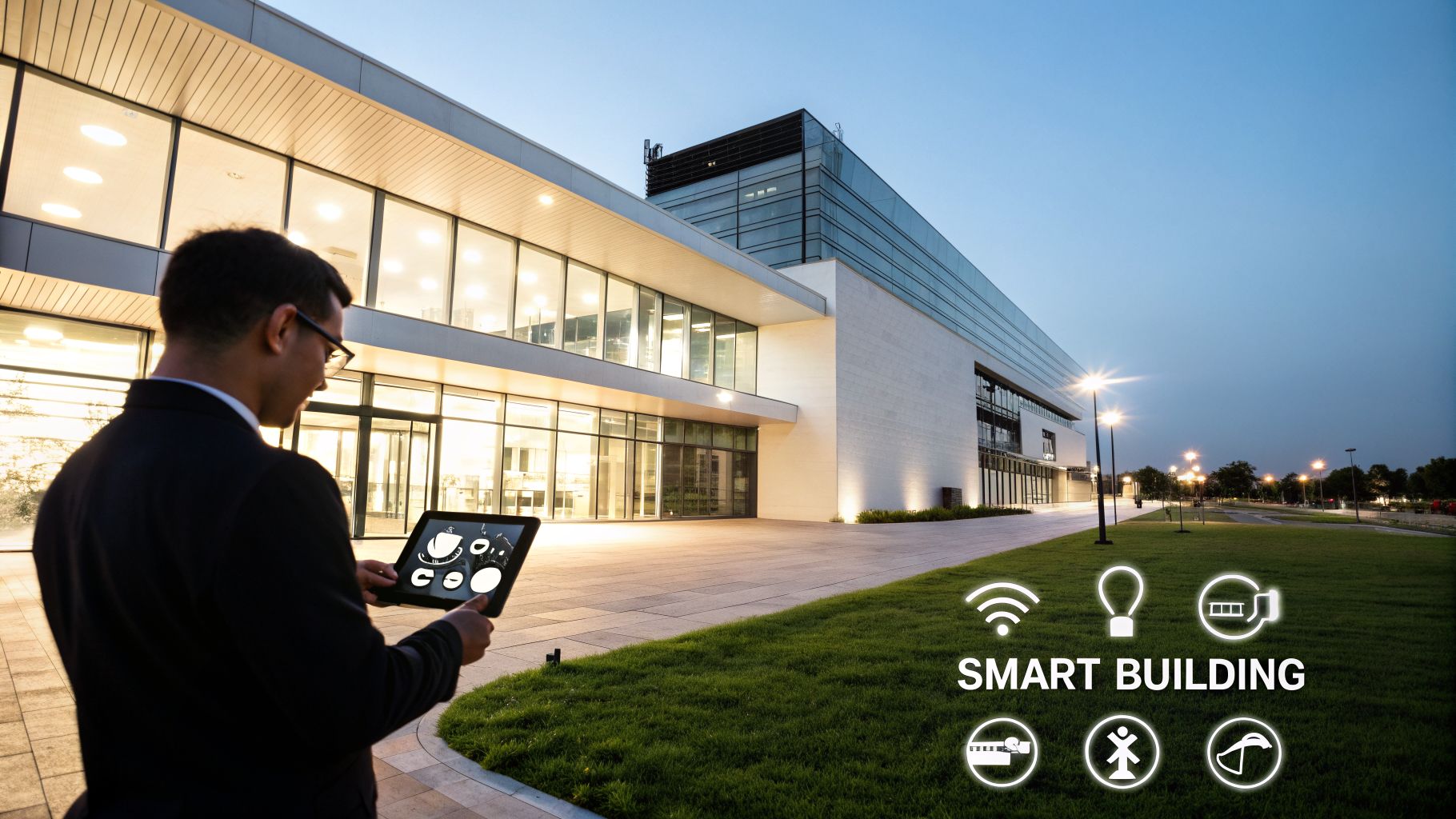
Smart building technology is the integration of software, automated processes, and Internet of Things (IoT) devices into a building's core infrastructure. All these connected systems talk to each other constantly, letting the building respond dynamically to its environment and the people inside it. It’s the difference between a static, unchanging structure and a responsive, intelligent one.
This technology creates a unified ecosystem where every component works in concert. We’re talking about more than just setting a few timers; we’re talking about true intelligence. A smart building learns from data, fine-tunes its own operations, and ultimately creates a better environment for occupants while generating serious cost savings for owners.
The Core Goal: Efficiency and Experience
At its heart, smart building tech is trying to do two things really well: improve operational efficiency and enhance the occupant experience. By linking systems that have always been siloed—like HVAC, lighting, and security—a smart building can make intelligent, coordinated decisions.
For instance, occupancy sensors can tell the system that a conference room is empty, which then triggers the lights to dim and the AC to power down. This simple action cuts energy waste with zero human effort. It's this kind of proactive management that can reduce a building's energy consumption by an impressive 30-50%, translating directly to lower utility bills and a much smaller carbon footprint.
Why It Matters for Atlanta Businesses
For businesses operating in Atlanta's competitive market, adopting smart building technology provides a clear edge. The upsides go well beyond just saving money and hit on several key business priorities:
- Meeting ESG Mandates: As corporate social responsibility becomes a critical measure of success, smart buildings offer a concrete way to prove your commitment to sustainability.
- Boosting Property Value: Intelligent, efficient buildings are simply more desirable. They attract better tenants and command higher valuations, making them a smart long-term investment.
- Enhancing Employee Wellness: By actively managing things like air quality, temperature, and lighting, you can create a healthier, more comfortable, and more productive workplace.
A smart building isn't just a collection of gadgets. It's a strategic asset that reduces operational expenses, strengthens your brand's reputation as a sustainable leader, and creates a superior environment for employees and clients.
These upgrades are quickly moving from "nice-to-have" to essential for any modern business. To see how these concepts might apply to your own facility, you can check out our detailed overview of a smart building upgrade. As you think about modernizing, it’s also critical to consider the full lifecycle of your tech. The last, crucial step of any upgrade is deciding what to do with the old equipment you’re replacing. Responsible disposal protects your data and gives you another chance to reinforce your company's commitment to the community and the environment.
Understanding the Core Components of a Smart Building
So, what exactly turns a regular building into a "smart" one? It's easy to get lost in the jargon, but the concept is simpler than you might think. Let's break down the smart building tech into its three core parts.
The best way to picture it is by thinking of the human body. We need senses to gather information, a brain to process it, and a nervous system to carry messages back and forth. A smart building works on the exact same principles, turning a static structure into a responsive, dynamic environment for the people inside.
Let's look at each of these pillars and how they come to life in a typical Atlanta office, hospital, or warehouse.
The Senses: IoT Sensors and Devices
First up are the senses—a network of small but mighty Internet of Things (IoT) sensors. These devices are the eyes, ears, and skin of the building, constantly collecting data about what’s happening in and around it.
Just like our eyes see and our skin feels temperature, these sensors detect things like room occupancy, air quality, light levels, and even water flow. An occupancy sensor in a meeting room knows when everyone has left. A CO2 sensor in an office checks that the air is fresh. These devices are the frontline, feeding a constant stream of real-world information to the system.
The Brain: Building Management System (BMS)
All that data from the sensors is just noise without a brain to make sense of it. This is where the Building Management System (BMS), or a more advanced Building Automation System (BAS), comes in. The BMS is the centralized command center, the brain of the entire operation.
It takes all the incoming data, analyzes it, and makes smart, automated decisions. For instance, when the BMS gets the signal that a meeting room is now empty, it can automatically tell the HVAC system to power down and the lights to turn off. No human intervention needed. This central intelligence is what elevates a building from simple automation to being truly smart. You can explore more on the topic of building automation to see how these systems continue to evolve.
The market for this "brain" is growing fast. Valued at nearly USD 7.3 billion in 2022, the global smart building software market is expected to hit USD 11.8 billion by 2028. This boom shows just how much businesses are prioritizing the efficiency these intelligent systems provide. You can find more details on these market trends from Verdantix.
The Pathways: Communication Networks and Protocols
Finally, the senses and the brain need a way to communicate. This is the job of the communication networks and protocols—the building's nervous system. These pathways carry data from the sensors up to the BMS and send commands from the BMS back down to the building's equipment.
You'll often find a mix of different protocols working together:
- BACnet (Building Automation and Control Networks): This is a universal language for building automation, allowing devices from different manufacturers to speak to one another seamlessly.
- Zigbee and Z-Wave: These are low-power wireless protocols, perfect for connecting lots of sensors without ripping up walls to run new wires. They're a fantastic option for retrofitting older Atlanta buildings.
- Wi-Fi and Ethernet: These familiar networks are used for high-bandwidth tasks, like connecting the BMS to the cloud for remote management and deep data analytics.
Together, these three pillars—the sensors, the management system, and the communication networks—form a complete ecosystem. A system that lets a building react to its surroundings, learn from past behavior, and even predict future needs.
To put it all together, here’s a simple breakdown of how these components work.
Key Components of Smart Building Technology
| Component | Function (Analogy) | Examples |
|---|---|---|
| IoT Sensors | The Senses (Eyes, Ears, Skin) | Occupancy sensors, temperature gauges, air quality monitors, light sensors. |
| BMS/BAS | The Brain (Decision-Making) | Centralized software that analyzes data and sends commands to other systems. |
| Networks | The Pathways (Nervous System) | BACnet, Zigbee, Wi-Fi, which allow all the components to communicate. |
By understanding how these core components of smart building tech fit together, Atlanta businesses can start to see the path toward transforming their properties into more efficient, comfortable, and secure assets.
How Smart Buildings Deliver a Real Payback for Businesses

The technology behind smart buildings is certainly impressive, but for any Atlanta business, it all comes down to one question: what’s the payback? This isn't just about spending money on fancy new gadgets. It's a strategic move that delivers hard numbers and a serious competitive edge.
From corporate offices to local healthcare clinics, smart buildings create value by fine-tuning operations, cutting out waste, and making spaces better for the people inside them. Let’s look at exactly how these benefits show up on the balance sheet.
Slashing Energy Costs in Commercial Spaces
For most commercial properties, energy is one of the biggest line items on the P&L. Smart buildings go after this expense with a vengeance, using intelligent automation to hunt down and eliminate every bit of waste. It’s where you’ll often see the fastest and most significant returns.
- Automated HVAC Control: Why blast the AC in an empty conference room? Smart HVAC systems use sensors to heat and cool only the rooms that are actually in use, precisely when they're needed. This alone can cut HVAC energy consumption by up to 30%.
- Intelligent Lighting: Smart lights combine schedules, motion sensors, and even natural light detection to make sure lights aren't burning in empty spaces. This simple fix can reduce lighting costs by 50% or more.
The demand for this kind of efficiency is driving massive growth. The global smart building market is on track to hit USD 143 billion in 2025 and an incredible USD 691.56 billion by 2034. Considering buildings consume nearly 40% of all electricity worldwide, it’s no surprise. We're seeing real-world examples where AI-driven systems cut energy waste by 30-50%. You can dig into the numbers in these booming market projections from EIN Presswire.
Boosting Productivity and Enhancing Wellness
The environment inside a building has a direct, measurable effect on your team. Things like stale air, fluctuating temperatures, or poor lighting aren't just minor annoyances—they kill focus and drag down productivity. A smart building creates an environment where people can do their best work.
An investment in a healthier building is an investment in your most valuable asset: your people. Studies show that employees in well-ventilated offices with optimized thermal comfort and lighting demonstrate significant improvements in cognitive function and productivity.
Think about it in a healthcare setting. Here, precise air quality monitoring isn't just for comfort; it can help improve patient outcomes by limiting the spread of airborne germs. In an office, automated lighting that adjusts to the time of day can reduce eye strain and headaches, keeping everyone sharp and focused.
Fortifying Security and Reducing Operational Risk
A strong ROI also comes from smarter, more integrated security. When you connect your access control, cameras, and alarm systems on a single intelligent platform, you gain a level of control and awareness that was impossible before.
This is a game-changer for data centers and other high-stakes environments around Atlanta. Smart systems can automatically track who is where, flag an unauthorized entry the second it happens, and pull up the corresponding video feed instantly. It not only stops threats but also massively cuts down on the hours your team spends investigating false alarms or minor incidents. That efficiency translates directly to lower security operating costs.
These investments don't happen in a vacuum—they build on each other. Lower energy bills free up cash for other projects. A more productive team drives revenue. And tighter security protects your bottom line from unexpected risks. Of course, bringing in all this new tech means phasing out the old. As you upgrade, our guide on reverse logistics solutions can help you create a secure and responsible plan for managing your retired assets.
Navigating Integration and Cybersecurity Challenges
While the upside of smart building tech is enormous, making the jump comes with its own set of hurdles. Bringing this technology into your facility isn't just about plugging in new sensors; it’s about making sure everything works together smoothly and securely. For most IT and facilities managers, two major concerns rise to the top: system integration and cybersecurity.
The good news? These challenges are completely manageable. With the right strategy, you can create a connected and secure smart building that lives up to the hype without introducing a bunch of new risks.
Solving the Interoperability Puzzle
The first real test is getting all your systems—both the new gadgets and the old workhorses—to speak the same language. This is what we call interoperability. Your brand-new, cutting-edge lighting system has to communicate flawlessly with your 10-year-old HVAC unit, and they both need to report back to your central Building Management System (BMS).
It’s like trying to run a meeting where everyone is speaking a different language. Total chaos. That's exactly what happens when you get locked into proprietary systems designed to keep you tied to a single vendor’s products.
The way to sidestep this mess is to prioritize solutions built on open protocols.
- BACnet (Building Automation and Control Networks): Think of this as the industry's universal translator for building systems. If you choose BACnet-compliant devices, you can be confident they'll talk to equipment from other manufacturers.
- Wireless Standards (Zigbee/Z-Wave): These protocols are fantastic for connecting a whole fleet of sensors without the headache of running new wires. This makes them a perfect fit for retrofitting older buildings here in Atlanta.
By insisting on open protocols from the start, you're building a flexible, future-proof system that doesn't depend on any single company. You get the freedom to pick the best tool for the job, no matter whose name is on the box.
Fortifying Your Building Against Cyber Threats
Every new IoT device you connect to your network—from a smart thermostat to a security camera—creates another potential doorway for a cyberattack. A "smart" building can become a dangerously insecure one if security isn't treated as a day-one priority.
As smart buildings lean more on cloud-based platforms to run their operations, it's critical to know where the vulnerabilities lie. Reading up on the inherent security risks of cloud computing can give IT managers a much clearer picture as they plan their infrastructure. Protecting your network demands a defense with multiple layers.
A smart building's greatest strength—its interconnectedness—can also be its greatest vulnerability. Without a robust security posture, you're not just risking data; you're risking control over the physical environment itself.
Here are a few essential security practices you should put in place:
- Network Segmentation: Whatever you do, don't put your critical building systems on the same network as your guest Wi-Fi. Create separate, isolated networks for your operational technology (OT) to contain any breach before it can spread.
- Mandatory Firmware Updates: Manufacturers are constantly releasing patches to fix security holes. You need a strict policy to make sure every single IoT device is kept up-to-date with the latest firmware.
- Strong Access Controls: Use multi-factor authentication (MFA) for anyone who needs to access the BMS. Stick to the principle of least privilege—give users access only to the systems they absolutely need to do their jobs, and nothing more.
- Secure Decommissioning: When it's time to upgrade, don't forget that old devices are still packed with sensitive data and network configurations. Proper disposal isn't just about being green; it's a critical final security step. To get a better handle on this, check out our guide explaining what data sanitization is and why it's so important.
A Phased Rollout Plan for Your Smart Building Upgrade
Jumping headfirst into a full-scale smart building conversion can feel overwhelming, both from a technical and a financial standpoint. For Atlanta organizations, a far more practical and budget-friendly path is a phased deployment. This approach lets you prove the value of smart building tech at every stage, building momentum and securing buy-in for a full facility upgrade.
Think of it as a methodical, step-by-step plan rather than one giant leap. This strategy gives IT and facility managers the tools they need to build a powerful business case, present a clear financial roadmap to leadership, and show off some quick wins along the way.
Step 1: Start with an Energy Audit
Before you even think about buying a single sensor, your first move should be a comprehensive energy audit. This assessment is the treasure map that reveals exactly where your building is hemorrhaging money. It pinpoints the specific areas—whether it’s an inefficient HVAC zone, old-school lighting, or poor insulation—that offer the biggest and fastest return on your investment.
An audit gives you hard data, turning your plan from educated guesswork into a targeted strategy. It helps you prioritize which smart upgrades will deliver the most punch right out of the gate, ensuring your initial investment produces results you can actually measure. This data-driven start is your most powerful tool for getting leadership on board.
Step 2: Launch a Focused Pilot Project
With your audit data in hand, the next step is to launch a small, contained pilot project. The goal here is simple: demonstrate a clear and rapid ROI without a massive upfront cost. This is your proof-of-concept.
Pick one department or a single floor to test a specific solution. A few great starting points include:
- Smart Lighting: Retrofit one area with occupancy sensors and modern LED lights. The energy savings are immediate and incredibly easy to quantify.
- HVAC Zone Control: Install smart thermostats in a handful of key zones to show how targeted climate control can slash waste.
- Submetering: Add meters to a single high-consumption piece of equipment to track its energy use in real-time and find opportunities for optimization.
By focusing on a pilot, you create a real-world case study right inside your own facility. The success of this small-scale project becomes the most compelling argument you can make for a broader, facility-wide rollout.
Of course, any rollout—from pilot to full scale—needs to be secure from the start. This graphic breaks down the essential security process you should have in place.
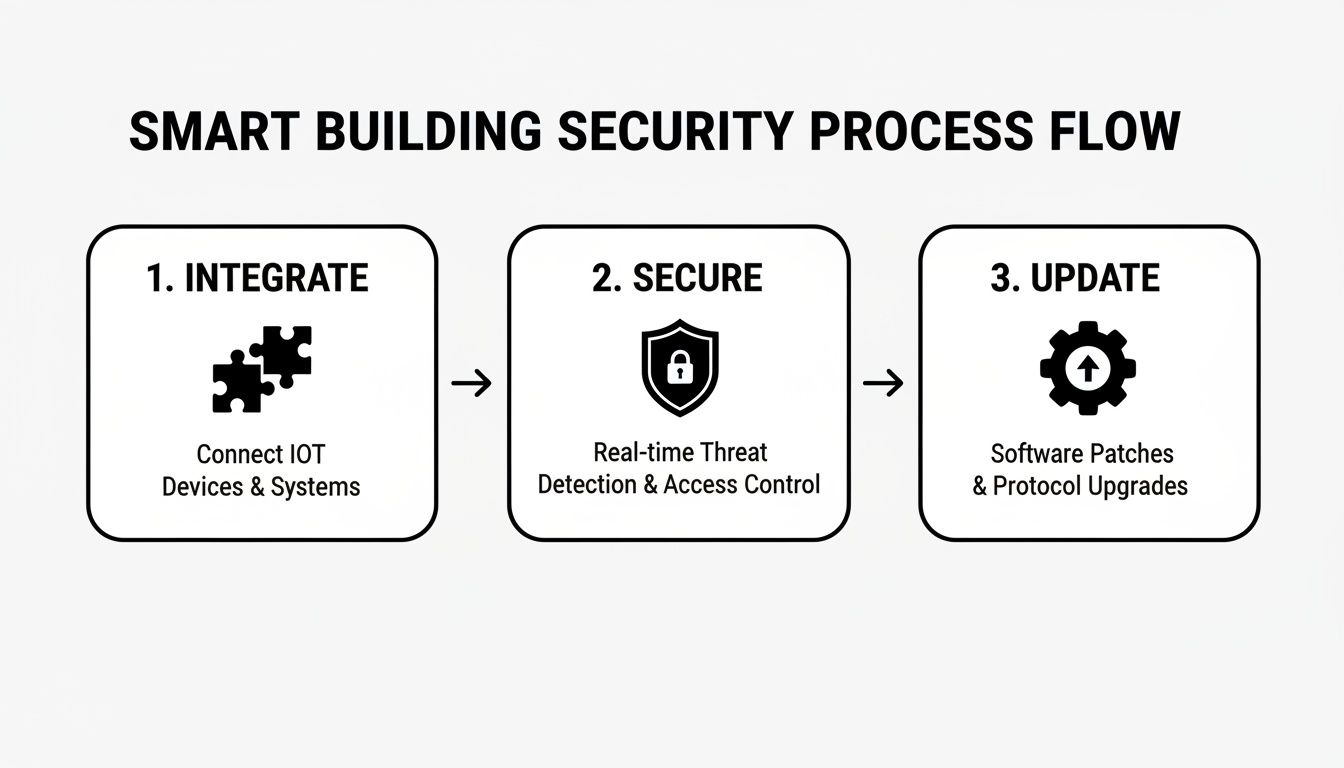
The key takeaway here is that integration, security, and updates aren't one-and-done tasks. They form a continuous cycle that is absolutely vital for a healthy and secure smart building ecosystem.
Step 3: Strategically Scale the Solution
Once your pilot project has proven its worth, it's time to scale. Take the data, ROI figures, and lessons you learned from the pilot and use them to expand the solution across your entire facility. This phased expansion allows you to manage budgets effectively, minimize disruption to daily operations, and fine-tune your approach as you go.
There's a reason the market for this technology is growing so fast. In the US alone, the smart building market is projected to swell from USD 27.36 billion in 2025 to USD 74.75 billion by 2035. This growth is fueled by the proven ability of smart systems to deliver energy cost reductions of 20-30% through real-time adjustments. You can explore more about these market trends from Precedence Research.
Turn Your Tech Upgrade into a Force for Good: Recycling That Restores Lives and Landscapes

Upgrading to smart building technology is a major win for efficiency and innovation. But the project isn't truly finished when the last sensor goes online. You're left with a critical final step: decommissioning the old equipment. This includes all the servers, computers, monitors, and cabling that your new smart building tech just made obsolete.
This last phase is more than a cleanup task; it's an opportunity to create a measurable, positive impact right here in Atlanta. Just throwing old electronics away isn't a viable path. It exposes your company to serious data security vulnerabilities and the risk of steep environmental fines, which can undermine the very ESG goals that often drive these upgrades in the first place.
This is where a responsible partnership is so important. GreenAtlanta.com provides secure, certified IT asset disposal that turns your electronic waste from a risk into a genuine force for good. When you partner with us, you aren't just ticking a box for recycling—you are directly funding veteran aid programs and helping to reforest our planet.
An Easy ESG Win for Atlanta Companies
A strong Environmental, Social, and Governance (ESG) strategy is a clear differentiator for any modern business. Partnering with GreenAtlanta.com makes this part of your building upgrade simple and deeply impactful. We enable your company to “Recycle with Purpose,” transforming a routine operational task into a powerful statement about your corporate values.
By choosing a partner with a dual mission, your old tech can house a veteran and grow a forest. This emotional connection transforms recycling from a logistical task into a powerful story of corporate responsibility that resonates with employees, customers, and stakeholders.
We make it straightforward for your business to get involved. For our corporate clients, we offer free pickup for 50 or more devices. Once we've securely processed your assets, we provide two key documents for your records:
- Plant-A-Tree Certificates: Tangible proof of the exact number of trees planted on your company’s behalf.
- Veteran Support Impact Reports: Official documentation detailing how your contribution supports local veterans, perfect for your annual CSR reporting.
This complete solution turns your e-waste into a verifiable ESG achievement, giving you all the documentation needed to prove it.
More Than Recycling—A Community Partnership
Our mission is to build a "Greener Atlanta" through grassroots community engagement and local collaboration. We’ve built our entire model on creating meaningful connections that produce direct benefits for our city. To that end, we actively seek out partnerships that can amplify our collective impact and make participation easy for everyone.
This includes co-hosting recycling drives with veteran support groups like local VFW chapters, as well as with environmental NGOs and community shelters. We also work with Atlanta-area schools, universities, and municipalities to collect devices, which creates an educational opportunity while contributing to a shared sustainability goal. To see how these efforts fit into a bigger picture, you can learn more about building a comprehensive business sustainability strategy in our detailed guide.
Turning Recyclers into Advocates
Our goal is to create a cycle of positive impact that continues long after a single pickup. We want every one of our partners, from a large corporation to a small local business, to feel a direct and personal connection to the good they’ve helped create.
To do this, we provide personalized impact certificates for every donation, showing exactly how many trees were planted and how you've helped support our veterans. Our “Recycled with Purpose” eco-badge also gives partners a digital credential they can proudly display on their websites and sustainability reports to showcase their commitment.
Ultimately, your smart building upgrade is a story of progress. By choosing GreenAtlanta.com for your IT asset disposal, you ensure that story has a powerful and inspiring conclusion—one that helps restore lives and landscapes right here in our community.
Frequently Asked Questions About Smart Building Tech
Making the jump to smart building tech brings up some very real questions for Atlanta business owners and IT managers. We hear them all the time, so here are some clear, practical answers to the most common ones.
Can Smart Building Tech Be Retrofitted into an Older Building?
You bet. A huge number of smart building solutions are actually designed with retrofitting in mind. The magic is in using wireless sensors and cloud-based management platforms, which sidesteps the need for costly and disruptive rewiring projects.
This makes upgrading older commercial properties throughout the Atlanta area completely doable. The most important thing is to work with an integrator who focuses on systems built on open protocols. This ensures any new devices you add can talk to the older infrastructure you might want to keep.
How Much Does It Cost to Make Our Building Smart?
There’s no single price tag. The cost really depends on your building's size, its age, and how big you want to go with the project. Because the price can vary so much, we always suggest starting with a phased approach to prove the value without a massive upfront commitment.
Kick things off with a professional energy audit to pinpoint where you’ll get the biggest bang for your buck. From there, launch a small pilot project—maybe installing smart HVAC controls or automated lighting in just one department. This lets you show a clear ROI on a smaller investment before you decide to scale the solution across your entire property. Many of these systems pay for themselves in just 2-5 years from the energy savings alone.
A phased rollout lets you build a powerful business case, show leadership some quick wins, and get budget approval for a full-scale deployment with very little financial risk.
What Happens to Our Old Equipment After We Upgrade?
Any tech upgrade is going to create a pile of e-waste—old servers, monitors, networking gear, and cables. This retired equipment doesn’t just take up space; it often holds sensitive company data and contains materials that need special handling.
This is where partnering with a certified e-waste recycler becomes a non-negotiable final step. A certified partner guarantees your data is securely destroyed to Department of Defense standards and that every component is recycled in full compliance with environmental laws. This move protects your business from data breaches and regulatory fines, and it gives you solid documentation for your ESG and CSR reports. For businesses here in Atlanta, it’s a chance to turn old tech into a real, positive local impact.
Ready to turn your decommissioned IT assets into a force for good? GreenAtlanta.com provides secure, certified electronics recycling that transforms your e-waste into support for local veterans and reforestation efforts. Learn more and schedule your pickup.