What to Do with Old Computer Components A Guide for Atlanta Businesses


When all that outdated tech starts piling up, figuring out what to do with old computer components becomes a surprisingly critical business decision. It's not just about freeing up closet space.
Your main routes are pretty clear: you can remarket the functional gear to recover some value, donate it to a good cause, or make sure the non-working stuff is securely and responsibly recycled. The right choice really boils down to the hardware's condition, how sensitive the data on it is, and what your company's own environmental goals are.
Your Quick Guide to Managing Old Computer Components
Deciding the fate of your old IT hardware is a strategic move that touches on data security, your bottom line, and your company's reputation. Every single server, laptop, and keyboard has an end-of-life path that can either create value or open you up to serious risk. The real trick is sorting through it all efficiently and pointing each piece of equipment down the right channel.
Think of this as an opportunity, not just a disposal problem. A solid plan protects you from data breaches, keeps you compliant with environmental rules, and can seriously boost your brand's image. When you turn a logistical headache into a strategic plus, you can hit your ESG (Environmental, Social, and Governance) goals and make a real impact. The first step is getting a handle on the full scope of what is IT asset disposition.
Making the Right Choice for Your Assets
The first question is always the easiest: does it still work? If the answer is yes, then resale or donation are great options. If it's a no, the next question is the most important one: does it hold any sensitive data? That answer dictates whether you need certified destruction before you can even think about recycling.
This simple decision tree helps visualize the process for any old computer part you have.
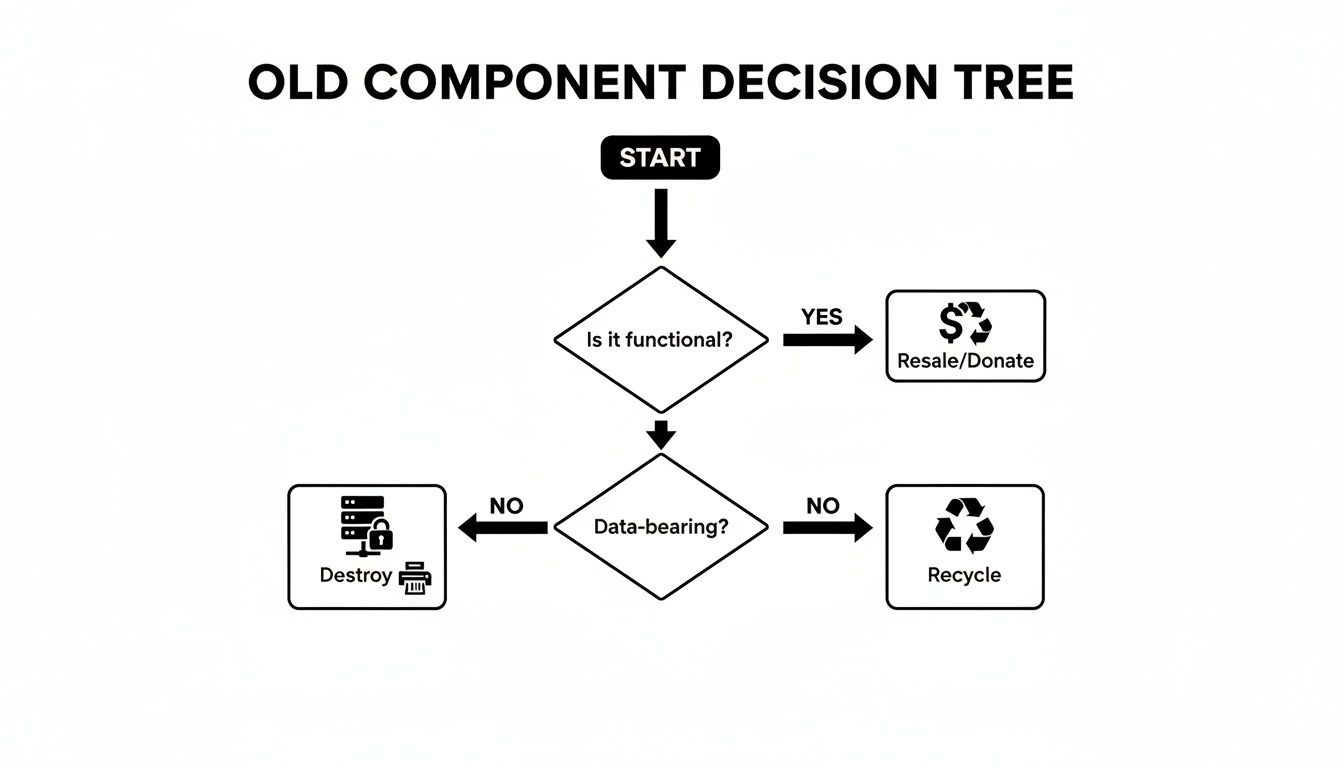
As you can see, it really comes down to whether it works and whether it holds data. Those two factors will guide you to the right disposal method every time.
To make things even clearer, let’s break down the main options side-by-side so you can weigh them against your business priorities.
Comparing Your Options for Old Computer Components
Here's a straightforward comparison to help you match your assets to the best disposition strategy.
| Method | Data Security Level | Environmental Impact | Value Recovery | Best For |
|---|---|---|---|---|
| Remarketing/Resale | Moderate to High (with certified data wiping) | Positive (extends product lifecycle) | High | Functional, newer equipment with market value. |
| Donation | Moderate to High (with certified data wiping) | Positive (provides resources to communities) | Moderate (tax benefits) | Functional equipment that can benefit schools or non-profits. |
| Responsible Recycling | High (when paired with data destruction) | High (prevents pollution, recovers resources) | Low to None | Non-functional or obsolete components. |
| Secure Destruction | Highest | Neutral (materials are recycled post-destruction) | None | Data-bearing devices requiring guaranteed data elimination for compliance. |
What this table really shows is that there's no single "best" answer for what to do with old computer components. The smartest strategy is almost always a mix of these approaches, tailored to what’s actually in your inventory.
The key is to work with a certified expert who can handle every step of the process—from secure logistics and data wiping to certified recycling and providing the reports to prove it was all done right.
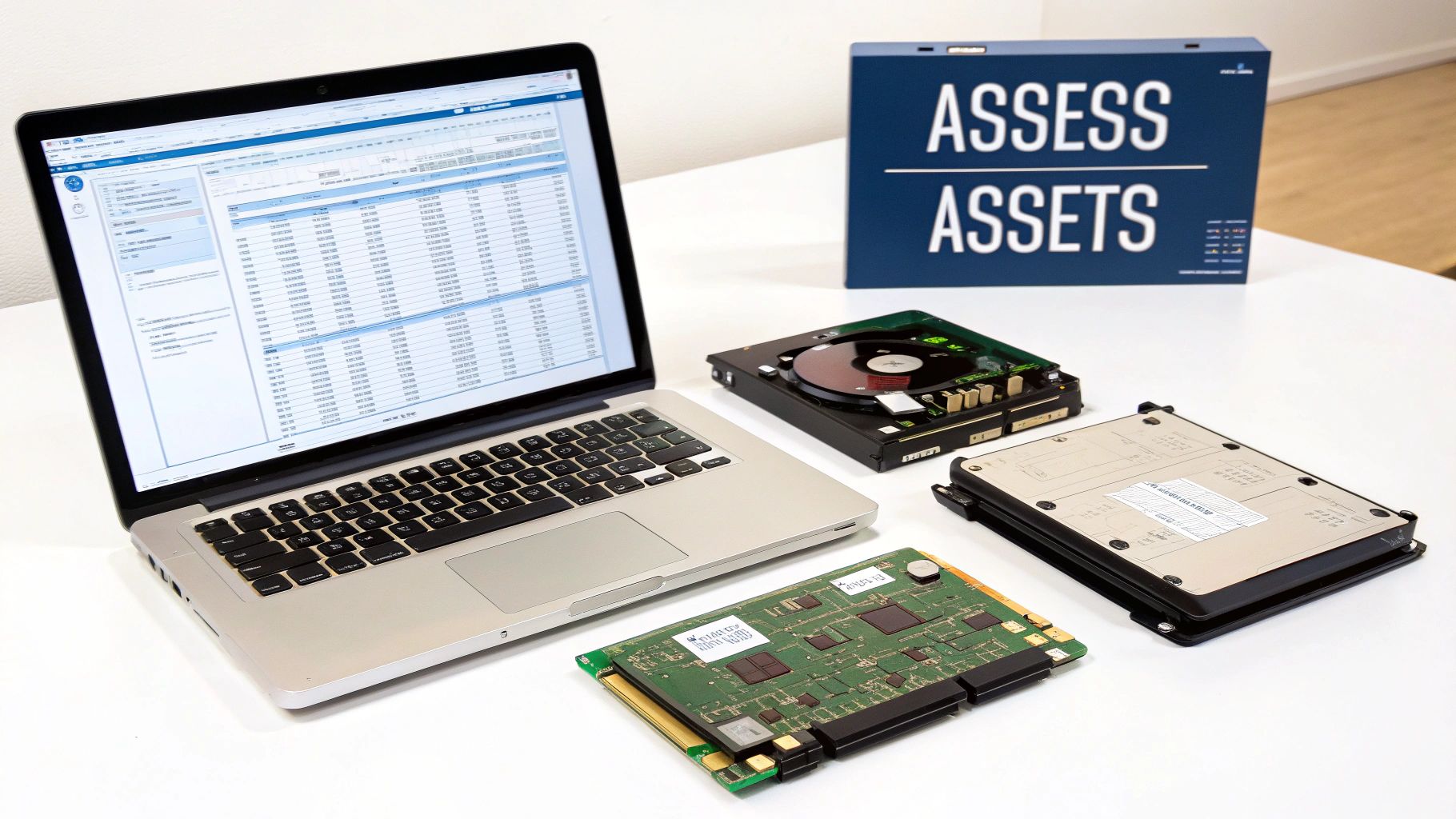
The First Step: Assessing Your Outdated IT Assets
Before you can figure out what to do with a room full of old computer gear, you have to know exactly what you're dealing with. That closet full of outdated tech is a pile of unknowns—unknown risks, unknown value, and even a few unknown opportunities. Turning that disorganized heap into a structured inventory is the only way to start.
This isn't just about counting machines. It's about getting a clear picture of each asset's potential, which is what allows you to build a secure and strategic plan for its disposal. By methodically evaluating your equipment, you can separate the valuable hardware from the true e-waste, setting the stage to recover maximum value while staying compliant.
Creating a Strategic IT Inventory
A solid assessment starts with some basic categorization. Grouping your assets helps you see the big picture and make smarter decisions for each type of equipment.
Start by sorting everything into a few broad categories:
- Core Computing: Servers, desktop computers, and laptops.
- Peripherals: Monitors, keyboards, mice, printers, and docking stations.
- Network Hardware: Routers, switches, and modems.
- Storage Media: External hard drives, solid-state drives (SSDs), and USB drives.
Once everything is sorted, look at each item through the lens of three key factors: age, condition, and function. A five-year-old server that still works perfectly has a much different future than a decade-old desktop that won’t even power on. This simple triage helps you quickly identify which components might have some resale value versus those that are headed straight for responsible recycling. Managing your technology from purchase to retirement is a major undertaking, and you can explore some great IT Asset Management Best Practices to help build a more complete framework.
Tagging for Data Security
Now for the most critical piece of the puzzle: identifying and tagging any asset that holds data. Think of it like a digital triage. A keyboard or a power cord doesn't pose a data risk, but a single forgotten hard drive can contain a goldmine of sensitive information.
An estimated 50 million metric tons of e-waste are generated globally each year, and a huge portion of that contains data that can still be retrieved. Failing to properly identify and sanitize these devices is one of the most common—and costly—security mistakes a business can make.
Tagging every single data-bearing device is non-negotiable. This one action dictates the level of data destruction required, whether that means software-based wiping that meets DoD standards or complete physical shredding. It's the foundational step to protecting your company from a data breach and ensuring you stay compliant with regulations like HIPAA. For Atlanta-area businesses looking to nail down their process, understanding IT asset management best practices is the perfect place to start. Getting this initial assessment right makes every other decision easier and safer.
Why Simply Deleting Files Is Not Enough
So, you’re ready to get rid of some old computer components. For most people, the first instinct is to drag everything to the trash can on their desktop or maybe even reformat the hard drive. Job done, right?
Not even close. This is one of the biggest—and most common—data security risks a business can take. Thinking a simple delete is enough is like tearing the index out of a book and assuming no one can read the pages anymore. All the information is still there; it’s just a little harder to find.
When you hit "delete," the operating system doesn’t actually erase the file. It just marks the space that file occupied as "available" for new data. Until something new is written over that exact spot, your original data—financial records, client lists, employee details—sits there, fully intact and easily recoverable with off-the-shelf software.
For businesses here in Atlanta, especially those in healthcare, finance, or government contracting, this casual approach isn't just risky. It’s a direct violation of serious compliance standards. Regulations like HIPAA for patient data and DoD 5220.22-M for government information come with hefty penalties for getting this wrong.
Understanding Certified Data Destruction Methods
To truly get rid of the risk, you need certified data destruction. This is a professional process that guarantees your information is gone for good and is completely unrecoverable. It's not a one-size-fits-all deal; the right approach really depends on the type of device and your security needs.
There are three main ways to get the job done right:
- Data Wiping (Software Overwriting): This method uses specialized software to write layers of meaningless data—think endless patterns of ones and zeros—over every single part of a hard drive. By overwriting the original information multiple times, it’s effectively buried beyond recovery. This is a great choice for devices you plan to resell or donate because it keeps the hardware functional.
- Degaussing (Magnetic Erasure): Degaussing is for magnetic storage like traditional hard disk drives (HDDs) and old backup tapes. The device is hit with an incredibly powerful magnetic field that instantly scrambles the magnetic structure where data is stored. The data is wiped clean, but the process also renders the drive permanently unusable.
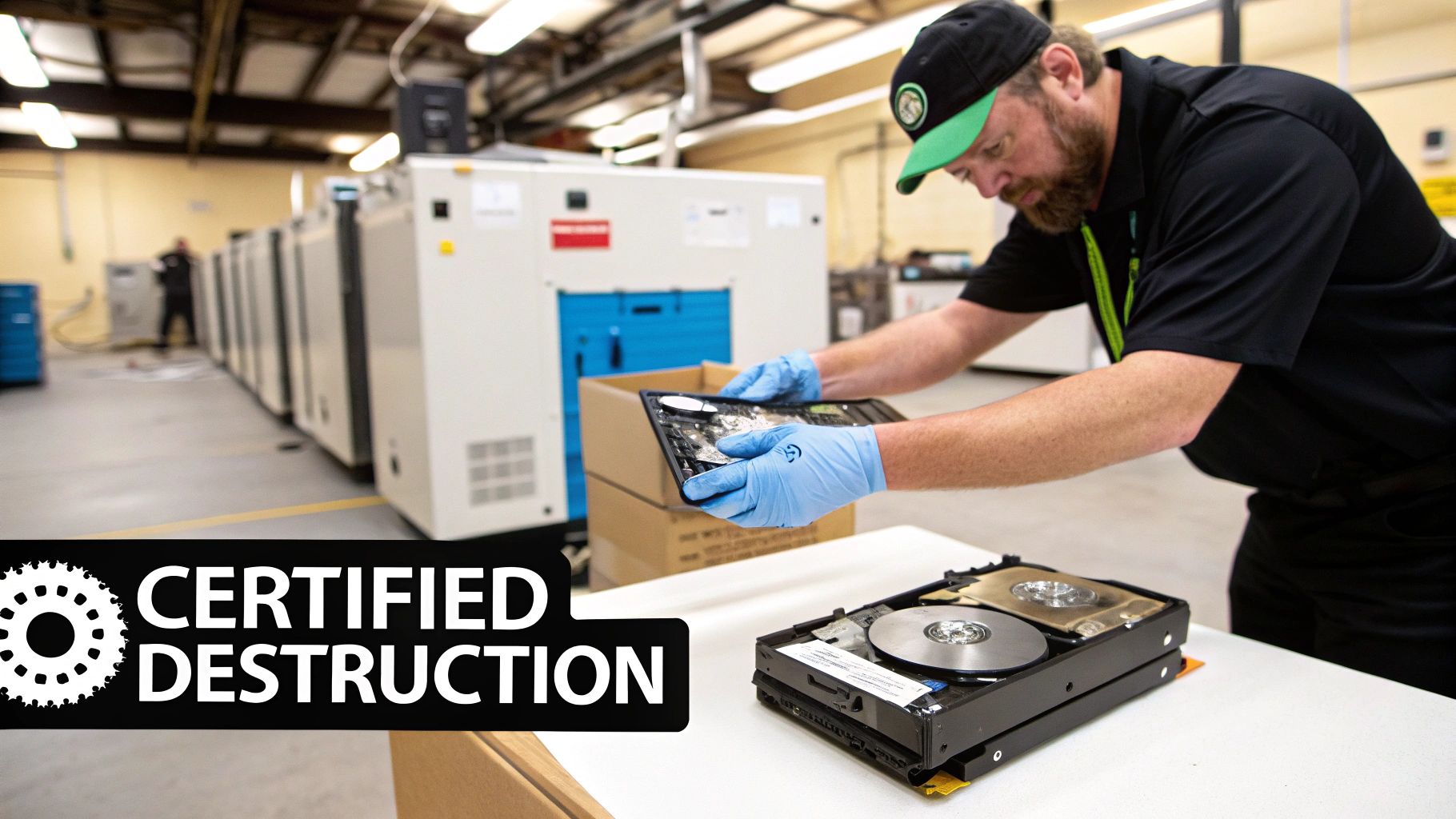
- Physical Shredding: This is the most final form of data destruction, period. The hard drive or solid-state drive (SSD) is fed into an industrial shredder that grinds it into tiny, unrecognizable metal fragments. There's no coming back from that—the physical media is completely destroyed.
Choosing the right method is key for compliance. A healthcare provider getting rid of patient records under HIPAA, for instance, needs absolute certainty the data is unreadable. Physical shredding offers undeniable proof.
The Importance of Auditable Proof
It’s not enough to just destroy the data. Your business needs a clear, auditable paper trail to prove you did it correctly. This is where a certified e-waste recycler becomes your most important partner. After they process your devices, you should get official documentation confirming secure destruction.
A Certificate of Destruction is a formal document that serves as your legal proof of compliance. It details the specific items destroyed, the method used, the date of destruction, and a unique serial number for each asset. This paperwork is crucial for internal audits and demonstrating due diligence to regulators.
This documentation officially closes the loop on your IT asset’s lifecycle, turning what could be a massive liability into a secure, verified process. Without it, you’re left exposed and can’t prove you took the necessary steps to protect your data.
For any organization building a compliant disposal strategy, understanding the details of secure data destruction is the single most important step. It’s the only way to be sure that when your old components leave the building, your sensitive data doesn’t go along for the ride.
Turning E-Waste Into a Corporate ESG Win
Deciding what to do with old computer components isn’t just an operational headache anymore—it's a massive opportunity to build your company’s brand. For any modern business, handling e-waste the right way is a cornerstone of a strong Environmental, Social, and Governance (ESG) strategy. It takes what used to be a simple compliance task and turns it into a powerful story of corporate citizenship that connects with customers, investors, and your own team.
Every outdated server, laptop, and monitor you retire represents a choice. Will it become a potential liability gathering dust in a closet, or will it become a testament to what your company values? By reframing the process, you can move beyond basic disposal and start making a real, positive impact.
This shift in perspective couldn't be more critical. The new Global E-waste Monitor 2024 report highlights a growing crisis, but it's also a call to action for corporate leaders. For businesses right here in Atlanta, this really hits home. Georgia is one of the states without mandatory e-waste recycling laws, which makes partnering with a certified, mission-driven recycler absolutely crucial for hitting your ESG goals and leading by example.
From E-Waste to ESG Asset: The "Recycle for a Cause" Model
Imagine transforming that pile of obsolete electronics into a genuine force for good. That’s the whole idea behind the "Recycle for a Cause" model—a strategic approach that turns standard e-waste recycling into a philanthropic mission with a dual impact. It’s a simple but profound concept: your old tech can help house a veteran and reforest our landscapes.
Instead of just checking a box for environmental compliance, this model lets your company be part of a story of restoration. It directly connects the act of recycling with tangible, emotional outcomes that you can share and celebrate.
Tagline in Action: “Recycling That Restores Lives and Landscapes.” This isn’t just a catchy slogan; it’s a mission statement. It positions your company’s routine IT asset disposition as an act that restores both lives and landscapes.
By partnering with a mission-driven recycler, your contribution becomes a measurable part of something much bigger. This is where your ESG reporting finds its real teeth.
Building Corporate Partnerships Through Shared Values
For Atlanta companies laser-focused on their Corporate Social Responsibility (CSR) benchmarks, this model is an easy and powerful win. It’s a ready-made solution for meeting sustainability goals while making a documented social impact at the same time. This is especially valuable for businesses looking to boost their community engagement and polish their brand reputation.
A purpose-driven partnership can offer unique benefits designed to bolster your ESG efforts:
- Corporate Recycling Drives: Offer businesses free pickup of 50+ devices, then deliver Plant-A-Tree certificates and Veteran Support Impact Reports for their CSR documentation.
- Documented Impact: After the drive, your company receives official Plant-A-Tree certificates and Veteran Support Impact Reports. These aren't just thank-you notes; they are auditable assets for your annual CSR and sustainability reports.
- Digital Recognition: Partners can earn a digital “Recycled with Purpose” eco-badge to display on their website, social media, and other corporate communications. This badge is a quick, visual signal to stakeholders that you’re committed to responsible, impactful recycling.
This framework transforms what might be seen as a cost center into a strategic investment in your brand’s identity and core values.
Engaging the Community and Amplifying Your Impact
The story of turning e-waste into positive change is one worth sharing. A mission-driven recycling program creates natural opportunities for community engagement and PR that build credibility and a strong local presence. You have to think beyond the transaction and focus on the collaborative potential.
You can extend your impact through several channels:
- Nonprofit Co-Hosting: Team up with local veterans' organizations, VFW chapters, or environmental groups to co-host community recycling drives. This move amplifies your reach and reinforces your company’s commitment to local causes.
- Educational Collaborations: Work with Atlanta-area schools and universities on a “Greener Atlanta” initiative. These partnerships can educate the next generation on responsible electronics disposal while collecting devices and planting trees in the community’s name.
- Local Media Features: The dual-impact story is compelling. Pitching your partnership to local outlets like the Atlanta Journal-Constitution or sustainability blogs can generate positive earned media, showcasing your company as a true leader in corporate citizenship.
Ultimately, choosing a recycler with a social mission changes the entire equation. What starts as a simple decision about old computer components evolves into a powerful statement about what your company stands for.
Recovering Value Through Resale and Donation
Not every piece of your retired IT equipment is destined for the shredder. In fact, for hardware that's still functional, the conversation shifts from simple disposal to a genuine value recovery opportunity. Many of your assets still hold significant market value, and remarketing them is one of the smartest ways to recoup a portion of your original investment.
This simple shift in perspective can transform your end-of-life IT program from a cost center into a potential revenue stream. Instead of just paying to have equipment hauled away, you can unlock the residual value still locked inside your used desktops, servers, and networking gear. It’s a financially savvy move that also gives the electronics a second life, which is a huge win for the circular economy.
Maximizing Returns Through Resale Channels
When you’re ready to sell your old IT assets, you’ve got a few solid options. The right choice really depends on the amount and type of equipment you have, not to mention how much time and energy your team can dedicate to the process.
- ITAD Vendors: For most businesses, partnering with an IT Asset Disposition (ITAD) vendor is the most efficient route. These specialists handle the entire process for you—from secure data wiping and testing to refurbishment and finding buyers. You get a share of the profits without any of the logistical headaches.
- Employee Buy-Back Programs: Offering functional equipment to your employees at a nice discount can be a fantastic perk. It’s a straightforward way to clear out inventory, boost team morale, and ensure the hardware keeps getting used.
- Direct Online Marketplaces: Platforms like eBay or other specialized tech marketplaces can sometimes bring in higher returns, but they demand a lot more hands-on effort. You'll be on the hook for listing, packing, and shipping every single item, which can quickly become a full-time job if you have a lot of gear.
No matter which channel you choose, one thing is non-negotiable: a thorough, certified data destruction process has to happen first. No asset should ever leave your possession without absolute certainty that every last bit of sensitive company and client information has been permanently wiped clean.
The Power of Purposeful Donation
Sometimes, the greatest value an old computer can offer isn't measured in dollars—it's measured in impact. For equipment that might not have a high resale value but is still perfectly usable, donation is an incredible option. This one decision can turn your outdated hardware into a vital resource for organizations that need it most.
Donating your old computers and peripherals to schools, nonprofits, and community centers right here in the Atlanta area helps bridge the digital divide. You're providing essential tools for education and workforce development, directly supporting your local community while clearing out your storage space. The benefits go far beyond just feeling good, and it's worth exploring the key ways that computer donations benefit your community to see the full picture.
Donating IT equipment is more than just an act of charity; it’s a strategic ESG initiative. Properly documented donations can provide significant tax benefits for your business while creating a powerful story of corporate citizenship that resonates with your employees and customers.
Before you donate, though, security has to be the top priority. Just as with resale, every device that holds data must go through certified data wiping to completely eliminate the risk of a breach. Once the data is securely destroyed, you can hand over the equipment, making sure to get proper documentation from the organization you're donating to. That paperwork is critical for claiming tax deductions and for your own internal and external reporting, turning a simple act of giving into a documented, secure, and socially rewarding part of your IT disposition strategy.
Recycling That Restores Lives and Landscapes
When your business decides what to do with its old computer components, that moment is more than just a logistical choice—it's the start of a powerful story. By choosing a partner with a clear social mission, you can transform a standard operational task into a tangible act of corporate citizenship. This is where compliance-driven recycling grows into purpose-driven impact, turning retired assets into a genuine force for good.
This approach draws a straight line between your e-waste and real-world outcomes. Think about this message: “Your old tech can house a veteran and grow a forest.” It’s a simple, resonant statement that reframes the entire process, showing exactly how a routine business function can deliver measurable social value.
Documenting Your Dual Impact
A mission-driven recycling program gives you more than just a clear conscience; it delivers powerful, concrete assets for your ESG and CSR documentation. Instead of a simple receipt, you get real proof of the good you’ve generated.
This documentation serves as a transparent record of your commitment:
- Veteran Support Impact Reports: These reports detail how your recycled assets directly contributed to programs aiding veterans, putting a human face on your sustainability efforts.
- Plant-A-Tree Certificates: For every qualifying pickup, you receive official certificates confirming the number of trees planted on your company’s behalf—a direct measure of your environmental contribution.
- The “Recycled with Purpose” Eco-Badge: As a partner, you can display this digital badge on your website and in sustainability reports, offering a clear visual signal of your commitment to ethical e-waste disposal.
This verifiable impact makes your CSR reporting far more compelling and authentic. You can feature impact counters on your website showing live stats like “1,245 veterans supported” and “3,700 trees planted” to reinforce transparency and social proof.
Turning One-Time Actions into Lasting Advocacy
The real goal here is to transform a single recycling event into a sustained relationship built on shared values. When you get your team and your customers involved in the story, you turn one-time recyclers into long-term advocates for your brand.
A strong engagement strategy keeps the positive impact front and center:
- Personalized Impact Certificates: After a donation, individuals can get automated emails detailing their specific contribution, like, “You planted 3 trees and helped 1 veteran.”
- Referral Programs: You can reward employees or clients who refer other businesses with an extra tree planted in their name, creating a ripple effect of positive action.
- Monthly Impact Newsletters: Sharing real stories of veterans supported and reforestation progress keeps the mission alive and demonstrates your ongoing commitment.
For effective disposal that also aims to benefit the environment, considering a professional service can be very helpful. You can learn more about finding a great junk removal company to handle logistics responsibly.
Ultimately, choosing a purpose-driven partner means you are not just closing the loop on your IT assets; you are starting a whole new cycle of positive change. To explore how your business can participate, check out our solutions for IT equipment recycling.
Answering Your Top E-Waste Disposal Questions
When you're dealing with a pile of old computer components, a few key questions always come up. It's smart to think about security, compliance, and just how to get it all done. Here are some straightforward answers to the questions we hear most often from businesses around Atlanta.

Is It Safe to Just Throw Away Old Hard Drives?
Absolutely not. Think of an old hard drive like a filing cabinet you've just rolled out to the curb. Even if you've "deleted" the files, that sensitive company, client, or employee data is still there, and data recovery software can easily pull it back from the brink.
This is more than just a privacy issue; it's a massive security risk that can lead to costly data breaches and steep regulatory fines. The only way to be certain is to have the drives professionally wiped to DoD standards or physically shredded into tiny, unrecoverable pieces. It's the only way to truly protect your business.
What Kind of Documentation Should We Expect From a Recycler?
A reputable, certified recycler won't just haul your equipment away—they'll provide an official paper trail. This documentation is your proof of compliance and a vital record for your company's sustainability reporting.
You should always expect to receive:
- A Certificate of Destruction for any device that held data, confirming it was properly wiped or shredded.
- A Certificate of Recycling that lists what was processed and verifies it was handled in an environmentally responsible way.
- Impact Reports if you're part of a cause-based program, like Veteran Support statements or Plant-A-Tree certificates.
These documents aren't just for filing away. They are critical for internal audits, proving you're compliant with regulations like HIPAA, and for backing up your company's ESG (Environmental, Social, and Governance) claims.
Our Office Has a Mix of Old Equipment. Can You Take Everything?
Yes, and you should insist on it. A comprehensive e-waste partner should be able to handle your entire inventory in a single pickup. This makes the logistics infinitely simpler and ensures you don't have to juggle multiple vendors.
A true turnkey service means everything goes—from desktops, laptops, and servers to monitors, printers, keyboards, mice, and all those random cables hiding in storage. It keeps the whole process secure and straightforward.
Key Takeaway: Using a single, certified provider for all your e-waste streamlines the process, cuts down on administrative headaches, and maintains a secure, unbroken chain of custody for all your retired assets.
How Does a 'Recycle for a Cause' Program Benefit My Business?
This is where a simple operational task gets a major upgrade. Instead of just being a line item for disposal, recycling becomes a powerful story for your brand. You get tangible proof of your company's positive social and environmental impact.
Think about it. That proof provides compelling content for annual CSR reports, enhances your brand’s reputation, and shows everyone—from customers to your own team—that your company is genuinely committed to the community. Turning old tech into support for veterans and reforestation efforts connects with people on a human level, proving your company's values are woven into everything you do. Look for opportunities to align with holidays like Veterans Day, Earth Day, and Arbor Day for special PR pushes and donation drives.
Ready to transform your old computer components into a force for good? Atlanta Green Recycling provides secure, responsible, and impactful e-waste solutions for businesses across the Atlanta metro area. We make it easy to protect your data, meet your ESG goals, and make a real difference. Schedule your pickup today at https://www.greenatlanta.com.