Secure Destruction of Data: Trusted Methods for Your Atlanta Business

Tapping "delete" on an old hard drive and calling it a day is like leaving your front door wide open when you go on vacation. It’s just not enough. True secure data destruction means making that information completely and utterly unrecoverable, shielding your business from breaches and painful legal battles. It’s not a janitorial task; it’s a core part of managing risk in any modern company.
Why Secure Data Destruction Is a Critical Business Function
For any organization in Atlanta, treating data disposal as a low-priority IT chore is a mistake that can cost you dearly. The simple truth is that secure data destruction is a fundamental pillar of how you do business today—it's essential for managing risk, staying compliant, and protecting the brand you've worked so hard to build.
Thinking you can just wipe a drive or stash old equipment in a storage closet is leaving a massive vulnerability in your defenses.
Imagine the difference between leaving sensitive paper files in an unlocked recycling bin on the curb versus feeding them into a certified, cross-cut shredder. One is an open invitation for disaster; the other guarantees the information is gone for good. The exact same principle applies to your digital assets. Cutting corners on IT asset disposal can lead to devastating fallout:
- Steep Regulatory Fines: Laws like HIPAA and FACTA don't mess around, imposing severe penalties for mismanaging data.
- Lasting Brand Damage: A single data breach can shatter the customer trust that took you years, or even decades, to build.
- Significant Financial Loss: The direct and indirect costs of cleaning up after a breach can be absolutely crippling.
The Escalating Need for Proactive Data Security
The scale of this problem is growing at a mind-boggling pace. What was once a niche compliance task has exploded into a multibillion-dollar global industry, fueled by skyrocketing data volumes and ever-present cyber threats.
Global data storage is projected to blow past 200 zettabytes by 2025. Every single decommissioned server, failed hard drive, or retired laptop in your Atlanta office holds a piece of this data. With the costs of cybercrime expected to hit $10.5 trillion annually by 2025, those old, data-rich devices are prime targets if they aren't properly sanitized.
Understanding your company's overall data security posture is the first step toward building an effective strategy. This means you have to stop looking at data destruction as a cleanup task and start treating it as a proactive security measure that protects your clients, your employees, and your bottom line. You can learn more about the specific benefits of using a professional https://www.greenatlanta.com/why-you-should-use-a-data-destruction-service-when-disposing-of-your-electronics/.
By partnering with a mission-driven provider, this critical security process can also become a powerful ESG and community-building opportunity. At GreenAtlanta.com, we believe in "Recycling That Restores Lives and Landscapes," turning your retired tech into support for veterans and reforestation efforts.
Understanding Your Data Destruction Options
When it's time to retire old IT assets, making sure the data they hold is gone for good isn't just a suggestion—it's a critical security step. This process, often called data sanitization, isn't a one-size-fits-all solution. You're really choosing between two core strategies: software-based wiping and physical destruction.
Each method has its place, and understanding the difference is key to making the right call for your Atlanta business.
Software Wiping for Asset Reuse
Think of software-based data wiping like professionally painting over a canvas. A quick, single coat might let the old image peek through. But apply several thick, methodical layers according to a strict formula, and the original is permanently gone. That’s the essence of professional data wiping.
It’s a meticulous process that overwrites every single sector of a hard drive with random characters—not just once, but multiple times. This isn't a simple "delete" function; it follows rigorous industry protocols like the NIST 800-88 standard to guarantee data is unrecoverable. For businesses that want to get more life out of their tech through resale or donation, this is the perfect path because it leaves the hardware intact and valuable.
If you want to get into the nitty-gritty, we break it all down in our guide on how to wipe a hard drive completely.
This approach is the go-to choice when your goal is to securely erase information while keeping the physical device in one piece. It’s perfect for situations like:
- Corporate Refresh Cycles: When you're upgrading employee laptops or desktops, wiping the old drives allows them to be safely resold or donated, recovering value.
- Lease Returns: Equipment leases often require that all company data be irretrievably removed before the assets are returned.
- Device Redeployment: An employee may leave the company, but their perfectly good computer can be wiped and reassigned to a new team member.
The main benefit here is sustainability and value recovery. You’re preventing functional electronics from becoming e-waste prematurely, which is a big win for any company’s ESG goals.
Physical Destruction for Absolute Certainty
Now, let’s jump to the other end of the spectrum: physical destruction. If software wiping is like painting over that canvas, physical destruction is like feeding the canvas into an industrial shredder. There is absolutely no coming back from it. The original is turned into irreparable confetti.
This method delivers the ultimate peace of mind. It's the only real option for damaged, obsolete, or non-functional hard drives where software just can't run. It's also the required standard for organizations handling top-secret or extremely sensitive information. The two most common methods are:
- Degaussing: This uses an incredibly powerful magnetic field to instantly scramble the magnetic data on drives and tapes, rendering them completely useless.
- Shredding: The device is physically pulverized into tiny fragments by an industrial shredder, making data recovery an absolute impossibility.
Choosing this route means the device can never be used again, but the data security it provides is bulletproof. The risks of getting this wrong are substantial, from fines and brand damage to serious financial loss.
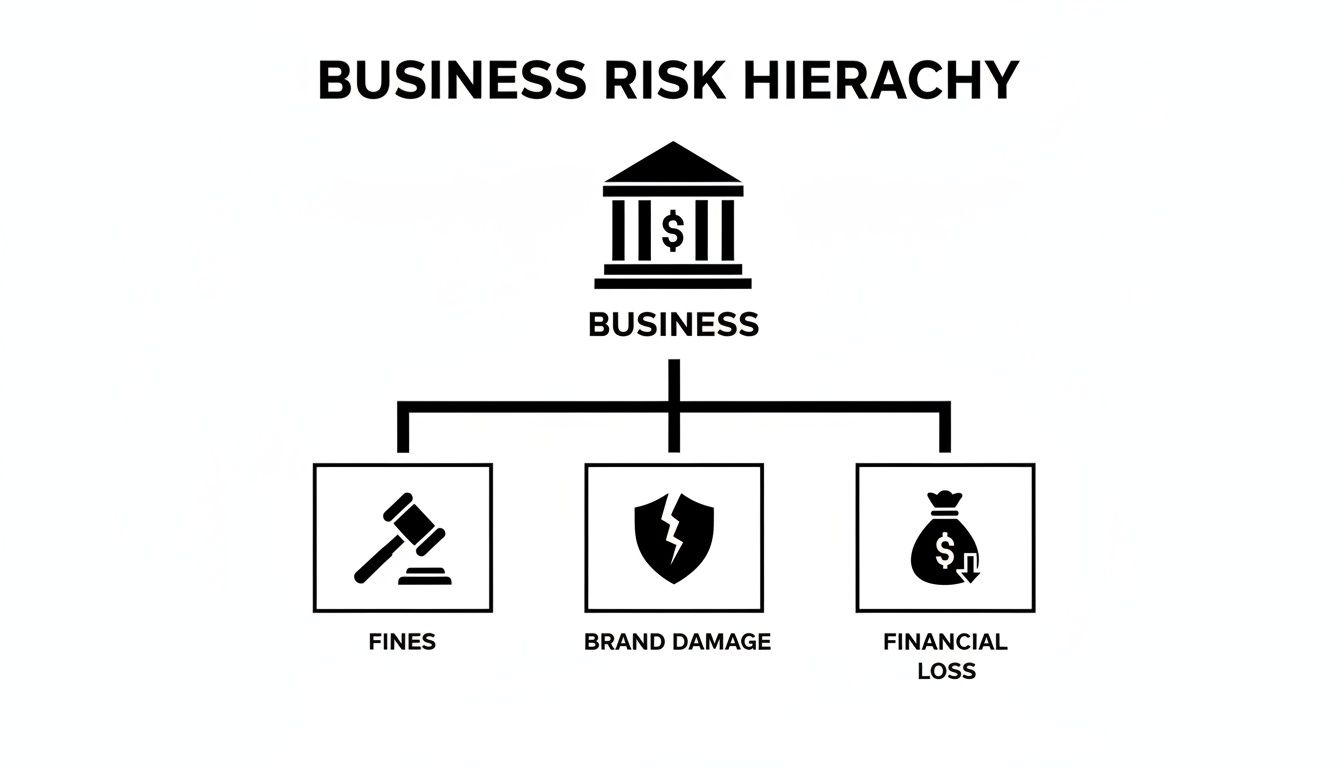
As you can see, the consequences of a data breach ripple through your entire company, hitting your finances, reputation, and legal standing. That’s why picking the right method is so important.
The choice between wiping and shredding really comes down to balancing your security needs with the potential for asset reuse. To make it easier, we've broken down the key differences.
Comparing Data Destruction Methods
Here’s a simple side-by-side look at the two primary methods to help you decide which is right for your specific needs.
| Method | How It Works | Best For | Device Reusable? | Security Level |
|---|---|---|---|---|
| Software Wiping | Overwrites existing data with random characters in multiple passes, following standards like NIST 800-88. | Functional devices intended for resale, donation, or internal redeployment. | Yes | Very High |
| Physical Shredding | Grinds the hard drive and its platters into small, irrecoverable fragments. | End-of-life, damaged, or obsolete devices containing highly sensitive data. | No | Absolute |
Ultimately, whether you need to preserve an asset's value or ensure data is gone beyond any shadow of a doubt, there is a proven method to meet your security requirements.
Navigating Data Security and Compliance Laws in Atlanta
For any business in Atlanta, compliance isn't just about ticking a box—it's about staying in business. Getting data security wrong can trigger catastrophic penalties that put your company's future on the line. The laws that govern the secure destruction of data aren't just abstract legal ideas; they're strict rules with very real consequences, especially for Atlanta's biggest industries like healthcare, finance, and tech.
It's easy to get lost in the alphabet soup of acronyms, but what's at stake is crystal clear. Picture a healthcare provider in Fulton County getting hit with a multi-million dollar fine because a single hard drive wasn't wiped before an office move. That’s not a scare tactic; it’s the kind of tangible risk businesses have to manage every single day.
The High Cost of Non-Compliance
Ignoring these regulations is a gamble you can’t afford to take. A compliance slip-up can do incredible damage to your finances and reputation, quickly turning a routine IT hardware refresh into a public relations crisis and a legal nightmare. These laws were written with teeth for a reason—to make sure organizations take data handling seriously, from the moment it's created to its final destruction.
Here are the main regulations Atlanta businesses need to have on their radar:
- HIPAA (Health Insurance Portability and Accountability Act): This is the big one for patient data protection. It demands that all Protected Health Information (PHI) be made completely unreadable, indecipherable, and impossible to reconstruct before you get rid of it.
- FACTA (Fair and Accurate Credit Transactions Act): This affects almost every business that deals with consumer information. FACTA requires the proper disposal of credit reports and similar data to head off identity theft.
- GLBA (Gramm-Leach-Bliley Act): Atlanta's financial institutions, from local banks to investment firms, must follow GLBA's Safeguards Rule. This includes specific requirements for securely disposing of customer financial information.
Staying on top of specific data security laws like HIPAA is non-negotiable for businesses handling sensitive information. You can learn more about HIPAA compliance in healthcare faxing to get a better sense of just how detailed these requirements can be.
Global Standards and Local Impact
The push for tough data protection is a global trend, and it has a direct impact right here at home. These strict rules and heavy penalties are what drive secure destruction policies for companies in major markets, including the ones we serve at GreenAtlanta.com. Under Europe’s GDPR, for instance, a company can be fined up to 4% of its annual global turnover for mistakes like not securely disposing of personal data.
Closer to home, HIPAA penalties for messing up protected health information—even on improperly discarded drives—can soar to $1.5 million per violation category, per year.
This regulatory pressure brings up a crucial point: if you can't prove your data was destroyed correctly, you haven't met your legal obligation. An undocumented process is just a compliance failure waiting to be discovered.
This is exactly why having a documented destruction process is your best defense. When you work with a certified provider, you get a Certificate of Destruction. This certificate is so much more than just a piece of paper; it’s a legally defensible document that audit-proofs your business.
It proves you did your due diligence and serves as concrete evidence that you took every necessary step to protect sensitive information. This is what mitigates your risk and lets you breathe a little easier. As you weigh your choices, it’s smart to understand what different IT asset disposition companies offer and the kind of documentation they can provide.
Choosing Between Onsite and Offsite Destruction Services
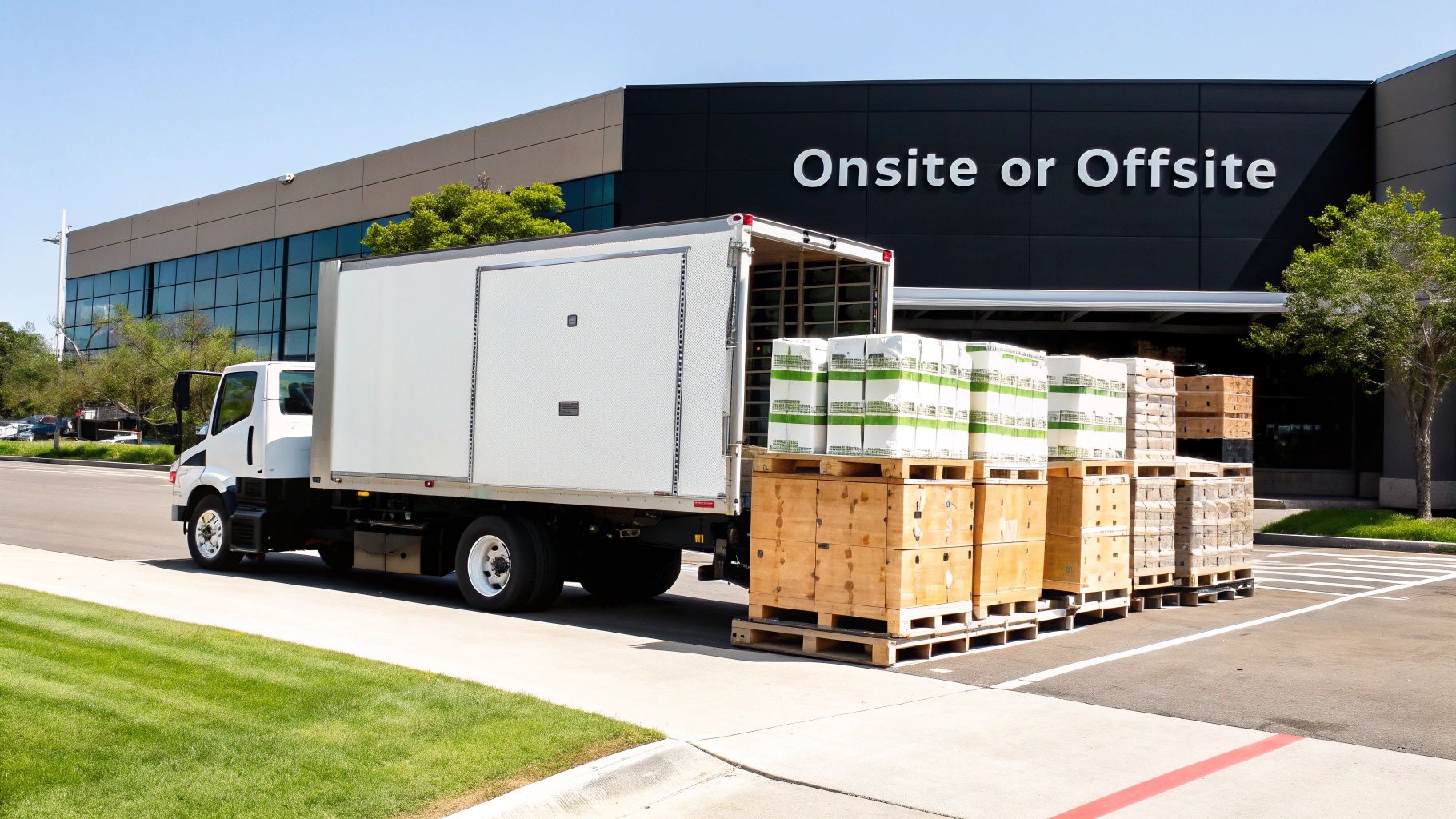
Once you’ve settled on physical destruction as the right path for your company’s sensitive data, the next big question is: where does it happen? The choice between onsite and offsite services is a pivotal part of the secure destruction of data process. Each approach has its own set of advantages, and the best fit really comes down to your company's security policies, daily operations, and budget.
Getting this decision right helps you build a strategy that's both secure and practical for your Atlanta-based operations. It has a direct impact on your chain of custody, compliance paperwork, and your overall peace of mind.
Onsite Destruction: Maximum Security and Visibility
Think of onsite data destruction as hiring a high-security private chef for your data. A specialized mobile shredding truck pulls right up to your facility, and the entire destruction process happens right in front of you. This method gives you the highest level of transparency and is the gold standard for organizations that can't afford any gaps in their chain of custody.
You can physically watch every single hard drive, backup tape, or SSD get fed into the shredder and turned into tiny fragments. This immediate, verifiable destruction is perfect for:
- Highly Regulated Industries: Businesses in healthcare, finance, and government often have strict internal or regulatory rules that demand witnessed destruction.
- Mitigating Risk: By never letting live data leave your property, you completely eliminate the risk of it being lost or stolen in transit.
- Peace of Mind: For many IT and compliance managers, seeing is believing. Onsite service provides undeniable proof that the job was done right.
If your organization needs this kind of rock-solid assurance, looking into onsite shredding near me is the logical next move to keep security and compliance buttoned up at your location.
The core benefit of onsite destruction is the unbroken chain of custody. The assets never leave your sight until they are rendered completely useless, providing an airtight security process from start to finish.
Offsite Destruction: Efficiency for Large-Scale Projects
Offsite destruction, on the other hand, is all about efficiency and scale. This service involves the secure packing and transport of your IT assets from your location to a specialized, access-controlled facility where the destruction takes place. It’s like using a fortified armored car service to move assets to a secure vault for processing.
This approach is ideal for large-scale projects where logistics and cost-effectiveness are the main concerns. At GreenAtlanta.com, our process guarantees security every step of the way. Assets are inventoried, sealed in locked containers, and moved by vetted personnel in GPS-tracked vehicles.
Offsite destruction is best suited for:
- Bulk IT Cleanouts: When you're decommissioning a data center or clearing out an entire office, trying to destroy thousands of devices onsite can be disruptive and just plain impractical.
- Cost-Sensitive Projects: Offsite services are often more budget-friendly because the provider can process materials from multiple clients in a controlled, efficient environment.
- Logistical Simplicity: Your team's job is done once the assets are securely loaded onto the truck. This frees up your internal resources to focus on other things.
Making the Right Choice for Your Atlanta Business
So, how do you decide? It really boils down to a quick evaluation of your priorities. You can use this simple framework to guide your decision:
- Security & Compliance: Does your industry or internal policy require you to witness the destruction? If the answer is yes, onsite is the way to go.
- Volume & Logistics: Are you dealing with a massive number of assets that would make shredding at your facility a huge headache? If so, offsite offers much greater efficiency.
- Budget: Is cost the main driver of your decision? Offsite services generally provide a more economical solution for secure destruction.
Ultimately, a flexible partner can create a solution that fits your specific needs, whether that means providing absolute onsite verification or managing a complex, high-volume offsite project with an impeccable chain of custody.
The Critical Role of Chain of Custody and Auditable Proof
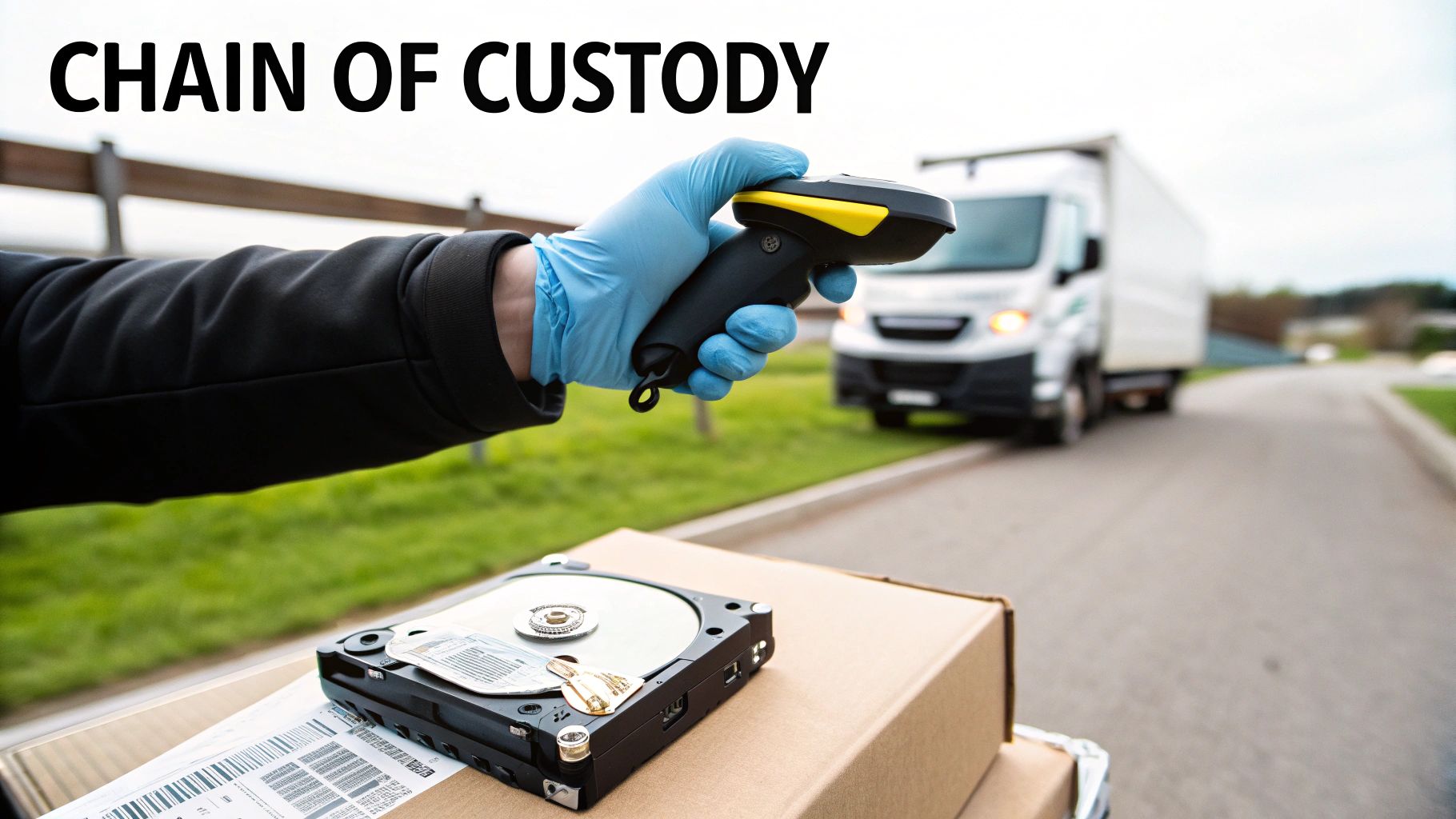
In the world of secure destruction of data, there’s a simple but unforgiving rule: if you can’t prove it was destroyed, it might as well not have been. This is where an unbroken chain of custody becomes one of the most important parts of your entire data security strategy. Without it, you’re left with gaps, uncertainty, and some serious legal exposure.
Think about tracking a high-value package. From the moment it leaves your hands, every single touchpoint is scanned, secured, and documented until it reaches its final destination. You know who handled it, where it went, and when it arrived. A professional data destruction process follows this exact same meticulous logic, creating a verifiable audit trail for your sensitive IT assets.
Building an Unbreakable Audit Trail
A strong chain of custody isn't just a handshake and a promise; it's a systematic process built on verifiable checkpoints. It’s a series of documented steps that account for every device from your Atlanta office all the way to its final destruction. This process is your best defense in an audit, proving you handled your obligations with professional diligence.
The essential elements of this process include:
- Serialized Asset Tagging: Every single hard drive, server, or device gets its own unique serial number and tag before it even thinks about leaving your facility.
- Secure, GPS-Tracked Transport: Your assets are moved in locked, secure vehicles driven by vetted personnel. Real-time GPS tracking gives you a complete log of the route from your door to the destruction facility.
- Access-Controlled Facilities: Once they arrive, your assets are moved into a secure, monitored facility with strict access controls. Only authorized individuals can ever handle them.
This careful documentation at every stage slams the door on potential security loopholes and builds a clear, defensible record of the entire process.
The whole point of a documented chain of custody is to eliminate all ambiguity. It turns what could be a huge liability into a documented, verifiable security procedure that protects your organization.
The Certificate of Destruction: Your Ultimate Proof
The final—and most critical—piece of this audit trail is the Certificate of Destruction. This document is so much more than a receipt. It’s a legally defensible record that formally transfers liability away from you and confirms that your data has been permanently destroyed according to all industry standards.
This certificate is your tangible proof of due diligence. When an auditor asks how you handled those retired assets, this document provides the detailed answer. It validates that you took every necessary step to protect sensitive information, effectively closing the loop on the asset’s lifecycle. You can find more details on what makes this document so crucial by exploring what goes into a hard drive certificate of destruction.
Ultimately, a meticulous chain of custody and a formal certificate are what give Atlanta businesses the concrete proof they need. It’s the difference between hoping your data is secure and knowing it is—backed by a paper trail that will stand up to any scrutiny.
Partnering for Data Security and Community Impact
Choosing a partner for secure data destruction goes way beyond just a security decision. It’s a choice that speaks volumes about your company’s values and your commitment to the world outside your office walls. We’ve walked through the critical methods, compliance laws, and chain of custody procedures that keep your Atlanta business protected. Now, let’s tie it all together with a bigger purpose.
At GreenAtlanta.com, we see things a little differently. We believe the end of your IT assets’ life doesn’t have to be an ending at all—it can be the start of something incredible. We’ve built our services around a unique dual mission that turns a routine security task into a powerful act of good.
Turning E-Waste into an ESG Win
Your company’s Environmental, Social, and Governance (ESG) goals aren’t just boxes to check on a report; they’re a testament to your commitment to corporate responsibility. Working with us makes hitting those goals feel less like a task and more like a natural part of doing business. The simple act of securely retiring old hard drives and servers directly fuels two vital causes: providing essential aid to veterans and reforesting our natural landscapes.
This approach transforms a standard operational cost into a real, measurable investment in society and the planet. We help you tell a story your team and customers can be proud of: “Your old tech can house a veteran and grow a forest.”
When you choose GreenAtlanta.com, you're not just hiring another vendor. You're bringing on a partner dedicated to making a tangible, local impact. Every device you hand over helps restore lives and landscapes, creating a ripple effect of positive change.
A Local Partner for a Greener Atlanta
The physical destruction side of our industry is seeing huge growth as more organizations realize they can have airtight data security and sustainable practices. For corporate campuses, hospitals, and universities across the Atlanta metro, finding a local partner who can combine on-site shredding, serialized tracking, and responsible recycling turns a logistical headache into a clear ESG victory. You can find more industry insights on how secure destruction is evolving on Spherical Insights.
We take that commitment a step further. We provide our corporate partners with:
- Veteran Support Impact Reports: Detailed documentation for your CSR records that shows the direct community benefits generated by your recycling efforts.
- Plant-A-Tree Certificates: Tangible proof of your environmental contribution, perfect for sustainability reporting and sharing your company's good work.
- "Recycled with Purpose" Eco-Badge: A digital badge your company can proudly display on your site, certifying your commitment to a circular economy that gives back.
When it’s time to manage your end-of-life IT assets, you have a choice. You can simply check the compliance box, or you can join a movement. Choose the partner that delivers certified security while helping you build a stronger, greener, and more supportive Atlanta community.
Answering Your Secure Data Destruction Questions
When it comes to getting rid of old electronics, navigating the world of secure data destruction can feel a little complicated. We get it. To help your Atlanta business make the right call with confidence, we’ve put together some straightforward answers to the questions we hear most often.
Is Deleting Files or Formatting a Drive Good Enough?
No, not even close. This is one of the most common—and riskiest—misconceptions out there. When you delete a file or run a standard format on a hard drive, you’re not actually erasing the data. You’re just removing the signposts that tell the computer where to find it.
The information itself is still there, and it’s surprisingly easy to get back with software anyone can download.
To be truly secure and meet the strict rules of laws like HIPAA and FACTA, you need professional data sanitization. That means either using multi-pass software overwriting that meets NIST 800-88 standards or, for total peace of mind, physically destroying the drive.
Think of it this way: deleting a file is like tearing the table of contents out of a book. The chapters are all still there; they’re just harder to find. Professional destruction is like putting the entire book through a shredder.
What Kind of Proof Should I Get After Destruction?
You should always walk away with a formal Certificate of Destruction. This isn't just a simple receipt; it’s a critical legal document that acts as your official proof that you did everything by the book.
A legitimate certificate from a certified partner like GreenAtlanta.com will always include key details like:
- The exact method of destruction used (e.g., shredding, wiping).
- The date the service was completed.
- A serialized list of every single asset that was destroyed, creating a clear audit trail.
This document is your shield in case of an audit. It proves your business followed the proper protocols for getting rid of sensitive data securely.
How Do I Know Which Destruction Method Is Right for Me?
The best method really comes down to your company's security policies and what you plan to do with the devices afterward. It's a trade-off between getting some value back from the hardware and ensuring data is completely gone forever.
Software wiping is perfect for functional equipment you want to resell, donate, or reuse within your company. It completely sanitizes the device of all data while keeping the hardware intact and valuable.
Physical shredding, on the other hand, is the ultimate security guarantee. It’s the go-to choice for old or obsolete media, damaged drives that can't be wiped, or any device that held extremely sensitive information. Our Atlanta-based team is happy to help you assess your inventory and figure out the best approach.
Can You Handle Large-Scale Projects Like an Office Cleanout?
Absolutely. We specialize in managing big, complex IT asset disposition projects for organizations all over the Atlanta metro area. We’ve handled everything from multi-floor office clear-outs to complete data center decommissioning.
Our team takes care of the whole process for you. We manage the secure on-site packing, logistics, transportation, and certified destruction of hundreds or even thousands of assets. We make sure the project is seamless, secure, and fully documented from start to finish, so you can focus on your business's next chapter.
Ready to turn your old technology into a force for good? At GreenAtlanta.com, we combine certified, secure data destruction with a mission to support veterans and restore forests. Choose a partner that protects your business and builds a better community. Schedule your secure electronics recycling pickup today.