
Loopnet com Atlanta: A Guide for Mission-Driven Businesses


When you're running a mission-driven business, finding the right commercial property is about so much more than square footage. For an electronics recycling operation, your facility is the heart of your entire workflow—from secure corporate pickups to processing the e-waste that ultimately funds veteran support and reforestation.
So, how do you find that perfect space? We start our search on LoopNet.
Finding Your Next E-Waste Facility on LoopNet com Atlanta

Navigating Atlanta’s competitive industrial market can feel like a massive undertaking, but a powerful tool like LoopNet simplifies the process immensely. For a purpose-driven organization like ours, your physical plant is where your dual mission—supporting veterans and planting trees—comes to life. Think of LoopNet as your strategic map for locating that vital hub where tech meets trees and transformation.
Atlanta's commercial real estate market is brimming with opportunities, especially for the industrial spaces an e-waste recycler needs. A quick look at the platform shows 39 commercial properties currently available for lease in Southeast Atlanta alone. Many of these are modern, expansive facilities built to serve the city’s booming logistics and manufacturing sectors.
Why the Atlanta Industrial Market Works for You
Atlanta's geography is a natural fit for any logistics-heavy business. Key industrial submarkets are clustered around major arteries like I-285 and the I-75/85 connector. For us, that’s a game-changer.
This strategic positioning allows our "Recycle for a Cause" campaign to operate smoothly. We promote it with the message, "Your old tech can house a veteran and grow a forest," and our location helps us fulfill that promise by cutting transit times for corporate equipment pickups and maximizing our impact.
When you're looking, you need a facility that supports every part of your operation:
- Expansive Warehouses: Crucial for processing bulk e-waste and sorting materials efficiently.
- Secure Flex Spaces: Absolutely essential for sensitive data destruction, a cornerstone service for our corporate ESG partners.
- Logistically Sound Locations: Being close to highways means your fleet can serve businesses across the entire metro area without costly delays, making corporate recycling drives for 50+ devices feasible.
To give you a better idea of what's out there, we pulled some data from LoopNet.
Atlanta Industrial Property Snapshot on LoopNet
Here’s a quick look at available industrial properties across key Atlanta submarkets to demonstrate opportunities for e-waste recycling operations.
| Atlanta Area | Number of Listings | Typical Size Range (SF) | Best For |
|---|---|---|---|
| Southeast Atlanta | 39 | 20,000 – 150,000+ | Large-scale processing, major logistics |
| Northwest Atlanta | 28 | 10,000 – 80,000 | Flex space, proximity to I-75 corridor |
| Gwinnett County | 45 | 15,000 – 100,000 | Access to suburban corporate clients |
| South Fulton | 32 | 50,000 – 200,000+ | Airport proximity, new construction |
As you can see, the options are plentiful, but it's about finding the right option for your specific workflows.
Connecting Your Mission to Your Search
As you start filtering through LoopNet com Atlanta, always frame your needs around your unique mission. You aren’t just looking for a building; you're looking for a home for a bigger purpose, like our "Recycling That Restores Lives and Landscapes" initiative.
A well-chosen facility reinforces your brand's commitment to security, efficiency, and social responsibility. It becomes a tangible asset when you're pitching stories to outlets like the Atlanta Journal-Constitution or building "Greener Atlanta" collaborations with municipalities and schools.
Your facility is more than just a place to process old tech; it's the physical proof of your promise to turn e-waste into hope. The right location will empower you to scale your veteran support and tree-planting efforts effectively.
Starting your property search with this mission-focused mindset will help you use LoopNet to pinpoint locations that can truly act as the engine for your community and environmental impact. For a more detailed walkthrough, check out our complete guide on using LoopNet for Atlanta properties.
Mastering Search Filters for Your Specific Needs
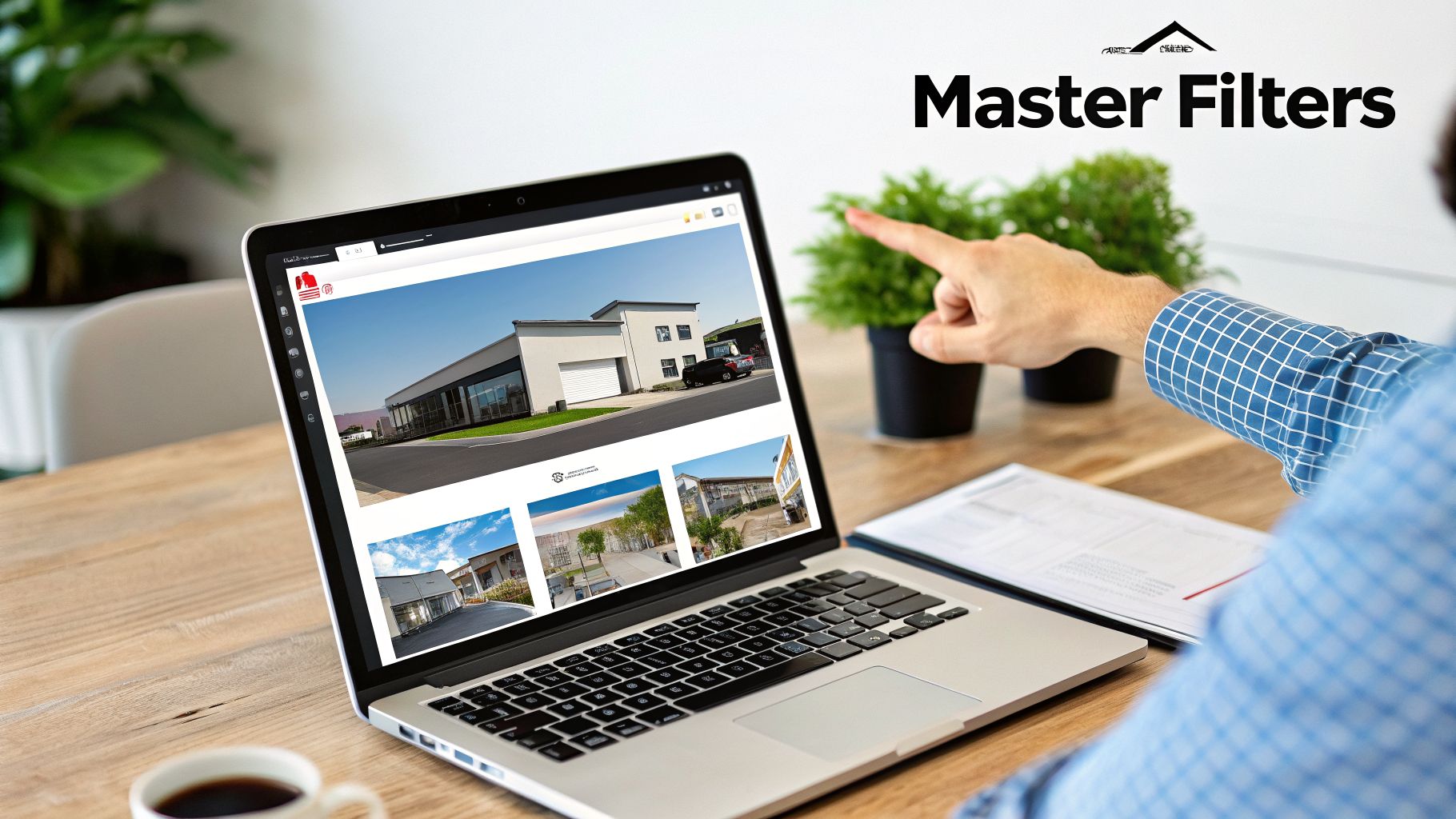
If you just run a generic search on LoopNet com Atlanta, you'll be swimming in a sea of results that are useless for an e-waste operation. Finding the right facility means getting granular. You have to move past basic filters like location and square footage to find properties that actually support your logistics, security, and even your social impact goals for keywords like "electronics recycling for veterans."
The first move is always to narrow down the property type. Start by selecting ‘Industrial’ and then zero in on either ‘Warehouse/Distribution’ or ‘Manufacturing’. This simple click cuts out all the noise from retail and office spaces, immediately focusing your search where it needs to be.
From there, it's about layering on the filters that match your day-to-day operational needs. We, for example, rely on extensive pallet racking for sorted materials, so a high ceiling is an absolute deal-breaker.
Drilling Down to Operational Essentials
Once you’ve selected the right property type, the “More Filters” button is where the magic happens. This is how you stop wasting time on properties that will never work.
For an electronics recycling facility, these are the filters I always start with:
- Clear Height: Set the minimum to 24 feet or even higher. This gives you the vertical space for pallet racking, which lets you maximize storage without paying for more square footage than you need.
- Dock-High Doors: I always filter for a minimum of two. Efficiently loading and unloading our trucks is critical, especially when we're running free pickups for corporate recycling drives across the metro.
- Power: This one is huge. Look for listings that specifically mention 3-Phase power. This heavy-duty electrical service is what you need to run industrial shredders and balers without shelling out a fortune for expensive, time-consuming power upgrades.
Think of these filters as your instant pre-qualification checklist. When you set these criteria upfront, every property you click on already meets your foundational needs. It saves an incredible amount of time.
Using Keywords to Uncover Hidden Gems
Beyond the standard dropdown menus, LoopNet’s keyword search bar can be your best friend. This is how you find properties with features that support high-value services, like secure data destruction for corporate ESG partners who need to meet sustainability and CSR benchmarks.
Using the right keywords can help you pinpoint facilities built for high-security standards, a must-have if you're pursuing certifications like R2 or e-Stewards. A secure site isn't just a feature; it's a major selling point for corporate clients trusting you with their sensitive IT assets, allowing you to offer a "Recycled with Purpose" badge for their website.
Here are a few keywords I've found effective:
- "Fenced lot" or "gated access"
- "Secure facility" or "security system"
- "Climate-controlled" or "HVAC warehouse"
Let's walk through a real-world example. Imagine you need a 15,000 sq ft facility near the I-285 loop. You’d set your size and location, then filter for an industrial warehouse with 24-foot clear height and 3-Phase power. Finally, you'd type "fenced lot" into the keyword search.
That highly specific query will instantly filter out everything that doesn't meet your operational and security requirements. For an even deeper dive into search strategies, our guide to using LoopNet in Atlanta, GA has more advanced tips. When you master these functions, LoopNet stops being a simple directory and becomes a powerful tool for strategic site selection.
Evaluating Properties Beyond the Online Listing
A promising listing on LoopNet com Atlanta is a great start, but it's just that—a start. The pictures can be polished and the square footage might tick a box, but the real work begins when you put boots on the ground. This is where you separate the real contenders from the pretty pictures and figure out if a facility can actually handle the demanding work of electronics recycling.
While you can do some initial weeding out from your desk—especially with LoopNet now offering 3D and virtual tours for over 750 Atlanta listings—nothing replaces an in-person walkthrough. It's especially critical in Atlanta's tightening market. With industrial absorption expected to hit 10 million SF in 2026 and vacancies dipping below 6%, you have to be ready to act fast when you find the right spot. You can get a feel for the current Atlanta leasing trends on LoopNet.com.
The On-Site Assessment Checklist
When you visit a potential property, you need to go in with a mission. You’re looking for the operational details a camera just can't capture. Forget the fresh paint and focus on the nitty-gritty of running an e-waste operation.
Logistics and Flow: Can a 53-foot trailer actually get to your loading docks without a 10-point turn? Walk the truck court. Imagine your collection fleet coming and going for community recycling drives co-hosted with local VFW chapters. A poorly designed truck court creates daily bottlenecks that cost you time and money.
Loading Dock Condition: Are the docks level? Do the roll-up doors work smoothly or do they scream for maintenance? Check the dock seals and bumpers. These are essential for keeping the elements out and maintaining security, especially when you're handling sensitive corporate assets.
Interior Layout and Condition: Look beyond the big, empty space. Are the concrete floors level and free of major cracks that can tear up forklift tires? Bring a laser measure to check the actual clear height. Don't just take the listing's word for it.
Verifying Power and Security
For an e-waste recycler, two things can sink your budget faster than anything else: inadequate power and weak security. Getting either of these wrong can lead to huge, unplanned expenses or, even worse, a data breach that destroys your hard-earned reputation with corporate ESG partners.
Confirming the electrical capacity is absolutely non-negotiable. Ask the property manager to open up the electrical room and show you the panels. You're looking for 3-Phase power. Snap a photo of the panel specs so your electrician can verify it can handle your industrial shredders and processing lines without a six-figure service upgrade.
Security is just as critical. You’re not just storing old equipment; you’re the custodian of sensitive data until it’s certifiably destroyed. As you walk the site, evaluate the existing security setup:
- Fencing and Gates: Is the entire perimeter secured? Is the gate automated, or will you need to staff it?
- Lighting: Is the exterior well-lit for overnight security and safe for your team during early morning or late-night shifts?
- Access Control: Are there already provisions for keycard readers or a camera system, or will you be starting from scratch?
Going beyond the online listing means doing your homework with a comprehensive due diligence checklist to uncover any hidden risks or deal-breakers. This level of detailed inspection is a core part of our own data center migration best practices, where we ensure every facility meets our non-negotiable standards for security and operational integrity.
Untangling Atlanta's Zoning and Permitting Web
Finding a promising property on LoopNet for your Atlanta-based e-waste operation is a great feeling. But don't pop the champagne just yet. The real heavy lifting begins now, and it involves navigating the complex world of zoning and permitting. Getting this part wrong can derail your entire project before it even starts.
A LoopNet listing will usually give you a zoning code, your first breadcrumb. You're looking for codes like I-1 (Light Industrial) or I-2 (Heavy Industrial). These are good signs, but they are far from a green light. You can't just take the listing's word for it.
Figuring Out Who's in Charge
The Atlanta metro area isn't one big entity; it’s a patchwork of different cities and counties, each with its own rulebook. A property you find might be in the City of Atlanta, or it could fall under the jurisdiction of Fulton, DeKalb, Gwinnett, or another municipality entirely. Your first job is to pinpoint exactly which government body makes the rules for your potential site.
Once you know who to call, get their planning and zoning department on the phone. Give them the property address and the zoning code from the listing. Be crystal clear about your intended use: "We're an electronics recycling facility that processes IT assets, and that includes secure data destruction." This is the only way you'll get a straight, official answer.
Don’t just rely on what the broker tells you about the zoning. They can point you in the right direction, but the final, legal say-so comes directly from the local planning department. That one phone call can literally save you months of frustration and thousands of dollars.
Of course, legal hurdles are only half the battle. Your physical site evaluation is just as important.
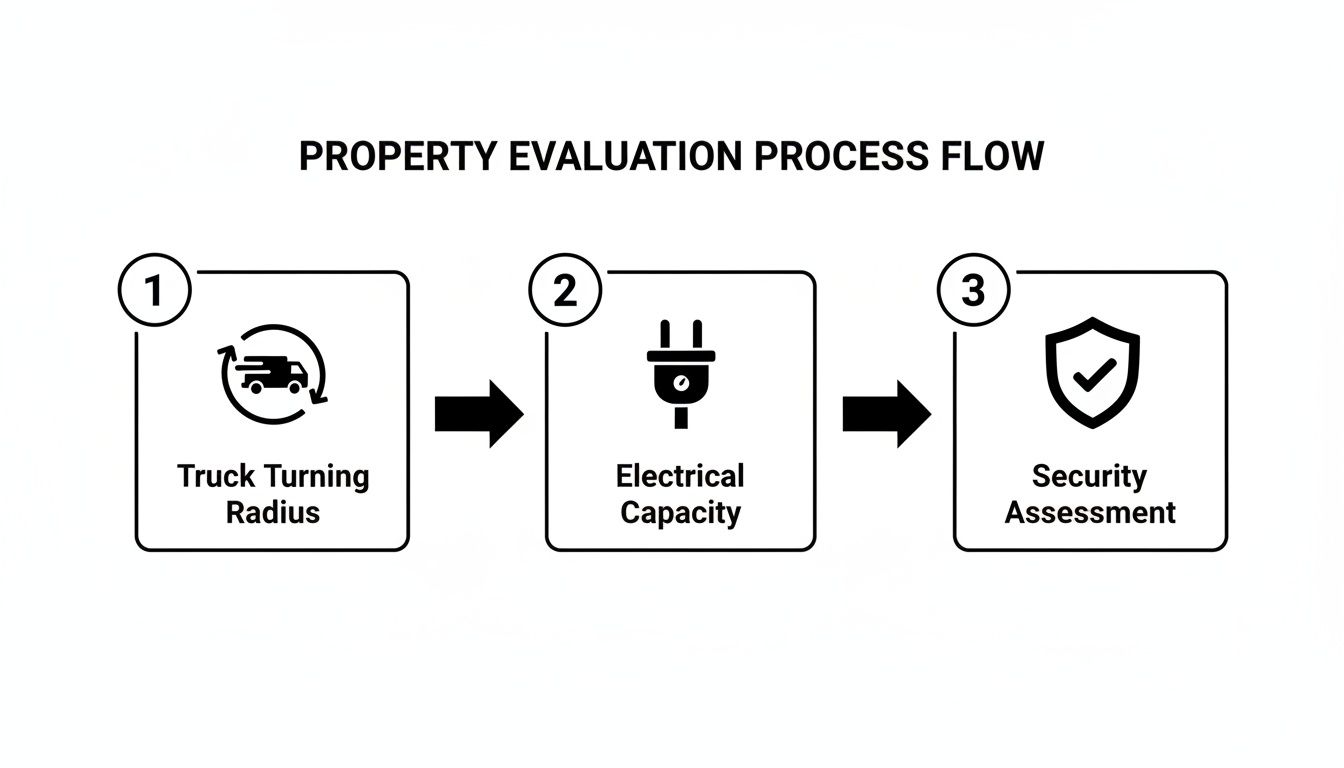
As you can see, checking the physical logistics—like truck access and power—goes hand-in-hand with confirming you can legally operate there.
Asking Brokers the Tough Questions
When you start talking to commercial brokers, you need to go deeper than just rent prices and square footage. Your questions should be laser-focused on the unique demands of an e-waste business. It shows you're a serious operator and helps you disqualify unsuitable properties fast.
Here’s a checklist of critical questions to have ready for your broker. These go beyond the basics and get to the heart of whether a site is truly viable for an electronics recycling operation targeting keywords like "corporate sustainability electronics disposal."
Key Questions for Your Commercial Broker
| Category | Question to Ask | Why It Matters |
|---|---|---|
| Environmental History | "Are there any existing Phase I or Phase II environmental reports for this site? What was the previous tenant's business?" | A property's past use (e.g., chemical storage, manufacturing) could leave behind contaminants that will complicate or block your environmental permits. |
| Permitted Use | "Has a business similar to electronics recycling or light industrial processing ever been permitted here before?" | A history of similar use can streamline the permitting process. If not, you might be the first to try, which can add time and uncertainty. |
| Landlord Restrictions | "Our process involves materials that require state and federal compliance. Does the landlord have any specific restrictions on storing or handling these materials?" | Some landlords or property associations have their own rules that are stricter than city or county regulations. You need to know about any private restrictions upfront. |
| Power Capacity | "What is the building's current electrical service capacity—specifically, the amperage and phase?" | Shredders, balers, and other processing equipment are power-hungry. You must confirm the site can handle the load, or if an expensive upgrade is needed. |
| Loading & Access | "Can a 53-foot semi-truck easily access the loading docks? What are the dock heights and door dimensions?" | Inefficient loading and unloading kills productivity. You need to ensure your trucks can get in and out without a headache every single time. |
By asking these pointed questions, you filter out the "maybes" and focus only on properties with real potential. It also builds credibility with the broker, which can be a real asset during negotiations.
For a deeper dive into the specific regulations you'll face, check out our complete guide on the legal landscape of electronics recycling in Atlanta. By tackling zoning and permitting head-on, you're building your business on a solid, compliant foundation from the very beginning.
From Lease Negotiation to Operational Readiness
So, you’ve sifted through the listings on LoopNet com Atlanta, navigated the maze of zoning codes, and pinpointed what looks like the perfect home for your electronics recycling operation. This is a huge milestone, but now the real work begins. It's time to shift gears from searching to securing, and that means negotiating a lease that sets you up for success and planning a flawless move.
A commercial lease isn't just about the monthly rent. For an industrial business with needs as specific as ours, it's a strategic tool. Think of it as the foundation for your entire operation—get it right, and you're golden. Get it wrong, and you'll face limitations down the road.
Negotiating a Lease That Works for You
A standard, off-the-shelf lease agreement just won’t cut it for an e-waste facility. You're going to need to make significant changes to the space, and you absolutely must have the landlord's green light baked into the contract from day one.
Here are the non-negotiables you should push for at the table:
- Tenant Improvements (TI) Allowance: This is a big one. It's the landlord's contribution toward your build-out costs. Understanding the typical tenant improvement costs per square foot will give you a solid baseline for your budget. This money can cover everything from building out office space to installing the heavy-duty power your shredders need.
- Right to Alterations: Don't get stuck without this. You need an explicit clause giving you permission to make necessary modifications. Think installing industrial-grade electrical systems, reinforcing floors for heavy equipment, or setting up the robust security and access control systems your corporate ESG partners require for their CSR documentation.
- Option for Expansion: Always be thinking a few years ahead. Your mission to support veterans and plant trees is going to grow. Try to negotiate a Right of First Refusal (ROFR) or a Right of First Offer (ROFO) on any adjacent units. This gives you the first shot at expanding without having to move.
Your lease negotiation is where you win or lose the long game. A well-crafted lease protects your facility investment and gives you the agility to scale your operation. Treat it with the same focus and intensity you brought to your property search.
Building Your Move-In Project Plan
Once the lease is signed, the real race begins. A chaotic move-in means downtime, and downtime means a disruption to your corporate recycling services and the powerful impact they fund. A detailed project plan isn't just a nice-to-have; it's your playbook for a seamless transition.
This plan becomes your command center, coordinating every contractor, every piece of equipment, and every team member. It's the blueprint that will transform an empty shell of a warehouse into the nerve center for your "Recycling That Restores Lives and Landscapes" mission.
Your project plan has to cover a few key areas:
- Contractor Coordination: Get your electricians, security installers, and any other trades on a master schedule. Set clear milestones and hold them to it to keep the fit-out process moving.
- Equipment Logistics: Moving your heavy machinery is a project in itself. You'll need to coordinate with riggers and specialized transport to get your shredders, balers, and forklifts moved and installed with minimal disruption.
- Workflow Establishment: This is your chance for a fresh start. Map out the new operational flow from floor to ceiling. Where does secure data destruction happen? What's the most efficient path from the receiving dock to sorting and processing? Use this opportunity to optimize every step.
- Team Transition: Don't leave your team in the dark. Walk them through the new layout and make sure everyone knows their role in making the move a success. Their buy-in is crucial for a smooth launch of seasonal campaigns around Veterans Day and Earth Day.
A smooth, well-executed move ensures there's no hiccup in serving your corporate partners. More importantly, it means no pause in the positive change you're creating. Get this right, and you'll be ready to turn old tech into new hope for veterans and new trees for our planet from the moment you open the doors.
Answering Your Questions About Using LoopNet in Atlanta
Diving into the Atlanta commercial real estate market always brings up questions, especially when you’re hunting for a space for a specialized business like electronics recycling. When you're using a tool like LoopNet to search for properties in Atlanta, a few common queries tend to pop up again and again. Let's walk through them.
How Accurate Are the Lease Rates I See on LoopNet?
Think of the lease rates on LoopNet as a starting point for a conversation, not a final price tag. For larger industrial spaces, you’ll often find listings simply marked as "Negotiable" or "Contact for Price."
Even when a specific rate is listed, say $12.00/SF/YR, it’s almost always a "NNN" (Triple Net) rate. This figure doesn't include the extra costs for property taxes, insurance, and common area maintenance (CAM). You have to talk to the broker to get the full, all-in cost, and you should always be prepared to negotiate based on your lease term and any improvements you need.
Consider the listed rate the opening offer. Your actual rent will come down to the current market, how motivated the landlord is, and how strong you are as a potential tenant.
Can I Find Properties That Qualify for R2 or E-Stewards Certification?
Absolutely. While LoopNet doesn’t have a handy "R2 Certified" checkbox, you can definitely use its filters to pinpoint properties that are strong candidates for meeting these strict standards. It’s all about a smart search strategy.
You’ll want to focus your search on properties that have features aligning with certification requirements. Look for:
- Serious Security: Use keywords like "fenced lot," "gated access," and "security system." This is vital for corporate clients.
- The Right Layout: You need enough space to properly segregate materials, which is a core requirement for R2 and e-Stewards. Look for facilities with clear, open floor plans.
- Correct Zoning: Make sure any property you consider is zoned for industrial use to handle both processing and storage operations without any headaches down the road.
Remember, you'll still need to confirm everything during an in-person site visit. Be upfront with the broker about your specific certification needs from the very first conversation—it's crucial for your credibility.
What’s the Difference Between Warehouse, Flex, and Industrial Space?
Getting these terms right is key to narrowing your search on LoopNet. Each property type is built for a different job.
- Warehouse/Distribution: These are what you probably picture—huge, open buildings with high ceilings and a bunch of loading docks. They're designed purely for storage and logistics.
- Industrial: This is a broader bucket that includes places for manufacturing. These often come with heavy-duty power and other specialized infrastructure.
- Flex Space: This is a hybrid property. It typically has a finished office space in the front and a smaller warehouse or workshop area in the back.
For a primary e-waste recycling operation focusing on keywords like "Atlanta tech recycling," you should be focusing your LoopNet search almost exclusively on "Warehouse/Distribution" and "Industrial" listings.
How Can I Use LoopNet to Back Up My Corporate ESG Partnership Goals?
You can use LoopNet to find a facility that becomes a powerful part of your company’s story, directly boosting your ESG value proposition for corporate partners. It’s about more than just square footage; it's about finding a property that demonstrates your commitment to security and professionalism. You can learn more about this in our broader Atlanta electronic waste recycling services guide.
When you search, filter for properties with secure perimeters and controlled access points. When you tour these potential sites, take photos and document these features. Highlighting your facility's security measures in LinkedIn thought leadership case studies or social proof ads with messages like "Your company can turn e-waste into forests" is a tangible way to show you’re the ideal ESG partner.
Ready to turn your company's old tech into a force for good? At Atlanta Green Recycling, we make electronics recycling simple, secure, and impactful. Our services not only protect your data and the environment but also directly fund veteran support programs and reforestation efforts. We even provide Plant-A-Tree certificates and Veteran Support Impact Reports for your CSR documentation. Schedule your corporate pickup today and let's create a greener Atlanta together. Visit us at https://www.greenatlanta.com.