A Guide to LoopNet Atlanta GA for Commercial Real Estate


Finding the right commercial space in Atlanta can feel like a monumental task, especially for businesses in tech, logistics, and sustainability. This is where a tool like LoopNet becomes your secret weapon for navigating the LoopNet Atlanta GA market. It's more than just a listing site; it’s the first real step toward operational excellence and hitting your company's ESG goals.
Why LoopNet Is the Key to Atlanta's Commercial Market
For any company managing IT assets or e-waste logistics, the right building isn't just an expense—it's the heart of your operation. Atlanta’s commercial real estate market is brimming with opportunity, but you need a powerful tool to cut through the noise. LoopNet gives you that power, offering deep market insights that go far beyond basic property listings.
This is especially true for a mission-driven organization like Atlanta Green Recycling. Our work, which channels electronics recycling into support for veteran aid and reforestation, has very specific facility needs. We require spaces that can handle secure data destruction and asset staging while also reflecting the professionalism our corporate ESG partners demand. A promise like “Recycling That Restores Lives and Landscapes” has to be backed by operational integrity.
Finding a Space That Amplifies Your Mission
The warehouse or processing center you choose directly impacts your credibility. When we tell our partners, “Your old tech can house a veteran and grow a forest,” we need a facility that guarantees the security and efficiency to make good on that promise. LoopNet is where we start, filtering for properties that meet these non-negotiable requirements from day one.
This is about finding more than just four walls and a roof. It’s about securing a location that becomes a marketing asset. Imagine showing corporate partners that their retired devices are processed in a secure, compliant Atlanta facility perfectly positioned for efficient logistics. It’s an easy ESG win for them and proof of your operational excellence. This is how a physical space becomes part of your brand story.
For businesses targeting corporate sustainability programs, a well-chosen facility is a critical piece of credibility. It demonstrates a commitment to operational excellence that goes beyond marketing promises and directly supports ESG/CSR benchmarks.
LoopNet is the undisputed leader in the commercial real estate marketplace, especially in a high-growth city like Atlanta. The platform boasts an impressive 300,000+ active listings across the U.S. and draws 13 million monthly visitors. For Atlanta specifically, this scale translates into hundreds of viable commercial properties ready for sustainable ventures like ours.
To give you a better sense of what's out there, we've put together a quick snapshot of the Atlanta market on LoopNet.
Atlanta Commercial Real Estate Snapshot on LoopNet
This table offers a high-level overview of the types and availability of commercial properties in key Atlanta submarkets found on LoopNet.
| Submarket | Approx. Lease Listings | Approx. Sale Listings | Common Property Types |
|---|---|---|---|
| Midtown | 150+ | 20+ | Office, Retail |
| Buckhead | 120+ | 15+ | High-Rise Office, Luxury Retail |
| Airport/South Atlanta | 180+ | 30+ | Industrial, Warehouse, Flex Space |
| Northwest Atlanta | 200+ | 40+ | Warehouse, Distribution, Industrial |
| Gwinnett County | 250+ | 50+ | Flex Space, Industrial, Suburban Office |
This data shows a healthy inventory, particularly in the industrial and warehouse sectors crucial for logistics and processing operations in the Airport and Northwest Atlanta corridors.
Ultimately, mastering the LoopNet Atlanta GA search is the first step toward building an operation that can deliver on ambitious goals. Whether you’re planning recycling drives with local VFW posts or issuing Plant-A-Tree certificates to corporate clients, it all starts with the right home base. A strategic property ensures you can manage logistics, maintain compliance, and build the trust needed to grow your impact. For a closer look at local property trends, feel free to check out our other articles on Atlanta real estate.
Using Search Filters to Pinpoint Your Ideal Logistics Space
Jumping onto LoopNet to find commercial space in Atlanta can feel like drinking from a firehose. The sheer number of listings is overwhelming. But the secret isn't in endlessly scrolling—it's in mastering the search filters. By getting specific from the start, you can cut through the noise and find the handful of properties that truly fit the unique needs of IT asset staging and e-waste logistics.
Forget a simple location search. The goal here is to turn a vague hunt into a surgical strike. For our line of work—handling equipment, destroying data, and processing materials—you'll want to immediately narrow your Property Type to Industrial, Warehouse/Distribution, or maybe a Flex space. These are the properties built for the kind of operational flow we need.
Zeroing In on Property Type and Size
Once you’ve set the property type, the next most important filter is Building Size. It’s tempting to just throw in a rough estimate, but getting this right saves a ton of time. Think through your entire process, from start to finish.
- Receiving & Staging: Where will you offload and sort pallets of servers, laptops, and networking gear?
- Data Destruction Area: How much dedicated, secure space do you need for hard drive shredding and wiping stations?
- Processing & Sorting: What's the footprint for technicians to test equipment, salvage parts, and sort materials for recycling?
- Outbound Storage: Where will you stage packed and palletized materials before they ship out?
Add up the square footage needed for each step. This gives you a realistic target range to plug into LoopNet, instantly filtering out spaces that are either too cramped to work in or too big for your budget. For an operation that's scaling up, targeting a space between 10,000 and 20,000 square feet is often a smart move, giving you room to breathe and grow.
This diagram really breaks down how you can go from being swamped with options to making a clear, strategic choice.
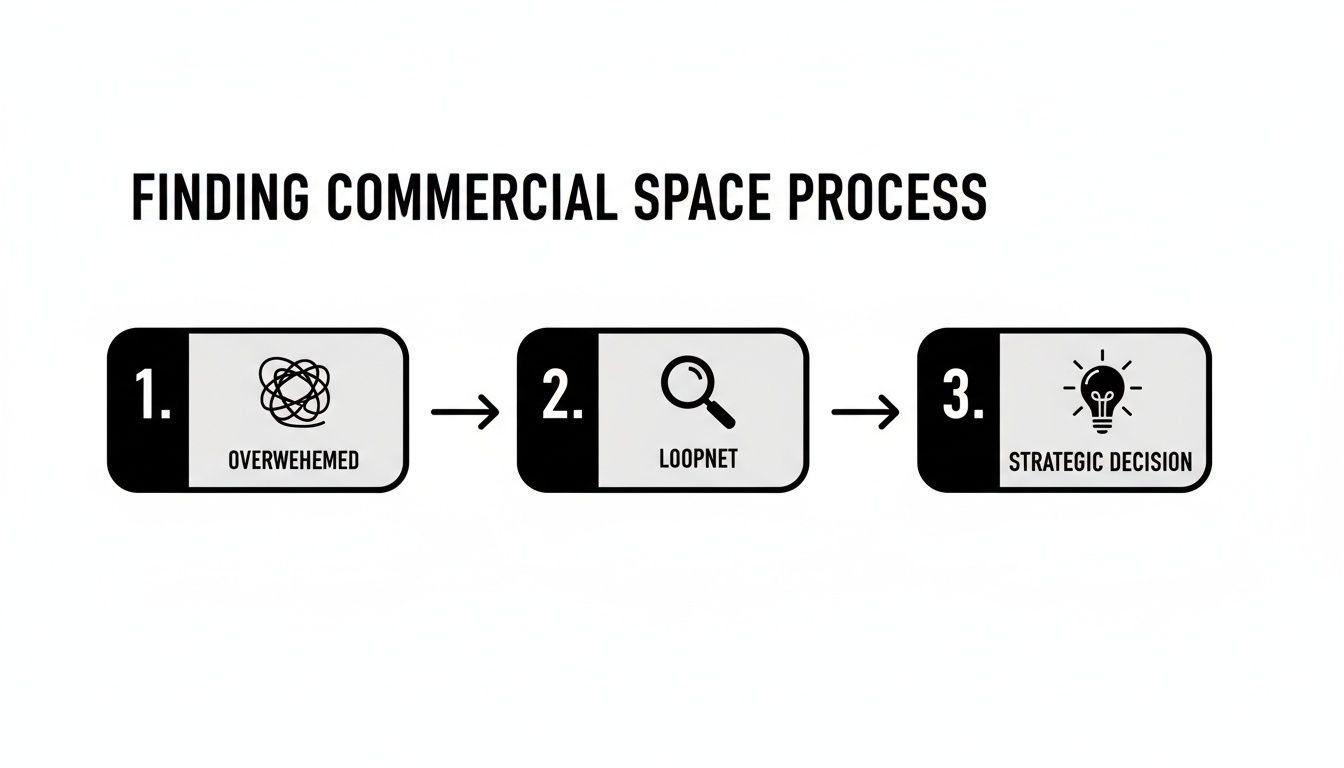
It’s all about a methodical approach. The right tools, used correctly, make a complex search manageable.
Unlocking Hidden Gems with Keyword Searches
The standard filters are your foundation, but the keyword search bar is where the real magic happens. This is how you unearth the properties that have the specific infrastructure an ITAD or e-waste facility absolutely requires. Don't just rely on the pictures; you have to actively search for the terms that signal a property is ready for your unique operational demands. Targeting keywords like “electronics recycling for veterans,” “Atlanta tech recycling,” and “corporate sustainability electronics disposal” can also help you find brokers familiar with your industry.
Here are the mission-critical keywords you should be using:
- Loading Docks: This is non-negotiable for getting pallets in and out efficiently. Search for both "dock-high" and "drive-in" doors.
- High Ceilings: You need vertical space for pallet racking. Look for listings that mention "clear height," like "24' clear height."
- Heavy Power: Your shredders, degaussers, and data wiping stations are power-hungry. Search for "heavy power" or "3-phase power" to find facilities that can handle the load.
- Secure Access: For handling sensitive IT assets, security is everything. Use keywords like "fenced," "gated," or "secure lot."
Pro Tip: Think like a broker. They might list "dock-high doors" instead of "loading docks," or describe power capacity in different ways. Try a few variations of your most important keywords to make sure you don't miss a perfect fit.
When you combine these targeted filters and keywords, your LoopNet Atlanta GA search becomes incredibly powerful. For a company like ours, finding a facility with these features is foundational. It’s part of the promise we make to our partners—that we operate with the efficiency and security they expect. It's also why we consider factors like proximity to major transit routes; you can learn more about how our services align with Atlanta's infrastructure like the MARTA system.
How to Vet Listings for Security, Power, and Accessibility
Once you have a shortlist of properties from your LoopNet Atlanta GA search, the real detective work begins. A listing can look perfect on screen, but the operational reality is often hidden between the lines. You have to scrutinize each property far beyond the glossy photos and basic stats to see if it can handle the intense demands of IT asset management and e-waste logistics.
This is the point where you shift from a browser to an investigator. The last thing you want is to sign a lease on a space that looks great online but fails in practice—a mistake that costs you time, money, and a major operational headache.
Assessing Security Infrastructure
For any organization handling sensitive corporate data, security isn't just a feature; it's the foundation. You need to look past the main photos and dig into the 3D tours and satellite views. What you're looking for are tangible security assets that immediately lower your risk.
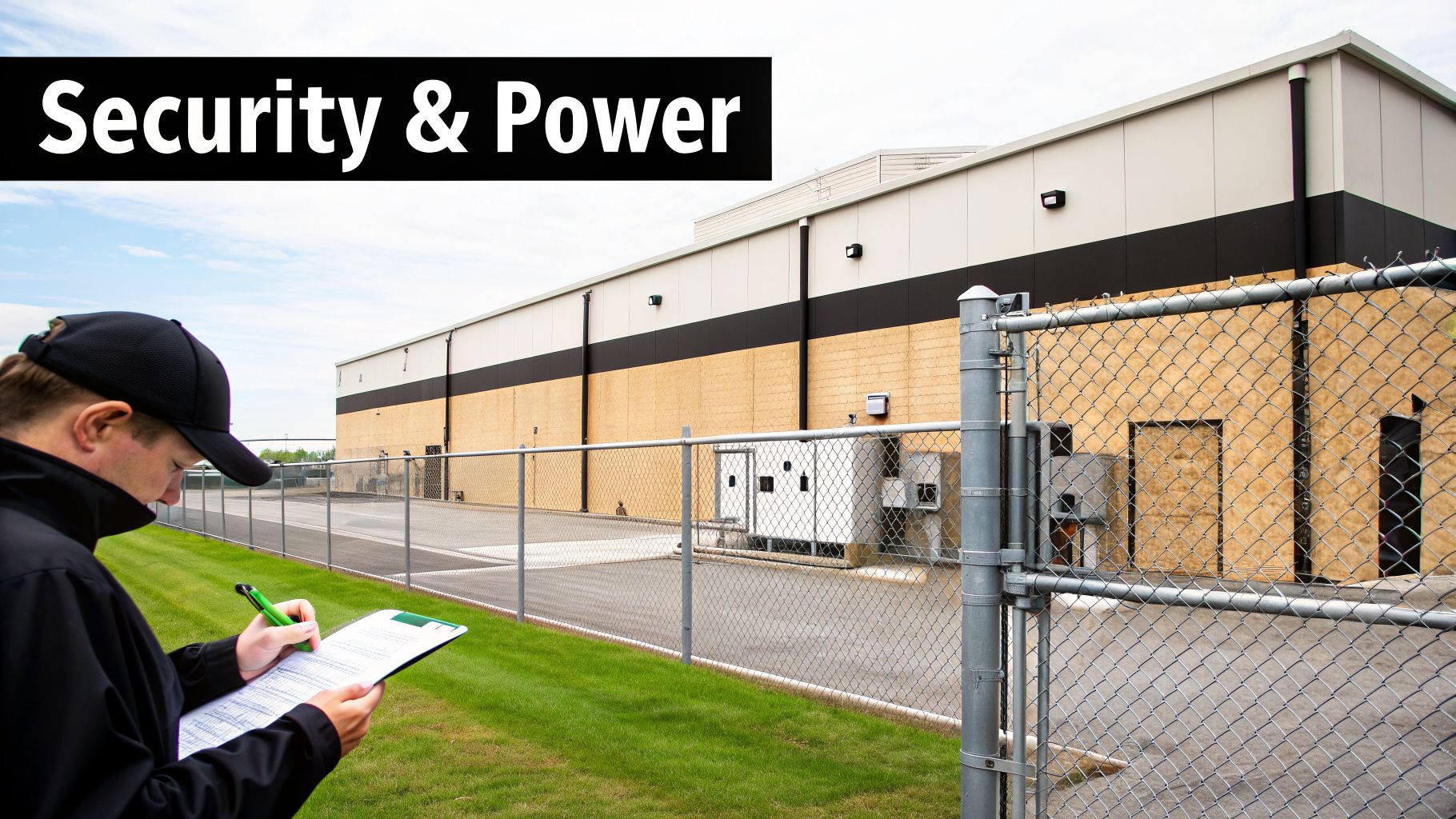
- Perimeter Security: Does the property have existing fencing? A fully fenced lot is a huge advantage, creating a solid first line of defense.
- Access Control: Check for gated entrances. While manual gates are good, electronic gates are far better because they let you control and log every entry.
- Surveillance Potential: Scan the property for existing light poles or building overhangs where you can mount cameras. A building that’s already easy to monitor will save you thousands on infrastructure costs.
Understanding the different types of commercial security systems available is a massive help here. It allows you to quickly assess what a listing already has and what you’ll need to add, letting you factor those costs in before you even think about making an offer.
Evaluating Power and Electrical Capacity
The heart of our operation is the machinery. Industrial shredders, powerful degaussers, and entire racks of servers all pull a massive amount of power. A standard office electrical system simply won't do the job.
As you comb through property descriptions, keep an eye out for keywords like "3-phase power," "heavy power," or specific amperage ratings, such as "400A/480V." If you don't see this information, it should be the very first question you ask the broker. Upgrading a building's electrical service is incredibly expensive and can take months, making this a critical deal-breaker.
A property without enough power is a non-starter, plain and simple. The cost and timeline for a service upgrade can completely derail your budget and business plan. Always prioritize listings that explicitly mention heavy or 3-phase power.
Analyzing Logistics and Accessibility
What good is a secure, high-power facility if your trucks can't get in and out? Logistics is the final, crucial piece of the puzzle. Fire up Google Maps and study the property’s site plan to get a feel for real-world access.
Key Logistical Checks:
- Truck Access: Can a 53-foot trailer easily get onto the property, turn around, and back into a loading dock? Tight turns, steep grades, or busy shared lots are major red flags.
- Proximity to Arteries: How close is the site to Atlanta’s major highways like I-75, I-85, and I-285? Every minute you save in transit adds up, improving efficiency and cutting down on fuel costs.
- Traffic Patterns: Take a virtual drive around the area during peak morning and evening rush hours. A location that gets gridlocked by traffic will create constant disruptions to your daily pickup and delivery schedules.
LoopNet’s inventory often gives you a good starting point—for instance, a search might show 31 results in Midtown, 43 in ZIP 30318, and 21 Downtown. The 3D tours are invaluable for pre-screening these kinds of logistical details. You might find that a retail space could be repurposed for warehousing old servers, while another building is perfectly set up for handling sensitive medical equipment. You can see what’s available right now by exploring the current Atlanta for-sale market on Loopnet.com.
A methodical vetting process is absolutely essential, especially when dealing with the complexities of moving large volumes of IT hardware. For more on that, take a look at our guide on data center migration best practices.
Confirming Zoning and Building Trust with Community Engagement
Alright, let's tackle zoning. Finding that perfect building on LoopNet Atlanta GA feels like a huge win, but hold on—it's only half the job. Before you even think about signing a lease, you absolutely have to confirm you can legally run your e-waste and IT asset management facility there. This is how you build trust with partners and the community from the ground up, showing that you are fully compliant and committed to the "Greener Atlanta" initiative.
This isn't just a box to check. It's the most critical step after finding a location. A zoning mismatch can kill your entire operation before it even gets off the ground.
Atlanta's municipal codes can seem like a maze, but for what we do, it really boils down to understanding industrial zoning. Our kind of work—storage, processing, and light industrial activities—means we’re hunting for properties zoned for industrial use.
Decoding Atlanta's Industrial Zoning Classifications
Here’s the thing: in Atlanta, not all industrial zones are the same. For the warehouse and flex spaces you'll be looking at, you'll mostly run into two classifications: I-1 (Light Industrial) and I-2 (Heavy Industrial). The difference is crucial for an e-waste recycler.
I-1 (Light Industrial): This is generally the sweet spot. It's designed for less intense uses like warehousing, distribution, and light assembly. A well-run IT asset disposition (ITAD) or electronics recycling operation usually fits perfectly within I-1 zoning, as long as you're not generating heavy emissions or a lot of noise.
I-2 (Heavy Industrial): This zone is for the big stuff. If your plans include large-scale shredding, smelting, or other processes that make significant noise or need special environmental permits, you'll almost certainly need an I-2 property.
I can't stress this enough: always verify a property's zoning designation directly with the City of Atlanta or the specific county it's in. A broker’s listing is a good starting point, but official confirmation is the only thing that matters. Don't take anyone's word for it.
Verifying Zoning and Building Community Ties
So you've got a promising listing from your LoopNet search. What's next? It's time to verify its zoning status online through the City of Atlanta's portal or by calling the Office of Buildings. While you’re at it, look for opportunities for community engagement. Co-hosting recycling drives with local VFW chapters, veteran shelters, or environmental NGOs builds goodwill and reinforces your mission. Partnering with schools, universities, and city programs to collect devices under a "Greener Atlanta" initiative further cements your local presence.
Be on the lookout for these common red flags:
- Zoning Mismatch: The listing says "industrial," but the official records show it’s zoned for commercial or mixed-use. This is a deal-breaker.
- Special Use Permits: The current tenant might be operating under a special permit that won't transfer to you or cover your specific activities.
- Neighborhood Overlays: Some areas have "overlay districts" with extra rules. These can put limits on truck traffic, hours of operation, or even outdoor storage.
Catching these issues early will save you from massive headaches. For a deeper look at the specific regulations governing our industry, you can learn more about the legal landscape of electronics recycling in Atlanta right here on our blog.
Actionable Tips for Securing Permits
Okay, you've confirmed the zoning is a perfect match. You're not done yet. You'll still need the right business licenses and operating permits from the City of Atlanta. For an e-waste facility, this always includes a general business license. Depending on the scale of your recycling activities, you might also need to register with the Georgia Environmental Protection Division (EPD). Having all your compliance documents in order is a powerful tool, just like pitching stories to outlets like the Atlanta Journal-Constitution about your dual-impact model to build PR credibility. It shows potential corporate partners you’re a professional, reliable choice, making you an easy ESG win.
Positioning Your Brand for Corporate ESG Partnerships
Once you’ve found the right compliant facility on a platform like LoopNet for Atlanta, GA, you need to think beyond its four walls. That secure, legally zoned warehouse is more than just an operational necessity; it’s one of your most powerful marketing assets.
Corporate partners today are under immense pressure to meet their Environmental, Social, and Governance (ESG) goals. They aren't just looking for another vendor. They need a partner who can provide an "easy ESG win"—someone who makes corporate responsibility simple, verifiable, and impactful. Our tagline, “Turning E-Waste into Hope,” captures this value proposition perfectly.
This is where you come in. By positioning your Atlanta operations correctly, you shift the conversation away from just cost and into the realm of purpose. You’re not just recycling electronics; you’re offering a tangible solution that boosts their corporate responsibility efforts, complete with real-world impacts on veteran support and reforestation.
Turning Your Facility Into a Marketing Tool
Your compliant, secure facility is the physical proof of your professionalism. It’s a visual representation of your commitment to security and responsible handling, something you should be showing off to potential corporate clients.
Highlight how your building's features directly support their ESG needs. Talk about the secure access controls, the monitored data destruction zones, and the organized flow of materials. This isn’t just about logistics; it’s about building trust from the first impression.
When you offer a corporate recycling drive with free pickup for 50+ devices, you're opening the door to a partnership. The real value, however, is delivered after the pickup, when you provide them with concrete proof of their positive impact.
- Plant-A-Tree Certificates: A professionally designed certificate that shows exactly how many trees were planted in their company's name.
- Veteran Support Impact Reports: A concise summary detailing how their specific e-waste contribution helped fund veteran aid programs.
These aren't just feel-good documents. They are critical assets that your partners can plug directly into their annual CSR and sustainability reports, making your service a strategic business decision.
Building Credibility Through Digital Assets
To cement your status as a go-to ESG partner, you need digital assets that reinforce your story. These tools act as social proof and make it incredibly easy for your partners to share their commitment.
A great starting point is creating a digital badge, something like a “Recycled with Purpose” certification. This is a simple eco-badge they can proudly place on their website, in email signatures, or within their sustainability reports. It’s a clean, visual way to communicate their responsible e-waste practices.
Your tagline, “Turning E-Waste into Hope,” truly comes to life when a corporate partner can display a badge showing they are part of that mission. It connects their routine IT asset retirement to a larger, positive story.
Thought leadership on platforms like LinkedIn reinforces this strategy. Publishing case studies is one of the most effective ways to do this. Imagine a story about how an Atlanta tech firm not only securely disposed of 2,000 laptops with you but also met its quarterly sustainability goals, planted 150 trees, and contributed to a local veteran housing project. These real-world examples, amplified with video storytelling of veterans receiving aid or reforestation footage, are far more compelling than any sales pitch. For more ideas on developing a strong program, you can get insights from our guide to a business sustainability strategy.
Ultimately, your property search on LoopNet Atlanta GA is just the beginning. By strategically positioning your secure and compliant facility as an integral part of your ESG solution, you become more than a service provider. You become an indispensable partner in their mission to do good.
Negotiating Your Lease and Planning a Seamless Move In
You’ve done the hard work of searching LoopNet Atlanta GA, vetting properties for power and security, and making sure the zoning fits. Now comes the make-or-break part: negotiating the lease and planning a move that ensures your operation is efficient from day one. This is where all that prep really shines, letting you negotiate from a place of strength.
A commercial lease is far more than just a rental agreement. For an ITAD and e-waste company, it's a strategic document that can either bottleneck your workflow or unlock its full potential. Standard boilerplate leases just won’t cut it; you need to zero in on clauses that directly affect your unique business.
Getting the Lease Right: What to Negotiate
Your most powerful negotiating chip is often the Tenant Improvement (TI) allowance. This is money the landlord provides to help you customize the space. Don't just settle for new paint and carpet; push for allowances that cover your core operational needs.
- Security Upgrades: Argue for TI funds to install high-security fencing, robust access control systems, or a comprehensive CCTV network.
- Power Enhancements: If the building’s electrical needs a boost to handle your shredders and server racks, make that a central part of your TI negotiation.
- Floor Reinforcement: Pallets of servers and processing machinery are incredibly heavy. Propose using the allowance to strengthen the concrete slab to handle the load capacity you require.
Beyond the TI allowance, you need to pore over every line of that lease. Pay close attention to the "Use" clause, ensuring it explicitly permits activities like "electronics recycling, data destruction, and IT asset management." A vague clause can lead to major headaches down the road.
Reviewing the fine print on hazardous materials handling is also non-negotiable. You need to confirm the lease terms align with your compliant processes for managing items like lithium-ion batteries, preventing future compliance issues.
To help you stay organized during these critical conversations, we've put together a checklist of key points to address. This ensures your Atlanta facility is set up for success from both an operational and a compliance standpoint.
Lease Negotiation Checklist for E-Waste Facilities
Key points to address during lease negotiations to ensure your Atlanta facility meets operational and compliance needs.
| Lease Clause/Topic | Key Consideration | Desired Outcome |
|---|---|---|
| "Use" Clause | Is it specific enough for e-waste/ITAD operations? | Explicit permission for "electronics recycling, IT asset disposition, and data destruction." |
| Tenant Improvement (TI) Allowance | Can it cover operational needs, not just cosmetic ones? | Funding allocated for security systems, power upgrades, and floor load reinforcement. |
| Hazardous Materials | Does the clause align with R2/e-Stewards standards for battery storage? | Clear terms that permit compliant storage and handling of e-waste components. |
| HVAC & Ventilation | Can the system handle dust and heat from processing equipment? | Landlord commits to or provides an allowance for necessary HVAC upgrades. |
| Security & Access | Do you have the right to install your own security systems? | Unrestricted rights to install and manage cameras, alarms, and access control. |
| Alterations Clause | Does it allow for installing heavy machinery and secure cages? | Flexible terms that permit non-structural changes required for your workflow. |
Having these items agreed upon in writing before you sign is crucial. It protects your investment and ensures the property can truly function as the secure, high-capacity facility you need.
Designing Your Operational Hub Before Move-In Day
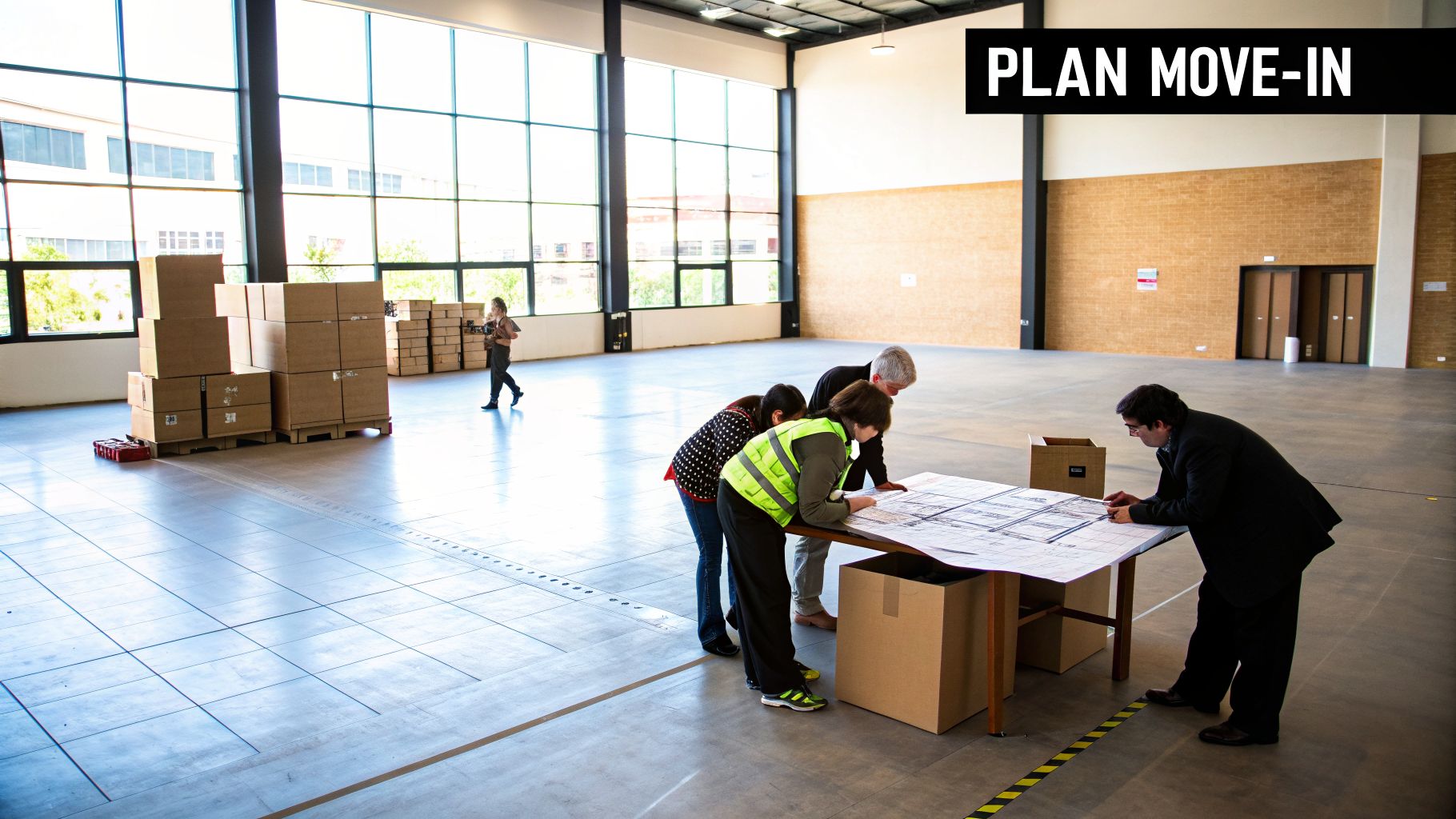
With a solid lease in hand, the real work of transforming an empty space into a high-functioning facility begins. This requires detailed planning before a single piece of equipment arrives. Don't just move in; engineer your layout with a purpose for every square foot.
Your goal is to create a facility layout that minimizes movement, maximizes security, and streamlines your workflow from receiving to shipping. This upfront planning is one of the most significant factors in long-term operational efficiency.
Start by mapping out a floor plan with distinct zones for each stage of your process. This strategic separation is vital for security, compliance, and an efficient workflow.
Key Facility Zones:
- Secure Receiving Area: This should be a dedicated, access-controlled space where all incoming assets are offloaded, inventoried, and staged for sorting.
- Data Destruction Zone: Think of this as a high-security "cage" or a separate room under 24/7 video surveillance. Access must be strictly limited to authorized personnel for hard drive wiping, degaussing, and physical shredding.
- Testing & Refurbishment Area: A clean, well-lit space for technicians to test devices for remarketing and perform any necessary repairs.
- Material Sorting & Palletizing Station: An area where non-functional equipment is broken down into commodities like plastics, metals, and circuit boards, then prepped for our downstream recycling partners.
- Outbound Shipping Dock: A clear, organized zone for staging and loading everything from refurbished assets heading to a new home to sorted materials on their way to be recycled.
Finally, once the lease is signed and the layout is planned, it's time to organize the physical move. A comprehensive resource like an Interstate Moving Checklist can be a lifesaver, ensuring you don't miss crucial details like transporting heavy equipment or coordinating utility hookups.
This methodical approach ensures your new Atlanta facility is more than just a building you found on LoopNet. It becomes the operational heart of your mission—a space perfectly tuned to deliver on our promise of "Recycling That Restores Lives and Landscapes" with unmatched efficiency and security.
Answering Your Top Questions About Using LoopNet in Atlanta
Once you start digging into LoopNet for the Atlanta market, a few common questions always seem to pop up. We get them all the time, especially from businesses with very specific needs for IT asset staging and e-waste logistics, just like ours.
For an operation that handles sensitive equipment and is built on a dual mission of supporting veterans and reforestation, getting the right space isn't just a detail—it's everything. Here are the answers to some of the most frequent questions we’ve encountered while searching for industrial, warehouse, and flex space in Atlanta.
How Accurate Are the Lease Rates on LoopNet Atlanta GA Listings?
Think of the lease rates you see on LoopNet as the asking rate—a solid opening offer, not the final price tag. The Atlanta market is dynamic, and the number on the screen is just the beginning of a much larger conversation.
The final rate you’ll lock in depends on a few key variables:
- Lease Term: A longer lease, say 5-10 years, gives you much more room to negotiate than a short-term deal. Landlords love stability.
- Your Creditworthiness: If your business has a strong financial track record, landlords see you as a lower risk. This can often translate into better terms.
- Tenant Improvement (TI) Allowance: Are you asking the landlord to fund significant upgrades for security systems or beefed-up power? They might hold firm on the base rent to offset that investment.
Always, always talk to the broker. The listed price almost never includes extra costs like Common Area Maintenance (CAM) charges, which can add a hefty sum to your monthly bottom line.
Treat the listed LoopNet rate as a starting point. The true cost of your lease only comes into focus after you’ve discussed your specific needs and negotiated the terms.
What Is the Difference Between Warehouse and Flex Space on LoopNet?
When you’re filtering properties, you'll see "Warehouse/Distribution" and "Flex" space pop up constantly. They might seem interchangeable, but choosing the right one is critical for your day-to-day operations.
A Warehouse/Distribution property is exactly what you imagine: a massive building built for pure storage and logistics. These spaces are defined by their high ceilings (often 24 feet or higher), multiple loading docks, and vast, open floor plans. For a business focused purely on IT asset staging or processing e-waste in bulk, a warehouse is usually the most practical and cost-effective choice.
Flex space, on the other hand, is a hybrid. It’s a single property that combines office space with a smaller warehouse or light assembly area. If you need a significant office for your admin team, a reception area for clients, or a dedicated lab for data destruction and device refurbishment, flex space is a fantastic all-in-one solution. It saves you the hassle and cost of leasing two separate locations.
Can I Find Short-Term Warehouse Space on LoopNet in Atlanta?
Yes, but you have to know where to look. While LoopNet is built around long-term leases (think 3 to 10 years), you can uncover short-term options for specific projects, like a one-off data center decommission or handling seasonal overflow.
Your best bet is to use the keyword search bar. Try terms like "sublease," "short-term," or "month-to-month." A sublease is the most common path, where you take over another tenant's lease for its remaining term—which could be as short as 6-18 months.
Another pro tip: reach out to industrial property brokers directly, even if a listing doesn’t advertise short-term availability. They have insider knowledge of spaces that might be available for shorter periods but aren't publicly marketed that way. A landlord might be more than willing to sign a 6-12 month lease to avoid a vacancy, especially for a reputable tenant.
Are There Other Resources Besides LoopNet for an Atlanta Property Search?
LoopNet is the heavyweight champion and an essential starting point for any commercial real estate search in Atlanta. But a truly smart search strategy never relies on just one tool. You could miss out on some hidden gems.
We highly recommend engaging a local commercial real estate (CRE) broker who lives and breathes the Atlanta industrial market. These brokers have access to "off-market" deals—properties that are available but not listed publicly anywhere. Their relationships and deep market knowledge can be a game-changer.
Another platform worth checking is CREXi, which is steadily growing its footprint in the Atlanta area. That said, for the sheer volume of listings, detailed property data, and powerful search filters, LoopNet remains the indispensable core of our search process. It’s the tool we trust to find spaces that help us turn e-waste into real hope for veterans and our planet.
Ready to partner with a company that turns your old electronics into a force for good? At Atlanta Green Recycling, we offer secure, compliant, and purpose-driven e-waste solutions. Schedule your corporate pickup today and let's work together to restore lives and landscapes.