Choosing IT Asset Disposition Companies in Atlanta A Complete Guide


When your company’s technology reaches the end of its life, what happens next? IT asset disposition companies step in to manage the secure and environmentally sound retirement of that equipment. The process is all about protecting sensitive data, recovering value from still-usable gear, and making sure your business stays compliant with a web of regulations. For any business in Atlanta, from a startup to a Fortune 500, picking the right partner for this is a huge decision for both security and sustainability.
What Is IT Asset Disposition and Why Does It Matter
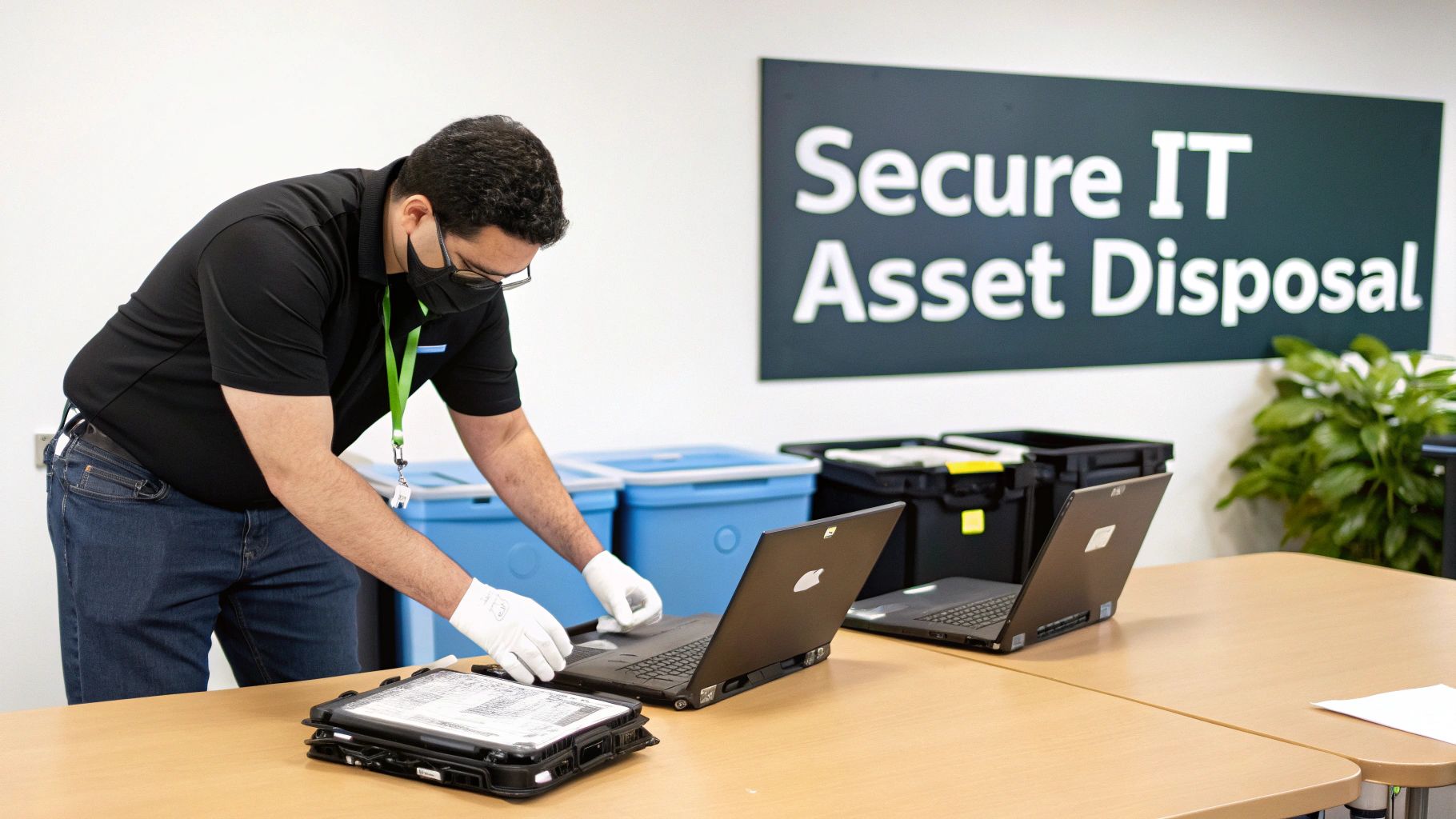
Think of IT Asset Disposition (ITAD) as the final, critical chapter in your hardware’s story. It’s so much more than just tossing out old computers. ITAD is a secure, systematic process for handling retired tech to shield your data, meet legal standards, and squeeze every last drop of value out of your initial investment.
It's a bit like decommissioning a naval ship—you wouldn’t just scuttle it and hope for the best. You'd have a team securely offload sensitive cargo, safely drain hazardous materials, and salvage valuable components for another use. That's exactly what professional it asset disposition companies do for your electronics.
They make sure every bit of sensitive data is permanently gone, environmental rules are followed to the letter, and any parts with life left in them are repurposed or sold. It’s a comprehensive approach that’s no longer optional in today's business world. To get a deeper look at the process, check out our guide on what is IT asset disposition and its essential parts.
From Compliance Requirement to Mission-Driven Impact
The best ITAD partners don’t just stop at disposal. They can help turn what feels like a routine chore into a powerful story for your brand. This is where a vendor’s own mission and values can make a world of difference.
For instance, imagine working with a partner that has a dual philanthropic mission, like supporting veteran aid and planting trees. Suddenly, your e-waste is doing real good in the world. Instead of just getting a standard certificate of destruction, you get back an impact report showing the positive change you helped create.
“Recycling That Restores Lives and Landscapes.” Your old tech can do more than meet compliance standards; it can help house a veteran and grow a forest. This transforms ITAD from a cost center into a cornerstone of your company’s Environmental, Social, and Governance (ESG) goals.
This mission-driven model delivers real results that connect with your employees, your customers, and your stakeholders on a human level. By partnering with local Atlanta organizations like VFW chapters or collaborating on a "Greener Atlanta" initiative, the impact becomes tangible and community-focused.
Core Functions of a Professional ITAD Service
A professional ITAD strategy rests on a handful of core services that are absolutely non-negotiable. Knowing what these are helps you tell the difference between a simple recycler and a true security partner dedicated to protecting your business.
Here's a quick rundown of the essential services that should be part of any comprehensive ITAD strategy.
Core Functions of a Professional ITAD Service
| Service | What It Achieves | Why It's Non-Negotiable |
|---|---|---|
| Secure Data Destruction | Permanently erases all sensitive information from hard drives and other media, making it completely unrecoverable. | Protects your company from devastating data breaches, financial penalties, and reputational damage. |
| Value Recovery | Identifies, refurbishes, and resells still-valuable components or whole devices to recoup a portion of your initial investment. | Offsets the cost of the disposition service and turns retired assets into a revenue stream. |
| Environmental Compliance | Ensures all e-waste is recycled according to local, state, and federal regulations, preventing harmful materials from entering landfills. | Avoids steep fines for non-compliance and demonstrates your company's commitment to corporate sustainability. |
| Chain-of-Custody Documentation | Provides a detailed, auditable trail tracking each asset from the moment it leaves your facility to its final disposition. | Delivers the proof you need for internal audits and regulatory compliance, confirming every device was handled securely. |
Ultimately, these functions work together to create a secure, responsible, and financially smart process for retiring your company's technology.
The Hidden Dangers of Improper IT Asset Disposal
Choosing not to work with a professional IT asset disposition company isn't a savvy way to cut costs—it's rolling out the welcome mat for serious financial, legal, and reputational damage. When your company’s old tech is handled the wrong way, two major threats pop up that can absolutely cripple a business: catastrophic data breaches and crushing environmental penalties.
Just imagine a local healthcare practice here in Atlanta getting slammed with HIPAA fines because a single hard drive they tossed still held thousands of patient records. Or picture a well-known local firm making the evening news after its e-waste was found illegally dumped in a nature preserve. These aren't just hypotheticals; they're the real-world risks businesses are up against every single day.
And in a major business hub like Atlanta, with our high concentration of regulated industries like finance, healthcare, and logistics, the stakes are even higher. A tiny oversight can snowball into a massive compliance failure in the blink of an eye. Pitching these stories to local outlets like the Atlanta Journal-Constitution can highlight the importance of responsible disposal.
The High Cost of a Data Breach
The most immediate and terrifying danger of bad IT asset disposal is exposing sensitive information. A simple wipe or factory reset just doesn't cut it. It often leaves confidential files easily accessible to anyone with basic recovery software, and the fallout can be devastating.
Beyond the environmental side of things, ignoring data security when getting rid of old assets can lead to major breaches. It’s important to understand the best practices for data security and privacy in electronic device handling for any device, and for a business, that risk is multiplied across hundreds or even thousands of assets.
Data centers are a huge part of the ITAD world, and the risks there are just as massive. Breaches from assets that weren't properly sanitized can trigger HIPAA fines up to $50,000 per violation for healthcare clients. When you skip a professional ITAD service, your company is left completely vulnerable to these liabilities.
Environmental Compliance and Reputational Damage
The second big threat comes from breaking environmental rules. Old electronics are chock-full of hazardous materials like lead, mercury, and cadmium. Both state and federal laws, including strict regulations from the Environmental Protection Agency (EPA), dictate exactly how these materials must be handled.
Dumping e-waste the wrong way can lead to huge fines and cleanup bills. But honestly, the damage to your reputation can be even worse. A news story about your company's equipment polluting a local river can shatter public trust and drive away environmentally-conscious customers for good. You can learn more about the harmful ways e-waste can impact our day-to-day lives in our related article.
Professional ITAD isn't just another operational expense—it's a high-return investment in risk management. Think of it as a shield, protecting your organization from the hidden dangers that linger in retired technology.
At the end of the day, picking a certified ITAD partner gives you a secure, compliant path for your old assets. It’s the only way to guarantee your data is completely destroyed, your environmental duties are met, and your brand's good name stays intact.
Essential Services To Demand From Your ITAD Partner
Let’s be honest: not all IT asset disposition companies are created equal. Plenty of vendors can haul away a pallet of old electronics, but a true ITAD partner does far more than that. They deliver a whole suite of non-negotiable services built to protect your organization from every possible angle.
These core functions are what separate a simple recycler from a dedicated security and compliance expert.
Whether you're decommissioning a whole data center out in Alpharetta or just refreshing a few hundred laptops in Midtown, you need to know what to ask for. Demanding the right services ensures you pick a vendor who can actually safeguard your data, handle the logistics without a hitch, and give you an unbreakable chain of evidence for every single asset.
If that sounds like a lot, consider the alternative. This flow chart breaks down the serious risks—from data breaches to environmental fines—that pop up when these essential services get overlooked.
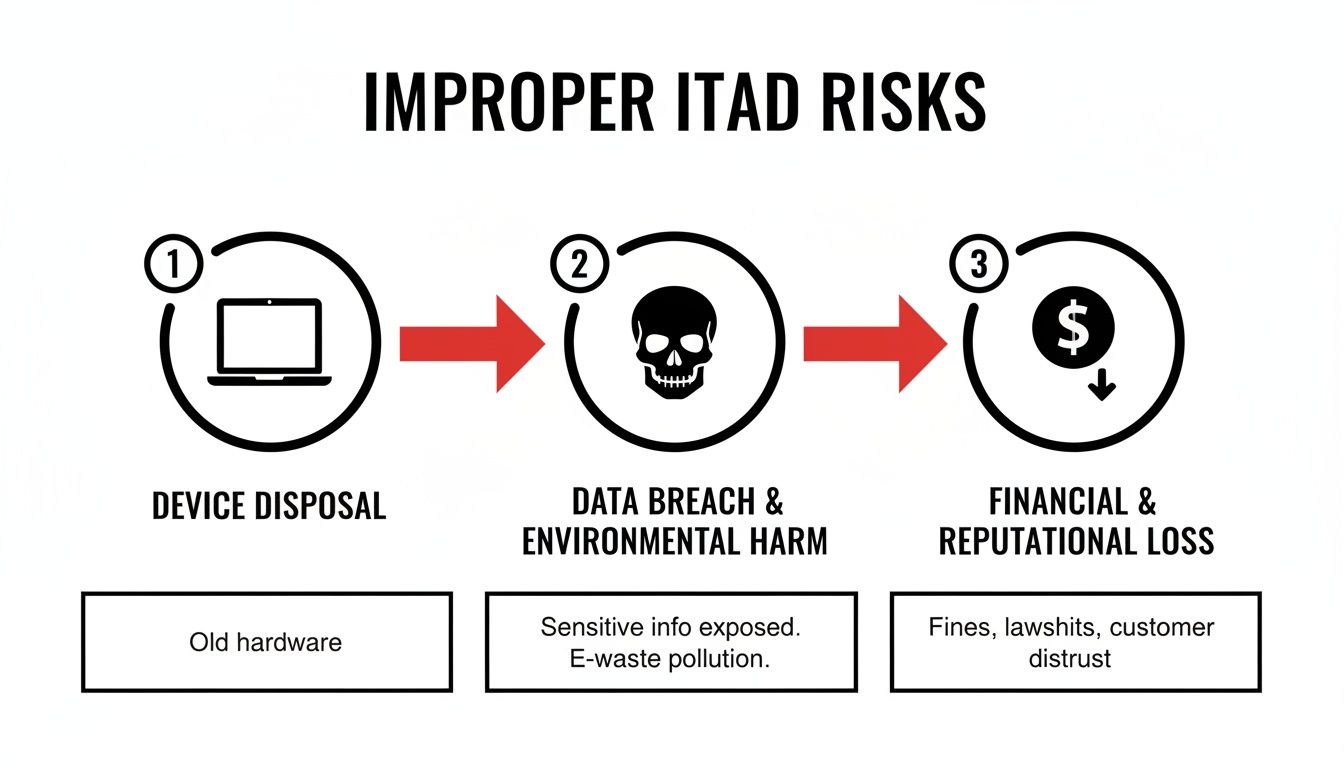
As you can see, there's a straight line from a casually discarded device to major financial and reputational damage. This is exactly why a secure, documented process isn't just nice to have—it's critical.
Secure Data Destruction
The absolute, unshakable cornerstone of any ITAD program is the permanent and verifiable destruction of your sensitive data. Simply deleting files or hitting "factory reset" doesn't cut it. With basic software tools, that data can often be recovered in minutes.
A professional ITAD provider has to offer multiple levels of secure data sanitization to meet different security needs. It's not a one-size-fits-all situation.
You need a partner who gets the nuances between different methods and can guide you to the right approach for your specific equipment and compliance rules. For a deeper look, check out our complete guide to secure data destruction and see how it protects your business.
A top-tier vendor won’t just push one solution. They’ll lay out a clear menu of options, each with its own security level and best-use case. This way, you’re not overpaying for extreme measures you don't need—or worse, under-protecting your most sensitive information.
A Comparison of Data Destruction Methods
Understanding the three primary methods of data destruction helps you select the right level of security for your assets. Each has its place, depending on whether you plan to reuse the hardware or need maximum, no-questions-asked security.
| Method | How It Works | Security Level | Ideal For |
|---|---|---|---|
| Software Wiping | Overwrites the entire hard drive with random data in multiple passes, following standards like DoD 5220.22-M or NIST 800-88. | High | Resale or reuse of functional hard drives, preserving the hardware's value while ensuring data is unrecoverable. |
| Degaussing | Exposes magnetic media (like traditional hard drives and tapes) to a powerful magnetic field, instantly scrambling the data. | Very High | Rapidly sanitizing large volumes of magnetic storage devices, rendering them unusable but completely secure. |
| Physical Shredding | Mechanically destroys the hard drive by grinding it into small, coin-sized fragments, making data recovery impossible. | Maximum | End-of-life, damaged, or obsolete drives where data security is the only priority and the hardware has no resale value. |
Ultimately, the goal is certainty. Whether wiped, degaussed, or shredded, you need documented proof that your data is gone for good.
On-Site Services and Secure Logistics
A truly professional ITAD process starts long before your assets ever hit the road. The best vendors bring their expertise right to your doorstep, offering comprehensive on-site services to manage the de-installation, packing, and transport of your equipment securely and efficiently.
This "white-glove" approach minimizes disruption to your daily operations and drastically cuts the risk of equipment being lost, damaged, or stolen in transit. It's an absolute must for any large-scale project, like an office move or a full data center decommissioning.
Look for a partner that provides:
- Professional De-installation: Trained technicians who know how to safely disconnect and remove servers, racks, networking gear, and workstations without causing chaos.
- Secure Packing and Palletizing: Using the right materials to protect assets and ensure everything is properly inventoried and ready for a safe journey.
- Company-Owned Fleet: Using their own trucks and vetted, trained drivers. This gives them—and you—far more control and security than relying on random third-party couriers.
Unbreakable Chain of Custody
From the second an asset leaves your building, you need a documented, auditable trail that tracks its every move. This is called the Chain of Custody, and it's your ultimate proof of due diligence.
A secure Chain of Custody is not just a report; it's a legal shield. It provides serialized, timestamped evidence that every device was handled, transported, and processed according to agreed-upon security protocols.
This documentation needs to be meticulous and transparent. It should include serial number scanning at your location, confirmation of locked and sealed transport, and verified receipt at the secure ITAD facility.
Without this unbroken chain, you can't definitively prove that your data was protected or that your assets were disposed of responsibly. For any organization that's serious about compliance, this is completely non-negotiable.
How to Navigate Atlanta's Compliance and Documentation Maze
When you hire an IT asset disposition service, the job isn’t over once the truck pulls away. In fact, that’s just the beginning of the paper trail. For any business in Atlanta, getting a handle on the complex web of compliance rules isn't just a good idea—it's mandatory. From healthcare data protected under HIPAA to federal EPA rules on e-waste, there’s no room for error.
The true test of a professional IT asset disposition company isn't just how well they process your old gear; it's their dedication to providing you with an ironclad, auditable record of their work. Think of this documentation as your shield, protecting you from hefty fines, legal trouble, and a damaged reputation long after the equipment is gone.
The Bedrock of Compliance: Your Chain of Custody
The single most important document in any ITAD project is the Chain of Custody report. It’s like a detailed passport for your IT assets, meticulously tracking every single device from the moment it leaves your building. This creates a clear, unbroken line of accountability.
A proper Chain of Custody document is far more than a simple checklist. It needs to include:
- Serialized Asset Lists: Every device, from a massive server down to an individual hard drive, must be scanned and logged by its unique serial number at your location.
- Secure Transit Records: Proof that your assets were moved in locked, sealed vehicles driven by vetted personnel.
- Facility Check-in: A timestamped record showing exactly when your assets arrived at the secure processing facility.
Without this granular level of detail, proving you did your due diligence during an audit is next to impossible. It’s the foundational document that everything else is built on. To get a better feel for the local rules, you can learn more about the legal landscape of electronics recycling in Atlanta and see how it directly impacts these documentation needs.
Essential Paperwork for Audits and Peace of Mind
Beyond the Chain of Custody, your ITAD partner needs to provide a whole suite of specific, legally binding documents. These are the certificates you’ll file away, ready to pull out for any internal or external audit.
The most critical one is the Certificate of Data Destruction. This is your definitive proof that all sensitive information has been wiped clean and is completely unrecoverable. It should clearly list the serial numbers of the drives or media that were sanitized and the exact method used—whether it was data wiping that meets NIST 800-88 standards or physical shredding.
You should also expect to receive environmental compliance paperwork. This certifies that all non-reusable materials were recycled according to EPA and state regulations, protecting you from being held liable if your e-waste is improperly dumped downstream.
From Compliance to Brand Story: Impact Reporting
While compliance paperwork is all about protecting your business from risk, a new kind of documentation is emerging that helps build your brand's reputation. The best ITAD partners now offer Impact Reports that go way beyond a simple service confirmation. This turns a routine operational task into a powerful story for your company’s Corporate Social Responsibility (CSR) program.
Imagine being able to report not just that you recycled 200 laptops, but that the process also helped plant 50 trees in a national forest and contributed to veteran support programs right here in our community.
This is where modern ITAD really shines. Instead of just getting a receipt, you get tangible proof of your positive social and environmental footprint. These reports often include things like:
- Veteran Support Impact Reports: Details on how your retired assets helped provide aid for local veterans.
- Plant-A-Tree Certificates: Official documentation showing the number of trees planted in your company’s name.
- Digital Eco-Badges: A "Recycled with Purpose" badge you can proudly display on your website and in sustainability reports.
This dual-impact approach transforms a compliance headache into a compelling story. It’s a narrative that resonates with employees, customers, and investors, proving that your old tech can do more than just disappear—it can make a real difference.
Your Vendor Selection Checklist for Choosing an ITAD Partner
Picking the right partner from a field of it asset disposition companies can feel overwhelming, but it gets a lot simpler when you know exactly what to look for. This isn't just about hauling away old computers. It’s about hiring a guardian for your data, an expert to navigate thorny regulations, and a partner who can even boost your brand’s reputation. A methodical approach is your best defense against risk.
The global ITAD market is exploding for a reason. Valued at USD 17.5 billion, it's expected to hit USD 40.1 billion by 2035, with big companies driving nearly 67% of that demand. This tells you one thing: businesses are taking this seriously and outsourcing the complex work to get it right. You can dig into the numbers and see the full global ITAD market trends and projections for yourself.
Foundational Security and Certifications
Before you even get to a conversation about price, your vetting has to start with security and compliance. These are the absolute non-negotiables. Any vendor who can't produce the right certifications is a massive red flag, plain and simple. It screams that there's a gap in their process.
Kick things off by grilling them on their credentials:
- Industry Certifications: Do they have current R2 (Responsible Recycling) or e-Stewards certifications? These are the gold standards that prove they meet the highest environmental and data security protocols.
- Data Destruction Protocols: Get specific. Ask them to walk you through their data sanitization methods. Can they wipe drives to standards like NIST 800-88 or DoD 5220.22-M? Even better, do they offer on-site shredding for that extra layer of security?
- Insurance Coverage: What’s their liability and data breach insurance look like? You need to know there’s a financial safety net if the worst-case scenario ever happens.
Logistics and Downstream Transparency
Once you’ve nailed down their security bona fides, it’s time to look at how they actually operate. A vendor's process is only as strong as its weakest link, which is often found in the logistics of moving gear or what happens to it downstream.
Ambiguity is a major red flag. If a potential partner is vague about their downstream recycling partners or their chain-of-custody process, it’s a sign to dig deeper or walk away.
Ask pointed questions about their process from the moment they arrive at your door:
- Secure Logistics: How does our equipment get from our facility to theirs? Do they use their own fleet of locked trucks with vetted employees, or are they just calling a third-party courier?
- Downstream Audit Trail: Can they show you exactly where everything goes? Ask for a complete list and documentation of their downstream partners who handle the final processing.
- Chain-of-Custody Documentation: Don't just take their word for it. Request a sample Certificate of Data Destruction and a chain-of-custody report. These documents need to be detailed, serialized, and auditable.
As you evaluate potential providers, it helps to apply general vendor management best practices to make sure you're building a truly strategic and secure partnership.
Aligning with Your Company's Values and Goals
The best it asset disposition companies do more than just manage risk—they create value. In a world where corporate responsibility is front and center, your ITAD partner should be an extension of your company’s own mission. This is where you move beyond the standard questions and find out how they can support your bigger picture.
Now's the time to ask the deeper, more strategic questions that uncover their real value:
- ESG and CSR Support: "How can your services help us meet our company's Environmental, Social, and Governance (ESG) goals?" A great partner will be able to provide detailed impact reports and case studies for your CSR documentation.
- Documented Social Impact: "Can you show us tangible proof of your social contributions?" Ask for things like Plant-A-Tree certificates or documentation showing support for community programs, like those for veterans.
- Brand Enhancement: "Do you offer any marketing collateral, like a digital eco-badge, that we can use in our sustainability reporting?" This shows they're thinking about how their work helps you tell your own brand story.
By using this checklist, you can get past the surface-level sales pitches. You’ll find an ITAD partner in Atlanta who isn't just a capable vendor, but a true strategic ally that lines up with your company’s deepest values.
Recycling That Restores: Turning E-Waste Into a Force for Good
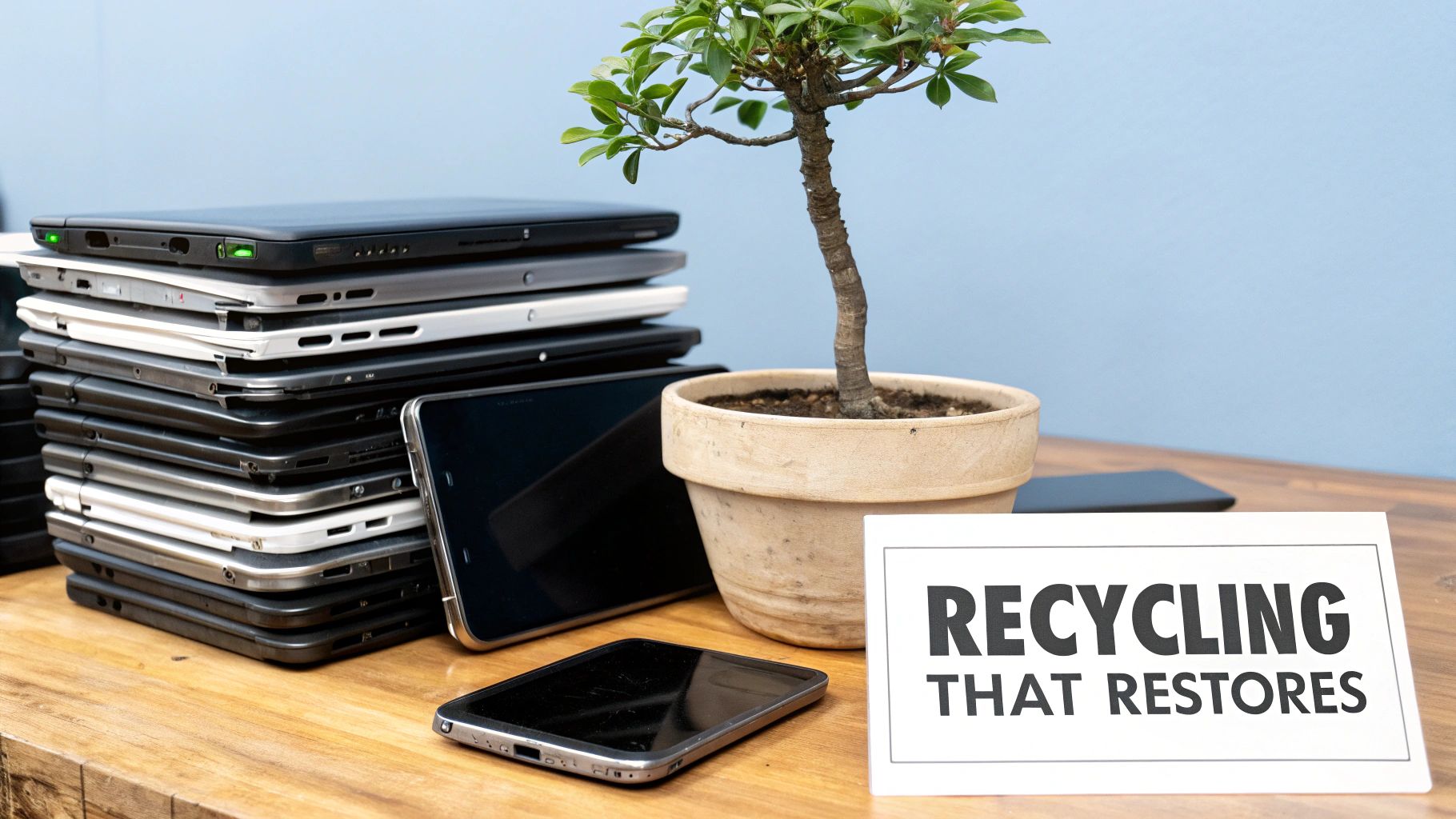
What if your company's retired technology could do more than just get wiped and recycled? The conversation around IT asset disposition is shifting. It's moving beyond the simple "how" of disposal and into the much more impactful "why."
Today, the best IT asset disposition companies offer a way to turn this routine process into a cornerstone of your corporate social responsibility (CSR) program. This approach transforms a logistical chore into a powerful partnership, giving you a compelling story to share with your stakeholders, employees, and customers.
Building a Legacy with Every Device
Imagine telling your board that your latest server refresh helped support local veterans and planted a new forest. This is the reality of cause-based ITAD. It turns a simple electronics recycling partnership into tangible community benefits, transforming e-waste from a liability into a genuine force for good.
The whole process is built on transparency. Instead of just a standard disposal receipt, you get detailed reports and certificates that spell out the positive impact you’ve made.
A "Recycle for a Cause" campaign reframes the entire narrative. Messaging like, “Your old tech can house a veteran and grow a forest,” connects the simple act of recycling with powerful, positive outcomes.
This model allows your business to become an active participant in community and environmental restoration—all through a service you already need. It’s an easy and incredibly effective win for your ESG goals, with opportunities for seasonal drives around Veterans Day and Earth Day to maximize impact.
Transforming Compliance into a Powerful Brand Story
A modern ITAD partner gives you the tools to truly showcase your commitment. This goes way beyond simple compliance paperwork and enters the realm of brand enhancement, with materials designed to slot right into your company’s sustainability reports.
This new generation of ITAD documentation includes:
- Impact Certificates: After a pickup, you get personalized certificates detailing your contribution—for example, “You planted 3 trees and helped 1 veteran.”
- Veteran Support Impact Reports: These documents summarize how your retired assets contributed to veteran aid programs, perfect for CSR and internal communications.
- Digital Eco-Badges: A badge like “Recycled with Purpose” can be displayed on your company website, reinforcing your brand’s commitment to sustainability at a glance.
By working with the right provider, you can tap into comprehensive services like those available for Atlanta electronics recycling that are built around this dual-impact model. It turns a routine operational task into a meaningful partnership that strengthens your brand and your community ties.
A Few Common Questions About IT Asset Disposition
When Atlanta businesses start looking into IT asset disposition companies, a few questions always pop up. The whole process can feel a little overwhelming at first, but once you get the basics down, it’s much easier to see the path forward for retiring your old equipment securely and responsibly.
Let’s tackle some of the most common questions we hear.
What’s the Difference Between E-Recycling and ITAD?
This is a big one, and it’s easy to get them mixed up. While the terms are often used in the same breath, they cover very different ground.
E-recycling is all about the materials. Its main job is to keep old electronics out of landfills by recovering raw materials like plastic, metal, and glass. It's a vital environmental service, no doubt about it.
ITAD, on the other hand, is a comprehensive, security-focused process. It’s the whole package: certified data destruction, meticulous asset tracking, recovering value by reselling usable gear, and finally, compliant recycling for what’s left. If your business handles any kind of sensitive customer or company data, a full ITAD program is the only way to truly cover your bases and eliminate risk.
Think of it this way: E-recycling handles the shell, while ITAD protects the soul—the data—and manages the asset's entire end-of-life journey. Both are crucial, but only ITAD shields your business from massive legal and financial headaches.
Can My Company Actually Make Money From Old IT Gear?
You bet. This is one of the best parts of a smart ITAD strategy, known as value recovery.
If your retired equipment—think recent-model servers, laptops, or networking hardware—still has some life left in it, a good ITAD partner can refurbish it and sell it through their remarketing networks.
Your company gets a cut of the sale, which can seriously reduce the cost of the disposition service. Sometimes, it even puts you in the black. This flips the script, turning old equipment from a costly liability into an asset that generates revenue.
How Do I Know for Sure That My Data Is Gone?
Any ITAD vendor worth their salt will give you concrete, legally-defensible proof. You should always, without exception, receive a formal Certificate of Data Destruction when the job is done.
This isn't just a simple receipt; it’s a critical compliance document. It lists the unique serial numbers of every single device and hard drive that was sanitized and specifies the method used, whether it was a multi-pass wipe that meets NIST 800-88 standards or complete physical shredding. In an audit, that certificate is your ironclad proof of due diligence.
How Are ITAD Service Costs Determined?
ITAD pricing isn’t one-size-fits-all because every project is different. The final cost really boils down to a few key things: the type and amount of equipment you have, the specific data destruction services you need, and any logistical heavy lifting like on-site de-installation or packing.
Some vendors might offer a rebate based on the value of your gear, while others will have a straightforward fee for their services. The most important thing is to ask for a transparent, itemized quote so you know exactly what you’re paying for and can steer clear of any surprise fees down the road.
Ready to turn your retired tech into a force for good? Atlanta Green Recycling offers secure, compliant ITAD services that also support veterans and reforestation efforts. Transform your e-waste into hope and schedule your free, no-obligation pickup today.
Learn More and Schedule Your Pickup with Atlanta Green Recycling