
Hard Drive Destruction: A Guide to Secure Data Disposal & CSR Impact

Dragging your old files to the trash bin might feel final, but when it comes to sensitive data, it's the digital version of leaving unlocked filing cabinets on the curb. Here’s a hard truth: simply deleting a file doesn't actually erase it. It only hides it, making the information shockingly easy to recover with basic software and creating a massive security risk for your organization.
That's why true data security demands irreversible hard drive destruction. This isn't just about risk management; it's an opportunity to turn e-waste into hope.
Why Erasing Files Is Not Enough
Looking at a stack of old hard drives, it's tempting to think a quick format or a mass file deletion will do the job. Unfortunately, this common mistake leaves Atlanta businesses dangerously exposed to data breaches. Getting a handle on the difference between deletion and destruction is the first step toward building a real risk management strategy.
Think of your hard drive as a library and its file system as the card catalog. When you "delete" a file, you aren't actually shredding the book. You're just removing its card from the catalog. The book itself—your sensitive data—is still sitting right there on the shelf, just waiting for someone to come along and find it.
The Illusion of Deletion
Freely available data recovery software can easily scan that drive and "find" all the books that no longer have catalog cards. This means your most confidential information—from employee records and customer lists to financial data and trade secrets—is still completely accessible.
For any Atlanta business, this vulnerability can quickly spiral into a nightmare:
- Devastating Data Breaches: A single improperly discarded drive could contain enough information to cause catastrophic financial and reputational harm.
- Steep Regulatory Fines: Failing to comply with data protection laws can trigger severe penalties and legal action.
- Loss of Customer Trust: A breach vaporizes the confidence your clients have in your ability to protect their information.
Understanding just how flimsy simple deletion is has never been more critical, especially given the rising threat of infostealer malware and significant data leaks that can stem from improper disposal.
To illustrate this, let’s quickly compare what happens when you delete a file versus when you truly destroy a hard drive.
File Deletion vs. Hard Drive Destruction
| Action | What Actually Happens | Data Recoverability | Security Risk Level |
|---|---|---|---|
| Deleting a File | The file system's pointer to the data is removed. The data itself remains on the drive until overwritten. | High. Easily recovered with widely available software until the space is reused. | Very High |
| Formatting a Drive | The file system is rebuilt, which is like erasing the table of contents. Most of the original data is still present. | High. Most data can be recovered using specialized tools. | Very High |
| Physical Destruction | The drive's platters are physically shredded, crushed, or disintegrated into tiny, unreadable fragments. | Zero. The data is physically gone and impossible to reconstruct. | Eliminated |
As you can see, the only way to be certain your data is gone for good is to make it physically impossible to access.
The Shift to Permanent Destruction
Real data security isn't about hiding data; it's about making it completely and permanently unrecoverable. This is precisely why professional hard drive destruction has become a non-negotiable best practice for any serious organization.
This growing need for secure disposal is clear across the industry. The global hard drive destruction service market was recently valued between USD 1.5–1.65 billion and is projected to grow by up to 11% annually through the 2020s. North America is leading the charge, driven by strict data protection regulations.
The only way to guarantee your data is gone forever is through professional data sanitization or physical destruction. While both are effective, they serve different purposes. To learn more about software-based methods, you can check out our guide on what is data sanitization. Ultimately, irreversible physical destruction is the only 100% foolproof method to protect your business.
Choosing Your Method: Software Wiping vs. Physical Destruction
When it’s time to retire an old hard drive, you arrive at a critical fork in the road. Do you wipe it clean or do you destroy it completely? For any Atlanta organization managing IT assets, this isn't a small decision. The right path depends entirely on one simple question: what’s next for the drive? Is it going to be reused, or has it reached the end of its life?
Think of software wiping as meticulously cleaning a whiteboard. The board itself is left perfectly intact, ready for new ideas, but every trace of the old information is gone. This process uses specialized software to overwrite every single sector of the drive with random data—often several times over—making the original files impossible to get back with software tools.
This is the go-to choice for hardware you plan to redeploy internally, donate to a good cause, or resell. It keeps the asset's value alive while locking down your data. If you're leaning this way, it's worth knowing what you're getting into. You can take a closer look at how to clear a computer's hard drive to understand the process.
On the other hand, physical destruction is like feeding that same whiteboard into an industrial woodchipper. There's no coming back. The drive isn't just wiped; it's physically pulverized, guaranteeing no one can ever access the data again, by any means. This is the final answer for drives that are too old, broken, or hold data so sensitive that you can't afford to take any chances.
This flowchart boils down the fundamental choice every IT manager has to make.
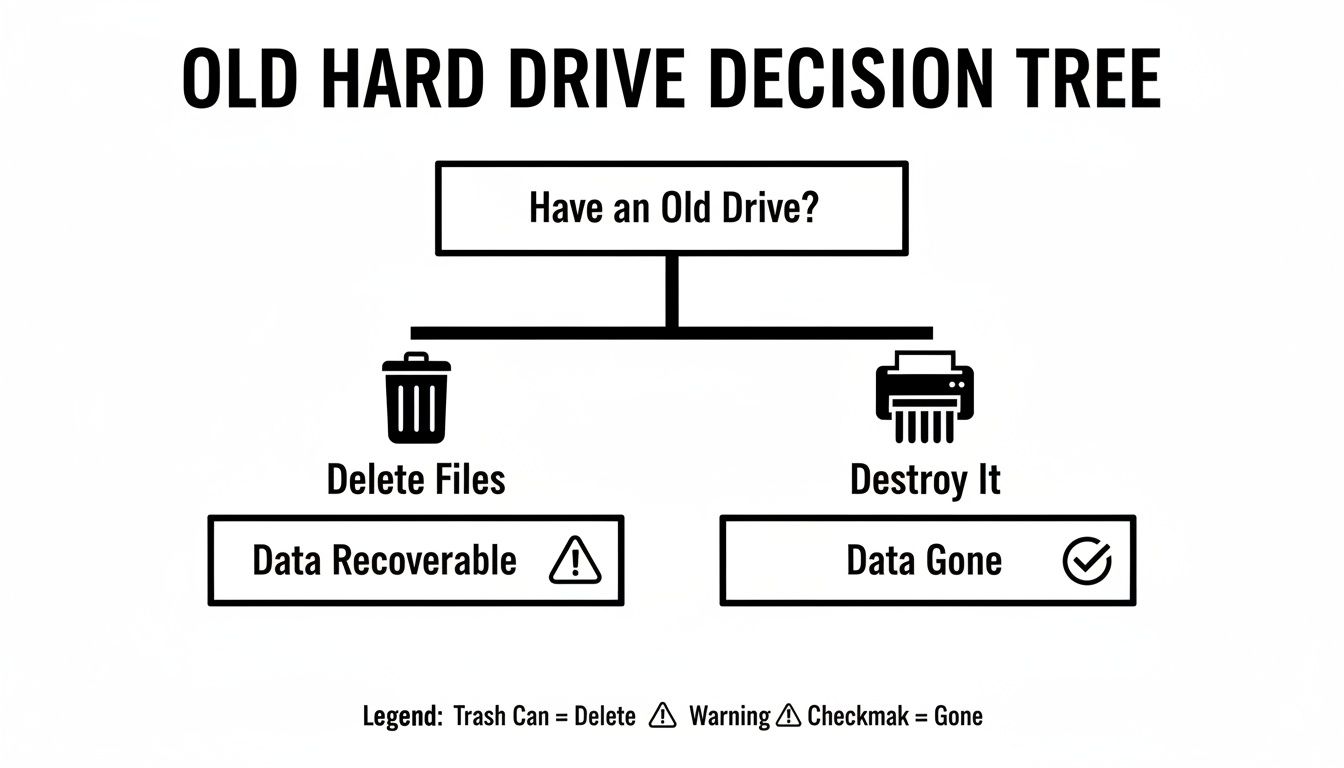
The takeaway here is that just hitting 'delete' gives a false sense of security. That data is often still recoverable. Only total destruction makes it gone for good.
When to Choose Software Wiping
Software wiping is your best bet when the hard drive—or the computer it’s in—still has some life left in it. The whole point is to preserve the hardware for secure reuse.
You should consider software wiping if:
- You plan to resell or donate the equipment. A proper wipe lets you safely pass on computers, servers, and laptops to new owners.
- You’re redeploying assets within your company. Moving a computer from accounting to marketing? A thorough wipe ensures no sensitive financial data makes the trip.
- You need to meet compliance standards for media sanitization. Many regulations, like NIST guidelines, accept certified wiping as a valid form of data destruction for hardware that will be used again.
At Atlanta Green Recycling, our certified wiping services meet stringent DoD and NIST standards. We provide all the paperwork you need to prove your data was handled correctly before the hardware gets a second life.
When to Choose Physical Destruction
Physical destruction is the ultimate guarantee. It's the only method that offers 100% certainty your data is gone forever, period. It completely removes any risk tied to that physical piece of media.
Choose physical destruction when:
- The hard drives are old, failing, or obsolete. If the hardware has no resale value or is simply past its prime, destruction is the safest and most logical step.
- You handle extremely sensitive or regulated data. For Atlanta's healthcare, financial, or government sectors, physical destruction is often the required method to leave zero chance of a data breach.
- Your company policy demands the highest level of security. Many organizations have a simple "destroy all" policy for retired drives. It’s clean, simple, and eliminates guesswork.
When you partner with a mission-driven recycler, this final step becomes more than just a task—it's an act of corporate social responsibility. Choosing destruction with Atlanta Green Recycling means you're not just wiping out risk; you're converting e-waste into real support for veterans and helping plant new trees. It turns a routine IT job into a measurable win for your company’s ESG goals, turning old tech into new hope.
Exploring Physical Hard Drive Destruction Methods
So, you've decided a hard drive has reached the end of its life. The next big question is: how do you make absolutely sure the data on it is gone for good? Physical hard drive destruction isn’t about taking a hammer to it in the parking lot; it’s a meticulous process designed to make data recovery physically impossible. For any Atlanta business, understanding the "how" is just as crucial as the "why."
The market for this kind of equipment is massive and growing, with valuations somewhere between USD 450 million and USD 2.9 billion. This boom reflects just how seriously enterprises and recyclers are taking data security, investing heavily in automated shredders, crushers, and degaussers to guarantee compliance and peace of mind. North America is a major player here, thanks to a huge installed base of shredders and strict regulations that demand secure disposal. You can discover more insights about this growing market on MarketReportAnalytics.com.
Let's walk through the three main techniques used to physically obliterate a hard drive and every last bit of data it holds.
Degaussing: The Magnetic Wipeout
Before a drive is crushed or shredded, it might first undergo degaussing. Think of a classic hard drive's platters as a canvas of tiny, perfectly arranged magnets that form your data. A degausser is essentially a super-magnet, generating an incredibly powerful magnetic field that violently scrambles that perfect arrangement in an instant.
The process completely neutralizes the magnetic charge on the platters, wiping out everything at once. While it works wonders for traditional magnetic hard drives (HDDs), it's critical to know that degaussing is completely useless for Solid-State Drives (SSDs). SSDs use flash memory chips, not magnets, so the magnetic field has zero effect on them.
Crushing and Punching: Brute Force Destruction
The next step up in physical destruction is all about applying immense, targeted force. This is where you see methods like crushing and punching.
- Crushing: A hydraulic press brings down thousands of pounds of pressure, deforming the drive's casing and shattering the delicate internal platters.
- Punching: A machine uses a hardened steel cone to punch a hole straight through the drive, perforating the platters and wrecking their ability to spin.
Both of these methods will certainly render a drive useless and make data recovery a nightmare for anyone trying. But for a highly motivated attacker with sophisticated tools? It’s not entirely impossible. That’s why crushing and punching are often just a prelude to the final, most secure solution: shredding.
Shredding: The Gold Standard of Destruction
When you need absolute, undeniable, and verifiable data elimination, nothing comes close to industrial shredding. This is the undisputed gold standard, trusted by government agencies, healthcare systems, and financial institutions all over the world.
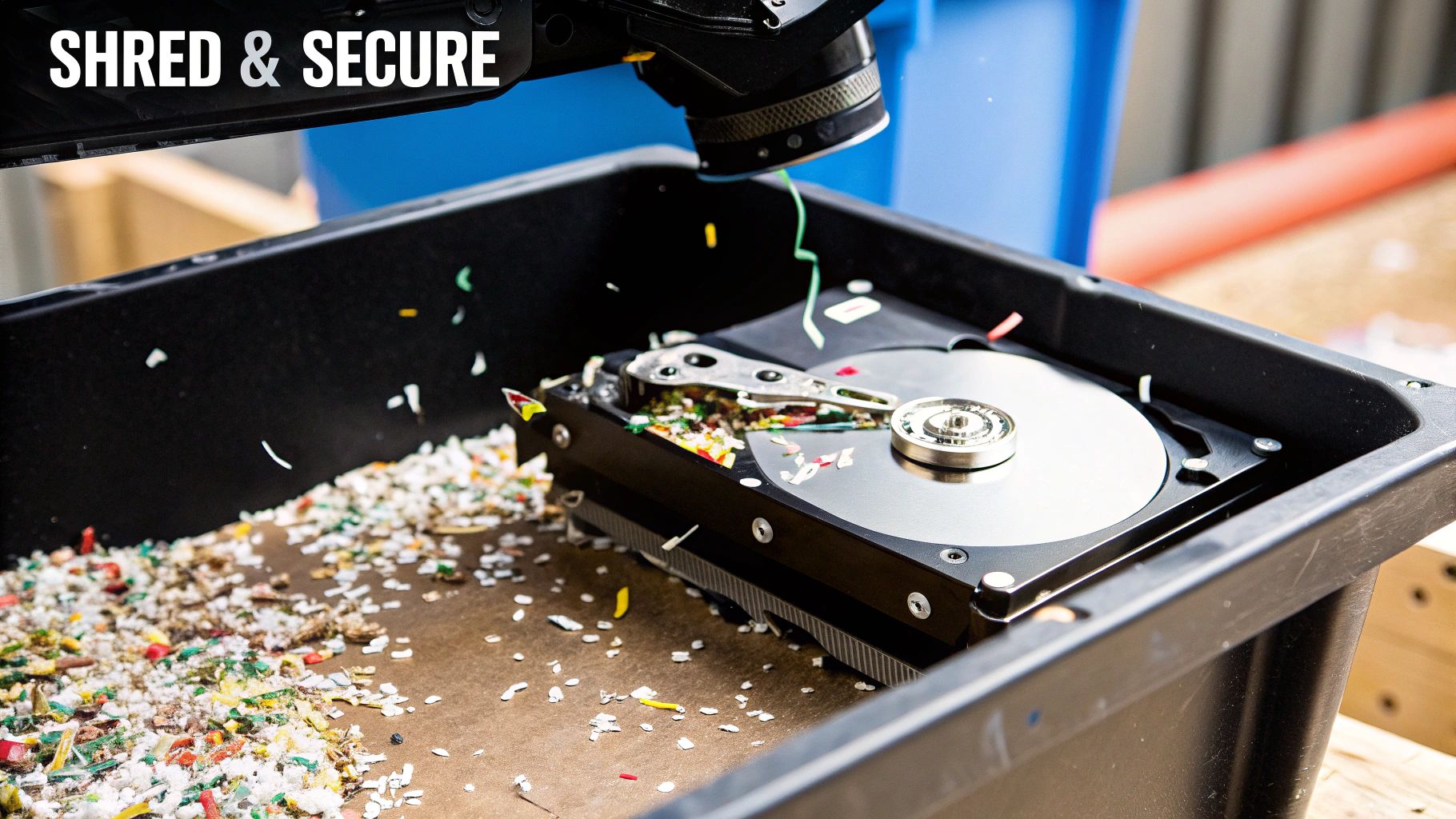
The shredding process doesn't just damage a drive; it disintegrates it. The hard drive is fed into a powerful shredder that uses rotating steel blades to cut the entire device—casing, platters, and all—into small, confetti-like fragments.
The final particle size is what determines the level of security. Smaller fragments make it exponentially harder—practically impossible—to piece together any section of a platter large enough to contain recoverable data. For the highest security requirements, shred sizes are often measured in millimeters, guaranteeing your information is gone forever. For businesses needing to securely dispose of other sensitive items, professional product destruction services apply this same rigorous standard to everything from prototypes to recalled goods.
At Atlanta Green Recycling, we rely on industrial shredding to give our clients the highest possible level of assurance. This method guarantees your data isn't just deleted—it's physically annihilated, turning a potential liability into harmless, recyclable material.
Meeting Compliance with HIPAA and NIST Standards
For a lot of organizations in Atlanta, secure data destruction isn't just a good idea—it's the law. Trying to navigate the tangled web of regulations can feel overwhelming, but getting a handle on your obligations is the first step in protecting your business from staggering fines and legal trouble. These standards aren't suggestions; they are iron-clad requirements for dealing with sensitive information.
Getting this wrong isn't a small slip-up. It's a direct threat to your company's financial stability and its hard-won reputation. These rules exist to protect customers, patients, and clients, and the regulators don't take enforcement lightly.
HIPAA: The Healthcare Mandate
If you're a healthcare provider, clinic, or any associated business in Atlanta, the Health Insurance Portability and Accountability Act (HIPAA) is non-negotiable. The HIPAA Security Rule is crystal clear: covered entities must have policies and procedures to handle the final disposal of electronic protected health information (ePHI).
What that means in plain English is that when a hard drive full of patient data hits the end of its life, that information has to be rendered completely "unreadable, indecipherable, and otherwise cannot be reconstructed." Just deleting files or even reformatting the drive doesn't come close to meeting this standard. Physical destruction is the only way to be absolutely certain the data is gone for good, making it a cornerstone of any healthcare compliance strategy.
NIST 800-88: The Gold Standard for Government and Business
Beyond healthcare, the National Institute of Standards and Technology (NIST) Special Publication 800-88 is the definitive guide for sanitizing digital media. While it’s technically a guideline, it has become the go-to standard for government agencies, defense contractors, and any corporation that takes data security seriously.
NIST 800-88 lays out three distinct methods for sanitization:
- Clear: This involves using logical techniques, like standard read/write commands, to sanitize data in all user-accessible storage areas.
- Purge: This method goes deeper, applying physical or logical techniques that make data recovery impossible even with state-of-the-art laboratory tools.
- Destroy: This is the final word. It renders the media completely unusable and beyond repair, making data recovery a physical impossibility. This includes methods like shredding, disintegrating, and incinerating.
When dealing with drives that held top-secret information or are simply being retired, NIST strongly recommends the Destroy method as the most bulletproof option. Of course, secure destruction is just one piece of the puzzle; a truly robust security posture involves managing compliance risk effectively across the board.
The Certificate of Destruction: Your Legal Shield
So, how do you prove you’ve actually followed these strict rules? The answer is a Certificate of Destruction. This piece of paper is much more than a simple receipt. It's your official, legally-defensible proof that you followed the proper procedures to protect sensitive data.
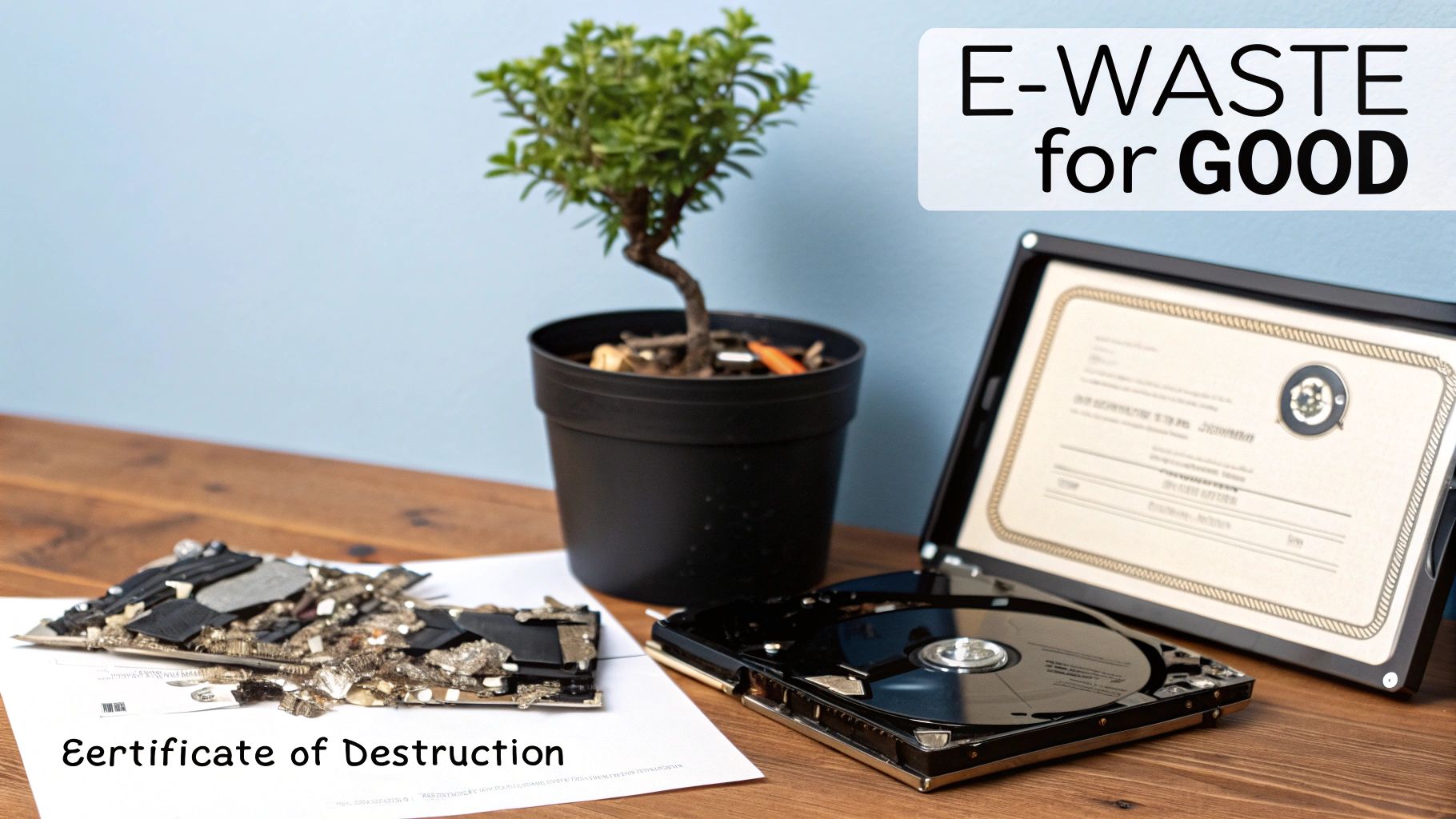
A Certificate of Destruction is your key evidence in an audit. It demonstrates that you followed a documented, compliant process for destroying your hard drives. It should always detail the method used, the date it happened, and a complete list of unique serial numbers for every drive destroyed.
This documentation isn't optional—it's essential. The modern risk landscape is unforgiving, with hardware failures and cyber incidents happening constantly. Recent data shows an annualized hard-drive failure rate of 1.42%, and other reports track over 3,000 data-breach incidents in the U.S. annually, affecting millions of people. Because software-based wiping can fail, many regulated industries now flat-out require physical destruction to minimize their exposure.
Partnering with a certified vendor who lives and breathes these standards protects your Atlanta business from crippling penalties. At Atlanta Green Recycling, we provide meticulous Certificates of Destruction that satisfy the toughest audit requirements, giving you the documentation you need to prove full compliance. When you drop off your old equipment with us, you’re not just recycling—you're securing peace of mind at a trusted e-waste recycling center that puts your security first.
On-Site vs. Off-Site Destruction Services
When it’s time to destroy your Atlanta business’s hard drives for good, you’ve got a big decision to make: should it happen right here at your office, or at a specialized, secure facility? This choice between on-site and off-site services really comes down to your company's unique security needs, budget, and day-to-day operations.
Both roads lead to the same destination—data that’s gone forever. But the journey is quite different, and understanding the pros and cons is key to making a smart call that aligns with your risk tolerance and compliance demands.
On-Site Destruction: Maximum Security and Witnessed Verification
On-site destruction, also known as mobile shredding, brings the whole operation right to your doorstep. A specialized shredding truck pulls up to your Atlanta office or data center, and you get to watch—in person—as every single hard drive is fed into an industrial-grade shredder.
This is the method for ultimate peace of mind. The chain of custody is as short as it gets, moving from your IT closet straight into the shredder. It’s the go-to solution for organizations that simply can’t afford to take any chances.
Key benefits of on-site destruction include:
- Unbroken Chain of Custody: Your assets never leave your property intact, which completely eliminates any risk during transport.
- Immediate Verification: You and your team can watch the destruction happen in real-time. There's no ambiguity, just instant confirmation.
- Perfect for High-Security Needs: This is the gold standard for healthcare, finance, government, and legal sectors where absolute certainty isn't just preferred—it's required.
Off-Site Destruction: Convenience and Cost-Effectiveness
Off-site destruction offers a more streamlined and often more budget-friendly path, especially when you're dealing with a mountain of old drives. The process kicks off with a secure collection from your location using locked, tamper-evident containers. From there, your assets are moved in a GPS-tracked vehicle to a dedicated destruction facility.
Once they arrive, the drives are shredded under constant camera surveillance, and you receive a formal Certificate of Destruction. This entire model is built on a foundation of rigorous documentation and a secure chain of custody, ensuring security from the moment we pick up to the final shred.
Choosing off-site destruction really clicks when:
- Managing Large Volumes: It's a highly efficient way to process hundreds or even thousands of drives from a data center refresh or a major office cleanout.
- Budget is a Key Factor: Because resources are centralized at one facility, off-site services are typically more cost-effective.
- Logistical Simplicity is a Priority: A scheduled pickup is often far easier to coordinate than finding space and time for a large shredding truck to operate on your property.
Deciding Between On-Site and Off-Site Destruction
To help you weigh your options, we've put together a straightforward comparison. This table breaks down the key factors to consider when choosing the right service model for your Atlanta business.
| Factor | On-Site Destruction (Mobile Shredding) | Off-Site Destruction (Plant-Based) |
|---|---|---|
| Security | Highest level; assets are destroyed before leaving your premises. | High level; relies on a secure, documented chain of custody. |
| Verification | Direct, real-time visual confirmation of the destruction process. | Verification is provided through a Certificate of Destruction. |
| Cost | Generally higher due to specialized equipment and on-site labor. | More cost-effective, particularly for larger quantities of drives. |
| Convenience | Requires scheduling and space for the mobile shredding truck. | Simple and efficient pickup process with minimal disruption. |
| Best For | Organizations with strict compliance needs (HIPAA, legal) or maximum risk aversion. | Businesses with large IT asset volumes, budget constraints, or seeking logistical ease. |
Ultimately, the choice depends on what your organization values most: the absolute, witnessed certainty of on-site shredding or the efficient, documented security of an off-site process.
At Atlanta Green Recycling, we offer both secure on-site and off-site hard drive destruction services. Whichever path you choose, the outcome is the same: guaranteed data elimination and a Certificate of Destruction for your records. Better yet, every drive we destroy contributes to our dual mission of supporting local veterans and planting trees, turning a necessary security task into a powerful act of corporate social responsibility.
Turn Your E-Waste into a Force for Good
What if the final step in your data security process could do more than just protect your business? When you choose the right partner for hard drive destruction, you can transform a routine IT task into a powerful act of corporate social responsibility. It’s a chance to turn obsolete technology into real, positive change for both the community and the environment.
This isn't just about recycling e-waste; it's about restoration. Picture this: your old, securely destroyed hard drives could help fund critical aid for a veteran or reforest a national park. This approach completely reimagines the end-of-life process for IT assets, creating value long after the data is gone.
An Easy ESG and CSR Win for Atlanta Companies
For businesses here in Atlanta, adopting a mission-driven destruction strategy is a straightforward way to meet—and even exceed—your Environmental, Social, and Governance (ESG) and Corporate Social Responsibility (CSR) goals. Instead of just getting a standard Certificate of Destruction, you get documented proof of your positive impact.
"Your old tech can house a veteran and grow a forest." This is the core of our "Recycling That Restores Lives and Landscapes" promise. We connect the secure act of recycling with tangible, emotional outcomes that resonate with employees, stakeholders, and customers alike.
By partnering with a vendor committed to this dual-impact model, you can:
- Demonstrate Environmental Stewardship: Receive Plant-A-Tree certificates for your records, showing a direct contribution to reforestation efforts.
- Support Social Causes: Get Veteran Support Impact Reports that detail how your e-waste contributed to aiding local veterans.
- Boost Your Brand Reputation: Earn a digital “Recycled with Purpose” badge to display on your website and sustainability reports, showcasing your commitment to the community.
Turning a Security Task into a Story
This model changes the entire narrative. What was once a simple cost of doing business becomes a valuable investment in your community. When you schedule a corporate recycling drive for 50 or more devices, the secure hard drive destruction is just the beginning. The real story is what happens next.
This philosophy extends far beyond just hard drives. When you work with us to recycle electronics in Atlanta, every single device—from servers to laptops—fuels this mission. Your company doesn't just eliminate data security risks; it actively participates in a cycle of restoration and hope.
You can then share this story through your own channels, using the impact reports and certificates to create authentic content for LinkedIn, internal newsletters, and annual CSR reports. It transforms a standard operational procedure into a compelling story of how your company is turning e-waste into a powerful force for good.
Common Questions About Hard Drive Destruction
When it's time to retire old hardware, Atlanta businesses often have the same questions about making sure their data is gone for good. Let's walk through some of the most common ones we hear.
Do I Really Need to Destroy Encrypted Drives?
Yes, absolutely. Think of encryption as a locked door—it’s a great first line of defense, but it’s not invincible. Keys can be stolen, human error can expose them, and who knows what future computing power could crack today's encryption standards.
More to the point, data privacy laws like HIPAA and standards like NIST don’t just care about the lock; they care about the door itself. Physical hard drive destruction is the only way to guarantee that the data is 100% unrecoverable, forever. It’s the final, foolproof step that encryption alone can't promise.
What Kind of Paperwork Should I Get After Destruction?
You should always receive a formal Certificate of Destruction from a certified recycler. This isn't just a simple receipt; it's a crucial legal document that proves you followed compliance rules and serves as your audit trail. After recycling with us, you'll also receive an Impact Certificate detailing how you helped plant trees and support veterans.
A proper Certificate of Destruction should clearly state:
- The exact date of destruction.
- The method used (e.g., shredding to a specific particle size).
- A detailed list of the unique serial numbers for every single drive.
- Confirmation that the process met specific compliance standards.
What Happens to the Drives After They're Shredded?
Once a hard drive is run through an industrial shredder, it’s reduced to a pile of tiny, unrecognizable metal fragments. The data is physically obliterated and gone for good. From there, a certified and environmentally-focused partner ensures those materials don't end up in a landfill.
The raw commodities—aluminum, steel, and precious metals from the circuit boards—are meticulously separated. They’re then sent to specialized downstream partners to be refined and reintroduced into the manufacturing supply chain. It's a process that turns a potential data liability into a valuable resource for the circular economy.
At Atlanta Green Recycling, every shredded drive contributes to our dual mission. The recycled materials not only re-enter the supply chain but also help fund our programs supporting local veterans and planting trees, transforming a necessary security task into a positive community impact.
Can You Destroy SSDs and Other Types of Media Too?
Of course, but it’s critical to understand that not all destruction methods work on all types of media. For example, Solid-State Drives (SSDs) store data on flash memory chips, not magnetic platters like traditional hard drives (HDDs). That means degaussing—a process that uses powerful magnets—is completely useless on an SSD.
The only truly secure way to destroy an SSD is to physically shred it into particles so small that the memory chips are demolished. A professional service will know exactly how to handle everything from backup tapes and USB flash drives to old company cell phones, applying the right destruction method for each device.
At Atlanta Green Recycling, we transform your data security needs into an opportunity for positive change. We provide certified hard drive destruction that protects your business while supporting veterans and restoring forests. Schedule your secure electronics recycling pickup today and turn your e-waste into hope.