A Guide to Vetting Elevator Inspection Companies in Atlanta


As a facility manager, you already know that elevator safety is non-negotiable. But picking from the dozens of elevator inspection companies out there is more than just checking a box on your compliance list. It’s about protecting your tenants, avoiding those notorious six-figure fines, and keeping your building running smoothly without costly interruptions.
Your Inspection Company Is More Than a Vendor—It’s a Partner in Risk Management
Choosing the right inspection firm is a major business decision, one that has a direct impact on your building’s safety, budget, and daily operations. This isn't just another vendor contract. It's a true partnership.
A great firm does more than just flag deficiencies. They deliver clear, actionable reports that help you prioritize repairs and maintain a perfect compliance record. They become an extension of your team, dedicated to risk management.
This guide will give you a proven framework for finding a genuine safety partner in Atlanta. We’ll look at how top-tier elevator inspection companies not only ensure you meet ASME A17.1 and local codes but also help you hit your company's ESG (Environmental, Social, and Governance) targets.
Finding a Partner Who Aligns with Your Goals
The demand for these specialized services is growing fast. The global elevator testing and inspection market was valued at around $7,500 million by 2025 and is set to expand, all thanks to stricter regulations and the simple need for safe vertical transportation. This growth just highlights how important it is to pick a partner who stays ahead of the curve.
When you start vetting potential companies, it really comes down to three things: Safety, Compliance, and Value.
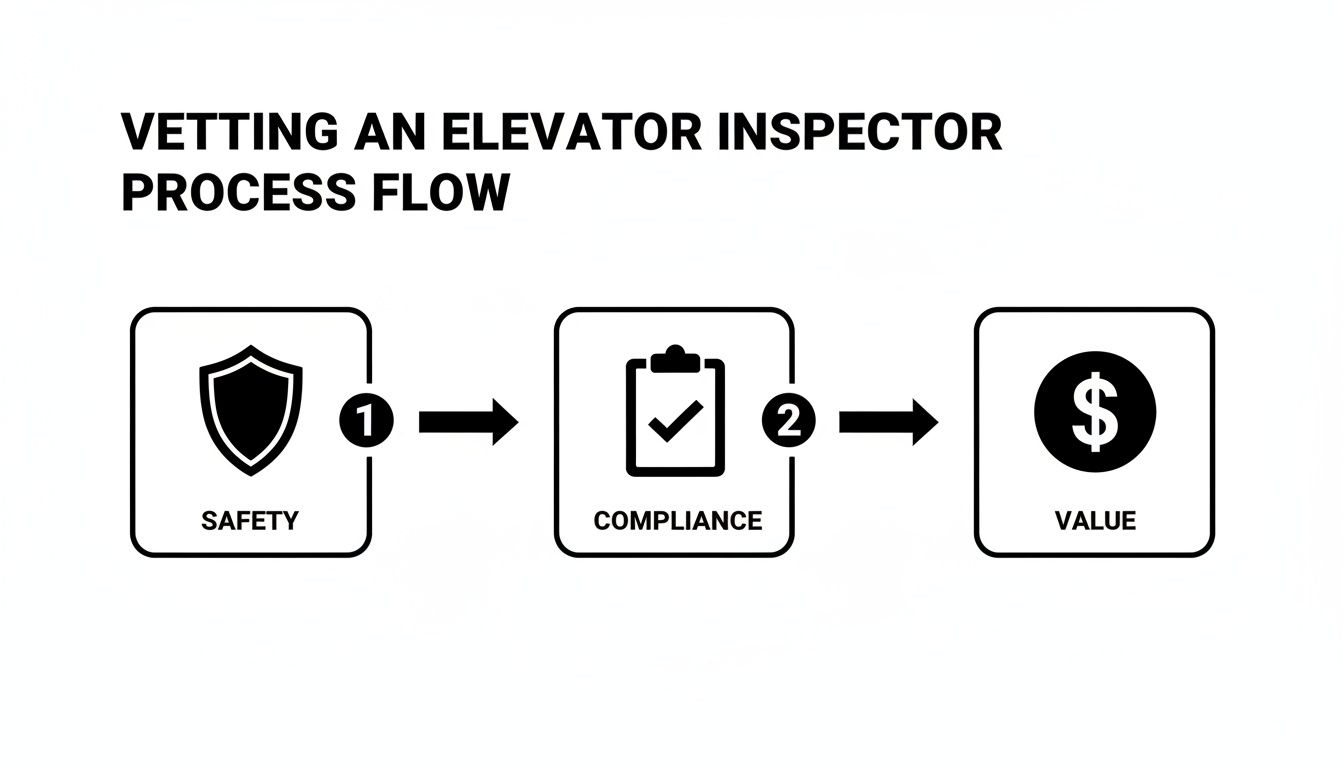
This process shows how each piece of the puzzle—from their safety qualifications to the long-term value they provide—builds on the last. It’s a structured way to make a decision that affects your entire property.
Here's a quick reference table to keep these key criteria top of mind during your evaluation.
Key Vetting Criteria at a Glance
| Criteria | Why It Matters for Your Building | Potential Red Flag to Watch For |
|---|---|---|
| Certifications (QEI) | Ensures inspectors are qualified to ASME standards, which is a non-negotiable for safety and legal compliance. | Vague or missing information about individual inspector certifications. |
| Local Code Expertise | Atlanta has specific regulations. A partner who knows them inside and out prevents costly fines and re-inspections. | They speak in general terms and can't cite specific local Atlanta or Georgia codes. |
| Reporting Quality | Clear, actionable reports with photos and prioritized recommendations make your job easier and speed up repairs. | Sample reports are just pass/fail checklists with no detailed explanations or photos. |
| Insurance & Liability | Adequate coverage protects your property from liability in case of an error or incident during the inspection. | Unwillingness to provide a Certificate of Insurance (COI) upfront. |
| Reputation & References | Hearing from other facility managers about their experience tells you what it's really like to work with them. | They can't provide references for buildings similar in size or type to yours. |
Ultimately, you're looking for a partner who gets the unique demands of your building and the specific regulatory world of Atlanta. For a deeper look at our own process, feel free to review our Atlanta elevator inspection services.
A truly valuable inspection partner doesn't just find problems—they help you anticipate them. Their reporting should provide trends and insights that empower you to transition from reactive fixes to proactive maintenance, saving you money and preventing downtime in the long run.
By focusing on deep qualifications, transparent communication, and a shared commitment to safety, you can build a relationship that protects your assets and makes your job as a facility manager a whole lot simpler. Let’s dive into what really separates a basic vendor from an indispensable partner.
Finding Qualified Elevator Inspectors in the Atlanta Area
When it's time to find an elevator inspector, your first instinct might be to open a new tab and start Googling. But let's be honest, that path often leads down a rabbit hole of generic results and questionable websites. A much better way to find a truly qualified local expert is to go straight to the source—official databases and trusted professional networks.
This approach lets you cut through the noise and quickly build a shortlist of proven, certified inspectors who know the ins and outs of Atlanta’s specific requirements.
Starting with a verified source is the single most efficient first step you can take. It ensures you’re only talking to companies that are legally cleared to work in Georgia, saving you a ton of time right from the start.
Start With the Georgia State Licensing Board
Before you even think about picking up the phone, your first stop should be the state's official list. The Georgia Office of Insurance and Safety Fire Commissioner keeps a database of every licensed elevator mechanic, inspector, and contractor. This is your ground truth.
An inspector’s QEI (Qualified Elevator Inspector) certification is the one credential that is absolutely non-negotiable. Using the state's database to confirm it upfront weeds out any unqualified providers immediately.
This simple check ensures that any elevator inspection companies you consider are legally compliant with Georgia's standards. It’s the bedrock of a safe and penalty-free inspection program for your facilities.
Tap into Your Local Professional Networks
A state license tells you an inspector is qualified on paper, but it doesn’t tell you if they show up on time, communicate well, or provide clear, actionable reports. For that, you need to talk to your peers. Reaching out to your network in the Atlanta commercial real estate and facility management world is where you'll get the real story.
A few places to start asking around:
- BOMA Atlanta: The Building Owners and Managers Association is a goldmine for this kind of thing. Ask a fellow member, "Who do you use for your QEI inspections in Fulton County? Would you recommend them?" You'll get candid feedback based on firsthand experience.
- Commercial Real Estate Forums: Local online groups or industry events are great for gathering names. People are usually happy to share both who they love working with and who they’d avoid.
- Your Maintenance Provider: They can't inspect their own work for the annual safety tests, but your elevator maintenance company deals with third-party inspectors all the time. They’ll know which ones are thorough, professional, and easy to schedule.
This adds a crucial human element to your search, giving you a feel for a company's reliability and customer service—something you’ll never find on a government website.
Understand the Local Market
In Atlanta, you'll find a mix of large national inspection firms and smaller, locally-owned companies. The big players often hold a huge share of the market, especially in cities with strict enforcement. In places like New York, where inspections happen every six months, this concentration is even more intense. It just goes to show how valuable certified expertise is, particularly when non-compliance fines can climb into the hundreds of thousands.
Don’t automatically assume a bigger name is better, though. A smaller, Atlanta-focused firm might offer more personalized service and have a deeper, more practical knowledge of specific City of Atlanta or DeKalb County codes.
As you vet potential partners, you'll need to know exactly what to look for. You can find a detailed breakdown in our complete guide to Atlanta elevator inspections. Your goal should be to build a solid initial list of three to five well-regarded, verified companies. This sets you up perfectly for the next phase of vetting and getting quotes.
Key Questions to Uncover a Company's True Capabilities
Alright, you've got your shortlist of qualified elevator inspection companies. Now it’s time to look past the glossy brochures and slick websites. This is where you really start to separate the contenders from the pretenders.
You're not just looking for "yes" or "no" answers. The goal is to start a real conversation that shows you how they think, how they react under pressure, and whether they're just a vendor or a genuine safety partner. The answers you get to the right questions will tell you everything you need to know.

Going Beyond Basic Certifications and Insurance
Any company that made it to your list should have QEI-certified inspectors and the standard liability insurance. That's just the price of entry. The real test is digging into the details of their qualifications and how prepared they are for a worst-case scenario.
A mediocre company will just confirm they have insurance. A great partner will explain why their specific coverage levels are essential for a property like yours.
Key Questions to Ask:
"Can you provide a Certificate of Insurance that lists our property as an additional insured? What are your limits for Errors & Omissions (E&O) insurance?"
This is non-negotiable. E&O coverage is what protects you if their oversight leads to a fine or, worse, an incident. A confident partner will immediately agree to provide the COI and explain that their E&O limits—say, $2 million or more—are specifically chosen to cover liabilities in commercial high-rise buildings."Are all of your field inspectors who will be on my property QEI-certified, or just a supervising manager? How do you keep your team current on Atlanta-specific code updates?"
The person physically inspecting your elevator must be certified. A solid company will confirm that 100% of their field inspectors hold active QEI certifications. They'll also be able to describe their internal training process, like holding regular sessions on updates from the Georgia Office of Insurance and Safety Fire Commissioner.
Sizing Up Their Process and Responsiveness
An inspection isn't a one-and-done event; it's a complete process. You need to understand how they manage everything from scheduling the initial visit to following up on violations. This is your window into their communication style and operational efficiency. Are they organized, or are they constantly just reacting to problems?
A top-tier inspection firm sees this as a team effort. Their process should be completely transparent, with clear lines of communication for your team and your elevator maintenance company so everyone is always on the same page.
Here’s how to get a feel for their workflow:
"Walk me through your exact process when you find a serious violation at a property like one of ours."
A weak answer sounds like, "We'll send you a report." A strong answer details a clear, immediate action plan: They’ll verbally notify your on-site contact right away, deliver a detailed digital report with photos and specific code citations within 24-48 hours, and provide clear next steps for fixing the issue and scheduling the re-inspection."What’s your typical turnaround time for reports, and what format do they come in?"
Slow reporting is a major red flag. Look for firms that guarantee detailed, digital reports with photographic evidence within a few business days. The best elevator inspection companies will also offer a client portal where you can access all your historical reports, check the status of open violations, and track safety trends over time.
Understanding Their Value as a Partner
Finally, you need to figure out if they see you as just another appointment on the calendar or as a long-term partner in keeping your facility safe and compliant. The right questions here will reveal if they can offer strategic value that goes beyond a simple compliance check. This is especially critical if your organization has a focus on corporate responsibility and needs solid documentation.
Questions that reveal their partnership mindset:
"How can your reporting help my team with our internal ESG and corporate responsibility documentation?"
A basic vendor might not even know what you're talking about. A forward-thinking firm will immediately connect the dots. They'll explain how their clear, date-stamped compliance reports provide an auditable record of your commitment to safety—a key data point for the 'Social' and 'Governance' pillars of ESG."For a portfolio of our size, would we have a dedicated account manager or a single point of contact?"
As any facility manager knows, having one person to call is a game-changer. A "yes" to this question shows they value the relationship and are structured to provide consistent, knowledgeable service. It means you won't be stuck in a generic customer service queue every time you have a question.
By asking these targeted, real-world questions, you shift the conversation from a sales pitch to a serious discussion about their actual capabilities. You'll quickly see which elevator inspection companies have the expertise, processes, and partnership mentality to truly protect your assets and, frankly, make your job a whole lot easier.
Making Sense of Certifications and Local Compliance
When you're managing a facility, the world of elevator compliance can feel like you're drowning in a sea of acronyms and local codes. But it doesn't have to be that complicated. To cut through the noise, you really only need to grasp a couple of key credentials.
Getting this right is about more than just checking a box. It’s about protecting your tenants, your property, and your budget from some very real risks. The biggest trip-up I see is facility managers not understanding the difference between a national standard and a specific local ordinance. A company that’s perfectly compliant in another state could completely miss a unique Atlanta rule, leading straight to failed inspections, fines, and frustrating delays.
The Gold Standard: QEI Certification
Let's start with the single most important credential in our industry: the QEI (Qualified Elevator Inspector) certification. This is the absolute, non-negotiable benchmark for any third-party inspection company you’re considering. In Georgia, it's not a nice-to-have; it's mandatory for anyone witnessing your annual safety tests.
A QEI certification proves an inspector has been professionally vetted and tested on the ASME A17.1 Safety Code for Elevators and Escalators, which is the foundational safety standard across the country. Think of it like the bar exam for elevator inspectors—it confirms they have the core knowledge to do the job right.
When you're vetting potential partners, your very first question should be about the QEI certification of the specific inspectors who will be on your property. This one step is the most critical thing you can do to ensure a baseline of quality and compliance.
Without a QEI-certified inspector signing off on your paperwork, you don't have a valid inspection. It's as simple as that.
The Crucial Layer of Local Atlanta Requirements
While ASME A17.1 sets the national stage, your local Authority Having Jurisdiction (AHJ) has the final say. For us in the metro area, that means following rules set by the Georgia Office of Insurance and Safety Fire Commissioner and, often, additional codes specific to the City of Atlanta or surrounding counties.
These local quirks can include things like:
- Specific filing procedures that have to be followed to the letter after an inspection.
- Unique testing criteria for certain building types or older elevator systems.
- Tighter deadlines for correcting violations than what the national code might suggest.
This is exactly why hiring an inspector with deep, local expertise is a game-changer. A company that works in and around Atlanta every day will know these nuances instinctively. They’ll help you avoid the simple administrative slip-ups that can jeopardize your certificate of operation. If you want to dive deeper, you can learn more about navigating Atlanta elevator codes in our other guides.
Verifying Credentials and Staying Audit-Proof
Never just take a company’s word for it—you can and should verify their credentials yourself. For inspectors here in Georgia, you can typically check their status through the state's official licensing portals. It’s a quick step that provides total peace of mind.
Once they’re verified, your focus should shift to documentation. To stay audit-proof, you need to keep a meticulous file for every single elevator. This file must contain:
- The current certificate of operation from your AHJ.
- All third-party inspection reports from at least the past few years.
- Proof that any violations have been corrected, including invoices from your maintenance company and the follow-up re-inspection report.
This level of rigor is more important than ever. With increasing regulatory pressure from agencies like OSHA, which now mandates annual inspections, the focus is on preventing failures before they happen. In a market where a single elevator outage can cost an average of $50,000 per hour in lost business, thorough inspections are a true business necessity.
Ultimately, a solid understanding of both QEI standards and the specific rules here in Atlanta is your best defense. It empowers you to choose a partner who won’t just keep your elevators running safely, but will also keep your building fully compliant and free from liability.
How to Compare Proposals and Find the Best Value
Once you've sent out your requests, the proposals from different elevator inspection companies will start rolling in. This is where the real work begins. It’s tempting to just look at the bottom-line price, but in my experience, the cheapest bid is almost never the best one.
True value comes from a partner who delivers thorough, reliable service—not just a low price that hides expensive surprises later on. You need to look at the total cost of the partnership, not just the number on the first page. Let’s break down how to really dissect these proposals to find the best value for your facilities.
Deconstructing Common Pricing Models
You'll quickly notice that elevator inspection proposals aren't always easy to compare side-by-side. Companies structure their fees in different ways, and knowing the model is the first step to figuring out your actual costs.
- Per-Elevator Fee: This is the most basic model. You pay a set rate for each elevator inspection. It’s simple, but you have to be careful about what it doesn't include.
- Annual Contract: This is often an all-in-one price that covers your annual inspections, any needed re-inspections for minor issues, and sometimes even the administrative work of filing paperwork with the AHJ. This model gives you budget certainty, which is a huge plus.
- Portfolio Pricing: If you're managing multiple properties, this is something you should ask for. Many firms will offer a discounted rate for inspecting all the elevators across your portfolio, which can lead to big savings.
A price that seems too good to be true usually is. When I see a suspiciously low bid, my first thought is that they're cutting corners. It could be on the inspection itself, or they’re just planning to make up the difference with a dozen little fees they didn't mention upfront.
Uncovering the Hidden Costs
The single biggest mistake you can make as a facility manager is assuming the initial quote is the final price. A low-cost proposal can easily become your most expensive option once all the hidden fees start appearing on your invoices.
You have to comb through the fine print for these common surcharges:
- Travel Surcharges: Is your property outside their main service area? They might tack on fees for travel time or mileage.
- Re-Inspection Fees: This is a big one. If a violation is found, what does that follow-up inspection cost? A good, value-focused company often includes one re-inspection in their contract. A low-bidder will almost certainly charge you a full fee all over again.
- AHJ Filing Fees: Does the proposal include the cost and labor of filing the report with the Authority Having Jurisdiction (AHJ)? Some companies bill this separately as an "administrative fee."
- After-Hours or Weekend Rates: If you need an inspection done outside of business hours to avoid disrupting tenants, are you going to be hit with a massive price hike?
A transparent proposal will clearly state what is included and what is not. If a bid is vague, demand a detailed breakdown of all potential additional charges before you even consider signing a contract.
Drafting an RFP That Gets You Comparable Bids
To properly compare your proposals, you have to make sure every company is bidding on the exact same scope of work. The best way to do that is with a clear, detailed Request for Proposal (RFP). A well-written RFP forces bidders to be specific and lets you make a direct, apples-to-apples comparison.
Here’s a sample outline you can adapt for your own RFP:
- Scope of Work: Clearly list the number of elevators, their types (hydraulic, traction, etc.), and which inspections you need (e.g., annual safety, 5-year full load).
- Required Deliverables: Be specific about what you expect. I always demand digital reports that include photographic evidence of any violations, the specific code citations, and clear, actionable recommendations for fixing them.
- Pricing Structure: Ask for a clear, itemized price list. Make them break out the cost for initial inspections, re-inspections, and any possible administrative or travel fees.
- Proof of Qualifications: Require them to provide their Georgia state contractor license number, a certificate of insurance (COI) showing Errors & Omissions (E&O) coverage limits, and proof of QEI certification for all inspectors who will be on your property.
This structured approach changes your procurement process from a guessing game into a data-driven decision. You can find more great ideas on this in our guide to sustainable procurement best practices.
Comparing Inspection Company Proposals
Once you have your itemized bids, a simple table can help you see past the sticker price and analyze the true value each company offers. This allows for a feature-by-feature comparison that highlights where one bid might save you money upfront but cost you more in the long run.
| Feature | Company A (Low Bid) | Company B (Value Bid) | What to Look For |
|---|---|---|---|
| Initial Inspection Fee | $250/elevator | $350/elevator | Is this the full cost or just the starting point? |
| Re-Inspection Fee | Full Price ($250) | Included (1 re-inspection) | This is a major source of hidden costs. |
| AHJ Filing | Billed Separately ($50/filing) | Included | Look for "administrative fees" in the fine print. |
| Reporting | PDF report via email | Digital portal with photos & history | Digital tools save time and help with record-keeping. |
| Account Support | 1-800 call center | Dedicated Account Manager | Who do you call when there's an issue? |
| Total Annual Cost (Est.) | $3,600 | $4,200 | The initial difference seems large… |
| True Cost (with 2 violations) | $4,100 | $4,200 | …but the real cost is much closer. |
As you can see, a couple of common re-inspections can quickly erase the savings from the low-bid option. By investing a little more upfront with a value-focused partner, you get budget predictability and fewer administrative headaches.
Weighing Intangibles That Deliver Real Value
Finally, don't forget that some of the most valuable services won't ever appear on a price list. Having a dedicated account manager who knows your properties and is just a phone call away is worth far more than a faceless, offshore call center.
Likewise, detailed digital reporting that gives you a historical view of your elevator's health is a powerful tool for proactive maintenance and long-term budgeting. These are the kinds of features that often come with a "value bid" that looks higher at first glance, but they pay for themselves over and over in reduced administrative work, faster problem-solving, and a much stronger safety posture for your buildings.
By choosing a partner based on total value, you're making a strategic decision that benefits your entire organization. It’s also a key part of your ESG commitment—a well-documented, professionally managed safety program is a tangible demonstration of good governance and social responsibility.
Building a Long-Term Safety Partnership
Getting the contract signed isn't the finish line—it’s actually the starting gun. The real goal isn't just a one-off transaction. You want to build a lasting partnership that makes your job easier, keeps your building safer, and cements your compliance record for the long haul.
Shifting from a simple vendor relationship to a genuine partnership starts the moment the ink is dry. It's all about clear communication and solid processes. A great partnership means you’re never scrambling for answers or digging for paperwork when an auditor walks in. It’s about making your inspection company a core part of your facility management strategy, building a true culture of safety.
Establishing Clear Communication Protocols
Right after signing, the first thing you need to figure out is who you call and when. There's nothing worse than having an urgent question and getting stuck in a generic customer service loop. You need a communication plan in place before the first inspection even happens.
Sit down with your new partner and define these key roles:
- Primary Point of Contact: Who is your dedicated go-to person for everything from scheduling and billing to simple questions? Get their direct phone number and email address.
- Emergency Contact: If an inspector finds an immediate, serious issue, who from their team calls who on your team? This needs to be crystal clear.
- Response Time SLAs: What’s their committed response time for routine questions versus urgent problems? A good partner will put this in writing.
Getting this sorted out early on eliminates a ton of future headaches and ensures that when issues pop up, they’re handled quickly by people who already know you and your property.
Creating a 'Compliance-in-a-Box' System
Your objective should be to have your entire elevator compliance program ready for an audit at a moment's notice. The best way I’ve seen this done is with a centralized "compliance-in-a-box," which can be a meticulously organized physical binder or a dedicated folder on your network. This becomes your single source of truth for all things elevator safety.
A well-maintained compliance box is more than just good record-keeping; it's a powerful risk mitigation tool. It provides undeniable proof of your due diligence and commitment to safety, which is invaluable during an audit or legal inquiry.
Your system should house every inspection report, certificate of operation, and all communications with both your inspection company and your maintenance provider. As soon as a new report arrives, review it, file it, and start tracking any corrective actions needed. This proactive habit turns your records from a dusty archive into an active management tool. For more on how local rules can impact your paperwork, you can check out updates on news relevant to the City of Atlanta.
By working together on corrective actions and keeping transparent records, you elevate your relationship with elevator inspection companies. They’re no longer just a vendor who visits once a year; they become a trusted advisor and a key player in your long-term risk management strategy.
Your Top Elevator Inspection Questions Answered
When you're a facility manager, navigating the world of elevator inspections can feel like deciphering a whole new language. We get it. Here are some straightforward answers to the questions we hear most often from folks managing properties in and around Atlanta.
How Often Do My Elevators Need Inspections?
For commercial elevators across Georgia, the baseline is an annual safety inspection. This isn't just a quick check-up; it has to be witnessed by a certified third-party inspector.
But here's the crucial part: local jurisdictions like the City of Atlanta can, and often do, have their own specific rules. This is why you need an inspection partner who is a true expert on the code in your building's exact municipality, not just the state-level requirements.
Can My Maintenance Provider Inspect Their Own Work?
That’s a definite no. Nearly every jurisdiction, including all of them in Georgia, strictly mandates that annual safety tests be witnessed by an independent, third-party QEI-certified inspector.
This rule exists for a very good reason: to prevent a clear conflict of interest. It ensures you get an unbiased, honest assessment of your equipment’s safety and compliance.
Think of it this way: your maintenance provider is the "doer," while the third-party inspector is the "checker." This separation is fundamental to a trustworthy safety program.
What Happens if a Violation Is Found?
First, don't panic. The inspector will issue a formal report that clearly details the code violation and gives you a deadline for correcting it.
Your next call is to your maintenance company. You'll work with them to get the repair done. Once the fix is complete, you'll need to schedule a re-inspection with the same third-party inspector. They will verify the work and officially clear the violation with the local authorities, getting you back in compliance.
Managing compliance documentation is crucial, but so is handling your company's retired IT assets. At Green Atlanta, we turn your e-waste into hope. Our dual-impact model ensures your old tech is responsibly recycled, with proceeds supporting local veterans and planting trees in USDA reforestation projects.
Partner with us to meet your ESG goals and make a tangible difference. We offer corporate recycling drives with full CSR documentation, an Eco-Badge for your website, and transparent impact reporting. Learn how your company can turn e-waste into forests and support those who served at https://www.greenatlanta.com.