Your Guide to Atlanta Elevator Inspection in 2026


An elevator inspection is much more than just a routine check-up. It's a thorough, formal assessment carried out by a certified professional to confirm that your building's vertical transportation system is up to snuff on safety, performance, and maintenance. At its core, this process ensures every mechanical, electrical, and safety component is working exactly as it should, keeping you in line with all local, state, and national codes. It’s a non-negotiable part of ensuring public safety and operational reliability.
To help you get a quick overview, here’s a snapshot of what an elevator inspection entails.
Elevator Inspection At a Glance
This table breaks down the essential components and objectives of any standard elevator inspection.
| Aspect | Primary Goal | Governing Authority |
|---|---|---|
| Safety Systems | Verify all safety features (brakes, alarms, sensors) are functional. | Local/State Code, ASME A17.1 |
| Mechanical Components | Check for wear and tear on cables, motors, and machinery. | Manufacturer Specs, ASME A17.1 |
| Electrical Systems | Ensure wiring, controls, and power supplies are safe and operational. | National Electrical Code (NEC), ASME A17.1 |
| Code Compliance | Confirm the elevator meets all current jurisdictional requirements. | Authority Having Jurisdiction (AHJ) |
Ultimately, a proper inspection gives you peace of mind that your equipment is safe, reliable, and fully compliant with the law.
Why Elevator Inspection Is a Core Pillar of Your Building's Safety
Picture your Atlanta high-rise without working elevators for just a single day. It wouldn't just be an inconvenience; it would bring your entire operation to a grinding halt. That's why looking at an elevator inspection as just another box to check on a regulatory to-do list completely misses the point. A proactive approach to inspections is a bedrock principle of public safety, operational continuity, and just plain smart risk management.
Think of your elevators as the circulatory system of your building. They are constantly at work, moving people and goods to keep the whole structure alive and humming with activity. In that light, a regular elevator inspection is the critical health checkup that makes sure this system runs smoothly and safely, preventing a sudden and costly breakdown.
The Goals of a Proactive Inspection Strategy
A scheduled inspection is about so much more than filling out a form. The real goals are to protect people and safeguard your property by making sure every single part is working as intended. This dedication to safety and compliance brings some major wins for building owners and facility managers.
Here’s what you’re really accomplishing:
- Guaranteeing Occupant Safety: This is always job number one. Inspections verify that every safety feature, from the emergency brakes to the door sensors, is in perfect working condition.
- Ensuring Code Compliance: Staying on the right side of Atlanta and Georgia codes, which are built on national standards like ASME A17.1, helps you dodge steep fines, legal headaches, and forced shutdowns.
- Protecting Your Asset: Consistent, detailed inspections catch small problems before they balloon into expensive, system-wide failures. This not only extends your elevator’s lifespan but also protects what is a significant capital investment.
Aligning Safety with Your Business Goals
In today's business world, a serious elevator inspection program also says a lot about your company's commitment to its Environmental, Social, and Governance (ESG) goals. When you put the well-being of every person in your building first, you directly strengthen the "Social" pillar of your ESG platform. For more on weaving these principles into your operations, take a look at our guide on building a business sustainability strategy for Atlanta businesses.
You really can't overstate the value of objective, third-party assessments, a key principle behind the growing demand for independent building inspections. The importance of this verification is recognized across the globe. In fact, the elevator inspection service market is expected to hit roughly USD 2.61 billion by 2033, a clear sign of how vital it has become in modern real estate.
Decoding Atlanta's Elevator Codes and Inspection Timelines
Trying to get a handle on elevator regulations can feel like untangling a knotted rope. But for any building owner in Atlanta, getting it right isn't optional—it's essential for keeping people safe and avoiding some serious fines. The rules for your building's elevator inspections aren't just one single document; they're a layered system, starting with national standards and getting more specific as you drill down to the state and city level.
Think of it like this: the foundation is a national safety code, the state then builds the walls and roof, and the city comes in to make sure everything is up to local standards. Getting your head around this structure is the key to a stress-free compliance plan.
At the very top, you have the ASME A17.1 Safety Code for Elevators and Escalators. This is the bible for elevator safety across North America, setting the technical bar for everything from the machine room setup to the emergency phone. This code is the bedrock that Georgia—and most other places—builds its own rules on.
From National Standards to Georgia State Law
Georgia takes that ASME A17.1 code and officially adopts it. But the state, through its Office of the Commissioner of Insurance and Safety Fire, adds its own administrative layer. So, while ASME dictates what an inspector checks (the technical bits), Georgia law dictates how and when it all happens.
In Georgia, every elevator needs a periodic safety elevator inspection at least once every 12 months. That annual check-up is the bare minimum you need to get your operating certificate. But that’s just the starting point. Depending on your elevator's age, technology, and how much it's used, you might be looking at more frequent or specialized tests.
Local Focus: The City of Atlanta's Requirements
While Georgia lays down the statewide law, the City of Atlanta is the one knocking on your door. The city has the authority to enforce these codes, and sometimes add its own requirements, acting as the Authority Having Jurisdiction (AHJ). For Atlanta building managers, your day-to-day compliance happens at this local level. It's always a smart move to keep an eye on official City of Atlanta news for any updates that might affect building codes or local enforcement.
This is the part that really matters because it directly shapes your inspection schedule and what you need to do to prepare. The inspector who shows up at your property will be enforcing the Georgia-adopted ASME code, but they'll be following the City of Atlanta's playbook to do it.
Key Takeaway: Think of compliance in three tiers. Your elevator must meet the national safety benchmarks (ASME A17.1), follow Georgia's annual inspection rule, and pass muster with the City of Atlanta's local enforcement.
How Inspection Frequency Varies in Practice
Not all elevators live the same life, and their inspection schedules reflect that. The standard annual check is just one piece of the puzzle. The real-world frequency and type of inspection depend on the elevator's age, technology, and daily grind.
Let’s look at a couple of real-world examples:
A Busy Downtown Hotel: Picture a high-traffic hotel near Centennial Olympic Park. Its elevators are working hard all day, every day. It'll get its standard annual inspection, of course. But every five years, it also needs a much more intense Category 5 (CAT5) Load Test. This is a heavy-duty test to make sure the elevator can still safely handle its maximum rated weight—a crucial check for a system under constant stress.
A Quiet Suburban Office: Now, think about a two-story office in a quiet suburb like Alpharetta. It might have a simple hydraulic elevator that sees a fraction of the traffic. It still needs that annual inspection to stay legal, but its five-year test requirements will be different, perhaps focusing on components like pressure relief valves instead of a full load test.
Understanding these differences is huge for budgeting and planning. Once you cut through the jargon and see how the national, state, and city rules work together, you can build a clear roadmap to keep your building safe, your tenants happy, and your operations running smoothly.
The Four Essential Types of Elevator Inspections
Not all elevator inspections are the same. Just as a person needs different kinds of health check-ups throughout their life, an elevator goes through distinct inspections to make sure it's safe and working correctly at every stage.
Getting a handle on these four essential types will help you stay ahead of requirements, budget your resources, and keep your building both compliant and safe for everyone. Each inspection serves a specific purpose, from the moment an elevator is installed to its daily grind and even its response to an unexpected crisis.
1. The Acceptance Inspection
Think of this as the elevator’s official "birth certificate." An Acceptance Inspection is a one-time, incredibly thorough review performed on any new or significantly modified elevator before it can legally be put into service. It is by far the most rigorous inspection of them all.
The entire point is to confirm that the elevator was installed exactly as planned, matching the manufacturer's specs and all relevant ASME, state, and Atlanta codes. An inspector will go over every single component, from the bottom of the pit to the machinery on the roof, to ensure it’s ready for the public from day one. Passing this is the final hurdle to getting your initial operating permit.
2. The Periodic Inspection
The Periodic Inspection is your elevator’s "annual physical." As required by Georgia law, this check happens at least once every 12 months. This is a routine inspection that focuses on spotting any wear and tear that comes from normal, everyday operation.
An inspector will methodically work through all the critical systems, including:
- Safety Mechanisms: Testing the brakes, speed governors, and emergency stop buttons.
- Door Operations: Making sure the sensors and closing mechanisms are working just right.
- Communication Systems: Verifying that the emergency phone and alarm connect properly.
- Cables and Hoistways: Looking for any signs of fraying, damage, or blockages.
This regular check-up is the backbone of preventative maintenance and your best tool for ensuring ongoing safety and reliability. It’s a huge reason why passengers at massive hubs, like those you can read about in our guide on Hartsfield-Jackson Atlanta International Airport operations, can travel without a second thought.
3. The Maintenance Inspection
You can think of a Maintenance Inspection as a "performance review" for your service company. While not always mandatory, this inspection is a smart move for any diligent building manager. It’s usually done by a third-party consultant to verify that your elevator maintenance contractor is actually doing its job right.
This audit confirms that all the required maintenance tasks are being done on schedule, the records are accurate, and the equipment's condition lives up to your service contract. It gives you an unbiased look at the quality of service you're paying for and helps you hold your vendors accountable.
Expert Insight: Letting maintenance slide dramatically increases risk. Statistics show that while elevator entrapments happen at a rate of 1 per 1,000,000 trips globally, that risk doubles with poor maintenance. This really highlights why every type of inspection is so vital for passenger safety. You can dive deeper into the data in a detailed report on elevator maintenance industry statistics.
4. The Emergency Inspection
Finally, the Emergency Inspection is the equivalent of an "ER visit" for your elevator. This is an unscheduled inspection that’s triggered after a specific incident or major malfunction. If an elevator is involved in an accident that causes an injury, has a major component fail (like a snapped cable), or gets damaged in a fire or flood, it has to be shut down immediately.
An inspector is then called in to assess the damage, figure out what went wrong, and specify exactly what repairs are needed. The elevator absolutely cannot return to service until it passes another thorough inspection, proving that all problems have been fixed and it is safe to operate again. This crucial step ensures a one-time failure doesn't become a recurring danger.
A Behind-the-Scenes Look at an Elevator Inspection
Ever wondered what an inspector actually does when they show up? It’s a lot more than just pushing a few buttons and calling it a day. Think of it like a detective's investigation—a methodical, top-to-bottom examination of every critical part to make sure the whole system is safe, sound, and working as one.
Let’s pull back the curtain and walk through what really happens. A certified inspector’s work is typically broken down into four key zones: the machine room, the top of the car, the hoistway, and the pit at the very bottom. Each area has its own checklist of crucial components that need a close look.
This process isn't just a once-a-year thing. Inspections happen at different stages of an elevator's life, from the day it's installed to routine checks and emergency calls.
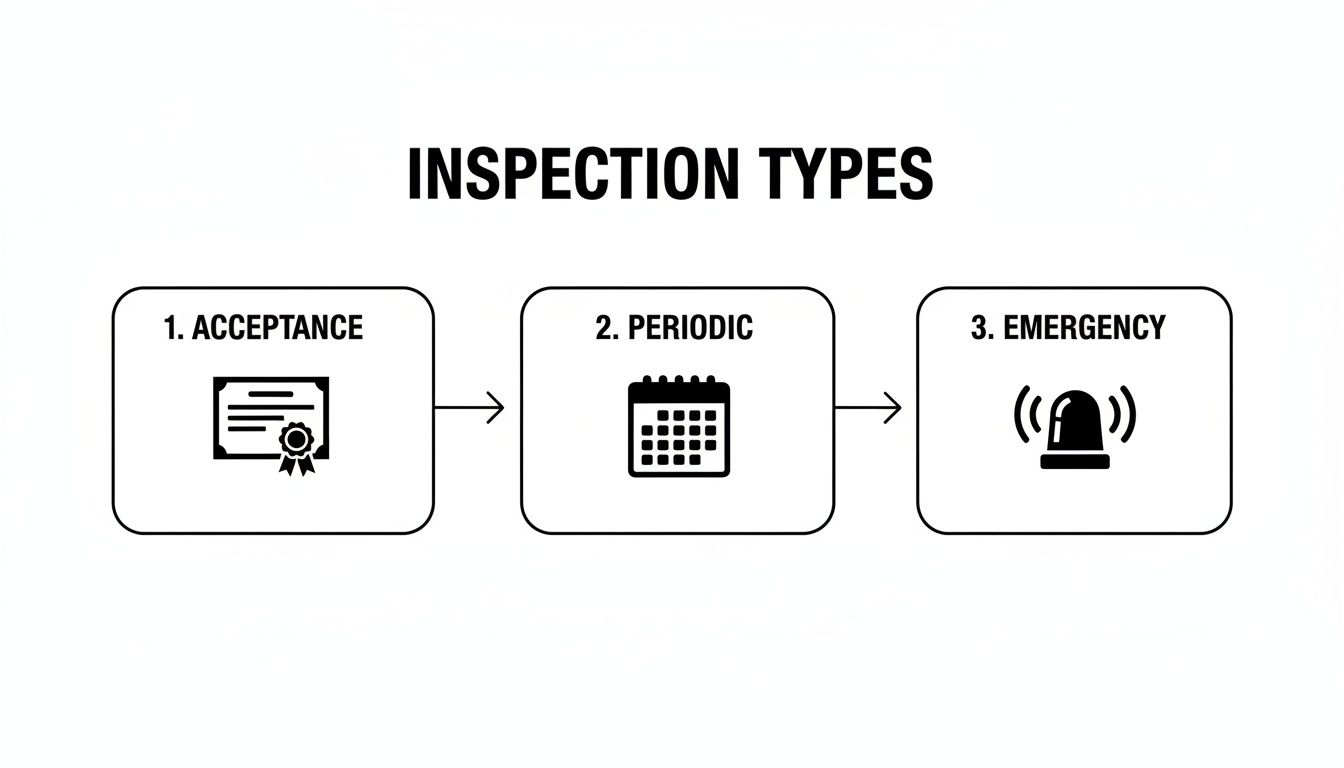
As you can see, these checks are woven into the entire lifecycle of an elevator, all with the single goal of upholding safety standards.
The Brain of the Operation: The Machine Room
The inspection almost always kicks off in the machine room. This is the control center, a restricted-access area that houses the powerful heart of the entire elevator system.
Here, the inspector has a specific list of things to check:
- The Motor and Drive Unit: They’ll look and listen for any signs of overheating, strange noises, or fluid leaks. These are often the first clues of a potential mechanical problem.
- The Controller: This is the elevator’s computer. The inspector confirms its software is current and that all its electrical connections are tight and secure.
- The Governor: A critical safety device. They will verify it’s properly set to trigger the emergency brakes if the car ever begins to move too quickly.
- Safety Gear and Signage: The room itself is part of the inspection. It needs proper lighting, clear, unobstructed access, and an up-to-date fire extinguisher. These details are non-negotiable safety requirements.
A View From the Top: The Elevator Car Top
Next up, the inspector will actually ride on top of the elevator car—a view very few people get to see. From this unique vantage point, they can get a close-up look at components inside the hoistway as the car moves at a slow, controlled inspection speed.
Key Checkpoint: The top-of-car inspection is where many vital safety functions get a real-world test. This is where an inspector confirms the emergency exit hatch is secure and that the stop switch—which lets a technician halt the car from on top—works instantly and without fail.
Inspectors will also carefully examine the guide rails and rollers, checking for proper lubrication and alignment. They’ll also scrutinize the traveling cables, which are the thick bundles of wires feeding power and communication to the car, looking for any frays, wear, or damage.
Inside the Shaft: The Hoistway
The hoistway is the long, vertical shaft the elevator moves through. While some of it is visible from the car’s roof, the inspector also performs checks at each and every floor.
They’ll confirm that the clearances between the car and the hoistway walls meet code, which is essential to make sure nothing can get snagged or block its path. They also pay very close attention to the door mechanisms at every landing, verifying that they close smoothly and that their safety edges or light curtains correctly spot obstructions to prevent them from closing on a person.
Down in the Pit: The Bottom of the Shaft
The final stop is the elevator pit, right at the bottom of the hoistway. This area might seem out of the way, but it contains essential safety and operational gear that has to be checked.
Here’s a quick look at what an inspector is looking for down in the pit:
- Buffers: These are large springs or hydraulic shock absorbers that act as the last line of defense if the car travels too far down. The inspector makes sure they’re in good shape and free of rust or damage.
- Tension Sheave: They’ll check the device that keeps the governor rope tight, confirming it moves freely and is correctly aligned.
- Overall Condition: The pit has to be clean, dry, and totally clear of debris. Any buildup of oil, water, or trash can create a serious fire hazard or get in the way of moving parts.
By systematically working through these four distinct zones, an inspector builds a complete picture of the elevator's health. This empowers you to understand the process, ask smarter questions, and ensure your service partners are maintaining a safe system. For a closer look at how our partner-focused approach works, you can learn more about our process for corporate partnerships.
A comprehensive elevator inspection checklist, like the one below, gives a clear roadmap for what a thorough check involves.
Sample Elevator Inspection Checklist by Area
To give you a clearer idea, here's a sample of what inspectors look for, broken down by location.
| Location | Component Checked | Purpose of Check |
|---|---|---|
| Machine Room | Brakes and Drive Motor | Ensure the primary stopping mechanism functions correctly and the motor shows no signs of excessive wear or oil leaks. |
| Car Top | Emergency Exit Hatch | Verify the hatch is securely closed, latched, and has not been tampered with to prevent unauthorized access. |
| Hoistway | Door Interlocks & Sensors | Confirm that doors cannot open between floors and that safety sensors reliably detect obstructions. |
| Car Interior | Emergency Phone & Alarm | Test the two-way communication system to ensure it connects to a 24/7 monitoring service for passenger assistance. |
| Pit | Buffers and Bumpers | Check for corrosion, damage, or fluid leaks in the final safety devices designed to cushion the car in an over-travel event. |
This checklist is just a snapshot, but it highlights how every part of the system—from the engine room to the final failsafe—is checked to guarantee passenger safety.
Common Inspection Violations and How to Avoid Them
There’s a certain feeling of dread that can creep in when an elevator inspection is on the calendar. But passing isn't about crossing your fingers and hoping for the best; it’s about smart, proactive preparation. From my experience, many of the most common violations we see in Atlanta buildings are surprisingly simple issues that can be caught and fixed long before an inspector ever steps foot on your property.
Think of it this way: focusing on these common trouble spots saves you from the headache and cost of failed inspections, re-inspection fees, and even potential fines. When you know what inspectors are trained to look for, you can transform a nerve-wracking process into a routine check-up.
Emergency System Failures
One of the very first things an inspector will check is the elevator’s emergency communication system. It’s amazing how many elevators fail this critical test for easily avoidable reasons.
The Problem: The emergency phone doesn’t connect to anyone, the line is dead, or it rings a number that’s been disconnected. This is an absolute deal-breaker from a safety perspective, as it leaves passengers with no way to call for help if they get trapped.
The Fix: Make it a habit to test the emergency phone monthly. Just place a call and confirm it connects to a live, 24/7 monitoring service. This simple check takes less than a minute but can single-handedly prevent an automatic failure on your official elevator inspection.
Inspectors will also test the emergency alarm bell. Give it a quick press to make sure it sounds off loud and clear.
Inaccurate Floor Leveling
An elevator that doesn’t stop perfectly flush with the hallway floor is far more than a minor inconvenience—it’s a serious trip and fall hazard. This issue, known as inaccurate leveling or "re-leveling," is a frequent violation that puts passengers at direct risk, especially those with mobility challenges.
The culprit could be anything from worn-out hydraulic valves on an older unit to miscalibrated electronic controls on a newer one. Your maintenance provider should be checking and adjusting the floor leveling during their routine service visits. If you ever notice even a slight lip between the elevator car and the building landing, report it to them right away.
Proactive Tip: Ride your own elevators regularly. Don't just take them for granted. Pay close attention to how smoothly they stop and whether they align perfectly with each floor. Being an observant building manager is your first and best line of defense.
Expired or Missing Machine Room Safety Items
The elevator machine room might be a restricted area, but its condition is a huge part of any inspection. It's a spot where simple housekeeping and safety checks are often forgotten, leading to some of the easiest violations to avoid.
Two of the most common culprits are:
- Expired Fire Extinguishers: Every machine room is required to have a current, properly tagged fire extinguisher. Check the expiration date quarterly and get it serviced or replaced well before it lapses.
- Improper Storage: The machine room is not your spare storage closet. Using it to stash cleaning supplies, old files, or other materials is a clear code violation. It creates a fire hazard and blocks crucial access for technicians in an emergency. Keep it clean, clear, and dedicated to its purpose.
Poorly Kept Records
Finally, we have one of the easiest violations to sidestep, yet it’s one of the most common: disorganized or missing records. An inspector will always ask to see your elevator’s Maintenance Control Program (MCP) and its accompanying logbook.
These documents prove that the elevator has been properly cared for. They must be kept on-site and be completely up-to-date, showing a clear history of all maintenance, tests, and repairs. If you can't produce a complete and organized log, it’s an immediate red flag for the inspector. A well-kept logbook not only demonstrates your commitment to safety but also makes the inspector's job easier, setting a positive and professional tone for the entire visit.
How Modern Tech Is Making Elevators Smarter and Safer
The future of managing elevators is here, and it's all about data. For decades, the standard approach to elevator safety was reactive. You'd wait for a scheduled inspection or, worse, a complete breakdown to find and fix problems. Today, technology is flipping that script entirely, paving the way for systems that are not just safer but also vastly more efficient.
This whole shift is being driven by the Internet of Things (IoT). Think of it like this: tiny, smart sensors are placed on the most critical parts of your elevator—the motors, brakes, and doors. These sensors work around the clock, gathering real-time data on everything from subtle vibrations and temperature changes to the number of times a door opens and closes.
Predictive Maintenance Is Now a Reality
All that data streaming from the sensors is the backbone of predictive maintenance. Instead of waiting for a part to wear out and fail, the system analyzes performance trends to flag potential trouble long before it can cause a shutdown. Modern elevators are increasingly using sophisticated Predictive Maintenance strategies to get ahead of failures.
This proactive model is a game-changer for your building’s uptime. It means fewer "out of service" signs, happier tenants, and maintenance that happens on your schedule, not in the middle of a crisis. This effectively transforms the traditional elevator inspection from a single snapshot in time to a continuous, ongoing process.
AI-Driven Analytics for Peak Performance
It doesn't stop at just predicting failures. Artificial Intelligence (AI) takes this data and uses it to fine-tune the entire elevator system. For instance, AI-powered analytics can spot patterns in passenger traffic to make dispatching smarter, cutting down wait times and preventing overcrowded cars during your building's busiest hours.
Optimizing performance like this has a direct, positive effect on your company's ESG (Environmental, Social, and Governance) goals. By making your elevators run more efficiently, these smart systems can dramatically lower energy consumption. That helps you hit sustainability targets and reduces your operational costs.
This evolution in elevator inspections has completely remade the industry. The move to IoT and AI-driven tools is shifting everything from reactive checklists to predictive, intelligent models. For example, Fujitec's 2023 high-rise installations saw a 21% reduction in emergency calls, all thanks to this proactive approach. You can dig deeper into these trends in a market report on elevator services.
Adopting these technologies shows you're a forward-thinking facility manager. You aren't just checking a box for compliance; you're using data to boost safety, improve sustainability, and protect your bottom line. Of course, with all this data comes the need for robust security; you can learn about our commitment at https://www.greenatlanta.com/data-security/. This new era of smart elevators makes your building safer, more reliable, and ready for whatever comes next.
Your Top Elevator Inspection Questions Answered
If you manage a facility in Atlanta, you know elevator inspections are part of the deal. But they can also bring up a ton of questions about cost, compliance, and what to do if things don't go perfectly. Let's clear up some of the most common concerns so you can stay ahead of the game.
How Much Should I Budget for an Elevator Inspection?
When thinking about your budget, it's wise to look beyond just the initial inspection fee. While a standard periodic inspection typically runs between $200 and $500 per elevator, this isn't the whole story. The final price can shift based on your exact location in the Atlanta metro and the inspector's level of experience.
The real variable, however, comes from potential follow-ups. If the inspection flags any violations, you'll need to budget for the necessary repairs—which can be anything from a minor tweak to a major component overhaul—plus the cost of a re-inspection to confirm everything is back in working order.
What Happens If My Elevator Fails an Inspection?
A failed inspection isn't a catastrophe; think of it as a clear-cut action plan for safety. The inspector will give you a detailed report that lists every violation and outlines exactly what needs to be fixed.
From there, the ball is in your court:
- Schedule Repairs Immediately: Get in touch with your elevator maintenance company to tackle every single issue on that report.
- Document Everything: Maintain meticulous records of all repairs, making sure to note the dates and a clear description of the work completed.
- Request a Re-Inspection: After the repairs are done, you'll need to schedule a follow-up inspection to get your elevator officially cleared and back in service.
Putting off these steps is not an option. Ignoring a failed inspection can lead to the city shutting your elevator down and hitting you with some pretty hefty fines.
How Do I Choose a Qualified Elevator Inspector?
Picking the right inspector is one of the most important decisions you'll make in this process. Here in Georgia, elevator inspectors are required to be certified and licensed. The gold standard you should look for is a QEI (Qualified Elevator Inspector) certification.
When you're evaluating a potential inspector, always ask for proof of their QEI certification. It’s also smart to check if they have experience with buildings similar to yours right here in the Atlanta area. A great inspector doesn't just know the codes inside and out; they also communicate clearly, helping you understand any problems they find and the exact steps you need to take to fix them.
Managing building compliance is complex, but handling your company's e-waste doesn't have to be. Atlanta Green Recycling offers secure and responsible electronics recycling services for businesses across Atlanta, helping you meet your ESG goals while protecting sensitive data. To schedule a pickup and turn your old tech into a force for good, visit us at https://www.greenatlanta.com.