
E-Waste Recycling Atlanta GA: Recycling That Restores Lives and Landscapes

For IT managers and business leaders across Atlanta, that closet full of old electronics is more than just a storage problem—it's a ticking clock of risk and a huge missed opportunity. This guide is all about reframing e-waste recycling in Atlanta, GA, turning it from a compliance headache into a powerful strategic move for your organization. Our mission is turning e-waste into hope.
Let's transform that logistical nightmare into a compelling story for your next ESG report.
Turn Your E-Waste Into a Strategic Opportunity
Those end-of-life IT assets—servers, laptops, even specialized medical equipment—aren't just gathering dust. They're packed with latent risks, from potential data breaches to environmental compliance violations. Having a structured plan for these assets isn't just about clearing space; it's about protecting your organization and building your brand's reputation as a leader in corporate social responsibility.
This is where a strategic approach to e-waste gives you a real competitive edge. Instead of seeing old tech as trash, think of it as a resource that can spark genuine, positive change. When you partner with a mission-driven recycler, you ensure every device is handled securely while also contributing to a cause that matters.
The Dual-Impact Advantage
Imagine a recycling program where the value from your obsolete equipment directly helps support American veterans and reforests our nation's landscapes. That’s the heart of the dual-impact model—turning a standard operational task into a powerful, human narrative.
Your old tech can house a veteran and grow a forest. This approach transforms a simple act of recycling into a measurable, emotional story that resonates with employees, customers, and stakeholders.
This model lets your organization generate tangible outcomes that go far beyond just diverting waste. You get detailed documentation not only for your environmental compliance needs but also for your corporate social responsibility (CSR) initiatives. It’s a straightforward ESG win.
From Risk to Reward
The process of turning e-waste from a liability into a celebrated achievement is simpler than you might think.
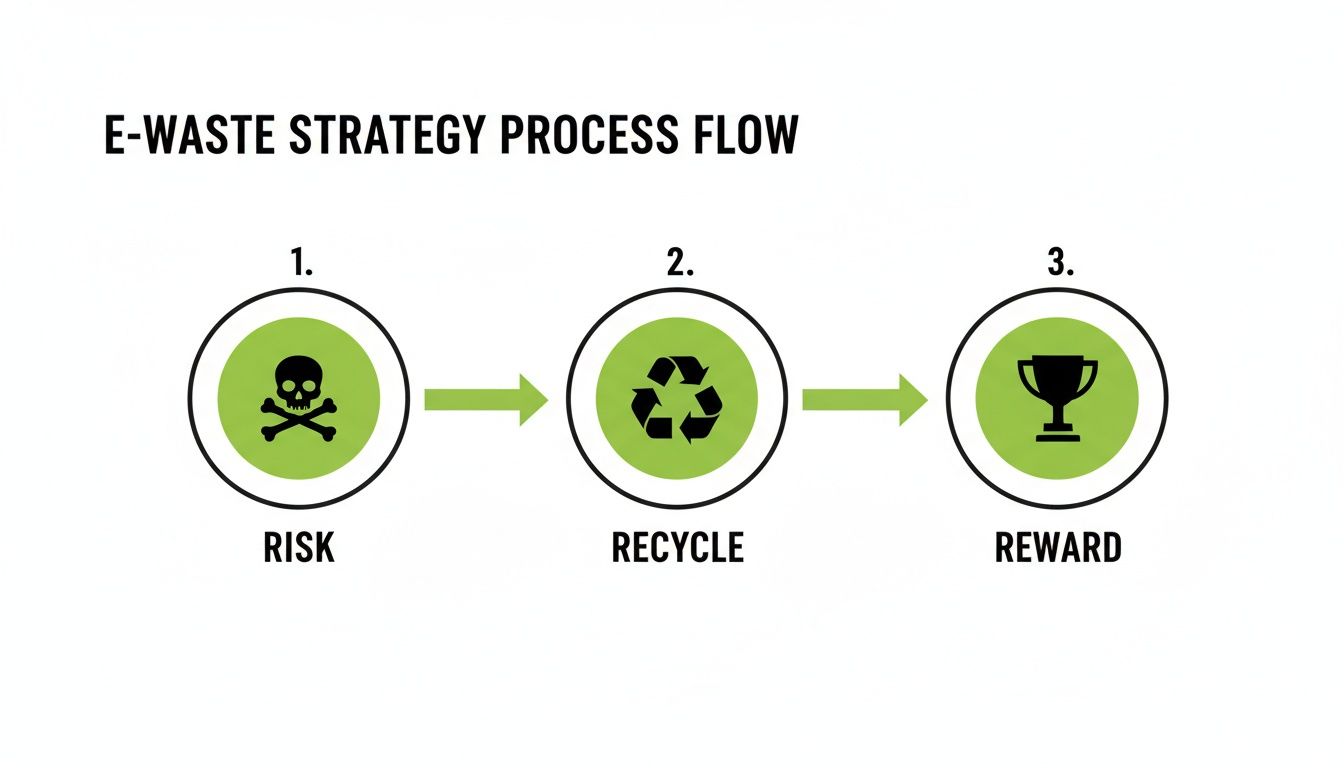
This journey shows how identifying the risks, choosing a truly responsible recycling partner, and embracing the rewards creates a virtuous cycle for your business and the community.
Atlanta is making real strides in sustainability. The city’s recycling efforts have doubled the diversion rate from 11% in 2017 to 23% by 2022. But here's the catch: standard curbside programs aren't equipped to safely handle the hazardous materials inside electronics. This creates a critical gap that specialized business services must fill. You can read more about Atlanta's progress and ongoing recycling challenges.
Securing Your Data And Auditing Your Assets
Before a single piece of old equipment leaves your facility, two things need to happen first: a complete inventory audit and a rock-solid data security plan. This isn't just a suggestion—it's the critical foundation of any responsible e-waste program. Whether you're pulling servers from a data center, clearing out a school computer lab, or retiring specialized medical gear, this step is non-negotiable.
A good audit protects you from data breaches down the line and makes sure every single asset is accounted for. This creates a clear, defensible chain of custody right from the start. We're talking about more than just a quick headcount. You need a detailed inventory list with serial numbers, asset tags, and the condition of each item. For many Atlanta organizations, especially in finance and healthcare, this audit trail is a core part of staying compliant.
Choosing The Right Data Destruction Method
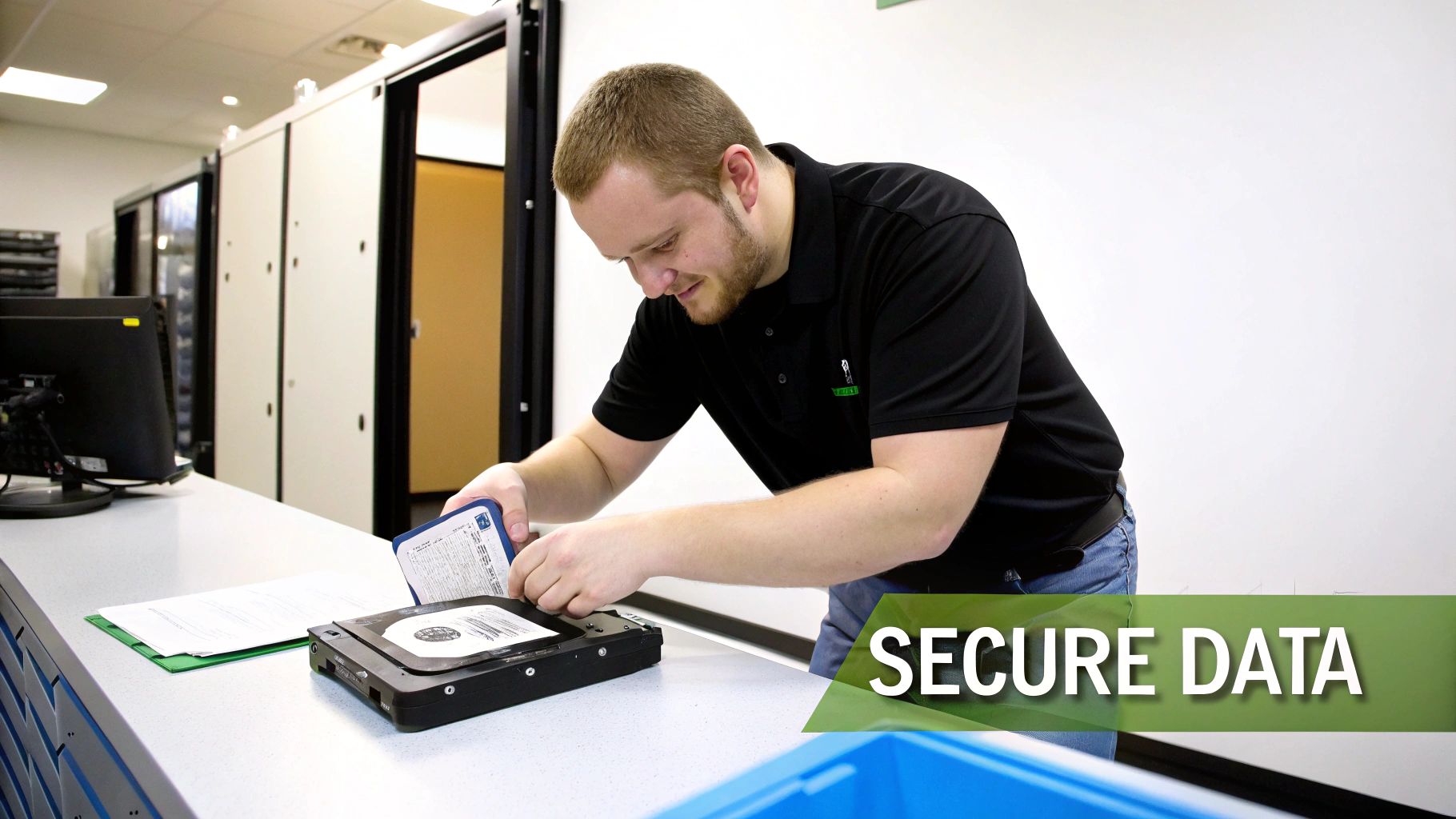
Once you know exactly what you have, the next move is deciding how to handle the sensitive data living on those devices. Hitting 'delete' is never enough. Anyone with basic recovery software can pull that data right back. True data sanitization means using certified, professional methods that guarantee the information is gone for good. The two industry-standard methods are DoD-standard data wiping and physical hard drive shredding.
Each one has its place. The right choice really depends on your organization's security policies, compliance mandates, and what you plan to do with the assets afterward. Knowing how to run effective computer security audits is key to making sure these processes are actually working before any device is officially declared e-waste.
Think about a healthcare provider bound by HIPAA. For them, absolute certainty is everything. The massive liability that comes with a patient data breach means there is zero room for error, which often makes physical shredding the only choice for total peace of mind.
The pressure to get this right is only growing. The electronic waste recycling market, valued at $32.14 billion in 2025, is expected to skyrocket to $239.5 billion by 2034. A huge driver of that growth is corporate tech refresh cycles combined with tougher data privacy laws. This shows just how much financial and regulatory heat Atlanta businesses are under to manage their old IT assets with certified security.
To help you decide which path to take, here's a quick comparison of the two main data destruction methods.
Choosing The Right Data Destruction Method
| Method | Best For | Security Level | Compliance Alignment | Atlanta Green Recycling Service |
|---|---|---|---|---|
| DoD Data Wiping | Reusable assets, devices with resale value, leasing returns | High (Meets DoD 5220.22-M) | Ideal for most corporate policies and data privacy laws. | Certified data wiping with detailed verification reports. |
| Physical Shredding | Damaged drives, non-functional media, maximum-security needs | Absolute (Completely irrecoverable) | Exceeds HIPAA, FACTA, and GLBA requirements. | Onsite and offsite shredding with a Certificate of Destruction. |
Deciding between wiping and shredding isn't just a technical choice—it's a strategic one that directly impacts your organization's security posture and financial return.
Real-World Scenarios in Atlanta
Let's look at how this plays out for two different Atlanta organizations.
Imagine a financial firm in Buckhead retiring a fleet of three-year-old laptops. They'd likely choose DoD-standard data wiping. This approach completely sanitizes the hard drives while keeping the laptops intact. By preserving the hardware's value, they can resell the assets and offset the cost of the entire disposition project.
Now, consider a hospital in the Emory healthcare system getting rid of old medical imaging equipment. For them, the only sensible option is physical shredding of all storage media. The risk of exposing protected health information (PHI) is just too high to consider anything else. The Certificate of Destruction they receive provides a concrete, unbreakable audit trail, proving they met all HIPAA regulations.
Making the right call here is a central part of any responsible e-waste recycling Atlanta GA program. You can see how we build this into a bigger strategy in our guide on IT asset disposition in Atlanta, GA.
You’ve inventoried your assets and wiped the data. Now comes the part that can feel just as daunting: getting all that old equipment out of your building without causing a major headache for your team. This is where the rubber meets the road, and a smooth, secure logistics plan is everything.
Imagine a university trying to clear out an entire computer lab over a quiet summer break, or a data center decommissioning hundreds of servers at once. That's not a job for a simple moving truck. It requires a dedicated team and a specialized fleet to handle the de-installation, packing, and secure transport without disrupting your operations.
Making Pickup and Transport Feel Effortless
A professional e-waste pickup shouldn't feel like a disruption. The goal is to make the entire process disappear into the background. A true turnkey service means we handle every last detail, from carefully de-racking servers in a tight data closet to palletizing desktops in a crowded office, all on your schedule. This is non-negotiable for organizations that can't afford any downtime.
Here’s what that looks like in practice:
- Scheduling That Works For You: We find a time that makes sense for your business, whether that’s after hours, over a weekend, or during a planned shutdown.
- A Professional Onsite Crew: Our uniformed and insured technicians show up with everything they need—dollies, pallet jacks, shrink wrap, and packing materials—to get the job done right.
- Secure Chain of Custody: Your assets are loaded directly into our dedicated, GPS-tracked vehicles. This ensures a secure, documented journey from your door to our facility.
This kind of managed approach is the hallmark of a professional https://www.greenatlanta.com/reverse-logistic-company/, turning what could be a logistical nightmare into a simple, predictable process.
Why Documentation Is Your Most Important Final Step
Once the truck pulls away, your job isn't quite done. The final, and arguably most critical, piece of the puzzle is the documentation. This paperwork is your official record, the proof that your organization followed every legal and environmental rule for e-waste disposal. If you're ever facing an internal audit or a call from the Georgia Environmental Protection Division (EPD), this is your shield.
Your responsibility for that equipment doesn’t end when it leaves your loading dock. It ends when you have a certified paper trail proving it was handled correctly. Without it, you’re leaving your organization exposed to serious legal and financial blowback.
To ensure you have full transparency, you need more than a simple pickup receipt. You need detailed, serialized reporting that closes the loop on every single asset. A great starting point is understanding the basics of tracking systems. This article explains what is a tracking number and why that level of detail is so important for accountability.
The Key Documents You Absolutely Must Have
Any reputable e-waste partner will provide a full documentation package that verifies every stage of the process. Don't consider the job complete until your compliance file contains these three items:
- Serialized Bill of Lading: Created at the time of pickup, this document lists every piece of equipment being transported, ideally with corresponding serial numbers or asset tags.
- Certificate of Data Destruction: If we handled data wiping or physical shredding, this certificate is your proof. It confirms all data was destroyed according to standards like DoD 5220.22-M and lists the specific devices by serial number.
- Certificate of Recycling: This is the final and most vital document. It certifies that your electronics were processed and recycled in an environmentally sound manner, meeting all local, state, and federal regulations.
These aren't just formalities; they are essential business records. They protect your company and prove your commitment to responsible e-waste recycling in Atlanta, GA. Having a complete and accurate set of certificates gives you the peace of mind that the job was done right from start to finish.
Turn Your E-Waste into Powerful ESG Wins
Once you’ve sorted out data security and logistics, your e-waste program is ready for its next evolution. It can move beyond a simple operational checklist item and become a cornerstone of your corporate narrative. This is where you flip the script, turning a compliance task into a compelling story of environmental stewardship and social impact—generating tangible wins for your Environmental, Social, and Governance (ESG) reports.
When you partner with a mission-driven recycler, your organization’s old tech is no longer just junk; it’s a catalyst for real-world good.
This mindset reframes the entire process. Instead of just "disposing" of assets, you're actively creating a positive outcome. It’s a story that resonates deeply with employees, stakeholders, and customers who are looking for businesses to prove they’re committed to social responsibility. It's a genuine way to show your company's values in action.
Frame Your Impact with a Powerful Story
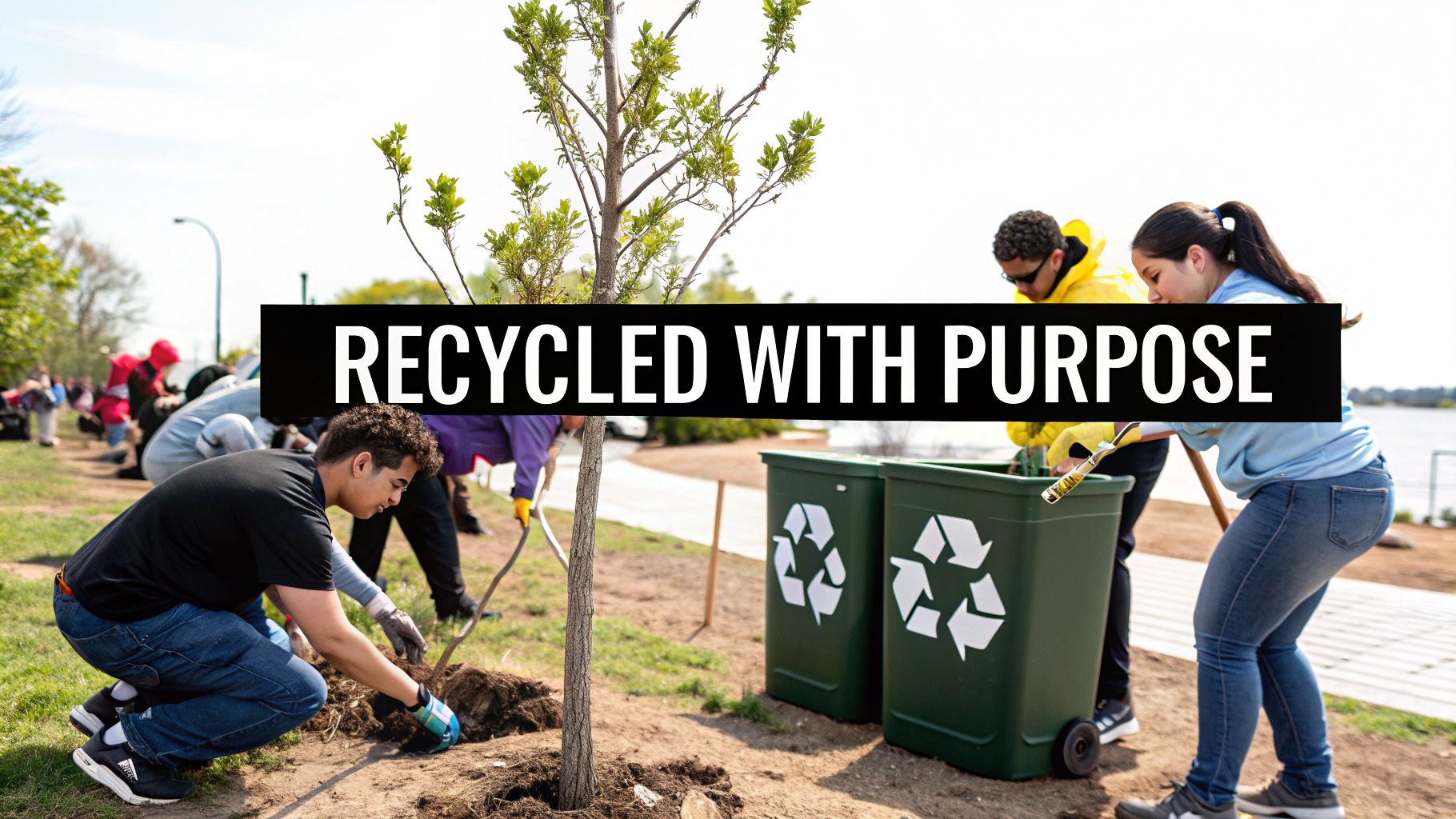
The heart of this strategy is a simple yet profound message: “Your old tech can house a veteran and grow a forest.”
This kind of emotional, outcome-driven language connects the routine act of recycling with tangible, positive change. It’s a story your marketing and communications teams can run with across every platform to showcase your company's commitment to the Atlanta community and beyond.
To make that story stick, you need transparent, verifiable proof. Imagine adding live impact counters to your corporate sustainability web page:
- Veterans Supported: 1,245
- Trees Planted: 3,700
These aren't just numbers; they are undeniable social proof. They reinforce the direct consequences of your partnership and move the conversation from abstract goals to concrete achievements.
Position Recycling as a Strategic ESG Asset
Framing your e-waste program as an easy ESG win makes it a strategic asset, not just a line-item cost. We specialize in corporate sustainability electronics disposal and help businesses target key ESG goals. For example, medical e-waste is a unique challenge in Atlanta, with hospitals generating surging volumes of equipment that risk contamination if not handled correctly.
By partnering with a specialized recycler, these institutions get HIPAA-safe data destruction and receive certificates proving proper diversion—perfect for compliance audits and bolstering their ESG credentials.
This dual-impact model turns every device into a quantifiable contribution. A free pickup of 50+ devices can yield Plant-A-Tree certificates and a Veteran Support Impact Report—perfect for your annual CSR documentation.
This approach creates a clear return on your recycling efforts. You're not just meeting environmental obligations; you're also generating powerful marketing and PR assets that set your brand apart. It’s a complete solution for companies looking to make a meaningful difference. Explore our corporate e-waste solutions to see how we build these programs.
Amplify Your Message and Engage Your Audience
Once you have a powerful story, it's time to tell it. There are several ways to weave this narrative into your corporate communications and build local credibility.
- LinkedIn Thought Leadership: Publish case studies that show how your partnership helped meet specific sustainability and CSR benchmarks. Detail the volume of e-waste diverted, the number of veterans assisted, and the trees planted.
- Eco-Badge Certification: Display a digital "Recycled with Purpose" badge on your website and in sustainability reports. This simple visual cue instantly communicates your commitment to responsible recycling and community support.
- Seasonal Drives: Align your recycling efforts with key dates like Earth Day, Veterans Day, or Arbor Day. These events create natural PR opportunities and are perfect for internal employee engagement campaigns or even community-wide donation drives.
By adopting these strategies, your e-waste recycling Atlanta GA program becomes a cornerstone of your corporate identity, proving that your organization is invested in building a better, greener community.
Build Long-Term Value Through Community Partnerships
A truly successful e-waste program doesn't just end with a single pickup. It grows into a platform for genuine community engagement and creates lasting value. When you move beyond a simple transaction, your recycling initiative becomes a powerful way to build local credibility, foster goodwill, and tell a continuous story of positive impact. This is how you turn one-time participants into passionate advocates for your mission.
For organizations here in Atlanta, that means looking for opportunities to amplify your efforts by joining forces with others who share your values. By building a network of community partners, you extend your reach and deepen the narrative of your commitment, making your recycling program a well-known and respected local initiative.
Forge Powerful Alliances with Local Nonprofits
The best way to build a real local presence and credibility is through grassroots engagement. Partnering with veteran and environmental nonprofits right here in the Atlanta area creates a powerful synergy, combining your resources with the trust they’ve already established in the community.
Imagine co-hosting a recycling drive with a local VFW chapter or a veterans' shelter. That kind of collaboration doesn't just collect more devices—it puts a human face on the "veteran aid" part of our dual-impact mission. It’s an authentic way to show your support in action, not just in words.
Here are a few ideas to get you started:
- Co-Hosted Recycling Drives: Team up with organizations like VFW posts, American Legion chapters, or local environmental groups to host community e-waste collection events.
- City & School Collaborations: Work with Atlanta-area schools, universities, or municipal governments on a "Greener Atlanta" initiative. You could collect devices and then fund tree planting to beautify local public spaces together.
- Local Press Features: Pitch your dual-impact story to outlets like the Atlanta Journal-Constitution or local sustainability blogs. Highlighting a successful partnership with a well-known nonprofit makes for a compelling local news feature.
These kinds of collaborations build invaluable social proof and show you're genuinely invested in the community, far beyond your own corporate goals.
Transform Customers into Brand Advocates
The goal is to make every interaction so meaningful that people feel compelled to share their positive experience. When you turn one-time recyclers into long-term advocates, you create a self-sustaining cycle of engagement and support for your program. It all starts by making the impact personal and tangible.
The moment someone recycles with you should be the beginning of a relationship, not the end of a transaction. Reinforce the positive impact they've made, and you'll earn their loyalty and their voice.
Even if your organization is primarily focused on B2B recycling, empowering the individual employees or community members who participate in your drives is key. A simple touch like automatically emailing personalized impact certificates after a donation—for example, “You planted 3 trees and helped 1 veteran”—makes the outcome feel immediate and personal. For many, this is their first time seeing a direct result from recycling.
You can also actively encourage advocacy through structured programs. A simple referral program that rewards users with an extra tree planted in their name for referring another business is a powerful motivator. It taps into the desire to do good while expanding your network organically. After all, figuring out what to do with old equipment is a common problem, and our guide on what to do with outdated computers can be a great resource to share.
Maintain Engagement with Consistent Storytelling
To keep your partners and past participants engaged, you have to keep telling the story. A monthly impact newsletter is a perfect way to do this. It keeps your mission top-of-mind and consistently reminds your audience of the good they helped create.
Your newsletter content should focus on real, human stories:
- Veteran Spotlights: Share brief, anonymized stories of veterans who have been supported through the program's funding.
- Reforestation Progress: Show, don't just tell. Include photos or short video clips from USDA reforestation projects where trees funded by Atlanta-based recycling are being planted.
- Partner Highlights: Feature a different corporate or nonprofit partner each month, showcasing their commitment and the results of your collaboration.
By focusing on authentic video storytelling and social proof, you reinforce the value of your e-waste recycling Atlanta GA program. Running paid social media campaigns featuring these impact stories—with messages like “Your company can turn e-waste into forests”—is a fantastic way to attract new corporate partners who are looking for an easy and meaningful ESG win. This consistent communication ensures your program remains a vibrant, ongoing initiative rather than a forgotten task.
Common Questions About Atlanta E-Waste Recycling
Even with a solid plan in place, you're bound to have a few questions when setting up an e-waste recycling Atlanta GA program. It's completely normal. To help you move forward with confidence, we've gathered the most common questions we hear from Atlanta-area IT departments, schools, and hospitals just like yours.
What Types of Electronic Devices Do You Accept?
Our entire process is built to handle bulk corporate IT asset disposition. We take a huge range of electronics common in business, education, and healthcare. Partnering with a single vendor who can manage all your different asset types just makes the whole process—from inventory to pickup—so much simpler.
We regularly handle items like:
- Core IT Infrastructure: Laptops, desktops, servers, and networking gear like routers and switches.
- Peripherals and Office Tech: Monitors, keyboards, mice, printers, scanners, and mobile phones.
- Specialized Equipment: We also have plenty of experience with unique assets, like those you’d find in a medical clinic or an industrial setting.
When in doubt, just ask. If you've got something unusual, we can quickly tell you if it's in our wheelhouse. If not, we'll help you find a solution. You can also see a more general list to learn where to recycle electronics in the Atlanta area.
How Do You Ensure Our Sensitive Data Is Destroyed?
This is, without a doubt, the most important question for any organization. And it should be. Data security is the absolute foundation of responsible e-waste recycling. We treat your data as seriously as you do, offering certified data destruction services that meet or exceed the toughest industry standards.
Your data is your liability until it is verifiably destroyed. A verbal promise isn't enough; you need an auditable, certified process that provides an unbreakable chain of custody and leaves no room for error.
We offer two primary methods, and you get a Certificate of Destruction no matter which you choose. This document is your official, legal proof that your sensitive information has been permanently wiped out.
- DoD 5220.22-M Data Wiping: This is a software-based approach that overwrites the entire hard drive with random data patterns, making the original information impossible to recover. It's perfect for newer assets that might be refurbished and find a second life.
- Physical Hard Drive Shredding: For the highest level of security or for older, non-functional drives, we physically shred the media into tiny, unsalvageable pieces. This is the go-to method for healthcare and financial institutions that must meet strict compliance standards like HIPAA.
Is There a Cost for E-Waste Recycling Services?
The cost can vary. It really depends on the volume of equipment, the specific types of devices you have, and any logistical needs, like if you need us to handle de-installation or packing on-site. Some items, like old CRT monitors, do have a net cost to recycle because of the hazardous materials inside.
But here’s the important part: many of your IT assets still hold residual value. Newer laptops, servers, and networking gear can often be refurbished and resold. We frequently use this value to offset or even completely cover the costs of recycling, data destruction, and logistics.
We always provide a transparent, custom quote after looking at your specific inventory. You'll know the full financial picture upfront, with no surprises down the line.
How Does Our E-Waste Support Your Dual-Impact Mission?
This is where your decision makes a real, tangible difference. When you recycle with us, you kick off a ripple effect of positive change. We’ve designed a model where the value from your old electronics is funneled into two powerful causes.
First, we work with trusted nonprofits to direct a portion of the proceeds to programs providing direct support to American veterans. Your old tech quite literally becomes tangible help for those who have served our country.
Second, for every qualifying pickup, we make a contribution to certified reforestation projects. This helps restore natural habitats and fight environmental decline. You'll get detailed Veteran Support Impact Reports and Plant-A-Tree certificates, giving you a powerful, measurable story for your ESG and CSR reports. Your old tech really can house a veteran and grow a forest.
Ready to turn your obsolete electronics into a force for good? At Atlanta Green Recycling, we make it simple for your organization to handle e-waste the right way while making a real impact on the community and our planet. Schedule your free e-waste pickup today.