
A Guide to Data Center Decommissioning in Atlanta: From E-Waste to ESG Win

When it comes to decommissioning a data center in Atlanta, having a smart plan isn't just a good idea—it's an absolute necessity. In a city where tech and cloud demands are skyrocketing, the lifecycle of IT hardware is shrinking. This makes the constant cycle of upgrades and retirements a core part of doing business.
Why Smart Decommissioning Matters in Atlanta
Atlanta's explosive growth as a top-tier tech hub presents both massive opportunities and new complexities. The non-stop pressure to modernize means data center decommissioning is no longer a simple cleanup job. Instead, it’s a chance to transform retired assets into a powerful force for good, helping you hit corporate ESG targets while making a genuine impact right here in our community.
This guide will walk you through the entire process. We’ll show how each phase connects to the next, leading to a secure, successful, and impactful outcome. What happens after you unplug your servers is just as important as the technology itself.
The Atlanta Effect on IT Infrastructure
The city’s tech scene isn’t just growing; it's booming. Atlanta’s data center market saw staggering growth between 2022 and 2024, doubling its construction pipeline each year. This incredible rise took it from the sixth-largest U.S. data center market to the second-largest, just behind Northern Virginia. By late 2025, the region had amassed a total inventory of 1,459.2 megawatts (MW). You can explore the full story of Atlanta's data center boom on AJC.com.
This intense growth has a direct impact on your operations:
- Faster Refresh Cycles: The drive for AI and high-performance computing makes your current hardware obsolete much faster.
- Increased E-Waste: More frequent upgrades mean a larger volume of retired IT assets that need to be managed responsibly. This is where keywords like “Atlanta tech recycling” and “electronics recycling for veterans” become critical.
- Heightened ESG Scrutiny: As your company's physical footprint in Atlanta grows, so do the expectations for sustainable and socially responsible practices.
A well-planned decommissioning project is your answer. It lets you efficiently clear out old infrastructure while turning what was once a logistical headache into a powerful story of corporate responsibility.
This simple diagram breaks down a well-managed project into three essential stages.
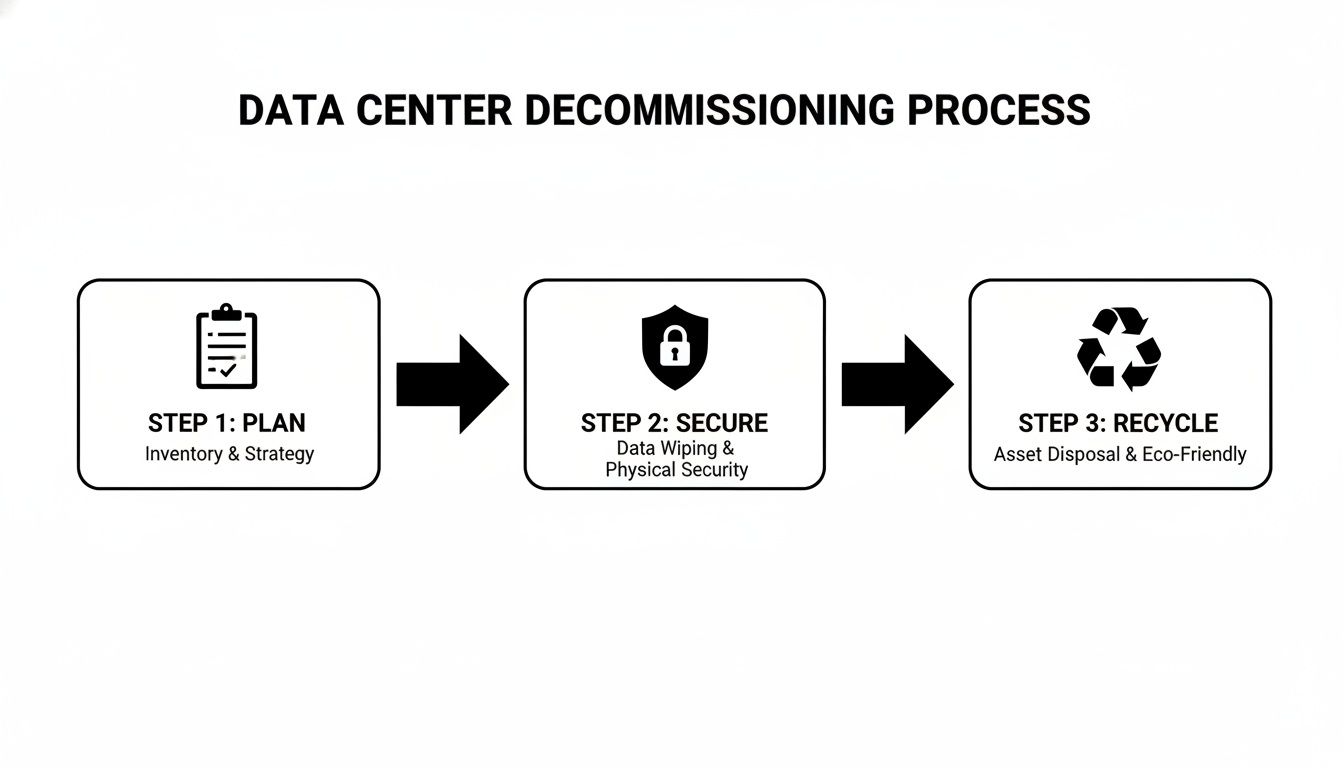
As you can see, a successful project flows from one stage to the next. Careful planning and rock-solid security come first, setting the stage for the final, impactful act of recycling.
Atlanta Data Center Decommissioning Project Phases
To give you a clearer picture, this table summarizes the core stages of a typical data center decommissioning project here in Atlanta.
| Phase | Key Activities | Primary Goal |
|---|---|---|
| Project Planning & Strategy | Site walk-through, defining scope, creating a project timeline, and logistical coordination. | Establish a clear, actionable plan that minimizes disruption and aligns with business goals. |
| Inventory & Asset Management | Cataloging all hardware, asset tagging, and creating a detailed inventory for tracking. | Gain complete visibility over all assets slated for decommissioning for accountability and valuation. |
| On-Site Execution & Removal | Securely disconnecting equipment, de-cabling, and palletizing assets for transport. | Efficiently and safely remove all designated hardware from the data center environment. |
| Secure Data Destruction | On-site or off-site data wiping (DoD/NIST standards) and physical shredding of media. | Guarantee that 100% of sensitive data is permanently destroyed and irrecoverable. |
| Logistics & Transportation | Secure, GPS-tracked transportation from your facility to our certified processing center. | Ensure a secure and unbroken chain of custody for all assets from start to finish. |
| Recycling & Remarketing | R2v3 certified recycling, component harvesting, and remarketing viable equipment for value recovery. | Maximize financial return while ensuring all non-viable materials are processed responsibly. |
| Documentation & Reporting | Issuing Certificates of Data Destruction, recycling reports, and environmental impact statements. | Provide auditable proof of compliance, security, and your positive community and environmental impact. |
Each phase is designed to build on the last, ensuring a seamless process from the initial plan to the final report that proves your commitment to responsible practices.
From E-Waste to ESG Win
When you partner with a mission-driven provider like Green Atlanta Recycling, you change the entire narrative. Decommissioning shifts from a disposal task to a cornerstone of your corporate social responsibility (CSR) program. Your old servers, racks, and cables stop being a potential landfill problem and start creating positive change.
This is where our tagline, "Recycling That Restores Lives and Landscapes," becomes a reality. A portion of the value recovered from your recycled assets directly funds our dual-impact initiatives:
- Supporting Veterans: We provide tangible aid to local veterans, turning your retired equipment into housing assistance, job training, and other critical support. On our site, you can see live impact counters showing stats like “1,245 veterans supported.”
- Reforestation Efforts: We work with the USDA and other tree-planting organizations to help restore forests, making your project a measurable win for the planet. Our live stats show “3,700 trees planted” and counting.
By choosing this approach, you get comprehensive documentation, including Plant-A-Tree certificates and Veteran Support Impact Reports. This is the concrete proof you need for ESG reporting. You not only manage risk but actively build your brand, showing that your organization is a positive force in the Atlanta community. To fully grasp what's at stake, you can learn more about the environmental impact of electronic waste in our detailed article.
Creating Your Decommissioning Project Plan
If you think a data center decommissioning starts the day you unplug the first server, you're setting yourself up for a rough ride. The truth is, a smooth project begins weeks or even months earlier with a solid, well-thought-out project plan. This isn't just paperwork; it's the strategic blueprint that will guide every decision, prevent costly surprises, and get you across the finish line on time and on budget.
This level of planning is especially critical right here in Atlanta. The market is absolutely white-hot. In 2025 alone, the metro area saw a staggering 456 megawatts of net absorption, and the vacancy rate dropped to an all-time low of just 2%. This happened even with a record amount of new space coming online. What does that mean for you? Intense pressure. Hyperscale, cloud, and AI users are snapping up every available megawatt, so landlords need their facilities cleared out fast.
Defining Your Project Scope and Goals
First things first, you need to know what "done" looks like. Are you simply vacating a colo cage? Are you clearing out an entire enterprise data center for an upgrade? Or are you consolidating several smaller sites into one? Your main objective will dictate everything that follows.
Get your key stakeholders from IT, finance, and facilities in a room and hammer out the answers to these questions:
- What's our hard deadline? A lease expiration date is non-negotiable and will be the biggest driver of your timeline.
- Who needs what? Finance will care about asset value recovery, while facilities will focus on meeting the landlord's return conditions.
- What does "empty" really mean? Does it mean a broom-swept floor, or do you need to remove all cabling, racks, and power distribution units?
Getting this clarity upfront is the single best way to avoid "scope creep"—that dreaded moment when unexpected tasks pop up mid-project, throwing your budget and timeline into chaos.
Building a Comprehensive Asset Inventory
You simply cannot manage what you haven’t measured. A detailed asset inventory is the absolute bedrock of a successful decommissioning plan. This means getting hands-on and cataloging every single piece of hardware you plan to remove—from servers and storage arrays down to the last switch, PDU, and rack.
A truly useful inventory captures more than just a count. You'll want to log:
- Asset Tag / Serial Number
- Make and Model
- Physical Location (Row, Rack, and U-position)
- Intended Plan (e.g., Recycle, Resell, or Securely Destroy)
This granular detail is what makes accurate value recovery estimates possible. It’s also crucial for maintaining a secure chain of custody and proving that no asset was accidentally left behind. To get started, you can use our data center migration checklist to help organize this critical first step.
A meticulous inventory isn’t just about counting boxes. It’s a critical security and financial control measure that provides auditable proof of what happened to every asset, from your floor to its final disposition.
Budgeting and Timeline Development
With a clear scope and a detailed inventory in hand, you can finally build a realistic budget and timeline. When you map out the costs, be sure to look beyond the obvious. It's easy to forget about the hidden costs of moving, which can quickly add up in a project of this scale.
Your budget should cover labor, logistics, secure data destruction, and potential recycling fees. But don't forget the other side of the ledger: the value you can get back from remarketing newer equipment.
This is where a mission-driven partner can change the entire financial equation. For example, the value we recover from your assets can directly fund our "Recycling That Restores Lives and Landscapes" program, which supports both veterans and reforestation efforts. This approach turns a necessary expense into a powerful ESG story—a massive win for any data center in Atlanta wanting to demonstrate a real, positive impact on the community. It’s how your old e-waste becomes new hope.
Executing Ironclad Data Destruction
With your plan in place, we get to the most sensitive part of the entire project: making sure every last bit of data on your old equipment is completely unrecoverable. In data center decommissioning, data security isn't just a box to check—it's a non-negotiable mission. One small slip-up can lead to devastating data breaches, crippling regulatory fines, and a hit to your reputation that's hard to come back from.

Here's the hard truth: just deleting files or reformatting drives provides zero real-world security. Off-the-shelf data recovery software can easily pull that "deleted" information right back. Real data destruction involves certified, proven methods that make data vanish for good. For any organization running a data center in Atlanta, this is your final, critical defense against future liability.
Choosing Your Method of Destruction
Not all data—or data storage media—is the same, so your destruction method shouldn't be either. The right call depends on your industry's compliance rules, your company's risk tolerance, and what kind of drives you're retiring. It usually comes down to three primary approaches.
Secure Data Wiping: This is a software-based process that overwrites every sector of a drive with random ones and zeroes. Following a protocol like DoD 5220.22-M involves multiple passes, making data recovery virtually impossible. It's an excellent option for newer, functional drives you might plan to resell, as it keeps the hardware's value intact.
Degaussing: Think of this as a powerful magnetic sledgehammer. A degausser uses an intense magnetic field to instantly scramble the magnetic data on hard drives and tapes. It's incredibly fast and thorough, but it also renders the drive totally inoperable afterward.
Physical Shredding: When you need absolute, undeniable proof of destruction, nothing beats a shredder. Industrial-grade shredders chew through hard drives, SSDs, and backup tapes, reducing them to small, useless fragments of metal and plastic. This is the gold standard for devices holding the most sensitive data, like patient health information (PHI) or financial records.
Scenario: An Atlanta-based healthcare system facing strict HIPAA compliance would almost certainly choose on-site physical shredding. The ability to have staff witness the destruction firsthand provides a bulletproof chain of custody and total peace of mind. There's simply no room for error.
Upholding the Highest Compliance Standards
To make sure your data destruction process is legally sound and defensible, you have to work with a partner who lives and breathes the industry's toughest standards. This is no place to look for a bargain.
There are two key credentials you should always look for:
NAID AAA Certification: This is the undisputed gold standard for the information destruction industry. A vendor with NAID AAA Certification is subject to unannounced, third-party audits that verify everything from employee background checks to their entire security and destruction workflow. It's your assurance of top-tier professionalism.
DoD 5220.22-M Compliance: While it originated with the Department of Defense, this 3-pass data overwrite standard has become the benchmark for secure corporate data sanitization. It confirms the wiping process is thorough, audited, and reliable.
When you hand over your assets to a certified partner, you're doing more than just hiring a vendor; you're securing a guarantee. It's how you turn a major operational risk into a fully documented, compliant, and worry-free process. We offer a full spectrum of compliant solutions, and you can learn more about our certified IT asset destruction services to see exactly how we protect your organization.
Managing Onsite Logistics and Responsible Recycling
Once your data is wiped clean, the project pivots from the digital world to the physical one. This is where the real boots-on-the-ground work begins, transforming a room full of decommissioned hardware from a logistical headache into a powerful asset for your company's ESG story. It’s the moment all that careful planning comes to life, managed by a team that knows how to navigate a live data center environment.

Let's be clear: this isn't just about unplugging servers and hauling them away. It's a precise operation. Our teams use specialized tools and a carefully coordinated workflow to de-install, pack, and transport every single piece of equipment—all without disturbing any adjacent, live operations. We ensure your assets are moved safely and your facility is left broom-swept and ready for whatever comes next.
From E-Waste to ESG Win
Here’s where your company’s decommissioning project truly becomes something special. Instead of trucking thousands of pounds of e-waste to a landfill, you're kicking off a cycle of renewal. We take those retired IT assets and immediately start the responsible recycling process, making sure hazardous materials are diverted and valuable commodities are recovered for reuse.
But we don't stop there. We connect the dots, transforming your old equipment into a tangible, measurable win for your environmental, social, and governance goals. Thanks to our unique dual-impact mission, your decommissioning project does more than just clear out a room—it helps build a stronger community right here in Atlanta.
This is where the story shifts. Your company's decommissioned hardware is no longer just e-waste; it becomes the catalyst for our "Recycle for a Cause" campaign. The message is simple but powerful: “Your old tech can house a veteran and grow a forest.”
That’s not just a feel-good tagline. It’s a transparent commitment we stand by. A portion of the value recovered from your assets directly funds two critical initiatives: providing real-world aid to local veterans and planting trees to support vital reforestation efforts.
A Comparison of Disposal Methods
When you’re planning a data center in Atlanta decommissioning, choosing a mission-driven partner creates a fundamentally different outcome than simply calling a standard disposal service. The choice you make has a ripple effect that extends far beyond the four walls of your facility.
The table below lays out the stark contrast.
| Metric | Standard Disposal (Landfill) | Atlanta Green Recycling Partnership |
|---|---|---|
| Environmental Impact | Adds toxic materials to landfills, contributing to soil and water contamination. | 100% landfill diversion, with all materials recycled to strict R2v3 standards. |
| Social Impact | Zero. Provides no benefit to the local community. | Directly funds veteran support programs and local reforestation projects. |
| ESG/CSR Reporting | Negative or neutral impact. Adds to the company's waste footprint. | Provides Veteran Support Impact Reports and Plant-A-Tree certificates for verifiable ESG documentation. |
| Brand Perception | Can be viewed as irresponsible and unsustainable. | Showcases your company as a socially conscious community leader. |
The comparison really makes the choice clear. By working with us, you’re not just managing waste; you are actively building a positive legacy. This entire approach is baked into our reverse logistics solutions, which are designed from the ground up to maximize both efficiency and real-world impact.
Turning Corporate Action into Community Impact
Our entire process is built to give your organization concrete, reportable results that prove your commitment to corporate social responsibility. When you work with us, especially on larger projects like our corporate recycling drives offering free pickup for 50+ devices, you get so much more than a clean, empty facility. You get a complete package of ESG documentation.
We provide you with:
- Plant-A-Tree Certificates: Official documentation detailing the number of trees planted in your company’s name as a direct result of your recycling project.
- Veteran Support Impact Reports: Detailed reports outlining exactly how the value from your assets contributed to veteran aid programs, perfect for your internal and external CSR reporting. We also publish LinkedIn thought leadership pieces showing how partners meet sustainability goals.
On top of that, we empower you to share the good news through our “Recycled with Purpose” digital badge. This certification can be displayed right on your website and in your sustainability reports, giving you immediate, visible social proof of your company’s commitment to making a real difference in the Atlanta community. Your decommissioning project becomes a powerful story of turning e-waste into hope.
Closing the Loop: Your Project's Final Documentation
The heavy lifting is over, the racks are gone, and the data center floor is empty. But a decommissioning project isn't truly complete until the final paperwork is in your hands. This is where we close the loop, providing you with a complete, auditable documentation package that proves everything was handled securely and responsibly.
Think of this documentation as your company's shield. It's the hard proof you need for internal audits, regulatory compliance checks for things like HIPAA or Sarbanes-Oxley, and your ultimate defense against the staggering costs of a potential data breach.
The Power of Proof
We don't just hand you a stack of papers; we deliver a meticulously assembled set of documents that establishes an unbreakable chain of custody for every single asset, from your facility to its final destination.
Your final documentation package will include:
- Serialized Asset Tracking Reports: A detailed, reconciled report that lists every piece of equipment by its serial number and confirms its final outcome—whether it was recycled, remarketed for value recovery, or physically destroyed.
- Certificates of Recycling: This is your official guarantee that all non-working electronics were processed according to strict R2v3 and e-Stewards standards, ensuring 100% landfill diversion.
- Impact Certificates: For every customer, we automatically email a personalized certificate detailing their specific impact (e.g., “You planted 3 trees and helped 1 veteran”).
- Certificates of Data Destruction: Arguably the most important document, this certificate verifies that every data-bearing device was either sanitized to NIST 800-88 standards or physically destroyed following DoD 5220.22-M guidelines.
A complete documentation package transforms your decommissioning from a logistical expense into a strategic investment. It’s how you prove your diligence, protect your brand, and turn corporate responsibility into a documented fact.
A Transparent Look at Project Costs and Value
We believe in total transparency when it comes to project costs. Decommissioning a data center in Atlanta has several moving parts, and we make sure you understand exactly what goes into the final price.
Key cost drivers typically include:
- Volume and Type of Equipment: The sheer number of servers, network switches, and racks directly impacts the labor and logistics involved.
- Data Destruction Method: On-site hard drive shredding, for example, requires specialized mobile equipment and is priced differently than software-based data wiping performed off-site.
- Logistical Complexity: Site access challenges, building rules like freight elevator scheduling, or the delicate de-installation of cabled infrastructure all factor into the equation.
But the conversation shouldn't stop at cost. It's just as important to focus on the value we help you recover and the enormous risks we help you eliminate. This isn't just an expense; it's an investment in your company's financial security.
The Bigger Financial Picture in Atlanta
The economic stakes in Atlanta’s tech industry are sky-high. In just the first seven months of 2025, the state attracted over $40 billion in new data center investments, according to the Georgia Chamber of Commerce. This incredible growth fuels a constant cycle of upgrades, making responsible e-waste management and "corporate sustainability electronics disposal" more critical than ever. You can read more about Georgia's data center boom on Georgia Trend.
By partnering with us, you're doing more than just managing retired assets; you're actively strengthening your brand in a fiercely competitive market. We provide you with tangible proof of your positive impact, like Plant-A-Tree certificates and Veteran Support Impact Reports. This turns a standard operational task into a powerful story for your ESG and CSR initiatives, demonstrating leadership and building brand equity.
Answering Your Top Data Center Decommissioning Questions
Even with the most detailed blueprint, you're bound to have questions when tackling a data center decommissioning. We get it. To give you some clarity, we’ve put together answers to the most common questions we hear from businesses all across Atlanta. Think of this as a practical cheat sheet to help you navigate your project with confidence.
What Makes Atlanta's Data Center Market So Different?
It all comes down to speed. Atlanta's tech scene is expanding at a breakneck pace, and the constant hunger for newer, more powerful infrastructure means hardware and even entire facilities can become outdated much faster here than anywhere else. This puts real pressure on companies to execute efficient, well-planned decommissioning projects.
On top of that, you have the city's incredibly tight real estate market. With vacancy rates at historic lows, landlords need to get new tenants in the door the second you move out. For any company leaving a data center in Atlanta, this means there’s absolutely no wiggle room for delays. A smooth, on-time decommissioning isn't just a goal—it's a must.
How Long Does a Decommissioning Project Really Take?
Honestly, it depends. A simple server room cleanout might be wrapped up in a few days. But a full-blown, multi-megawatt data center takedown? That could easily stretch over several weeks.
A few key things really drive the schedule:
- Sheer Volume: The total count of servers, racks, and networking gear is always the biggest factor.
- Data Destruction Method: On-site hard drive shredding, for instance, requires more logistical planning and time on the ground compared to off-site data wiping.
- Site Logistics: Things you might not think about, like building access rules, elevator availability, and the complexity of de-cabling, can all add time to the clock.
We map all this out with you right at the start. The goal is to build a realistic timeline that hits your move-out date without any last-minute chaos.
The most critical thing to remember is that a hard deadline, like a lease ending, sets the pace for everything. Kicking off the planning process as early as possible is the single best way to ensure you hit every milestone without the scramble.
How Do You Guarantee Compliance with Rules like HIPAA?
For us, compliance isn't a checkbox; it's a core part of our process, built to be fully certified and auditable. We know that for businesses in healthcare, finance, or government, having undeniable proof of secure data destruction is a dealbreaker.
Our entire approach is built on the industry's most trusted standards:
- NAID AAA Certified Services: We provide certified data destruction, which can include bringing a mobile shredder right to your facility to physically destroy hard drives and other media. This certification means our people, processes, and security are subject to surprise third-party audits.
- Serialized Asset Tracking: From the moment a drive or server leaves your hands, it's tracked by its unique serial number all the way through to its final destruction.
- Certificates of Destruction: Once the job is done, you get a formal Certificate of Data Destruction. It lists every single serial number we sanitized or destroyed, giving you a rock-solid, legally defensible chain of custody for any audit.
This isn't just about peace of mind. It’s about giving you the concrete paperwork needed to satisfy the toughest auditors and regulatory bodies.
What Actually Happens to Our Old Equipment?
This is the best part. Your project becomes a catalyst for real, measurable good right here in our community. Instead of your retired IT assets ending up as a liability in a landfill, we give them a new purpose. A portion of the value recovered from remarketing and recycling goes directly into our dual-impact mission.
Your old hardware helps us:
- Support Veterans: We team up with local Atlanta organizations and VFW chapters to provide tangible assistance to veterans. We share these stories through video storytelling and our monthly impact newsletter.
- Restore Forests: Through our environmental partners, we plant trees to help rebuild vital ecosystems. We even run paid social proof ads featuring our reforestation footage.
It’s the heart of our "Recycling That Restores Lives and Landscapes" promise. We make the connection crystal clear through our "Recycle for a Cause" campaign: "Your old tech can house a veteran and grow a forest." We follow up with Veteran Support Impact Reports and Plant-A-Tree certificates, turning what was once e-waste into a powerful ESG story for your company.
Ready to turn your decommissioning project into a story of positive impact? Atlanta Green Recycling provides secure, compliant, and mission-driven e-waste solutions for businesses across the metro area. Let us help you manage your end-of-life IT assets with a partner that puts purpose first.
Schedule your free consultation with Atlanta Green Recycling today.