
Data Center Atlanta GA Decommissioning Done Right

If you're running a data center in Atlanta, GA, you're at the very center of a massive transformation. The city’s explosive growth is rewriting the rules for how we manage retired IT infrastructure. Having a smart, forward-thinking decommissioning strategy isn't just a good idea anymore—it's a critical part of doing business here.
Why Atlanta's Data Center Boom Demands a New Strategy
Let's be clear: Atlanta is no longer just a regional tech city. It has become a global data center powerhouse. The insatiable demand from hyperscale cloud providers and the rise of artificial intelligence have kicked off an incredible construction boom, and that changes everything for local operators.
This isn't a small change. Atlanta has leapfrogged other markets and is on track to become the second-largest data center market in North America by the end of 2025, with an expected 1,459.2 megawatts (MW) of total inventory. With over 3 gigawatts (GW) in power commitments already on the books, we're looking at a future of non-stop upgrades and hardware refreshes.
The Constant Churn of Technology
As new, more powerful servers and network gear are rolled in to keep up with AI and cloud demands, the old equipment has to go somewhere. We're not talking about a few servers in a back closet; this is entire rows of racks, massive storage arrays, and core networking switches being decommissioned all at once.
Every single upgrade cycle creates a huge volume of retired IT assets. This turns data center decommissioning from a rare, one-off project into a continuous operational task that needs real strategic planning.
This constant churn creates a serious challenge. What do you do with mountains of outdated hardware? Letting it pile up in a warehouse is a security risk, a waste of valuable space, and a missed financial opportunity. Simply throwing it out is even worse—it's an environmental nightmare and a huge compliance liability.
More Than Just Logistics
It's a costly mistake to think of decommissioning as just a moving job. For any business with a data center presence in Atlanta, the process cuts across several core functions of the company:
- Data Security: Every single retired hard drive and server still holds data. If that information isn't properly destroyed, you're risking a catastrophic data breach, massive regulatory fines, and lasting damage to your brand.
- Compliance and Audits: If you're in healthcare (HIPAA) or finance, you know the rules for data handling are incredibly strict. You need a documented, auditable process with Certificates of Data Destruction to prove you’ve met your obligations.
- Financial Performance: Decommissioning has costs, but it's not just an expense line. Many retired assets still have residual value that can be recovered to offset the project’s cost. On the flip side, a poorly planned project can hit you with unexpected expenses and disrupt your operations.
A Shift in Perspective
The smartest enterprises in Atlanta are already looking at asset retirement differently. It's no longer a chore or a cost center. Instead, they see it as a strategic opportunity to strengthen their security, prove their compliance, and meet their corporate social responsibility goals.
The question is shifting from, "How do we get rid of this stuff?" to "How can we decommission these assets securely, compliantly, and in a way that actually benefits our brand?" This strategic approach is becoming a real competitive advantage in Atlanta's crowded market, especially as giants like Amazon continue to grow their local data center footprint. You can learn more by reading about Amazon's data center land purchases in the Atlanta area.
Building Your Decommissioning Playbook for Atlanta Operations
Thinking about decommissioning your Atlanta data center? The real work doesn't start the day the trucks show up. A truly successful project kicks off months earlier with a solid, well-documented plan. This playbook is what turns a massive logistical headache into a predictable, manageable process.
The entire lifecycle of a data center, from growth to upgrades and finally decommissioning, is a continuous loop. Every stage naturally sets up the next one.
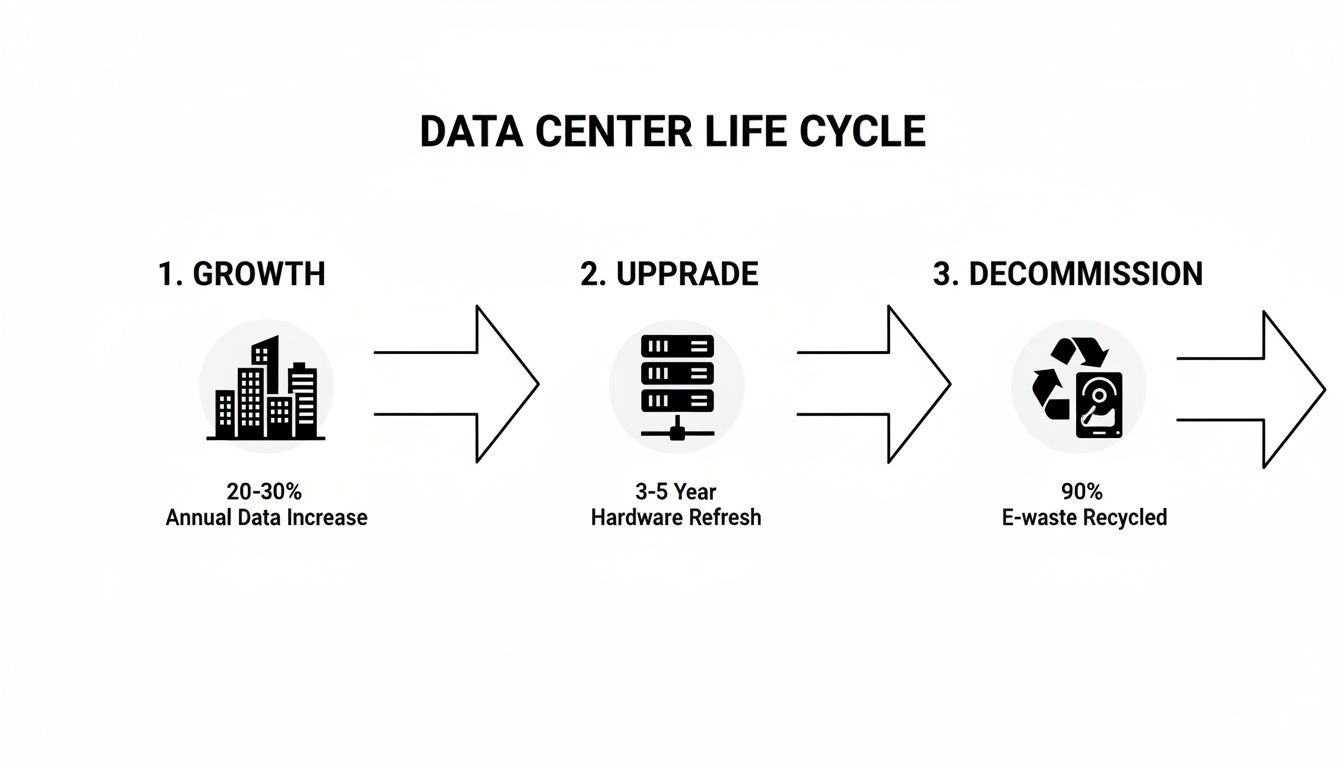
As you can see, decommissioning isn’t just an endpoint. It’s a vital transition that paves the way for new technology and growth. For any data center in Atlanta, GA, getting this cycle right is key to staying ahead of the curve.
Crafting a Detailed Statement of Work
Your most important document, bar none, is the Statement of Work (SOW). A vague SOW is a recipe for scope creep, surprise costs, and frustrating delays. It needs to be incredibly detailed, leaving zero room for interpretation.
Think of it as the blueprint for your entire project. A good SOW spells out every single task, deliverable, and responsibility. It ensures your team, your ITAD vendor, and even the building managers are all on the same page. This is where you get granular, outlining everything from the specific racks being pulled to the data destruction standards for each hard drive.
The SOW isn't just a formality; it's your primary defense against miscommunication and budget overruns. The more detail you include upfront, the smoother the execution will be.
For example, a strong SOW for an Atlanta data center project will clearly define:
- Project Scope: A precise inventory of all hardware set for decommissioning—servers, storage arrays, networking gear, even the cabling.
- Data Destruction Services: Specify the "how" and "where." Do you need on-site shredding for maximum security, or will off-site wiping to DoD 5220.22-M standards suffice?
- Logistical Requirements: This is where local knowledge is key. Detail any site-specific rules, like security check-in procedures at a downtown high-rise, elevator access times, or loading dock restrictions.
- Reporting and Documentation: Outline the proof you'll need for audits and ESG reports. This includes Certificates of Data Destruction, detailed asset tracking reports, and environmental impact statements.
To help you get started, we've put together a simple checklist that covers the essential planning phases for any Atlanta-based project.
Decommissioning Project Planning Checklist
This table breaks down the core actions you'll need to take and highlights specific Atlanta-based factors that can impact your project.
| Phase | Key Action | Local Consideration (Atlanta) |
|---|---|---|
| 1. Discovery & SOW | Create a detailed hardware inventory and draft the Statement of Work (SOW). | Factor in building access rules for high-rises in Midtown or Buckhead. Define security protocols required by your facility. |
| 2. Timeline & Budget | Map out key milestones, secure internal approvals, and finalize the budget. | Build in buffer time for potential traffic delays (e.g., I-285 rush hour) and for coordinating with property management. |
| 3. Vendor Selection | Vet and choose an ITAD partner with proven Atlanta experience and certifications. | Verify the vendor’s knowledge of local disposal regulations and their ability to navigate city logistics. |
| 4. Pre-Project Walk | Have your vendor conduct an on-site walkthrough to finalize logistical plans. | Assess tight corridors, freight elevator capacity, and loading dock access to avoid surprises on execution day. |
| 5. Execution | Oversee the physical de-racking, packing, and secure transport of assets. | Ensure the ITAD team schedules pickups during off-peak hours to avoid traffic snarls and sticks to the building’s schedule. |
| 6. Documentation | Receive and file all project reports, including certificates and asset logs. | Confirm all documentation meets your internal audit, finance, and ESG compliance requirements. |
Following a structured checklist like this takes the guesswork out of the process, ensuring no critical step is missed.
Building a Realistic Project Timeline
One of the most common missteps we see is underestimating how long a decommissioning project actually takes. It’s so much more than just the physical work. You have to factor in the time it takes to get approvals from all your internal stakeholders, run through procurement, and get on your ITAD partner's schedule.
A good approach is to map out your key milestones and then work backward from your deadline. Always build in some buffer time. Here in Atlanta, just getting the green light from your finance, legal, and security teams can sometimes take longer than you'd expect.
Once you have that internal buy-in, you can bring your ITAD vendor into the loop. An experienced partner can help you fine-tune that timeline based on your project's scale and their own capacity. For a deeper look at the complete process, check out our guide on IT asset disposition in Atlanta, GA.
Navigating Atlanta's Unique Logistical Hurdles
Decommissioning a data center in a major metro area like Atlanta brings its own set of challenges. Managing the logistics successfully requires on-the-ground knowledge and meticulous planning.
After all, a project in a secured downtown skyscraper involves a completely different set of rules than one at a sprawling campus out in Alpharetta or Lithia Springs.
Keep these Atlanta-specific factors on your radar:
- Traffic and Transportation: Scheduling asset pickups means knowing Atlanta's traffic inside and out. A pickup planned for rush hour on I-285 or the Downtown Connector is a guaranteed delay. Experienced local vendors are smart enough to schedule transport for off-peak hours, ensuring everything moves on time.
- Building Management Coordination: If you’re in a multi-tenant building, you have to get property management involved early. This means reserving freight elevators, securing loading dock access, and making sure your ITAD team has the right insurance and follows all security protocols.
- On-Site Logistics: The physical layout of your facility can make or break the project day. Are there narrow hallways? Tight corners? Multiple floors to deal with? A pre-project site walk is non-negotiable. It allows your ITAD partner to plan for the right crew and equipment, eliminating any costly day-of surprises.
By thinking through these local details ahead of time, you turn potential roadblocks into simple line items on a checklist. This is the kind of foresight that separates a chaotic, stressful project from a smooth, successful decommissioning.
Executing Flawless Data Destruction and Asset Removal
Once your decommissioning plan is set, you’ve reached the most critical moment: making sure every last byte of sensitive data is permanently and verifiably destroyed. For any business with a data center in Atlanta, GA, this isn't just a technical task—it's a massive security and compliance hurdle. One slip-up can have devastating consequences.
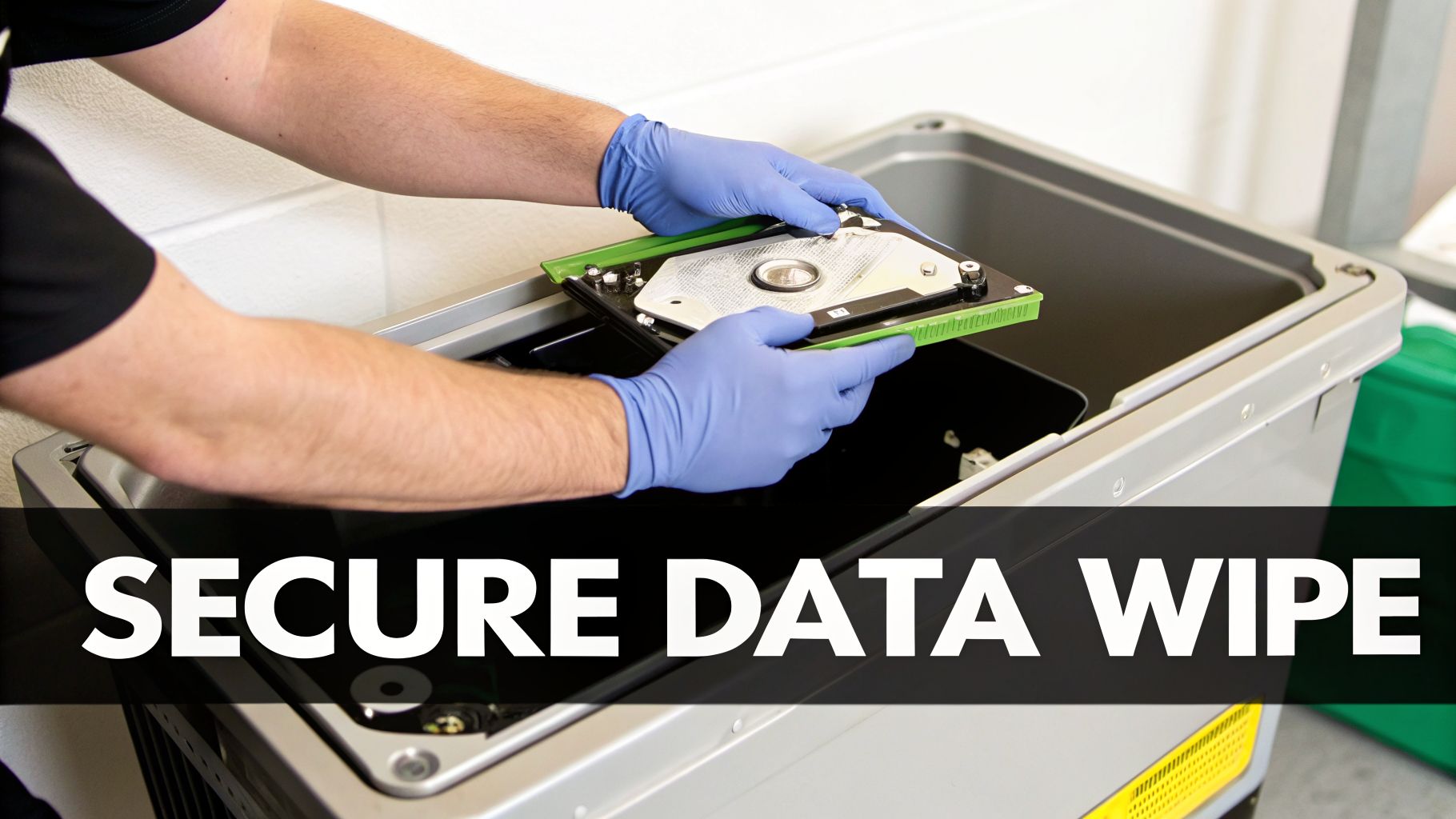
The stakes are sky-high, especially for those in tightly regulated industries. Think about it: a local Atlanta hospital system must prove HIPAA compliance for every patient record on its retired servers. A fintech firm over in Buckhead has to ensure its proprietary trading algorithms never, ever see the light of day. For them, just hitting "delete" is a non-starter. They need absolute, undeniable certainty.
Choosing Your Method: Software Wiping vs. Physical Shredding
When it comes to total data annihilation, you essentially have two paths. Your choice will really boil down to your internal security policies, how old the media is, and what your auditors need to see.
Data Wiping (Sanitization) is a software-based process that overwrites the data on a hard drive with random gibberish, making the original information impossible to recover. The gold standard here is the DoD 5220.22-M protocol, which runs multiple passes to guarantee nothing is left. This is a great route for newer, working drives you might want to resell to recover some of your initial investment.
Physical Shredding is the other side of the coin. For ultimate security—or for drives that are old, have failed, or can't be wiped—physical destruction is the only real answer. The drives are fed into an industrial-grade shredder that grinds them into tiny, useless metal fragments. There's no coming back from that. It’s the definitive end-of-life for a drive.
Many Atlanta companies we work with actually use a hybrid approach. They'll wipe newer assets that have some resale value but demand on-site physical shredding for any drives that held their most sensitive IP.
The Unbreakable Chain of Custody
From the second a server is unplugged in your data center to its final moments in a shredder, you need a documented, unbroken chain of custody. This isn't just a nice-to-have; it's a non-negotiable for any serious compliance audit.
This means meticulous tracking every step of the way:
- Serialized Asset Logging: Before anything leaves your site, every single drive and device is tagged with a unique serial number and scanned into a secure inventory.
- Secure, GPS-Tracked Transport: Assets are moved in locked containers inside GPS-tracked vehicles, giving you a real-time log of their entire journey.
- Facility Security: The destruction facility itself needs to have controlled access, 24/7 surveillance, and secure storage areas to prevent any chance of unauthorized access.
An unbroken chain of custody is your proof that no asset was lost, misplaced, or tampered with between your data center and the point of destruction. Without it, you can't be certain your data remained secure.
This is exactly why partnering with a vendor who provides a detailed audit trail is so crucial. That paper trail is your golden ticket for satisfying internal security teams, external auditors, and the C-suite.
The Certificate of Data Destruction: Your Proof of Compliance
After your assets are wiped or shredded, the final piece of the puzzle is the Certificate of Data Destruction (CoDD). This is the legal document that officially proves you've destroyed the data in line with industry standards.
A proper CoDD will list the serial numbers of every asset destroyed, the exact method used (like DoD 5220.22-M wiping or physical shredding), the date of destruction, and the signature of an authorized representative. This certificate becomes a permanent part of your compliance records, ready to be pulled out for any security or regulatory audit.
It gives you the peace of mind that comes from knowing you've done your due diligence. For Atlanta businesses facing fierce competition and a complex regulatory environment, this documentation isn't just important—it's everything. If you want to dig deeper, you can learn more about the importance of secure data destruction services and how they shield your organization from risk.
Navigating Atlanta's Logistics and Environmental Compliance
Once your sensitive data is wiped clean, the job's only half done. Now comes the heavy lifting—literally. You have to get all that hardware out of your facility and manage it responsibly. For any company with a data center in Atlanta, GA, this is a two-headed monster: navigating tricky city logistics and meeting strict environmental rules. Fumble on either one, and you’re looking at project delays, hefty fines, and a black eye for your brand.
The logistical side of IT asset disposition (ITAD) in the Atlanta metro area is no joke. It demands real, on-the-ground experience. Pulling a full-scale server rack out of a secure facility in Lithia Springs is a completely different ballgame than coordinating freight elevators and loading docks in a packed downtown skyscraper. Success comes down to working with a partner who gets these local quirks—from scheduling pickups to dodge the infamous I-285 gridlock to knowing the specific security protocols for different commercial buildings.
The Critical Role of Certified E-Waste Recycling
Beyond the logistics of moving equipment, your biggest responsibility is making sure it never sees a landfill. This is where partnering with a certified e-waste recycler is absolutely non-negotiable. Certifications like R2v3 (Responsible Recycling) and e-Stewards are the gold standard in our industry. They’re your guarantee that an ITAD partner is held to the highest bar for environmental safety, data security, and worker protection.
These certifications aren't just fancy badges; they provide a rock-solid, auditable framework that proves your company is serious about sustainability. They ensure every single component, from old servers to individual circuit boards, is properly handled—either refurbished for a second life, resold, or broken down into raw materials. This process keeps tons of hazardous materials out of Georgia’s environment and shows a real commitment to being a good corporate citizen.
Your partnership with a certified recycler is the single most important step you can take to mitigate environmental risk. It creates a paper trail that proves every asset was handled correctly, shielding you from the serious penalties tied to improper electronics disposal.
More Than Compliance: Turning an Obligation into an ESG Win
Meeting compliance standards is the baseline, but a truly modern ITAD strategy goes a step further. It can transform a routine operational task into a powerful story for your brand. When you choose a recycling partner with a dual mission, the simple act of retiring old hardware creates a ripple effect of positive community impact. It flips a business cost into an authentic ESG (Environmental, Social, and Governance) victory.
Imagine your old servers helping to fund job training programs for local veterans or contributing to critical reforestation projects right here in Georgia. This is where a tagline like “Recycling That Restores Lives and Landscapes” becomes a reality. Your company doesn't just get a certificate of destruction; you get detailed impact reports showing exactly how your decommissioned assets made a measurable difference.
These reports become incredible assets for your own marketing, investor relations, and CSR documentation. You can share concrete outcomes with your stakeholders, such as:
- Veteran Support Impact Reports: Details on how your retired IT equipment directly contributed to aid and resources for local veterans.
- Plant-A-Tree Certificates: Official documentation showing the number of trees planted in your company’s name.
- "Recycled with Purpose" Digital Badge: A sharable eco-badge for your website and sustainability reports to publicly showcase your commitment.
Integrating Environmental Responsibility into Your Strategy
Properly handling your decommissioned assets means having a deep understanding of all the materials involved. When you're dealing with older infrastructure, for example, you have to be aware of substances used in equipment like electrical switchgear. As you navigate environmental compliance, it's vital to understand the full picture, including things like the environmental impact of SF6 gas that can be found in some older switchgear.
By taking this kind of forward-thinking approach, your company’s decommissioning project becomes more than just a logistical headache. It evolves into a cornerstone of your corporate sustainability program, aligning your operational needs with a mission that matters. In a competitive market like Atlanta, this is a simple and highly effective ESG win.
For more on local green initiatives, our guide to the City of Atlanta's recycling programs offers some great additional context.
Turning Decommissioning Into an ESG Win for Your Brand

When it comes to decommissioning a data center in Atlanta, most companies just see a logistical headache. But what if that project could be more than just an operational cleanup? Today, it’s a powerful opportunity to strengthen your brand by building a genuine Environmental, Social, and Governance (ESG) story.
With the right ITAD partner, you can transform what seems like a standard business chore into a strategic asset. We’re talking about moving beyond simple disposal and creating real, positive community impact. Imagine your company’s retired servers and networking gear becoming tangible support for local Atlanta veterans or helping fund critical reforestation projects.
That’s how an operational necessity becomes a compelling, authentic story for your brand.
From E-Waste to an Easy ESG Victory
Framing your decommissioning project as an ESG initiative is one of the most straightforward wins a company can get. By deliberately choosing a mission-driven partner, you can directly link your IT asset disposal to social and environmental outcomes you can actually measure. It’s about making your e-waste work for good.
This is a message that resonates deeply with stakeholders, customers, and employees, who all expect businesses to show real corporate social responsibility (CSR). In 2023 alone, Georgia's data centers added $25.7 billion to the state's GDP and supported over 176,000 jobs. As this multi-billion dollar market grows, so does the inevitable flood of retired IT assets.
A partner like GreenAtlanta.com provides the B2B services needed to turn that e-waste into a positive force. We do it through cause-based marketing campaigns that support local veterans and environmental reforestation. If you want to see the numbers, you can find more on the growing Atlanta data center market on markettrendsanalysis.com.
Imagine presenting an Impact Report to your board that doesn't just show compliance but details how your old servers helped plant a forest or provided aid to a veteran in need. This is the new standard for a responsible data center Atlanta GA operation.
This strategic choice makes your company part of a positive local story, transforming a routine task into a powerful branding tool.
Activating Your Impact Through Cause-Based Campaigns
Authenticity is everything when it comes to effective ESG storytelling. A mission-driven ITAD partner gives you the substance you need to launch real cause-based marketing campaigns that connect with your audience.
For example, consider launching a "Recycle for a Cause" campaign around your decommissioning project. The message is direct and hits home: "Your old tech can house a veteran and grow a forest." This simple statement connects the act of recycling with tangible, heartwarming outcomes that are easy for anyone to understand and get behind.
You can amplify this strategy through:
- Corporate Recycling Drives: We can offer businesses free pickup of 50+ devices and, in return, provide your company with official Plant-A-Tree certificates and Veteran Support Impact Reports. These documents are perfect for your own CSR and ESG files.
- Seasonal PR Pushes: Align your recycling drives with holidays like Veterans Day, Earth Day, or Arbor Day. These are perfect opportunities to pitch stories to outlets like the Atlanta Journal-Constitution about your dual-impact model and earn positive press.
- Digital "Eco-Badge" Certification: We can provide a "Recycled with Purpose" digital badge for your corporate partners. They can display this on their websites and in sustainability reports as clear social proof of their commitment.
This is how a standard business operation becomes a public-facing demonstration of your company’s values.
Engaging the Community and Sharing Your Story
Beyond internal reporting, this approach helps you build credibility and a strong local presence through community engagement and earned media.
Partnerships amplify your message. Co-hosting recycling drives with local VFW chapters, veteran shelters, or environmental NGOs creates powerful community ties and makes your efforts feel much more authentic.
Storytelling brings the impact to life. Think about creating short, compelling videos for your social channels. You could feature footage of veterans receiving aid made possible by donations or show USDA reforestation footage where trees funded by your retired assets are being planted. These visual stories create a much deeper emotional connection than simple statistics ever could. For a deeper look into this, check out our guide on building a comprehensive business sustainability strategy.
Finally, a consistent engagement plan can turn one-time recyclers into long-term brand advocates. After a pickup, imagine automatically sending a personalized Impact Certificate that says, "You planted 3 trees and helped 1 veteran." This simple touchpoint reinforces the value of their decision and makes them feel like part of a larger mission—turning e-waste into hope.
Your Data Center Decommissioning Questions Answered
Even with a detailed plan, a project as big as a data center decommissioning always throws a few curveballs. For businesses here in Atlanta, those challenges often involve a mix of security, logistics, and compliance hurdles. We get these questions all the time, so let's tackle them with some straight, practical answers.
What Are the Biggest Risks We Should Be Watching Out For?
Hands down, the two things that can sink a project are data breaches from drives that weren't properly wiped and compliance failures from sloppy documentation. A data breach isn't just a technical problem; it can cause devastating financial and reputational harm, especially in a competitive market like Atlanta.
Failing to produce a clear chain of custody or official Certificates of Destruction can lead to failed audits and serious fines. This is a huge concern for Atlanta’s booming healthcare and fintech sectors, which are bound by strict rules like HIPAA. One small mistake in the paperwork can have massive consequences.
How Long Does a Typical Decommissioning Project Take in Atlanta?
The timeline really depends on the size of the job. A small server room cleanup might be done in a week, from planning to pickup. But shutting down a full-scale enterprise data center in Atlanta, GA, is a different story—that can easily stretch over several months.
A few key things will shape your schedule:
- Volume of Equipment: The sheer number of servers, racks, and drives is the biggest factor.
- Data Destruction Needs: On-site shredding, for example, adds logistical steps that off-site wiping doesn't require.
- Logistical Complexity: We always build in a buffer for navigating high-traffic Atlanta areas or dealing with tight building access rules in places like Midtown high-rises. You just have to plan for transport delays.
Our advice? Start the planning process at least a few months before your deadline. This gives you enough time for internal approvals and getting on your vendor’s schedule.
Can We Get Any Value Back from Our Old IT Equipment?
Absolutely. While a lot of hardware from a decommissioning project is truly at the end of its life, some components still have real residual value. We often see things like modern CPUs, high-capacity RAM, and newer servers get a second life on the secondary market.
A good ITAD partner will perform a detailed asset assessment specifically to identify remarketing opportunities. This process of value recovery can generate a welcome return that helps offset the overall cost of the decommissioning project.
A transparent partner gives you a clear, itemized report showing what sold and for how much. This ensures you get a fair return and helps turn a pure expense into a much smarter financial move.
How Do We Turn This into a Positive Story for Our Brand?
This is where working with a mission-driven partner makes all the difference. Instead of just getting rid of old assets, you can transform the entire project into a powerful ESG win for your company. By choosing a recycler with a dual mission, your old hardware can do more than just get recycled—it can help fund veteran aid programs and reforestation efforts.
Imagine telling your stakeholders that your old servers helped plant 3,700 trees or supported over 1,245 veterans. With programs like "Recycle for a Cause," you get real, tangible numbers for your CSR reports and a compelling story to share. You can even get a "Recycled with Purpose" digital badge for your website, turning a standard operational task into a public statement about your company's values.
Ready to transform your IT asset disposition from a cost center into a powerful story of community impact? Contact GreenAtlanta.com today to learn how our secure, compliant, and mission-driven services can benefit your organization. Find out more at https://www.greenatlanta.com.