Business is for sale: 2026 Guide to Valuation, Due Diligence, and Smooth Sales

If you're asking yourself whether now is the right time to put your business on the market, the short answer is that conditions are surprisingly strong. For many owners, 2026 presents a unique window of opportunity, driven by high buyer confidence and a renewed hunger for strategic acquisitions.
Deciding to sell is a massive step. This guide is here to help you figure out if now is your moment.
Is 2026 the Right Time to Sell Your Business?

The decision to sell the business you've built is easily one of the most significant choices you'll make as an entrepreneur. It's a complex mix of personal readiness, financial goals, and—critically—market timing. As we move through 2026, the mergers and acquisitions (M&A) landscape is showing remarkable strength, creating a fantastic environment for sellers who have done their homework.
After a few years of economic caution, corporate buyers are back in a big way. They are actively hunting for strategic acquisitions to snap up market share, acquire new technology, or break into new territories. This competition is heating up the market, often leading to premium valuations for the right kind of companies.
Understanding the Current M&A Landscape
The M&A market saw a major comeback in 2025, with megadeals—those transactions valued above $5 billion—surging dramatically. We saw 111 megadeal transactions announced in 2025, a whopping 76% increase from 2024. This flurry of activity at the top signals strong confidence that has trickled down to the middle and lower markets where most small and mid-sized businesses live.
In fact, a recent survey found that 41% of CEOs plan to pursue major acquisitions in the next three years. This proves that the demand for quality businesses is real and growing.
This heightened activity means more potential buyers are out there looking for a business just like yours. But make no mistake, they’re also more selective than ever.
Buyers today aren’t just buying your past performance; they are investing in your future potential. Your ability to tell a compelling growth story, backed by clean financials and a solid operational foundation, is what will command a premium price.
Aligning Your Business with Buyer Demand
So, what exactly are today's buyers looking for? Some sectors are particularly hot right now, attracting serious interest and higher multiples. These include:
- Technology and Software-as-a-Service (SaaS): Any company with a recurring revenue model and proprietary tech is in high demand.
- Healthcare and Life Sciences: The constant push for innovation in healthcare continues to fuel M&A activity in this stable, growing sector.
- Sustainable and ESG-Focused Businesses: Companies with a strong environmental, social, and governance (ESG) profile are increasingly attractive as corporations work to meet their own sustainability targets. A business with a clear, mission-driven brand identity—like one "Recycling That Restores Lives and Landscapes"—can really stand out.
If your business for sale falls into one of these categories, you're already in a great position. If not, you can still make your company more appealing by highlighting other strengths—like a loyal customer base, a strong local brand, or hyper-efficient operations.
For local entrepreneurs, understanding these market dynamics is the key to a successful sale. You might find our deep dive into the specifics of selling a business in Georgia especially helpful. Ultimately, 2026 offers a promising market, but your success will absolutely hinge on preparation and smart positioning.
How to Prepare for a Sale and Determine Your Business Value
The most successful business sales almost always begin long before a "For Sale" sign ever goes up. Getting your business ready for a buyer’s discerning eye is all about getting your house in order. It's a shift from running a day-to-day operation to presenting a polished, marketable asset.
This process starts with a serious cleanup of your financial records. You can bet that any potential buyer and their accountants will want to scrutinize every line item, so your books need to be immaculate. We're not just talking about having accurate P&L statements; you need to present a clear financial story that highlights your company's stability and profitability over the last three to five years.
Think of it as getting ready for a financial audit before anyone even asks for one. This "pre-diligence" approach lets you find and fix any potential red flags—like messy expense tracking or unrecorded owner perks—before they can spook a buyer.
Demystifying Your Business Valuation
With clean financials in hand, the next big step is figuring out what your business is actually worth. Before you even think about putting your business on the market, it's absolutely crucial to determine your business value using proven methods. This isn’t just about pulling a number out of thin air; it’s a strategic exercise that will anchor your entire negotiation.
You'll likely come across two common valuation methods:
- Seller's Discretionary Earnings (SDE) Multiples: This is the go-to for most small to mid-sized businesses. It begins with your net profit and then adds back the owner's salary, one-time expenses, and other non-essential business costs. The result is a true picture of the cash flow available to a new owner. That SDE figure is then multiplied by a number (the "multiple") that changes based on industry, location, and business stability.
- Discounted Cash Flow (DCF): This method is more common for larger or high-growth companies. It involves projecting future cash flows and then discounting them back to what they're worth today. It’s a more complex but forward-looking approach that helps buyers understand the future earning potential they are buying into.
For example, an Atlanta-based software company with predictable, recurring revenue is going to fetch a much higher multiple than a local manufacturing firm with heavy equipment costs and seasonal sales. Knowing where you stand is key to setting realistic expectations.
Showcasing Growth and Unique Strengths
A business's value isn't just a reflection of its past—it's tied directly to its future potential. As the seller, your job is to craft a compelling story about what’s next for the company, and you need the evidence to back it up.
You should shine a spotlight on key areas that signal future growth:
- Strong Customer Relationships: Do you have long-term contracts? A high customer retention rate? This kind of loyalty is a massive selling point. For example, a referral program where customers get an extra tree planted in their name can build a strong community of advocates.
- Unique Market Position: Are you the top provider in a specific niche here in the Atlanta market? Make sure you emphasize that competitive edge.
- Scalable Operations: Show how a new owner could easily grow the business—whether by expanding services or entering new markets—using the foundation you've already built.
A business with a strong brand, documented processes, and a clear path for growth is infinitely more attractive than one that relies solely on its owner's personal relationships. Buyers are purchasing a system, not just a job.
This preparation phase also means getting all your essential legal and operational documents in order. We’re talking about everything from business registration and employee contracts to supplier agreements and lease documents. Organizing this information in a virtual data room shows you’re a professional and makes the inevitable due diligence process much faster and smoother for everyone involved.
Every single step you take to professionalize your operations now will benefit you when it's time to negotiate. Even cleaning up your old assets can turn a simple task into a financial plus. You might be surprised to learn how to get cash for old electronics, turning a liability into a small win. Presenting your business in its best light is about sweating the small stuff so you can confidently ask for—and get—your price.
Navigating the Modern Due Diligence Gauntlet
So you’ve found a serious buyer. Congratulations. Now the real work begins. If you think due diligence is still a simple financial review between you and the buyer, you're in for a surprise. It’s no longer a one-on-one chat; it’s an intense, multi-faceted investigation.
Today, when a business is for sale, buyers bring a full team to the table. Everyone wants a look under the hood. A recent analysis from Forrester on global business buying trends found that a typical purchasing decision involves around 13 internal stakeholders and nine external influencers.
What does this mean for you? You’re not just selling to a single person. You have to convince a committee of experts from finance, legal, IT, and operations that your business is a solid investment. This expanded team means due diligence now covers more ground than ever before. To get through it, you need to think like they do and get ahead of their questions.
The Key Pillars of Diligence
Buyers will methodically pick apart your business, and they usually focus on four main areas. Being ready in each one is non-negotiable if you want to keep the deal moving and maintain trust.
Financial Diligence: This is more than just P&L statements. Expect buyers to dig into detailed sales reports, ask about customer concentration, and want proof of your recurring revenue. They'll also compare your tax returns against your financial statements, searching for any discrepancies.
Legal Diligence: Their legal team will be scrutinizing every contract you have—leases, customer agreements, and employee contracts. They’ll also be on the hunt for any past, present, or potential litigation and will want to see that all your corporate records are pristine.
Operational Diligence: Here, they want to understand how your business actually runs day-to-day. What are your key processes? How stable is your supply chain? Is the management team strong enough to run things without you? They’re assessing if the business can operate smoothly once you’re gone.
IT & Data Security Diligence: In the current market, this has become a make-or-break area. Buyers will audit your entire IT infrastructure, check software licenses, and most critically, inspect your data security protocols. A business that can show it targets keywords like "corporate sustainability electronics disposal" demonstrates a forward-thinking, risk-aware strategy.
Getting organized before buyers start digging is your best strategy. This simple workflow shows the foundational steps: get your documents in order, figure out a realistic valuation, and audit yourself for red flags.
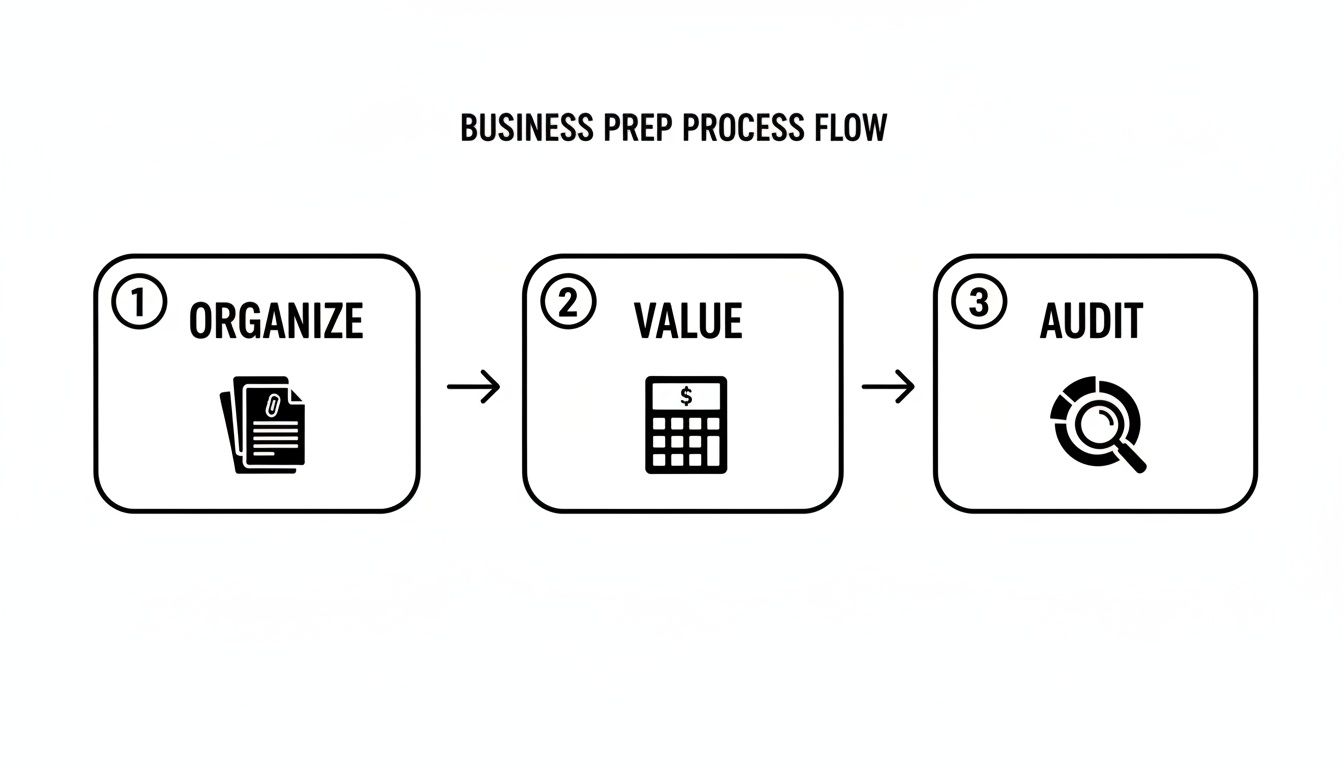
Being proactive is your greatest asset. When you address issues internally first, you enter negotiations from a position of strength, not defense.
To help you get organized, here’s a breakdown of the key areas you’ll need to prepare for as a seller. Think of this as your internal pre-diligence checklist.
Key Areas of Due Diligence for Sellers
| Diligence Area | What Buyers Look For | Seller Preparation Checklist |
|---|---|---|
| Financial | Profitability, cash flow stability, quality of earnings, customer concentration, and verifiable financial records. | Gather 3-5 years of P&L statements, balance sheets, tax returns, and detailed sales reports. Prepare a list of top customers and revenue breakdowns. |
| Legal | Clean corporate records, valid contracts, intellectual property ownership, and no outstanding litigation or compliance issues. | Organize all articles of incorporation, bylaws, contracts (customer, vendor, employee), leases, and permits. Disclose any legal disputes. |
| Operational | Efficient processes, stable supply chain, key employee dependencies, and a clear organizational structure. | Document key business processes and workflows. Create an org chart and list key employees with their roles. Detail your main suppliers. |
| IT & Security | Secure infrastructure, properly licensed software, data privacy compliance (GDPR, etc.), and disaster recovery plans. | Conduct an IT asset inventory, verify all software licenses are current, document your data security and backup procedures, and note any past breaches. |
Having these documents ready and organized will dramatically speed up the process and show buyers you're serious and professional.
Setting Up a Secure Data Room
The modern standard for managing all this information is a secure virtual data room (VDR). A VDR is an online repository where you upload all your sensitive documents, giving the buyer's team a controlled environment to conduct their review.
This isn't just for convenience; it’s about security and control. A quality VDR lets you track who views which documents and when, and you can revoke access instantly. This is crucial for protecting your confidential information, especially if a deal falls through.
Think of your data room as the single source of truth for the entire transaction. A well-organized, comprehensive data room sends a powerful signal to the buyer that you are a serious, professional seller who respects the process.
When you're navigating the sale of a business, especially in a competitive market, a clear plan is your best friend. For those exploring opportunities in the Atlanta area, you may find our guide on finding a business for sale in Atlanta useful for more local insights.
Ultimately, surviving the due diligence gauntlet comes down to one thing: transparency. Hiding weaknesses or being unprepared will only create suspicion and drag out the process. By anticipating what buyers want and preparing your documents with care, you build the trust needed to get to the closing table.
Managing IT Assets and Data Security During a Sale
When your business is for sale, it's easy to focus on the big-picture financials. But in my experience, a surprising number of deals get tripped up by something sellers often overlook: technology. Your IT infrastructure can be a major asset, or it can be a hidden liability just waiting to torpedo the deal.
Today’s buyers are savvy. They’re not just inheriting your products and client list; they're taking on your entire digital footprint. That includes everything from the aging server in a back closet to the sensitive customer data on employee laptops. Any vulnerability becomes their problem—and they will absolutely make it your problem during negotiations.
The High Stakes of IT and Data Diligence
Let’s be frank. Buyers are terrified of the skeletons that can hide in unmanaged IT assets. A single data breach discovered during due diligence can instantly shatter trust and give a buyer all the leverage they need to demand a steep price cut. I’ve seen it kill deals outright.
They're going to come at you with tough questions. You need to be ready.
- Data Security: How are you protecting customer, employee, and company secrets? Are you compliant with regulations like HIPAA or GDPR if they apply to your business?
- Hardware Lifecycle: What's your process for retiring old equipment? Are you sure the hard drives on old computers and servers have been properly wiped or physically destroyed?
- Software Licensing: Is every piece of software you use fully licensed and accounted for? The new owner doesn't want to inherit a lawsuit from a software company.
If you can't answer these questions with confidence, it's a huge red flag for a buyer. It signals a lack of control and a potential minefield of problems they'll have to clean up after the sale.
Why an IT Asset Disposition Plan Is Not Optional
When you're prepping a business for sale, getting a complete handle on your tech is non-negotiable. This process, often called IT Asset Management (ITAM), is all about making sure every piece of hardware and software is tracked, valued, and compliant. A critical piece of this is having a formal IT Asset Disposition (ITAD) plan.
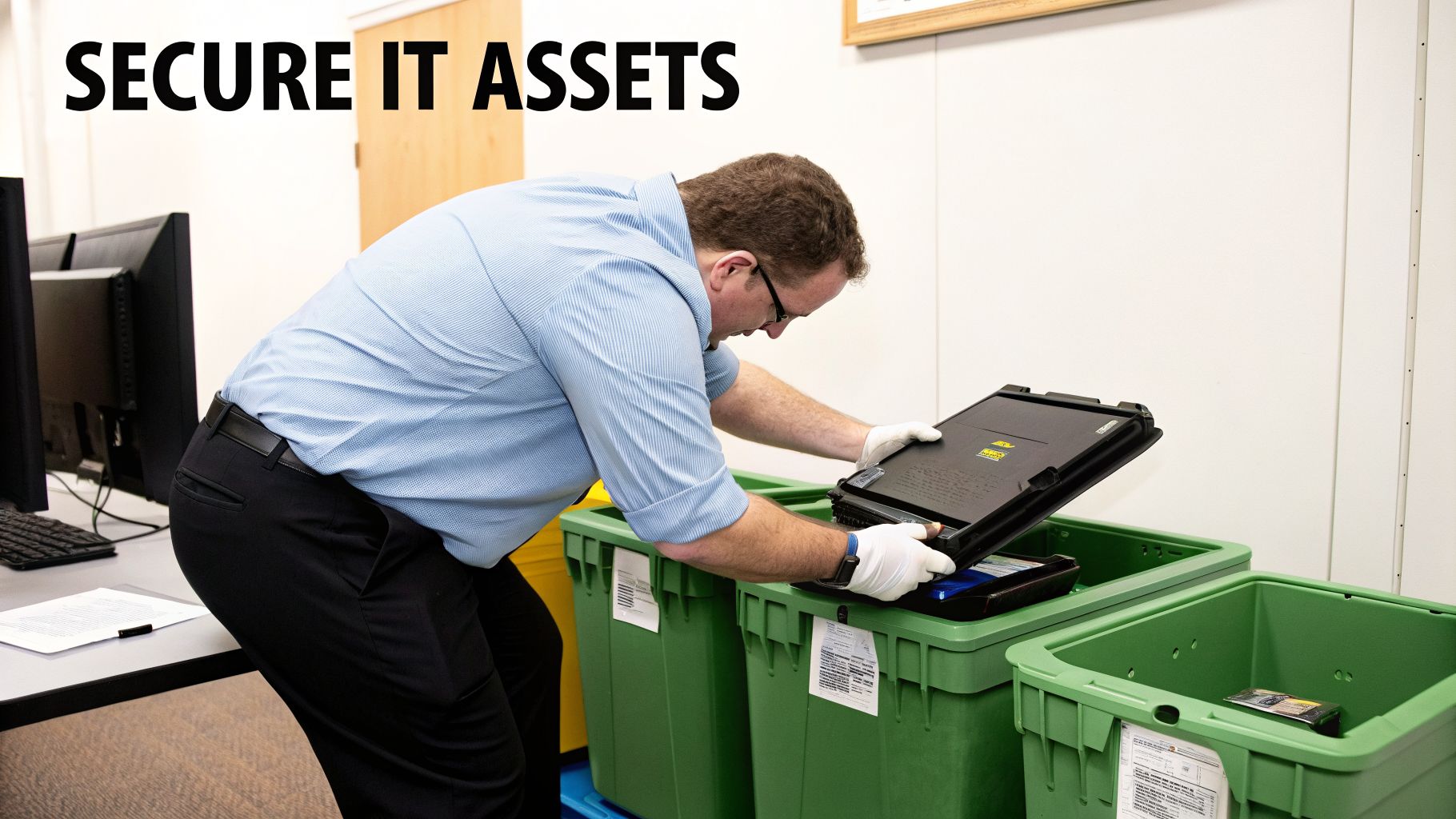
An ITAD plan is simply your documented process for securely and responsibly getting rid of old or retired tech. This isn’t about just tossing old computers in a dumpster—that’s a direct path to a data breach and environmental fines. A professional ITAD strategy is your shield against future liability.
Think of it this way: a single old hard drive that isn't properly destroyed could contain years of sensitive company financials or customer records. If that data falls into the wrong hands after the sale, you could still be held responsible.
A certified ITAD partner gives you a documented, defensible process. They manage everything from securely picking up the equipment to providing Certificates of Destruction. These are official documents that prove your data-bearing devices were sanitized or destroyed according to strict standards, like those from the Department of Defense. You can learn more about how this documentation protects your business in our guide explaining what an IT asset disposition plan entails.
Turning a Liability Into an ESG Win
For businesses in the Atlanta area, managing e-waste is more than just avoiding risk. It's an opportunity to make your company much more attractive to modern buyers, who are increasingly focused on Environmental, Social, and Governance (ESG) criteria. A messy environmental footprint makes a business less appealing, period.
This is where a forward-thinking seller can really shine. By partnering with a local, mission-driven recycler, you can turn your e-waste problem into a legitimate selling point. For example, Green Atlanta not only guarantees compliant data destruction but also connects the recycling process to a dual philanthropic mission of supporting veterans and planting trees. This transforms a routine operational chore into a tangible ESG victory.
Green Atlanta makes it incredibly easy for a business to document its positive impact, offering services like free pickup for 50 or more devices and providing detailed Plant-A-Tree certificates and Veteran Support Impact Reports for CSR documentation.
This is a story that resonates with buyers. Instead of seeing a closet full of old computers as a cleanup cost, they see a company that is proactive, responsible, and in tune with modern corporate values. You’re not just selling a business; you’re selling a business that makes a positive difference—and that makes your company a far more attractive acquisition.
Negotiating Terms and Closing the Deal
You’ve made it through the mountain of paperwork and the tough questions of due diligence. Now, you’re in the final stretch. This is where a handshake agreement gets real and turns into a legally binding contract.
The negotiation phase is a delicate dance. It’s not about one side "winning"—it's about finding a practical middle ground so both you and the buyer can walk away feeling good about the deal. When a business is for sale, the final price is just one piece of the puzzle. The deal structure, your role after the sale, and who takes on which liabilities are all on the table.
Let's break down what you need to know to close your deal on the strongest possible terms.
Asset Sale vs. Stock Sale: What’s the Difference?
One of the very first things you'll negotiate is the type of sale: an asset sale or a stock sale. This choice has massive tax and liability implications for everyone involved, so it’s critical to understand what you're agreeing to.
Asset Sale: In this scenario, the buyer hand-picks specific assets they want to purchase—things like your equipment, inventory, customer lists, and brand. Your original company entity stays with you, along with most of its debts and liabilities. Buyers almost always prefer this because it lets them avoid inheriting any unknown legal or financial skeletons in the closet.
Stock Sale: Here, the buyer purchases the shares of your corporation, acquiring the entire company as-is. That means they get all the assets and all the liabilities, both known and unknown. Sellers often push for this because it can mean a cleaner break and better tax treatment for them.
You can expect some back-and-forth here. A buyer will likely push for an asset sale to minimize their risk, while you might argue for a stock sale. A common compromise is to adjust the purchase price to make up for the less favorable structure one party has to accept.
Crafting a Strong Letter of Intent
Once you’ve settled on the big-picture terms, it's time to put them in writing with a Letter of Intent (LOI). While an LOI is usually non-binding, don't underestimate its power. It lays out the framework for the deal and shows that both sides are serious before you start racking up heavy legal bills.
A solid LOI should clearly define:
- The proposed purchase price and payment terms.
- Whether it’s an asset or stock sale.
- A target timeline for closing the deal.
- Any key conditions, like you staying on for a transition period.
- A "no-shop" clause that stops you from talking to other potential buyers.
Even though it’s not the final contract, treat the LOI with the seriousness it deserves. It’s your first and best opportunity to lock in the most important parts of the deal. Trying to change these terms later is an uphill battle.
Addressing Real Estate and Facility Transitions
The physical location of your business is often a huge part of its value, especially in a competitive market like Atlanta where good commercial space is hard to come by. Real estate can quickly become a major hurdle in any negotiation.
Global investment in real estate has seen sustained momentum, with transaction volumes climbing 19% year-over-year through 2025. This surge is making high-quality office and industrial spaces scarcer and more expensive, which can definitely give you some leverage in your negotiations.
If you own the building, will you sell it with the business or lease it back to the new owner? If you’re currently leasing, the buyer needs to either take over your existing lease or negotiate a new one with the landlord. This alone can add weeks or months to the closing timeline, so get the ball rolling on this early.
The most overlooked part of many deals is the facility transition. Don't assume the landlord will approve a lease transfer. Start those conversations early to prevent a last-minute crisis that could derail the entire sale.
The Final Closing Checklist and Handover
With the final Purchase Agreement signed, you’re ready for closing day. This is the official event where ownership is transferred, money changes hands, and the deal is done. Your advisors will guide you, but having your own checklist ensures nothing falls through the cracks.
Your closing checklist should include:
- Finalize All Documents: Make sure every contract, bill of sale, and transfer document is signed and ready to go.
- Transfer of Funds: Confirm the buyer has wired the purchase price to the escrow account.
- Asset Handover: Formally transfer all physical and digital assets. This includes keys, security codes, account passwords, and intellectual property. For any IT hardware you’re decommissioning, make sure you get a Certificate of Destruction to prove you've properly handled sensitive data.
- Employee and Customer Communication: Work with the buyer on a joint plan to announce the change to your team and most important customers.
A smooth, organized handover is the final piece of the puzzle. It leaves a positive last impression and helps set the new owner up for success, protecting the legacy of the business you worked so hard to build.
Common Questions When a Business Is for Sale
Putting your business on the market is a huge step, and it's natural for a flood of questions to come up. From timing and valuation to confidentiality, sellers in Atlanta often face the same uncertainties. Let’s tackle some of the most frequent questions with straight, practical answers to help you see the path forward.
How Long Does It Typically Take to Sell a Business in Atlanta?
While every deal moves at its own pace, you can generally expect the process of selling a small to mid-sized business in the Atlanta area to take 6 to 12 months.
What's the biggest variable in that timeline? Your readiness. The more prepared you are from day one, the faster things will move. Clean financials, organized legal documents, and a solid plan for your IT assets can shave months off the buyer's due diligence. It sends a powerful signal that you’re a serious, professional seller, which builds trust and keeps the momentum going.
What Is the Biggest Mistake Sellers Make?
The most damaging—and common—mistake is a nasty combination of poor preparation and unrealistic price expectations. Too many owners decide to sell and then try to get their house in order, which almost always leads to a frantic scramble when buyers start asking tough questions.
A massive blind spot in today's market is failing to address data security and e-waste liabilities. Buyers are smarter than ever about these risks. If you don't have a clear plan for disposing of old IT hardware and destroying the data on it, you can create major delays or even leave yourself exposed to legal problems after the sale.
A business sale is a marathon, not a sprint. The groundwork you lay months or even years before you list your company for sale will have the biggest impact on the final outcome.
Do I Really Need a Business Broker to Sell My Company?
There's no law that says you have to hire one, but for most deals over $1 million, bringing on a reputable business broker or M&A advisor is one of the smartest investments you can make. Their value goes way beyond just finding a buyer.
A great broker will:
- Run a confidential marketing process to protect your business operations.
- Vet potential buyers to weed out tire-kickers and focus only on serious, qualified candidates.
- Develop a professional, defensible business valuation to justify your asking price.
- Manage the complex, often emotional, back-and-forth of negotiations.
Ultimately, their expertise not only leads to a higher sale price but also frees you up to keep running your business. The last thing you want is for performance to dip while you're distracted by the sale.
How Can I Protect My Confidential Information?
Guarding your company’s sensitive data during the sale is absolutely non-negotiable. Your first line of defense is always a rock-solid Non-Disclosure Agreement (NDA). No potential buyer should see any confidential details without signing one first.
From there, it’s about releasing information in stages. You don't hand over the keys to the kingdom on day one. Deeper, more sensitive data should only be shared once a buyer has proven their serious intent and financial capacity to do the deal.
The industry standard is to use a secure virtual data room. This allows you to control who sees what and track all activity, ensuring your trade secrets and customer lists stay protected.
Another smart move is to proactively shape your company's public narrative. Positive press can build brand credibility and attract buyers who care about corporate responsibility. For example, if you have a great story about your community impact—like partnering with local media such as the Atlanta Journal-Constitution to highlight how you recycle electronics to support veterans—it makes your business that much more attractive.