Your Guide to Finding an Atlanta GA Business For Sale


Thinking about buying a business in Atlanta? You've picked a fantastic spot. The city is more than just a dot on the map; it’s one of the country's most vibrant economic engines. This guide is your on-the-ground playbook for finding, vetting, and ultimately closing on an existing business here, turning your entrepreneurial drive into a real, cash-flowing asset.
Why Atlanta Is a Goldmine for Business Buyers

Before you start scrolling through listings and poring over financial statements, it’s worth understanding why Atlanta is such fertile ground for business ownership. The city’s economic resilience and steady growth create a stable environment where established companies don't just survive—they often thrive.
Buying an existing company gives you an incredible head start. You’re not just buying a name; you’re inheriting immediate cash flow, a loyal customer base, and operational systems that have already been battle-tested. Instead of spending years building a brand from scratch in a competitive market like this, you can focus your energy on growth and optimization from day one.
Atlanta's Diverse Economic Pillars
The real strength of Atlanta’s market isn't just its size—it’s the sheer diversity. This isn't a one-trick-pony economy. Multiple key sectors create a stable foundation, meaning you’ll find opportunities across a wide range of industries.
- Technology and Fintech: They don't call it "Transaction Alley" for nothing. Atlanta is a genuine hub for financial technology, which supports a massive ecosystem of B2B service providers, from specialized IT firms to digital marketing agencies.
- Logistics and Supply Chain: With the world's busiest airport and a sprawling network of rail and trucking, Atlanta is the backbone of logistics in the Southeast. This fuels countless businesses in transportation, warehousing, and distribution.
- Professional and Corporate Services: A huge concentration of Fortune 500 headquarters means there's a constant, high-level demand for legal, accounting, marketing, and consulting services.
- Sustainable Industries: There’s a growing appetite for green business. As corporations get serious about ESG (Environmental, Social, and Governance) goals, companies offering solutions like B2B electronics recycling or sustainable construction are becoming hot acquisition targets.
A key advantage of the Atlanta market is its forward-thinking corporate culture. As more companies prioritize their environmental, social, and governance (ESG) goals, businesses that help them meet these benchmarks gain a significant competitive edge.
To successfully navigate this process, you'll need a solid team and the right resources. Think of it as building your personal acquisition toolkit.
Your Atlanta Business Acquisition Toolkit
Here are the essential resources and professionals you'll need to navigate the process of buying a business in Atlanta.
| Resource or Professional | Your Key to Success | Where to Find Them in Atlanta |
|---|---|---|
| Business Broker | They have access to non-public listings and can connect you with qualified sellers. An experienced broker understands local market valuations. | Look for brokers affiliated with the Georgia Association of Business Brokers (GABB). |
| M&A Attorney | Your legal quarterback for everything from the Letter of Intent (LOI) to the final purchase agreement. They'll protect you from hidden liabilities. | The Atlanta Bar Association is a great place to start your search for an attorney specializing in business transactions. |
| CPA/Accountant | Essential for deep-diving into the financials during due diligence. They'll verify the seller's numbers and help you structure the deal tax-efficiently. | Seek out a local CPA firm with a strong background in small business valuation and transactional services. |
| SBA Lenders | Many Atlanta-based banks have dedicated SBA departments that are pros at financing business acquisitions. | Major banks like Truist and Bank of America, as well as local community banks, have active SBA lending programs in the metro area. |
Assembling this team before you get too deep into the search will save you headaches and put you in a much stronger negotiating position.
The Advantage of Established Infrastructure
Beyond its core industries, Atlanta’s physical and digital infrastructure is built for business growth. You're not just buying a company; you're plugging into a community with serious momentum.
The city's ongoing development, from major transportation upgrades to projects that improve quality of life, makes it an attractive place for both customers and top talent. For anyone exploring an Atlanta GA business for sale, this constant public and private investment is a powerful signal of long-term prosperity.
You can see a great example of this in the city's commitment to creating vibrant, connected communities. For a closer look at how local development fuels commercial opportunity, check out our guide on the Atlanta Beltline's impact. This kind of built-in momentum provides a strong tailwind for any new business owner.
Where to Uncover Businesses for Sale in Atlanta
Finding a great Atlanta GA business for sale isn't about luck; it's about knowing exactly where to look. While your first instinct might be to fire up a web browser, the best deals are rarely the ones everyone can see.
Think of it as a two-part strategy. You'll start with the wide net of online marketplaces but quickly move to the insider track, where the real gems are found. This means getting connected with the right people on the ground.
The big online platforms like BizBuySell, BizQuest, and LoopNet are the obvious first stop. They're useful for getting a broad-strokes view of the market. You can filter by industry, revenue, and specific areas from Fulton to Gwinnett County, which helps you get a baseline for asking prices.
But here’s a common mistake I see new buyers make: they stop there. The most profitable, well-run businesses often get sold before they ever hit a public listing site.
Tapping Into the Hidden Market with Business Brokers
This is where a good local Atlanta business broker becomes your most powerful ally. These folks are completely dialed into the local scene. They hear about owners thinking of retiring or selling long before the "For Sale" sign ever goes up.
These "off-market" deals are the holy grail for a reason. You're not competing with a flood of other buyers, which gives you incredible leverage.
A quality broker is much more than a finder. They act as your strategic partner from day one.
- Access to Off-Market Deals: Their network of local business owners, CPAs, and attorneys is a constant source of opportunities you'd never find on your own.
- Initial Vetting: They've already done the first pass, filtering out businesses that are poorly documented or owners who aren't serious about selling. This saves you an immense amount of time.
- Confidentiality: The whole process is handled with discretion. This is non-negotiable for sellers who need to keep operations running smoothly and for buyers who want to conduct due diligence without tipping their hand.
Don't think of a broker as just a salesperson. They are your guide to the specific rhythms and nuances of the Atlanta market. For more on what's happening locally, we often share insights based on what's covered in the Atlanta business journal.
Leveraging Professional and Community Networks
Beyond brokers, don't underestimate the power of your own network. Atlanta's business community is large but surprisingly tight-knit. Getting involved in the right circles can open doors you didn't even know existed.
Zero in on industry-specific groups. If you're targeting a tech company, get active with the Technology Association of Georgia (TAG). If manufacturing is your focus, events held by the Georgia Chamber of Commerce are a must. You'll be in the same room as owners and advisors who have the inside track.
I saw this play out perfectly for a client. She wanted to buy a sustainable business and started attending local environmental council events. She got to talking with an accountant there, who casually mentioned his client—the owner of a B2B recycling firm—was getting ready to retire. That conversation led to an introduction and, eventually, a quiet acquisition of a fantastic business that was never listed anywhere.
Actionable Steps for Uncovering Opportunities
To make this happen, you need a disciplined, multi-channel approach. Don't just browse online; get out there and connect with real people.
- Systemize Your Online Search: First, set up saved searches and email alerts on the major platforms for "Atlanta GA business for sale" using your specific criteria. Let the technology do the grunt work.
- Interview Local Brokers: Don't just pick one. Schedule meetings with at least three different Atlanta-based brokers. Ask them about their track record in your target industry and how they source off-market deals.
- Engage with the Metro Atlanta Chamber: This is the nerve center of the city's business world. It’s an excellent place to build connections with influential leaders and decision-makers.
- Network with Purpose: When you go to industry events, have a goal. You’re not just there to hand out cards; you're there to have real conversations about your mission to acquire a business.
By combining the scale of online searching with the targeted precision of in-person networking and a solid broker relationship, you stop leaving your search to chance. This is how you strategically uncover the very best business opportunities Atlanta has to offer.
How to Properly Evaluate an Atlanta Business Opportunity
So, you’ve found a promising Atlanta GA business for sale. You've gone through the online listings, talked to brokers, and something has caught your eye. This is where the real work starts. This stage, what we call due diligence, is all about peeling back the layers and seeing what’s really under the hood of the business.
It’s about more than just looking at the numbers the seller provided. You need to get a real feel for the company's place in the competitive Atlanta market. This is the single most important phase to protect your future investment.
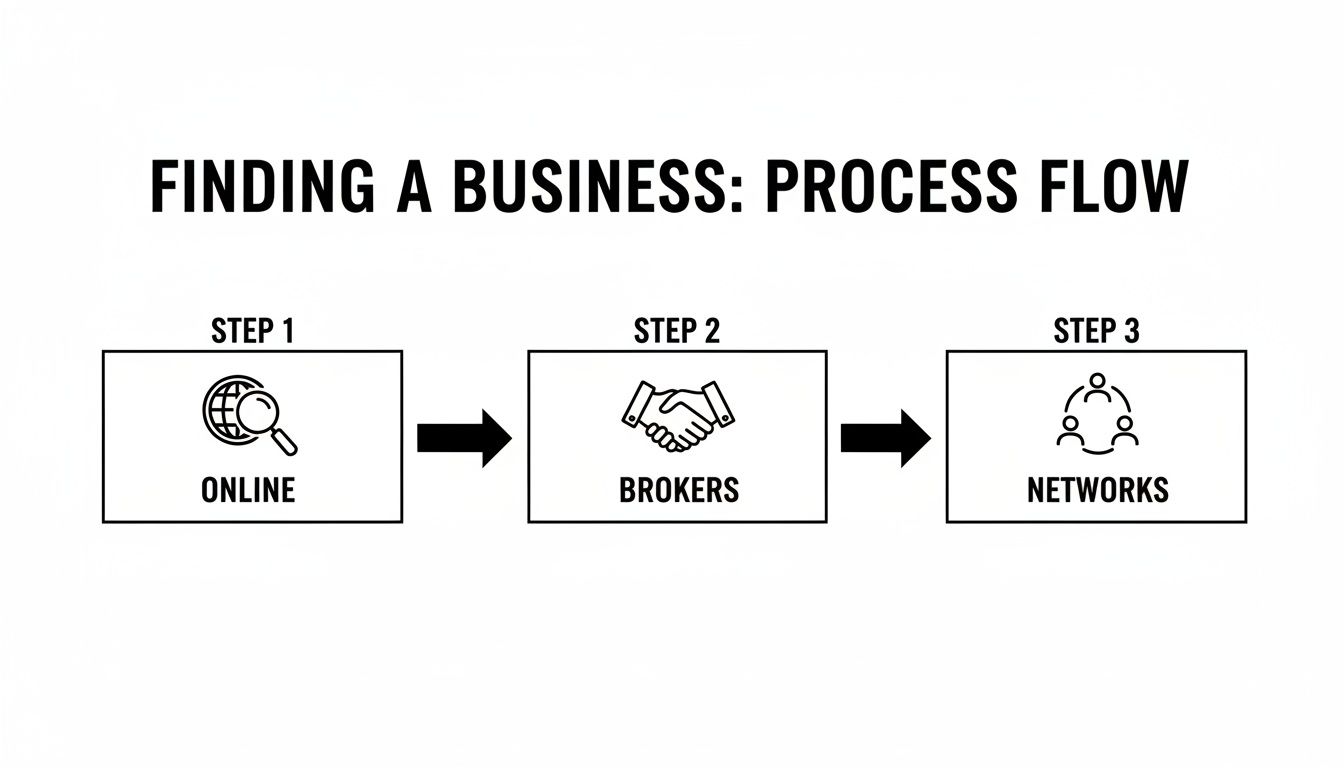
As the diagram shows, a good search starts broad online but quickly gets more focused. The best deals often come from targeted conversations with brokers and industry insiders who know about opportunities that never even get listed publicly.
Getting to the Real Valuation
The first question on every buyer's mind is simple: "What's this business really worth?" A seller's asking price is just that—a starting point. Your job, alongside your accountant, is to calculate a realistic valuation based on cold, hard facts. The go-to method for most small and mid-sized businesses is a multiple of Seller's Discretionary Earnings (SDE).
SDE might sound technical, but the concept is straightforward. It’s the total financial benefit a single owner-operator can expect to pull from the business. You get to this number by taking the net profit and adding back a few key items:
- The current owner's salary
- One-off or unusual expenses (like a major roof repair that won't happen again for 20 years)
- Non-cash expenses like depreciation and amortization
- Owner perks and benefits (think a company car used for personal trips)
Think of SDE as the true "take-home" potential of the business before you, as the new owner, decide how to pay yourself or structure expenses. It provides a standardized way to compare different businesses, regardless of how the previous owner managed their books.
Once you have a solid SDE figure, you apply a market multiple. For a typical service or retail business in the Atlanta metro, you're usually looking at a multiple between 2.5x to 4.5x SDE. Where a business falls in that range depends on things like industry stability, whether a few big clients make up most of the revenue, and how clean the financial records are.
It's Not All About the Numbers
A perfect profit and loss statement is great, but it’s only half the story. The "soft" assets of a business are often what dictates whether it will thrive or dive in the long run.
Your due diligence has to answer these critical questions:
- Brand Reputation: How is the company perceived locally? Read the online reviews, for sure, but then go talk to suppliers or even other non-competing business owners in the area.
- Customer Base: Is the revenue stream propped up by one or two giant clients? Losing one of them could be catastrophic. A diverse customer base is a much safer bet.
- Operational Systems: Are there well-documented processes for everything? Or is all the critical knowledge locked away in the current owner's head? You don't want the business to grind to a halt the day they hand over the keys.
- Employee Stability: Are the key employees likely to stick around after you take over? Their expertise and customer relationships are often a massive part of what you're actually buying.
And for any business with a physical footprint, local regulations are a huge deal. Zoning laws in Fulton County can be wildly different from those in DeKalb or Cobb. You absolutely must verify that all permits and licenses are current and, crucially, transferable. Never take the seller’s word for it—have your attorney confirm everything directly with the city or county.
Evaluating Mission-Driven and ESG-Focused Businesses
We're seeing a growing appetite in the Atlanta market for businesses with a strong ESG (Environmental, Social, and Governance) mission. Companies in sustainable services are especially hot right now as larger corporations look to acquire them to boost their own corporate social responsibility credentials.
A prime example is B2B electronics recycling firms that offer a dual social mission, such as supporting veterans and planting trees for every ton of e-waste recycled. This creates a compelling brand position with a tagline like, “Recycling That Restores Lives and Landscapes.” When looking at a business like this, your due diligence needs a few extra items:
- Compliance and Certification: Go through their environmental compliance records with a fine-tooth comb. Verify any special certifications they claim, like R2 or e-Stewards for electronics recyclers.
- Impact Verification: If they claim to support a cause, you need to see the proof. Ask for donation records, partnership agreements, or impact reports showing "veterans supported" and "trees planted" stats.
- Corporate Client Contracts: Look closely at their CSR-focused contracts. Are they recurring service agreements that provide corporate partners with an easy ESG win? Recurring revenue is gold.
Understanding how a company’s mission drives its brand is a key part of the evaluation. For a deeper look into this, check out our guide on building a business sustainability strategy. Once you've thoroughly vetted these qualitative and mission-driven elements, you can make an offer with confidence, knowing it reflects the complete, true value of the business.
Securing Financing for Your Business Purchase in Atlanta

So you've found the perfect Atlanta GA business for sale. You've done the initial research, and the numbers look promising. Now comes the moment of truth: securing the capital to make it yours. This is where many aspiring entrepreneurs get stuck, but it doesn't have to be intimidating.
Structuring the deal is the next big hurdle, and understanding your financing options is everything. For most buyers I've worked with in the Atlanta area, the path forward involves one of three avenues—or, more often than not, a savvy combination of them.
Exploring SBA 7(a) Loans in Atlanta
The SBA 7(a) loan is the absolute workhorse for buying a small business, and for good reason. The U.S. Small Business Administration (SBA) doesn't hand you the money directly. Instead, they guarantee a big chunk of the loan for a partner lender, which takes a lot of risk off the bank's shoulders and makes them far more likely to say "yes."
Here’s why these loans are so popular with buyers:
- Longer Repayment Terms: You can get up to 10 years to repay a business acquisition loan. This spreads out the debt and keeps your monthly payments from crushing your cash flow.
- Lower Down Payments: A conventional bank might want 30% down, or even more. With an SBA-backed loan, you can often get into a deal with just 10% to 20% of your own capital.
- All-in-One Funding: The loan isn't just for the purchase price. It can also be structured to cover your initial working capital needs, inventory, and even the professional fees for closing the deal.
Plenty of Atlanta-area banks have excellent SBA departments that know the local market inside and out. It's always a good idea to partner with local financial institutions. You can get a sense of what's available by researching options like Fulton Bank's business services.
The Role of Traditional Bank Loans
If you're coming to the table with a rock-solid personal financial statement and a substantial down payment, a conventional commercial loan is another great path. These are handled directly by the bank without any SBA involvement.
The trade-off is that the underwriting standards are typically tougher, and the repayment terms might be shorter than what you'd get with an SBA loan. To get approved, your application has to be airtight. Lenders will want to see a detailed business plan showing you've thought through exactly how you'll run the company and improve it. More importantly, they'll scrutinize your financial projections to make sure the business can comfortably support the new debt.
Lenders are betting on you just as much as they are on the business itself. Your job is to build a convincing case, backed by hard data, that shows them their money is safe and that you have what it takes to succeed.
Before you sign any term sheet, it's critical to understand all the considerations when getting a business loan, as the covenants and conditions will shape how you operate for years to come.
Leveraging Seller Financing for a Win-Win Deal
This is the secret weapon of deal-making, and it’s surprisingly common. With seller financing, the person you're buying the business from agrees to act as a lender for a portion of the purchase price. They receive the rest of the money in payments over an agreed-upon term, with interest.
You might wonder why any seller would do this. It's actually a win-win.
- It opens the door to a much larger pool of qualified buyers who might not have access to 100% of the funding from a bank.
- For the seller, it can dramatically speed up the closing process by reducing bank-related hurdles.
- It creates a passive income stream for the seller through the interest they earn on the note.
For a buyer, a seller note can be a complete game-changer. It shows lenders that the previous owner has "skin in the game" and believes in the continued success of the business. Banks love to see this. A very common deal structure is for the buyer to put down 10%, the seller to finance another 10-15%, and the bank to fund the remainder. This creative approach can make a great deal possible when it might have otherwise been just out of reach.
Navigating the Legal Path to Ownership in Georgia
Getting the legal side of your purchase right isn't just a box to check—it's the foundation of a secure and successful acquisition. Let's walk through the critical legal steps you'll face when buying a business in the Atlanta area, with a sharp focus on Georgia-specific rules.
The real legal dance begins once you’ve found a business you’re serious about and have a handshake agreement on the big-picture terms. Your first major piece of paper will be a Letter of Intent (LOI). Think of it as a formal roadmap for the deal. It’s a non-binding agreement that lays out the proposed price, the structure of the purchase, and the timeline for your due diligence.
While the LOI is mostly a statement of intent, it has teeth. It almost always includes legally binding clauses, like a confidentiality agreement and an exclusivity period, often called a "no-shop" clause. This is huge—it stops the seller from shopping the deal to other buyers while you're spending your time and money digging into the details. A sharp, attorney-drafted LOI sets a professional tone from the get-go and makes sure everyone is on the same page before the heavy lifting starts.
Assembling Your Atlanta Deal Team
Don't even think about going through this process alone. Your most valuable asset here is a local "deal team"—a group of pros who live and breathe business transactions in Georgia. This team is your shield and your guide.
Your core team should absolutely include:
- An M&A Attorney: This is your legal quarterback. They'll draft and scrutinize everything from the LOI to the final purchase agreement, protecting you from nasty surprises and hidden liabilities.
- A Transactional CPA: Your accountant is your numbers guru. They will dive deep into the financials, verify the seller's claims, and advise on the most tax-smart way to structure the deal.
- Your Business Broker: As your first point of contact, a good broker keeps the lines of communication open and the deal moving, helping smooth over the inevitable bumps between you and the seller.
Getting this team in place early is a game-changer. Their on-the-ground knowledge of the Atlanta market, from county permit quirks to local valuation norms, is simply invaluable.
The Purchase Agreement and Key Legal Structures
The Purchase Agreement is the big one. It's the final, legally binding contract that makes the sale official. This document is leagues more detailed than the LOI and spells out every single aspect of the deal. It includes the seller's representations and warranties, conditions for closing, and indemnification clauses that protect you if issues pop up later.
A critical legal step you'll take after the deal is done involves choosing your business structure. For most new business owners in Georgia, it boils down to two main choices: forming a Limited Liability Company (LLC) or an S-Corporation (S-Corp). Many favor an LLC for its simplicity and the liability shield it provides, keeping your personal assets separate from the business. An S-Corp, on the other hand, can offer some tax benefits but comes with more rigid operational rules. Your CPA and attorney are the best people to help you weigh the pros and cons for your specific situation.
Navigating Licenses, Permits, and ESG Value
With your new legal entity formed, the next hurdle is transferring all the necessary business licenses and permits. This can get tricky, as the rules can differ quite a bit between the City of Atlanta and neighboring counties like Gwinnett or Cobb. Your attorney can build a checklist of every local, state, and federal permit you need to operate legally and guide you through getting them transferred or reapplying. You can see how specific these can be by checking out local resources, like these Buckhead through our county guides.
A powerful trend we're seeing in M&A is the premium buyers place on businesses with a strong Environmental, Social, and Governance (ESG) story. Companies with a verifiable mission—like supporting veterans or planting trees with every sale—are becoming incredibly attractive acquisition targets.
This is especially true for B2B electronics recyclers that help companies meet their own ESG goals. This dual-impact model is a real competitive advantage. Buyers recognize that a mission to turn e-waste into hope is a powerful engine for future growth, attracting both corporate clients and top talent.
Common Questions About Buying a Business in Atlanta
As you get serious about finding an Atlanta GA business for sale, you’re bound to have questions. It’s a big step, and the path is filled with critical decisions and potential pitfalls. I've pulled together answers to the most common questions I hear from buyers, based on years of hands-on experience in the Atlanta market.
What Are the Most Common Mistakes to Avoid?
I see the same mistakes over and over. The biggest ones are rushing due diligence, overpaying because you got caught up in the seller's optimism, and failing to have enough working capital set aside for after you take over. Those are universal traps, but Atlanta has its own quirks.
A classic Atlanta-specific mistake is underestimating the hyper-local competition. The market dynamics in the tech-heavy corridors of Midtown are completely different from the industrial hubs near the airport or the retail pockets in the northern suburbs. You have to know the specific sandbox you'll be playing in.
By far, the most preventable mistake is letting emotion cloud your judgment. When you get invested in a deal, it's easy to ignore red flags. Your advisory team—your accountant and attorney—are your objective reality check. Trust them, especially when they tell you something you don't want to hear.
Finally, a massive oversight is not having a rock-solid transition plan. You absolutely must know how you're going to retain key employees and reassure top clients from day one. A botched handoff can sink an otherwise great acquisition before you even get started.
How Long Does It Take to Buy a Business in Atlanta?
Patience is more than a virtue here; it's a necessity. From the day you start your search to the day you get the keys, you should realistically budget 6 to 12 months for the entire process.
Here’s a rough breakdown to help you set expectations:
- Initial Search & Vetting: This can easily take 2-4 months. You’re sifting through listings, talking to brokers, and finding businesses that are actually a good fit.
- Negotiation & Letter of Intent (LOI): Once you’ve found your target, expect this back-and-forth to take about one month.
- Due Diligence & Financing: This is where the real work happens. It’s an intense 2-4 month period of digging into the financials, legal documents, and securing your loan.
- Final Legal & Closing: The last leg of the race, finalizing the purchase agreement and closing the deal, usually takes another 1-2 months.
Don't be surprised if it takes longer, particularly if the deal has complex legal issues or you’re using SBA financing, which comes with its own structured timeline and approvals.
Which Industries Are Strongest in the Atlanta Market Right Now?
Atlanta's economy is incredibly diverse, which creates a lot of opportunities. Tech is still a monster, especially in the fintech and Software-as-a-Service (SaaS) spaces. This, in turn, fuels a massive ecosystem of B2B service firms that support them.
Thanks to our position as a major transportation hub, logistics and supply chain businesses are absolutely booming. You also have the evergreen industries like healthcare and professional services (marketing, accounting, legal), which are always in demand because of the sheer concentration of corporate headquarters here.
We're also seeing a huge uptick in businesses centered on sustainability. Companies offering "electronics recycling for veterans" or corporate sustainability electronics disposal are hot targets as corporations scramble to meet their ESG goals. For instance, a recycling firm with a dual mission to support veterans and plant trees commands a premium. It's an easy ESG win for corporate clients, and that brand identity—“Where Tech Meets Trees & Transformation”—is a powerful differentiator. And of course, home services—HVAC, plumbing, landscaping—remain incredibly strong, driven by the region's nonstop population growth.
What Does a Business Broker Do and Do I Really Need One?
Think of a business broker as your guide and advocate, not just an intermediary. For anyone looking for an Atlanta GA business for sale, a good local broker is an invaluable asset.
They give you access to a huge pipeline of listings, including many off-market deals you'll never see advertised publicly. Frankly, those are often the best opportunities. A broker helps you accurately value a business, structure a smart offer, and quarterbacks the entire closing process with the lawyers and lenders.
While you're not legally required to use one, going it alone is a huge risk. A good broker’s expertise can save you from making a multi-million dollar mistake. Their network alone is something you could never build yourself. Since the seller typically pays their commission, their value to you as a buyer is immense, and they drastically improve your odds of a successful acquisition.
Are you a business in the Atlanta area looking to meet your ESG goals while securely managing your old IT assets? Atlanta Green Recycling provides turnkey electronics recycling and data destruction services that help your company make a positive impact. We turn e-waste into hope by supporting veterans and reforestation with every device we process. Learn more and schedule your free pickup at https://www.greenatlanta.com.