
Secure Atlanta Corporate Laptop Recycling Services

A lot of Atlanta companies have the same closet. It might be a locked storage room, a shelf in the server area, or a back office with retired laptops stacked in bins. Some still power on. Some have asset tags from employees who left two office moves ago. All of them hold risk.
Old laptops are easy to postpone because they don’t interrupt the workday. They just sit there. But every retired device represents three live issues at once: data exposure, disposal liability, and missed recovery value. If your company handles patient records, financial information, student data, customer files, or internal intellectual property, those machines aren’t dead assets. They’re dormant liabilities.
The shift I’ve seen in mature IT programs is simple. They stop treating laptop disposal as junk removal and start treating it as end-of-life asset management. That changes the questions. Instead of asking, “Who can haul this away?” they ask, “Who can document the chain of custody, sanitize drives properly, recover usable value, and help us tell a better ESG story?”
That’s where Atlanta Corporate Laptop Recycling Services become more than an operations task. With the right process, a retired laptop can move through secure pickup, verified data destruction, responsible downstream recycling, and reporting that your compliance and sustainability teams can use. With a mission-driven partner, it can also support work your employees and customers care about, including veteran aid and reforestation.
For Atlanta businesses building a smarter disposition process, the first step is seeing old tech for what it is: not clutter, but a practical business opportunity tied to security, sustainability, and community impact. If your organization is reviewing options for Atlanta business electronics recycling programs, that mindset shift is where genuine value starts.
Introduction Your Company’s Old Laptops Are An Opportunity
The usual trigger is mundane. A lease refresh happens. A department upgrades to newer laptops. A merger leaves duplicate hardware in storage. Then someone from IT, facilities, or operations has to decide what happens next.
In a lot of organizations, that decision gets delayed because the assets don’t look urgent. They aren’t flashing red in a dashboard. They aren’t causing a ticket backlog. But they still contain drives, batteries, circuit boards, and a record of how disciplined your company is when equipment leaves service.
The closet problem is really three problems
The first problem is security. A laptop that’s no longer assigned to an employee can still contain local files, cached credentials, saved browser sessions, and fragments of regulated data.
The second is environmental handling. Electronics can’t be treated like ordinary office waste if your company wants a defensible sustainability program.
The third is lost strategic value. A well-run recycling and ITAD process can produce documentation for audits, support internal ESG reporting, and contribute to cause-based campaigns that mean something outside the building.
Old laptops create the most trouble when companies treat them as leftovers instead of governed assets.
Why the opportunity matters now
Atlanta businesses are under pressure from several directions at once. Security teams want proof of data destruction. Legal and compliance teams want records. Sustainability teams want landfill diversion and credible reporting. Marketing and leadership teams want community impact that isn’t generic.
That combination creates a better standard for end-of-life laptop handling. A serious recycling partner doesn’t just remove devices. They fit into governance. They reduce uncertainty. They help convert an unavoidable operational task into something your company can stand behind publicly.
That’s why the best laptop recycling programs aren’t built around convenience alone. They’re built around documented control, practical logistics, and a mission that gives the process a wider purpose.
Why Responsible Laptop Recycling Matters for Atlanta Businesses
A retired corporate laptop can hurt you in two ways. It can expose data, and it can expose weak environmental controls. Both problems start subtly, which is why companies underestimate them.
The scale of the issue is not small. The EPA reported that over 63 million computers were being discarded annually in the U.S. by 2007, and recycling one million laptops can save energy equivalent to what 3,500 U.S. homes use in a year, according to Atlanta Computer Recycling’s summary of EPA context. That’s the backdrop for why Atlanta Corporate Laptop Recycling Services matter operationally and strategically.

The business risk is immediate
When a company leaves retired laptops in storage, risk doesn’t disappear. It just moves out of sight. Drives can be lost during office moves. Assets can leave the building without documentation. Informal disposal decisions can bypass the controls your company uses everywhere else.
What makes this more serious is that old laptops often contain a broad mix of information. HR files, finance exports, VPN profiles, saved email data, browser history, and department spreadsheets don’t look dramatic on their own. In aggregate, they can create a serious incident if the wrong person gets access.
A professional recycling workflow closes that gap by making asset disposition part of governance. It gives the business a repeatable process instead of improvisation.
The sustainability case is also operational
Responsible recycling isn’t just a values statement. It affects procurement, waste policy, and reporting discipline. Companies with formal sustainability goals need a way to show that retired IT equipment didn’t end up in general waste streams and that reusable materials moved through controlled channels.
That matters because a laptop contains more than a shell and a battery. It contains recoverable metals, plastics, and components that should either be reused or processed correctly. When a recycler can document what happened to those materials, sustainability stops being a slogan and becomes a managed business function.
Here are the practical gains companies usually care about most:
- Lower data handling uncertainty by removing retired devices from ad hoc storage.
- Cleaner audit posture through documented disposition records.
- Stronger brand credibility when environmental claims are backed by traceable action.
- Better internal alignment because IT, compliance, facilities, and sustainability work from the same process.
Practical rule: If your company tracks laptops during deployment, it should track them just as carefully at retirement.
Reputation follows process
Atlanta buyers, employees, boards, and community partners can tell the difference between a company with a real end-of-life program and one that’s winging it. The difference isn’t a press release. It’s whether your claims hold up under scrutiny.
That’s why responsible recycling belongs inside corporate governance. It protects the business first. Then it creates a platform for broader ESG and community outcomes. For companies reviewing the wider benefits of e-waste recycling for business operations, the strongest argument is simple: disciplined recycling reduces risk while creating usable environmental value.
Decoding Atlanta Corporate Laptop Recycling Services
Most companies know they need to recycle old laptops. Fewer know what occurs after pickup. That gap matters because the quality of the process determines whether you get real security and compliance or just a disposal receipt.
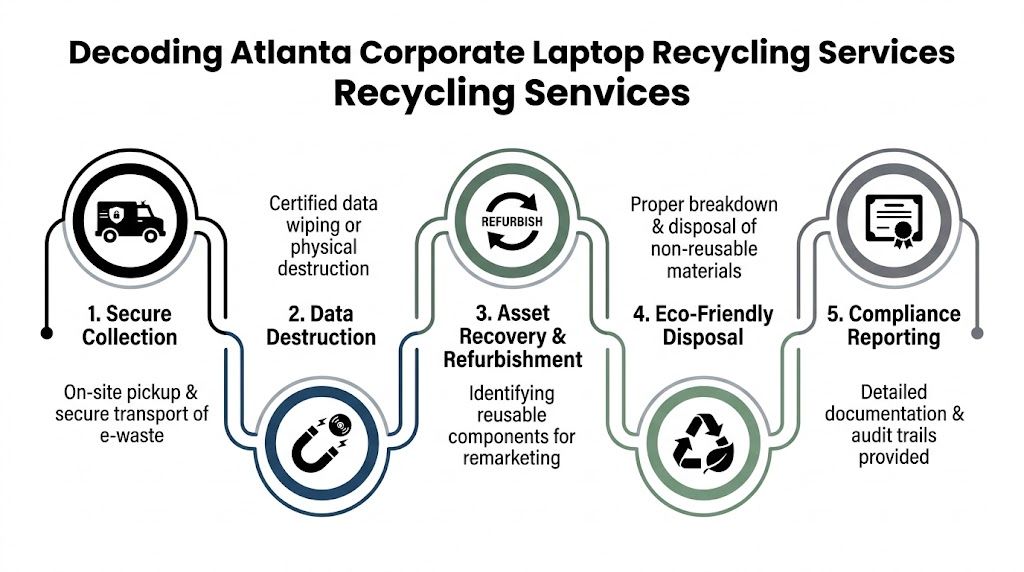
A complete Atlanta Corporate Laptop Recycling Services program usually includes secure collection, data destruction, asset evaluation, material processing, and final reporting. Those steps sound straightforward. The details are where companies either protect themselves or create exposure.
What secure collection should look like
Pickup is more than loading boxes into a truck. A corporate recycler should be able to receive equipment in a controlled way that preserves accountability from your office to their facility.
That usually means coordinating with IT or facilities, labeling assets, documenting counts, and making sure devices don’t disappear in the gap between decommissioning and processing. If your company is large, multi-site, or handling a refresh with many retired units, logistics become part of risk management.
This process view helps clarify the full lifecycle:
Data wiping and shredding are not the same thing
This is the point where many non-specialists get confused. Data wiping and physical shredding solve related problems, but they are not interchangeable.
Think of data wiping like erasing and rewriting a whiteboard until the original writing can’t be recovered. Think of shredding like smashing the whiteboard into particles so there’s nothing left to read. Both have a place.
According to Reworx on e-waste recycling in Atlanta, Atlanta corporate laptop recycling services use DoD 5220.22-M and NIST 800-88 compliant multi-pass data wiping, overwriting data 3-7 times to achieve 99.99%+ data destruction efficacy, while non-refurbishable devices may be physically shredded so hard drives are reduced to particles smaller than 2mm.
When wiping makes sense and when shredding is better
Wiping is useful when the device or storage media can still support lawful reuse, refurbishment, or remarketing. It preserves asset value while still meeting a serious sanitization standard.
Shredding is usually the right call when the drive is damaged, the device isn’t refurbishable, or the organization’s risk tolerance requires physical destruction. Highly regulated industries often prefer this route for selected assets because it removes the recovery question entirely.
A practical way to think about the trade-off:
- Choose wiping when the asset still has resale or reuse value and your policy allows certified sanitization.
- Choose shredding when hardware is physically compromised, obsolete, or subject to a stricter destruction policy.
- Use both methods in the same project when your inventory includes a mix of reusable and end-of-life equipment.
For most corporate fleets, the right answer isn’t wiping or shredding. It’s a documented decision tree that applies the right method to each class of asset.
What happens after data destruction
A good recycler doesn’t stop at erasure. They evaluate which components can be recovered safely and which materials need downstream processing. RAM, metals, plastics, and other recoverable parts can move into approved channels, while unusable materials should be handled through zero-landfill or similarly controlled downstream processes if that aligns with your company’s policy requirements.
This stage is where IT asset disposition intersects with sustainability. If a provider can recover value from usable parts while still maintaining secure destruction standards, the business gets a stronger outcome than simple disposal.
What reporting should close the loop
At the end of the process, your company should receive paperwork that tells a coherent story. Not just that equipment was removed, but what was collected, how data was destroyed, and how the assets were processed afterward.
That reporting is what turns a pickup event into a controlled business record. Without it, you’ve moved the laptops. You haven’t really closed the risk.
Navigating E-Waste Compliance and Documentation in Georgia
A lot of companies focus on the physical act of removing laptops and overlook the paper trail. That’s a mistake. In regulated environments, documentation is what proves the process happened the way your policy says it should.
Healthcare organizations, financial firms, schools, public agencies, and enterprise IT teams all need more than verbal assurance. They need records that survive internal reviews, client questionnaires, and external audits. The key issue isn’t whether a recycler says the job was done. It’s whether they can prove it.
The documents that matter most
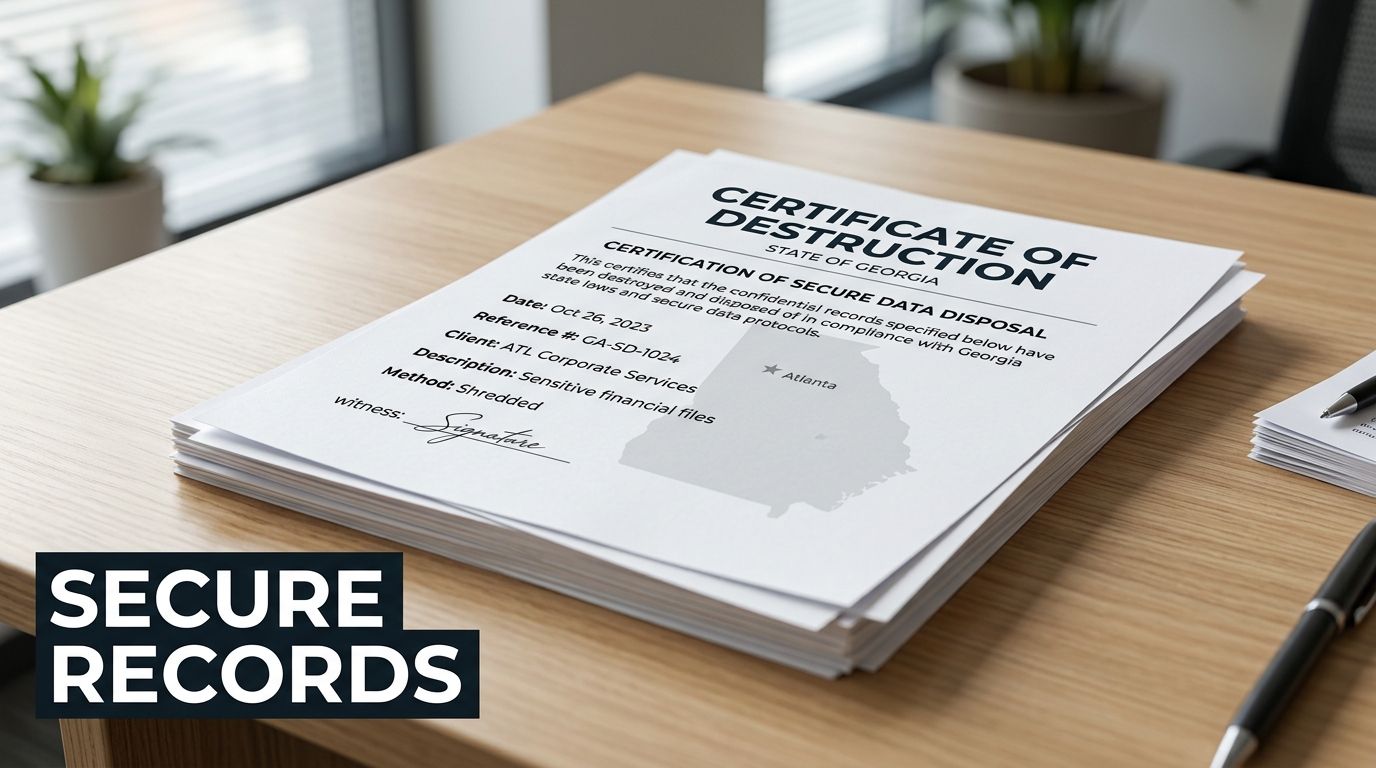
The first document organizations should ask for is a Certificate of Data Destruction or Certificate of Destruction. This is the record that confirms the recycler performed the agreed sanitization or destruction process.
The second is a chain-of-custody log. That log should show who transferred the equipment, when possession changed hands, and how the assets were tracked through the disposition process.
A strong documentation packet often includes:
- Asset identification such as serial numbers, internal tags, or itemized counts.
- Destruction method that notes whether assets were wiped, shredded, or otherwise processed.
- Transfer records showing when custody changed and who received the equipment.
- Completion confirmation tying the final disposition back to the original pickup.
Why these records matter in practice
If your compliance officer, internal auditor, or legal team asks what happened to a retired laptop from a departed employee, “we sent it to recycling” isn’t enough. A documented trail is what protects the company.
For healthcare and finance, this matters because disposal is part of data governance. For schools and public entities, it matters because public accountability and procurement standards often require records that can be reviewed later. For enterprise IT, it matters because asset management isn’t complete until decommissioning is documented.
Documentation turns recycling from a trust exercise into a verifiable control.
Certifications matter, but records matter more day to day
A provider may talk about standards, but your team still needs transaction-level proof. Certifications tell you the recycler operates within a framework. Your own destruction certificates and custody records tell you what happened to your devices.
That distinction is useful during audits. Auditors often want to see both the recycler’s general qualifications and the paperwork tied to your specific assets. If either piece is missing, the answer starts to sound thin.
Here’s a practical review workflow many organizations use:
- Match retired assets to internal inventory records before pickup.
- Confirm the agreed destruction method for each asset category.
- Review the chain-of-custody record as soon as pickup is complete.
- Archive final certificates with procurement, ITAD, or compliance records.
- Tie the paperwork to retention policy so it’s available when questions surface later.
For teams building a defensible file, a clear primer on what a certificate of destruction should include can help standardize what you request from vendors before the first truck arrives.
Beyond Compliance Recycling as a Strategic ESG Win
Most companies begin with laptop recycling because they have to. The more forward-thinking ones keep investing in it because they realize it can do more than close risk. It can support ESG reporting, employee engagement, and cause-based brand work that feels concrete instead of performative.
That shift matters. Compliance asks, “Did we dispose of these laptops correctly?” Strategic ESG asks, “How do we turn a necessary operational process into measurable community value?”
Why the economics make this easier than people expect
For many Atlanta businesses, this doesn’t start as a budget headache. According to Beyond Surplus on Atlanta computer recycling, most commercial clients can recycle IT equipment with a certified vendor free of charge because recovered material value covers service costs. The same source notes the material recovery potential behind that model. Recycling one million cell phones yields 35,000 pounds of copper, 772 pounds of silver, 75 pounds of gold, and 33 pounds of palladium.
That matters for ESG strategy because an initiative is easier to scale when it doesn’t fight your budget from day one. Instead of framing laptop recycling as a pure cost center, companies can treat it as a controlled disposition program with environmental value and mission potential.
The cause-based model is what employees remember
In this scenario, a mission-driven recycler changes the conversation. A standard vendor can remove laptops. A cause-linked program can help your company say something stronger about what happens next.
The strongest messaging is simple and human:
- Recycle for a Cause with language that connects old tech to veteran support and reforestation.
- Seasonal drives around Veterans Day, Earth Day, and Arbor Day so employees have a timely reason to participate.
- Impact reports and certificates that give sustainability, HR, and marketing teams something tangible to use.
When this is done well, the internal story gets easier. Employees understand that retired equipment didn’t just leave the office. It contributed to a visible mission.
This kind of reporting works best when it’s easy to share visually:

What works and what doesn’t
What works is tying the recycling program to documents and assets your company already uses. Think Veteran Support Impact Reports, tree-planting certificates, a digital Recycled with Purpose badge for sustainability pages, and LinkedIn posts that explain the operational side and the social side together.
What doesn’t work is vague CSR language with no proof. If the only output is “we care about the planet,” employees tune it out and auditors can’t use it.
A practical model looks like this:
| ESG move | Useful output | Why it works |
|---|---|---|
| Corporate recycling drive | Pickup plus impact summary | Operations and CSR both get value |
| Seasonal campaign | Internal communications package | Gives employees a reason to participate |
| Vendor mission alignment | Shareable badge or certificate | Helps procurement and marketing speak the same language |
| Sustainability reporting support | Structured disposition records plus social impact narrative | Makes the program easier to include in ESG materials |
A good ESG recycling program gives three teams something usable: IT gets control, compliance gets records, and communications gets a credible story.
Repair, reuse, then recycle
The smartest ESG programs don’t jump straight to destruction. They follow a hierarchy. Extend life where practical. Reuse when policy allows. Recycle correctly when an asset is fully done.
That approach aligns with broader Right to Repair initiatives that push organizations to think more carefully about refurbishment, maintainability, and keeping technology in productive use longer before final recycling.
For Atlanta companies formalizing that approach, a broader business sustainability strategy for electronics end-of-life planning can connect IT asset disposition to procurement, reporting, and community impact without treating them as separate projects.
How to Evaluate and Select an Atlanta Recycling Partner
The hardest part of vendor selection isn’t finding companies that say the right things. It’s verifying which ones can back those claims up with records, processes, and transparent downstream handling.
That verification matters because certification language is easy to put on a website. According to STS Electronic Recycling’s discussion of Atlanta electronics recycling standards, up to 70% of U.S. e-waste recyclers may lack full certification, and 15% of “certified” providers may fail independent audits. That’s why Atlanta firms should ask for recent audit reports or on-site audit access instead of relying on self-reported claims.
Start with proof, not marketing copy
If a provider says they follow R2v3, NAID AAA, or DoD sanitization standards, ask for current documentation. Not a logo. Not a brochure. The current certificate, the scope, and if possible, the latest audit materials they’re willing to share.
This one step removes a lot of uncertainty. It also tells you how a vendor behaves under scrutiny. Serious operators are used to compliance questions and won’t act surprised by them.
Ask operational questions that expose weak processes
A vendor can sound polished and still have gaps. The best questions are concrete enough that weak providers can’t answer cleanly.
Use a checklist like this when comparing Atlanta Corporate Laptop Recycling Services:
| Evaluation Criteria | What to Look For | Why It Matters |
|---|---|---|
| Certification verification | Current certificates, audit dates, willingness to provide supporting records | Reduces the risk of relying on outdated or unverified claims |
| Data destruction methods | Clear policy for wiping versus shredding, plus device-level documentation where needed | Confirms the method matches your risk profile |
| Chain of custody | Written transfer process from pickup through final processing | Protects against asset loss and undocumented handling |
| Reporting quality | Certificates, serialized logs when applicable, readable final documentation | Makes internal audits and external reviews easier |
| Logistics capability | On-site pickup, packing, de-installation support, scheduling discipline | Determines whether your team will actually use the service consistently |
| Downstream transparency | Explanation of where materials go after initial processing | Helps validate landfill diversion and responsible recycling claims |
| Accepted asset scope | Laptops, docks, monitors, peripherals, storage media, servers, mixed loads | Prevents fragmented disposal across multiple vendors |
| Mission alignment | Veteran support, tree planting, local community partnerships, usable ESG outputs | Turns disposal into a stronger CSR and employee-engagement asset |
Watch for these warning signs
Some problems show up early if you know what to notice.
- They avoid audit questions. A vendor who gets vague when you ask about certifications, scope, or recent audits is telling you something.
- Their paperwork is thin. If they can’t explain what records you’ll receive after pickup, assume documentation will be weak.
- They oversimplify data destruction. “We wipe everything” or “we shred everything” can be a sign they don’t have a policy-based approach.
- They can’t explain downstream processing. If they don’t know where material goes after they take possession, your ESG claims may be hard to defend.
- Their free pickup offer is the whole pitch. Cost matters, but it shouldn’t be the only thing they can articulate.
If a recycler can’t answer basic chain-of-custody questions before pickup, they won’t get more organized after they have your laptops.
Evaluate mission fit as seriously as compliance fit
This is the piece many companies skip, even though it’s where the long-term value often sits. If your organization has ESG, CSR, community-relations, or employee-engagement goals, ask whether the recycler gives you anything beyond disposal.
Can they support a company-wide recycling drive? Can they provide impact documentation your communications team can use? Can they align with causes your employees care about, such as veteran support and reforestation?
Those questions are not fluff. They determine whether the program becomes a repeatable part of company culture or remains a one-off cleanup exercise.
One local option some Atlanta businesses review is Atlanta Green Recycling’s IT asset disposition services, which include pickup, removal, data destruction workflows, and business-focused electronics recycling. Whether you choose that provider or another, the evaluation standard should stay the same: verify claims, inspect the process, and choose a partner whose documentation and mission both fit your organization.
Conclusion Turning Your Atlanta E-Waste into Hope and Growth
Old laptops don’t belong in storage closets, unsecured back rooms, or informal disposal streams. They belong in a controlled process that protects data, supports compliance, and handles materials responsibly.
That’s the practical baseline. The bigger opportunity is what happens when your company chooses a recycling partner that also helps turn IT asset disposition into visible community value. Then the work doesn’t stop at destruction certificates and pickup logs. It becomes part of how your business shows responsibility in Atlanta.
The strongest programs do both jobs well. They satisfy security and audit needs, and they give leadership, employees, and stakeholders a reason to care about the outcome. A retired fleet can support a cleaner supply chain, stronger ESG reporting, veteran-focused impact, and reforestation efforts that make the act of recycling feel meaningful.
That’s why this work deserves more attention than it usually gets. Handled well, it becomes Recycling That Restores Lives and Environments. It becomes Turning E-Waste into Hope. For Atlanta businesses, that’s a better standard than simple disposal, and it’s a standard worth building into every refresh cycle.
Frequently Asked Questions
Is corporate laptop recycling in Atlanta usually free for businesses
For many commercial clients, yes. The economics often work because recyclers recover value from reusable components and raw materials. Charges may still apply for certain hard-to-process items or specialized on-site services, so it’s smart to confirm scope in writing before scheduling.
Should our company choose data wiping or physical shredding
It depends on the asset and your policy. Wiping is useful when a laptop or drive can still support reuse after certified sanitization. Shredding is the better fit when the media is damaged, obsolete, or subject to stricter destruction requirements.
What documentation should we ask for after pickup
Ask for a certificate of destruction or data destruction certificate, plus chain-of-custody records and an itemized asset list when applicable. Those records help IT, compliance, and legal teams show that retired devices were handled through a controlled process.
Can these services support ESG reporting
Yes, if the provider gives you usable outputs. The most helpful vendors provide documentation that supports landfill diversion, responsible handling, and any mission-based outcomes tied to the program, such as veteran support or tree-planting initiatives.
What types of organizations use Atlanta Corporate Laptop Recycling Services
Healthcare systems, schools, financial firms, government agencies, data centers, manufacturers, and office-based businesses all use them. Any organization retiring laptops at volume benefits from a repeatable process with secure handling and strong reporting.
What should we ask before booking a pickup
Start with the essentials:
- Ask about certifications and request current proof.
- Confirm destruction methods for reusable versus non-reusable assets.
- Review logistics including pickup, packing, and chain of custody.
- Clarify reporting so you know exactly what records you’ll receive.
- Discuss mission alignment if your company wants the program to support CSR and community goals.
If your organization is ready to clear retired laptops responsibly and turn the process into a stronger security, compliance, and ESG outcome, Atlanta Green Recycling is one Atlanta-based option to review for business electronics pickup, data destruction, and purpose-driven e-waste programs.