
Georgia Tech’s Role in Atlanta Innovation

On any weekday in Midtown, you can watch the handoff happen in real time. A student heads to class, a researcher crosses to a meeting, and a corporate team walks into Tech Square looking for its next partner, hire, or product idea.
That's the clearest way to understand Georgia Tech's role in Atlanta innovation. It isn't abstract. It's physical, local, and increasingly relevant to businesses that don't think of themselves as part of the startup world.
The Powerhouse Next Door
For Atlanta business leaders, Georgia Tech is best understood as an operating asset in the regional economy, not just a respected university. Its scale affects hiring, R&D access, vendor ecosystems, and the pace at which new ideas turn into commercial tools.
The numbers make that plain. Georgia Tech's 2024 economic impact reached $5.8 billion, with over 3,500 faculty members and over $1 billion in annual research awards, according to Georgia Tech's economic impact reporting. That combination gives Atlanta something many metros want but few have. A dense, recurring source of talent, applied research, and institutional credibility.
Why local companies should care
If you run an enterprise IT team, a hospital department, a school system, a logistics operation, or a compliance-heavy back office, Georgia Tech still matters to you even if you never sponsor a startup. The university shapes the local labor market, attracts corporate innovation activity, and helps normalize faster adoption of new systems across the city.
That changes the competitive baseline. Companies that stay close to the ecosystem usually hear about new capabilities earlier, meet talent earlier, and form relationships earlier.
Practical rule: In Atlanta, treating Georgia Tech as “someone else's ecosystem” is usually a strategic mistake.
There's also a civic angle that matters for local SEO and local business positioning. Firms that understand Atlanta's innovation geography can align their own messaging with the city's priorities, from research commercialization to sustainability and responsible growth. That's especially useful if your audience follows City of Atlanta news and local policy developments that influence procurement, infrastructure, and institutional partnerships.
What works and what does not
A lot of businesses get this wrong in one of two ways.
| Approach | What happens |
|---|---|
| Treat Georgia Tech only as a hiring source | You compete for resumes but miss research, pilot, and partnership opportunities. |
| Treat Georgia Tech only as a branding opportunity | You sponsor events or appear nearby, but you don't build operational relationships. |
| Treat Georgia Tech as a working ecosystem | You connect talent, problem-solving, and local market access in a more durable way. |
The companies that benefit most don't ask, “How do we get near innovation?” They ask, “Where does our business naturally fit into the Atlanta innovation workflow?”
How Tech Square Rewrote Atlanta's Map
Midtown did not become Atlanta's innovation shorthand by accident. Georgia Tech helped build that outcome through location, density, and repeated investment in the space between campus research and commercial use.
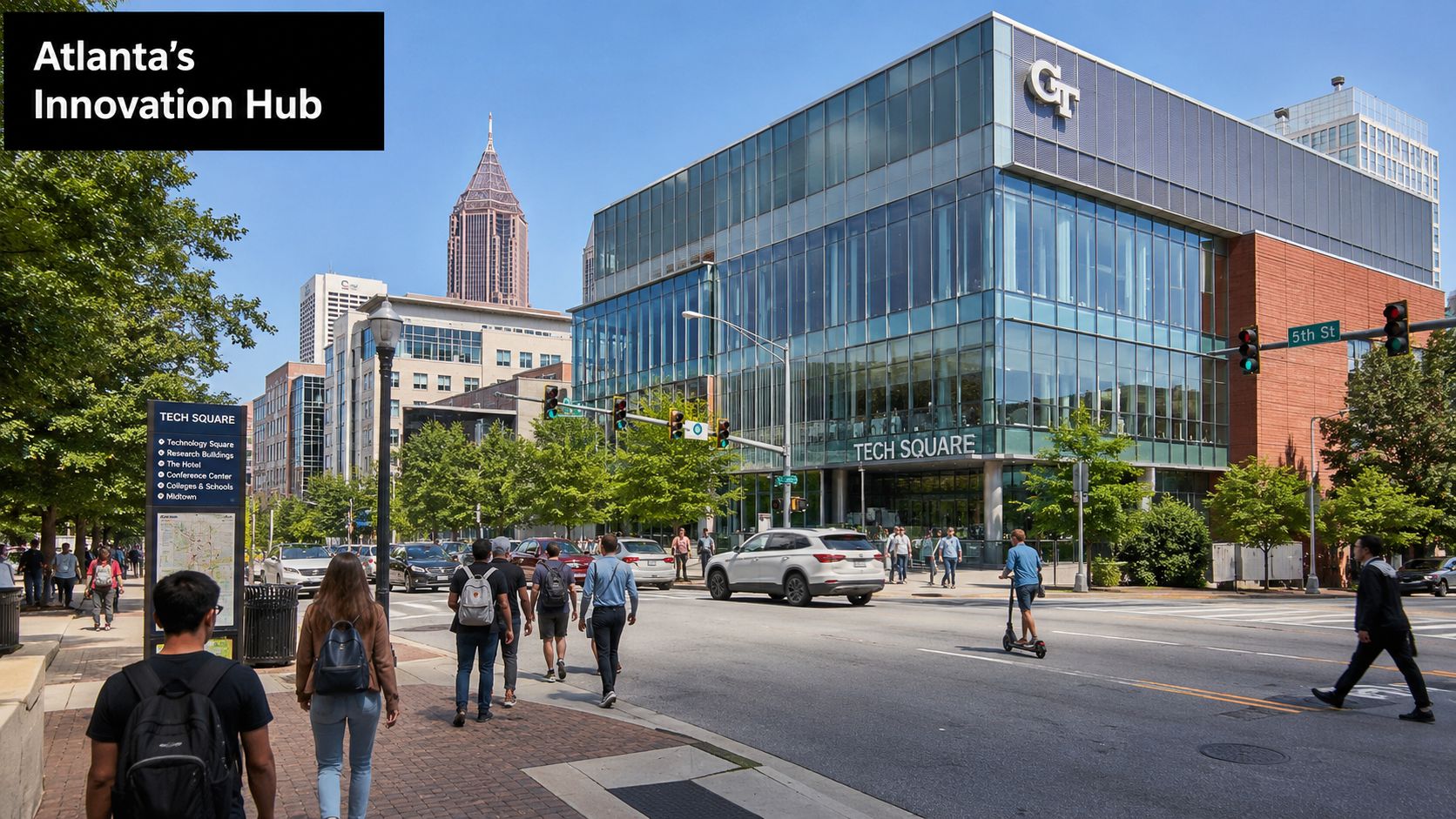
The important point for operators is not just that Tech Square exists. It's that Georgia Tech used it to collapse distance. Researchers, students, founders, corporate innovation teams, and service partners can move through the same few blocks in one afternoon. That sounds simple, but in practice it changes how quickly conversations turn into pilots, recruiting discussions, or procurement opportunities.
More than a real estate play
A lot of cities try to create innovation districts by adding office space and hoping demand appears. Tech Square worked because Georgia Tech tied place to a functioning pipeline. The area became a place where companies could do more than rent a floor. They could plug into university research, student energy, and startup activity without building all of that from scratch themselves.
That's one reason Midtown's innovation identity feels more durable than a short-term development trend. The district has a clear institutional anchor, and that anchor keeps feeding the surrounding market.
For Atlanta companies, this matters in the same way the Atlanta BeltLine reshaped how people think about access, location, and neighborhood connection. Infrastructure changes behavior when it gives people a practical reason to show up and stay engaged.
What business leaders should notice on the ground
The most useful observation about Tech Square is that it reduces friction. A regional bank can meet faculty, a health system can scout applied tools, and a manufacturer can talk to students who think differently about a process problem.
That creates a few practical effects:
- Faster discovery: You don't need a national innovation tour to find emerging ideas. Many are already concentrated in Midtown.
- Easier relationship building: Repeated proximity builds trust. Trust makes pilots and partnerships easier to start.
- Better local signaling: Being active around Tech Square shows employees, recruits, and partners that your company is serious about staying current.
Some Atlanta firms still talk about innovation as if it requires flying to another coast. In many cases, the first useful meeting is already happening in Midtown.
The trade-off most people miss
Physical clustering helps, but it doesn't solve execution. Businesses still have to assign owners, define problems, and follow through after the first meeting.
That's where some companies stall. They visit Tech Square, attend a program, take a few introductions, and then go quiet internally. The district creates access. It doesn't replace operational discipline.
Inside Georgia Techs Innovation Pipeline
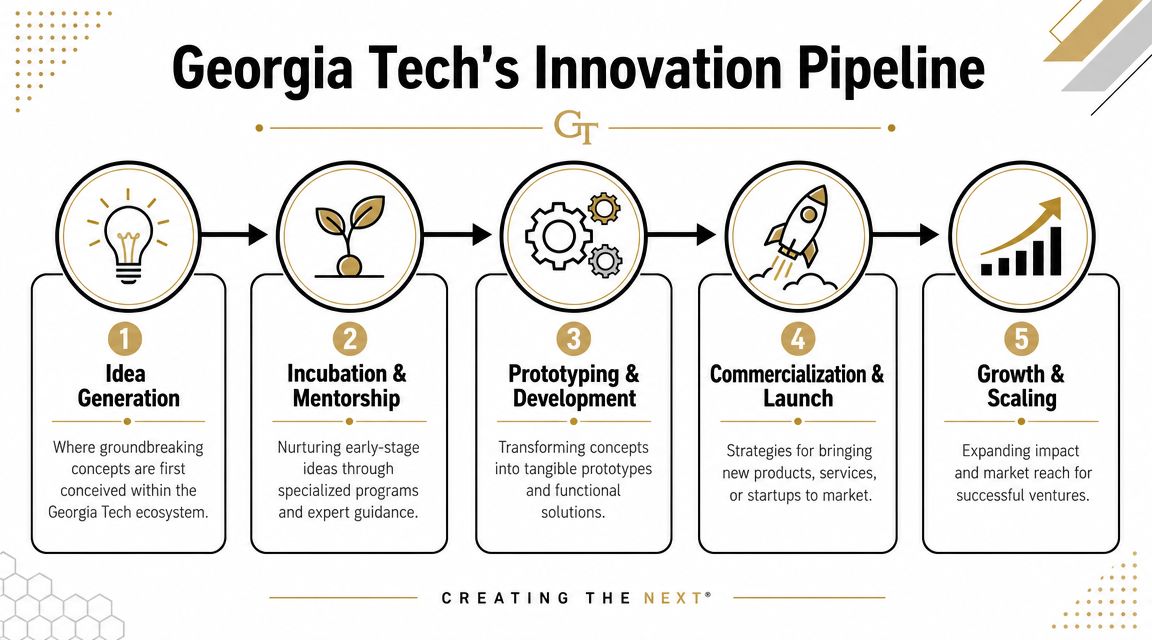
Georgia Tech's ecosystem matters because it's organized. Ideas don't just float around until someone notices them. The university and its affiliated programs give different kinds of builders a path from concept to company, partnership, or licensed technology.
A key part of that system includes VentureLab, CREATE-X, and the Advanced Technology Development Center, according to Georgia Tech's reporting on advancing Atlanta's tech ecosystem. That same coverage notes a projection that Atlanta would need roughly 2,000 startups annually by 2027 to reach a top-five U.S. tech hub goal.
This is the process at a glance.
Different programs solve different problems
Executives often lump university innovation programs together, but the distinctions matter.
VentureLab is closely tied to commercialization of research. If an idea starts with faculty work, technical IP, or a discovery that needs a path to market, this is the kind of infrastructure that helps shape it into something investable or licensable.
CREATE-X has become a visible route for student founders. It gives entrepreneurial students a place to test whether an idea can survive outside class. For businesses, that means early access to teams that may become suppliers, acquisition targets, or specialized solution partners later.
ATDC plays a more mature support role. It helps companies that need structure, market feedback, mentoring, and growth support after the initial spark. For local business leaders, ATDC is often the most practical place to watch for startups that are moving beyond concept mode.
Where established businesses fit
This pipeline isn't only for founders. Non-startup organizations can engage at several points.
| Pipeline stage | Best use for an established business |
|---|---|
| Research and concept stage | Spot emerging technologies relevant to operations, cybersecurity, logistics, health, or data workflows |
| Early venture stage | Pilot a narrow use case with a small team before broad procurement |
| Scaling stage | Explore vendor relationships, channel partnerships, or talent acquisition |
That makes Georgia Tech's pipeline useful to any organization that wants lower-friction exposure to new tools without building an internal venture arm.
What works in practice
The strongest partnerships usually start with a narrow problem statement. A company says, “We need a better way to handle this specific workflow, security challenge, or compliance bottleneck.” That gives the ecosystem something concrete to respond to.
Weak partnerships usually start with vague innovation language. “We want to collaborate” doesn't create momentum. Neither does “we're looking for disruption.”
Here's the more effective sequence:
- Define one business problem. Pick something operational, not performative.
- Identify your internal owner. If nobody owns the relationship, it dies after the intro meeting.
- Choose the right point of entry. Research commercialization, student entrepreneurship, and startup acceleration are not the same.
- Build a pilot path early. If legal, IT, procurement, or security will matter later, involve them sooner.
For technology-intensive operations, this is especially relevant in sectors tied to infrastructure, cloud growth, and physical computing environments. Companies active around the Meta data center presence in Georgia and related digital infrastructure conversations already understand that innovation doesn't stop at software. It touches energy use, hardware lifecycle planning, decommissioning, and secure operational turnover too.
The best Georgia Tech partnerships don't start with ambition. They start with a defined business problem and someone empowered to solve it.
Cultivating Atlantas Next-Generation Workforce
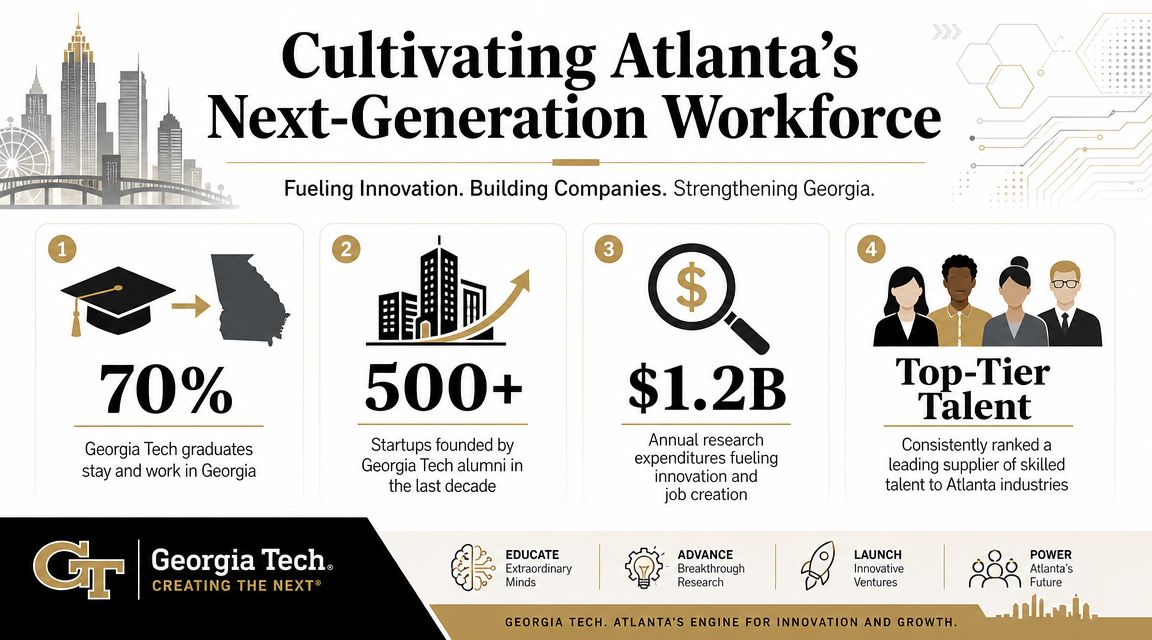
If you ask long-term operators what Georgia Tech contributes most consistently to Atlanta, the answer is usually talent. Buildings matter. Startup density matters. But skilled people are what keep the ecosystem useful year after year.
That's why many local companies should think less about “campus recruiting” and more about workforce design. Georgia Tech gives employers multiple ways to evaluate people before making full-time bets. That's better than waiting until graduation season and competing in a rushed hiring market.
Better than a job posting
A job posting tells candidates what you want. A real engagement model shows them how your company works.
The strongest local employers do some combination of the following:
- Co-ops and internships: These let managers assess technical ability, communication style, and adaptability in a real environment.
- Capstone or applied project sponsorship: Students work on a defined challenge, and the company gets fresh thinking on a real problem.
- Student organization engagement: Teams meet future hires before they hit the broad market.
- Manager-level involvement: Prospects want to hear from the people they'd work with, not only recruiters.
Why this matters for regulated sectors
Hospitals, public agencies, schools, and industrial operators often assume Georgia Tech talent mainly flows to software firms. That's too narrow. Many students and graduates want applied environments where systems have consequences, data has controls, and operations have public impact.
That creates an opening for employers that can offer mission plus complexity. A healthcare system can talk about secure data environments. A municipality can talk about infrastructure and service delivery. A school district can connect technology work to student outcomes. Even asset lifecycle and responsible disposition programs can matter when framed as part of a serious operational and sustainability agenda, especially in initiatives similar to electronics for schools programs that tie technology access to community value.
If you want Georgia Tech talent, don't market only perks. Market the hard problems your team gets trusted to solve.
What usually fails
Three patterns show up again and again.
| Hiring mistake | Why it underperforms |
|---|---|
| Only showing up at career fairs | You meet candidates too late and blend into the crowd. |
| Using generic employer branding | Technical candidates want specifics about tools, teams, and ownership. |
| Offering no path to meaningful work | Strong candidates leave if the role feels boxed in or bureaucratic. |
Atlanta employers win when they make the local case. They show that a graduate can stay in the city, work on substantial problems, and build a career without treating Atlanta as a temporary stop.
Landmark Success Stories and Partnerships
The easiest way to see Georgia Tech's practical impact is to look at the mix of organizations around it. This isn't just a startup campus, and it isn't just a corporate satellite zone. It's a working intersection where different kinds of institutions try to shorten the path from idea to use.
According to Capital Analytics coverage of Atlanta's research hubs and startup growth, Tech Square hosts more than 100 startups and 25 corporate innovation centers. The same report says Georgia Tech attracts more than $100 million in industry research each year. That's what gives the area unusual weight. It has startup activity, corporate presence, and recurring industry-funded R&D in the same orbit.
What these partnerships signal
For an established business, those facts matter less as bragging rights and more as evidence of market behavior. Companies do not keep investing time and attention around Georgia Tech solely because the branding is attractive. They do it because the ecosystem gives them access to talent, research capability, and earlier visibility into what might matter next.
That's also why the partnership story in Atlanta is broader than software. Logistics, healthcare, education, industrial systems, and data-heavy business services all have reasons to engage.
The useful lesson for non-startups
Many executives read about startup ecosystems and assume the takeaway is “be more like a founder.” Usually that's the wrong lesson.
The better lesson is this:
- Large organizations can use Georgia Tech to shorten learning cycles
- Mid-market firms can use it to meet talent and specialist partners
- Compliance-heavy institutions can use it to modernize without pretending to be venture-backed
- Local service companies can align themselves with the city's innovation standards and expectations
That last category matters more than people admit. An innovation economy needs operators, logistics, secure handling, refurbishment decisions, procurement discipline, and responsible end-of-life workflows. It doesn't run on pitch decks alone.
There's a local parallel here. Big civic brands and business ecosystems often shape a city's identity beyond their own walls, much the way the Atlanta Braves influence business activity, partnerships, and surrounding development patterns beyond the ballpark itself. Georgia Tech plays a similar anchor role for Atlanta's innovation side.
The unanswered business question
There is still a real trade-off in this story. Public coverage often celebrates startup formation and innovation real estate, but it doesn't always show who captures the long-term value. Do the strongest companies stay local? Do institutional buyers in Atlanta get durable access to the solutions being built? Do local vendors and service partners grow alongside the ecosystem?
Those are the practical questions business leaders should keep asking. Innovation matters most when Atlanta keeps more of the capability, jobs, and operating relationships here.
How Your Business Can Engage and Benefit
For established Atlanta businesses, the useful question isn't whether Georgia Tech is important. It's where your company can engage without wasting time. Most organizations do not need a venture fund, a flashy innovation lab, or a campus announcement. They need a focused way to get value from the ecosystem.
Recent coverage points to a broader opening. Reporting on the Biltmore Innovation Center and Georgia Tech's expanding footprint notes that initiatives such as the Creative Quarter and the Biltmore Innovation Center are aimed at serving a wider range of industries and institutional partners, including regulated fields that care about procurement efficiency, secure data handling, and ESG outcomes.
That's the shift many local companies have been waiting for. Georgia Tech's role in Atlanta innovation is becoming more relevant to institutions that measure success in audit readiness, operational resilience, and responsible growth, not only in venture headlines.

Five practical paths for non-startup companies
Use Georgia Tech to solve a specific operating problem
Start with one issue that matters to your business. Cybersecurity workflow. Asset tracking. Data governance. Energy management. Equipment turnover. Narrow problems attract better collaborators than broad innovation themes.Build talent relationships before you have an opening
If you wait until a role is urgent, you're late. Internships, sponsored projects, and recurring campus relationships create a steadier hiring pipeline.Pilot before you procure at scale
This is especially important for hospitals, public agencies, and large enterprises. A focused pilot helps legal, security, and procurement teams assess fit without locking the organization into a broad rollout too early.Treat sustainability as an operating discipline
Innovation programs create downstream realities. Devices age out. Labs refresh equipment. Offices move. Data-bearing assets need secure handling. Responsible asset retirement belongs in the same conversation as modernization.Package the work into your ESG and CSR story
Internal sustainability efforts gain traction when leaders can show concrete actions. Electronics recovery, secure decommissioning, reuse pathways, and documented diversion all fit naturally into a serious corporate responsibility program.
Where cause-based marketing fits
This is also where community-facing businesses can differentiate. In Atlanta, sustainability messaging works better when it connects to visible local impact rather than generic environmental language.
A cause-based model can help if it's real and documented. For example, a “Recycle for a Cause” campaign that ties electronics recycling to veteran support and tree planting gives employees and customers a clearer reason to participate. Seasonal drives around Veterans Day, Earth Day, and Arbor Day can make those campaigns easier to activate internally.
For B2B firms, that becomes more than marketing. It turns routine asset disposition into a participation point for CSR reporting, employee engagement, and local goodwill.
A useful decision filter
Before joining any university-adjacent initiative, ask these questions:
| Question | Why it matters |
|---|---|
| Do we have a business owner for this relationship? | Without one, the partnership will stall. |
| Can we define success operationally? | “Visibility” is weak. A pilot, hire, or process improvement is stronger. |
| Will legal, IT, or procurement block us later? | Bring them in early if the answer might be yes. |
| Does this support our ESG or corporate responsibility goals? | Good partnerships should serve more than one business objective. |
A final point for Atlanta operators. Innovation and sustainability now overlap in practical ways. Hardware refresh cycles, secure media destruction, decommissioning, and responsible recycling are part of modern risk management. Companies that handle these well don't just reduce waste. They strengthen governance and create cleaner documentation for auditors, boards, and customers.
Building a Smarter Future for Atlanta Together
Atlanta does not need more vague talk about innovation. It needs more institutions and businesses that know how to work with each other.
Georgia Tech gives the city a rare asset. It combines research depth, commercialization infrastructure, talent production, and a physical district where those forces can meet. That makes it valuable to founders, but it also makes it valuable to hospitals, schools, logistics firms, industrial operators, public agencies, and every business that needs smarter systems and stronger local partnerships.
The most important takeaway is simple. You do not need to become a startup to benefit from Georgia Tech. You need to know where your organization can connect to the ecosystem in a practical way. For some companies, that will mean hiring. For others, it will mean pilots, faculty collaboration, student projects, or more disciplined sustainability operations.
Atlanta's next phase won't be built by startups alone. It will be built by established organizations that decide to use local innovation capacity instead of watching it from the sidelines.
If you lead a business in this city, Georgia Tech is not just nearby. It is part of your operating environment.
For organizations that want their sustainability, compliance, and community impact efforts to be more tangible, Atlanta Green Recycling helps turn routine IT asset disposition into a practical ESG and CSR win. The company supports secure electronics recycling, data destruction, decommissioning, and compliance-minded pickup programs for Atlanta businesses, schools, healthcare providers, government agencies, and data centers. Its mission-driven model also creates room for cause-based campaigns tied to veteran support and tree planting, which can strengthen employee engagement, local PR, and “recycled with purpose” reporting for Atlanta companies that want responsible operations to show up in more than a policy document.