Atlanta Electronics Recycling: A Guide to ESG and Social Impact

For most Atlanta businesses, that back storeroom full of old laptops, servers, and monitors is just a logistical headache. It’s one more compliance task to manage, another cost to absorb. But what if you looked at it differently? What if that pile of outdated tech could become a powerful tool for your corporate social responsibility (CSR) work and a genuine cornerstone of your ESG strategy?
Transform E-Waste Into a Strategic ESG Asset
This is about reframing Atlanta electronics recycling from a simple disposal chore into a strategic move. We're talking about moving beyond basic compliance and finding a partner who can generate tangible social returns from your retired IT assets, turning e-waste into hope.
Beyond Compliance to Community Impact
Today, stakeholders, employees, and customers expect more than just profitability. They are drawn to companies that show a real commitment to their communities and the planet. Choosing the right recycling partner lets you build a compelling story that connects with those values.
Instead of just getting a standard certificate of destruction, imagine receiving a detailed impact report that shows exactly what your old equipment accomplished.
- Veteran Support: Your company’s retired servers could help fund essential services for local veterans transitioning back to civilian life.
- Reforestation Efforts: Those old monitors and keyboards can fund the planting of new trees, contributing to a greener, healthier Atlanta.
- Digital Inclusion: Donated, refurbished computers can bridge the digital divide for underserved families and students right here in our community.
This approach creates a powerful, authentic narrative. Your company isn't just getting rid of e-waste; it’s turning it into hope and restoration. It’s worth exploring the broader benefits of e-waste recycling to see just how significant this shift can be for your organization.
A Roadmap for Strategic Recycling
This guide is a playbook for procurement, IT, and CSR teams. We'll get into the practical details of secure data sanitization, smooth logistics, and most importantly, how to use your recycling efforts to build your brand's reputation. To truly turn e-waste into a strategic asset, you need to manage and make sense of data from various sources; a robust AI-powered knowledge management system can be instrumental in pulling value from scattered information.
“Your old tech can house a veteran and grow a forest.” This is more than a tagline. It’s a new way of thinking about end-of-life asset management—one that turns a liability into a legacy.
Consider this your blueprint for turning outdated technology into a tangible win for your company, your community, and the planet.
Navigating Data Security and Compliance
When your Atlanta business is ready to retire old IT assets, the focus instantly shifts. It's no longer about the hardware's value; it's all about the data liability locked inside. Simply dragging files to the trash or hitting "factory reset" is a rookie mistake that leaves sensitive information exposed and easily recoverable.
For any corporate Atlanta electronics recycling project, data security isn't just a feature—it's the absolute bedrock of a compliant, trustworthy process.
Think about it. What would happen to a healthcare provider if old servers leaked patient data protected under HIPAA? Or imagine the legal firestorm a financial firm would face if client information was pulled from improperly wiped hard drives. This is precisely why certified data destruction is completely non-negotiable.
Understanding Data Destruction Methods
To keep your organization safe, you have to know the different ways to sanitize data. Each method offers a specific level of security, and picking the right one is key to ensuring compliance and crushing risk.
- Data Wiping (Sanitization): This is a software-based approach that overwrites every bit of data on a hard drive with random characters. It typically follows strict standards like DoD 5220.22-M or NIST 800-88, making the original information impossible to get back. The big win here? The drive can be safely reused or sold.
- Degaussing: This technique uses a beast of a machine to generate a powerful magnetic field, scrambling all the data on magnetic media like hard drives and tapes. It's incredibly effective but also renders the drive useless afterward, so it's not an option for devices you hope to refurbish.
- Physical Shredding: When you need the highest level of security—or when devices are just plain broken—nothing beats physical destruction. We're talking powerful industrial shredding equipment that pulverizes hard drives, servers, and other media into tiny, confetti-like fragments. Data gone. Forever.
If you want to get into the weeds on these methods, you can learn more about what data sanitization entails and see how it shields your business. A good ITAD partner will help you figure out which approach makes the most sense for your specific assets.
The Certificate of Data Destruction: Your Proof of Compliance
No matter which destruction method you choose, the whole process has to end with one critical document: the Certificate of Data Destruction (CoDD). This is a legally binding record proving that every single serialized asset has been properly and permanently sanitized.
This certificate is your shield during an audit. It provides an irrefutable, serialized inventory of every device and hard drive, detailing the date and method of destruction. It’s the proof you need to demonstrate due diligence and compliance with data privacy regulations.
A CoDD is way more than a receipt. It’s a core piece of your risk management strategy and a tangible asset for your ESG reports, building trust with stakeholders by showing a verifiable commitment to keeping data safe.
Streamlining Your Corporate E-Waste Logistics
Once your data security protocols are locked in, the next big piece of the puzzle is the physical logistics. For any large-scale Atlanta electronics recycling project, this can feel like a monster task, especially when you're staring down a storeroom filled with hundreds of devices from different departments.
The goal is simple: get from a cluttered pile of retired assets to a clean, documented, and professional pickup, all with the least amount of disruption to your team's actual work.
Preparing for a Seamless Pickup
Your first move is a quick inventory. You need to know what you have and where it is. We're not talking about a complex audit here; a simple spreadsheet listing the type of device (laptop, server, monitor), quantity, and its current location is all you need to get the ball rolling.
From there, the single most helpful thing you can do is consolidate everything. Pick a spot—an empty office, a corner of the warehouse, a secure storage room—and gather all the e-waste there. This one step saves an incredible amount of time and keeps the recycling team from having to go on a scavenger hunt through your entire facility. It streamlines the whole process.
For companies with 50 or more devices, most certified recycling partners, including us, will handle the pickup completely free of charge. This is a huge win, saving you from pulling your own staff off their projects to haul heavy, awkward equipment. Let the pros bring the right trucks, tools, and insurance to get it done right.
Your team's job is simply to get the assets ready and in one place. A professional recycler handles the heavy lifting, the secure transport, and all the downstream processing. It turns a logistical headache into a smooth, managed workflow.
What to Expect on Collection Day
On the scheduled day, a logistics team will show up ready to work. They should be fully equipped with pallets, bins, shrink wrap, and anything else needed to secure the equipment for safe transport. This isn't just about moving boxes; it's about protecting your assets until they reach the processing facility.
A critical handoff happens at this point: the chain-of-custody document. Before anything leaves your building, you should be given a detailed receipt or manifest listing exactly what is being collected. This is your proof. It's the first link in a verifiable audit trail that ensures every single device is tracked from your door to its final destination.
This pickup is just the first step in a much larger operational flow. For anyone managing a complex IT lifecycle, it’s worth understanding how a top-tier reverse logistics company can build end-to-end solutions that are far more efficient.
The infographic below shows the secure journey your data-bearing devices take after we pick them up.
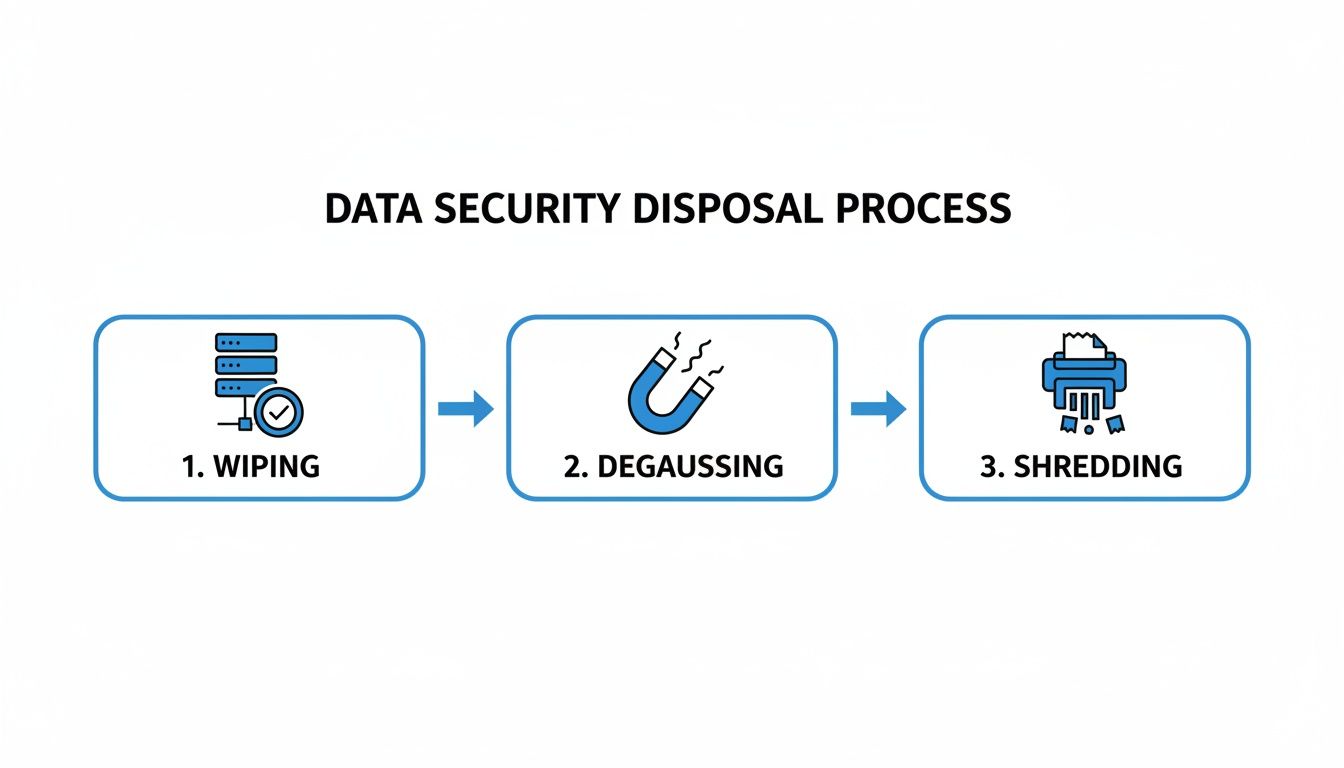
As you can see, every step, from secure wiping to complete physical shredding, is designed to eliminate 100% of the data risk.
From Your Doorstep to Final Disposition
Once loaded onto a secure, GPS-tracked truck, your equipment is taken directly to a certified processing facility. The moment it arrives, everything is sorted. All data-bearing devices are immediately segregated and queued for the data sanitization methods we covered earlier.
This professional, streamlined approach offers some major advantages:
- Minimal Business Disruption: Your people can keep doing their jobs while the experts handle the entire removal process.
- Enhanced Security: Professional transport and strict chain-of-custody protocols drastically reduce the risk of assets getting lost or stolen.
- Cost Efficiency: With services like complimentary pickup for bulk quantities, you avoid the internal costs and labor of trying to transport everything yourself.
Ultimately, a well-managed logistics plan makes your corporate electronics recycling program not just compliant and secure, but remarkably painless.
Turning E-Waste Into a Powerful ESG Win
For years, corporate electronics recycling in Atlanta was viewed as little more than a cost center—a compliance task to be checked off a list. That perspective is completely outdated. Today, responsible e-waste disposal is no longer just about avoiding fines; it’s a strategic move that can seriously boost your Environmental, Social, and Governance (ESG) and Corporate Social Responsibility (CSR) programs.
This is where recycling evolves into a powerful brand story. By partnering with a mission-driven organization, you can turn a logistical headache into a source of compelling, measurable social impact that truly connects with customers, employees, and stakeholders.
Recycle for a Cause: The Dual-Impact Model
Imagine your company’s old laptops and servers doing more than just being safely processed. What if they could directly help a local veteran transition back to civilian life or reforest a critical watershed here in Georgia? That's the heart of a "Recycle for a Cause" campaign.
The idea is simple but incredibly profound. It links the physical act of recycling with tangible, emotional outcomes. The message shifts from "disposing of old tech" to powerful statements like, “Our outdated equipment helped plant a forest and support a veteran.” This narrative is authentic, easy to share, and directly fuels your company's social responsibility goals.
Leveraging Impact Reporting for CSR Documentation
Standard recycling gets you a certificate of destruction. A mission-driven partner delivers an Impact Report. This document is your key to transforming your recycling efforts into a cornerstone of your annual sustainability reporting.
Instead of a generic line item, you can report concrete metrics that really mean something:
- Veteran Support: "This year, our IT asset disposition program provided direct support to 15 local veterans."
- Reforestation: "We funded the planting of 250 trees in Georgia through our electronics recycling initiative."
These specific, measurable outcomes are exactly what ESG frameworks and conscious investors are looking for. You could even publish a case study on LinkedIn detailing how your Atlanta office turned its tech refresh into a community win, generating positive buzz and demonstrating a real commitment to corporate citizenship.
Creating an Easy ESG Win for Your Company
Integrating this model into your operations is refreshingly simple. Many partners offer free pickup for businesses with 50 or more devices, which gets rid of the logistical costs and headaches. After collection, you receive not just the standard compliance paperwork but also your Veteran Support Impact Report and Plant-A-Tree certificates.
These materials are perfect for both your internal and external communications:
- Share the results in your company-wide newsletter to boost employee morale.
- Feature the impact on your careers page to attract top talent who care.
- Incorporate the hard data into your annual ESG reports to show measurable progress.
By choosing a partner with a dual-impact mission, you create a seamless ESG win. You meet all your compliance needs while generating authentic social good that makes your brand stand out.
From E-Waste to ESG Impact: A Corporate Action Plan
Turning e-waste into a tangible ESG asset requires a clear plan. It's about connecting your operational processes to your corporate values and, most importantly, reporting on them effectively. The table below breaks down how your company can take simple actions and turn them into reportable ESG victories.
| Corporate Action | ESG/CSR Impact | How to Report It |
|---|---|---|
| Partner with a mission-driven, certified recycler. | Social (S): Directly supports community initiatives (e.g., veteran support, local charities). Governance (G): Demonstrates ethical procurement and responsible vendor selection. | Feature partner stories in CSR reports. Highlight community investment figures. Document vendor due diligence in governance statements. |
| Schedule regular IT asset refresh cycles. | Environmental (E): Ensures old devices are properly recycled, preventing landfill waste and recovering valuable materials. Social (S): Contributes to a circular economy and job creation in the recycling sector. | Report total pounds of e-waste diverted from landfills. Include metrics on materials recovered. Mention support for the local green economy. |
| Implement a company-wide employee device recycling program. | Social (S): Boosts employee engagement and morale by involving them in a positive initiative. Environmental (E): Amplifies environmental impact by collecting personal e-waste. | Share participation rates in internal communications. Aggregate total recycling data (corporate + employee) for annual reports. Use photos from collection events. |
| Use the provided Impact Reports and Eco-Badges. | Environmental (E) & Social (S): Provides quantifiable metrics for reforestation and community support. Governance (G): Offers third-party validation of your company's commitment. | Incorporate specific numbers (trees planted, veterans helped) into ESG reports. Display the eco-badge on your website's sustainability page. |
By following these steps, you build a robust program that doesn't just manage waste—it creates value. This proactive approach shows stakeholders that your commitment to ESG is more than just talk; it's embedded in how you do business.
Building Your Brand with an Eco-Badge
To further showcase your commitment, a certified partner can provide a digital "Recycled with Purpose" badge. This is a simple but effective tool for your website, email signatures, and sustainability pages. It serves as a visual, third-party validation of your responsible practices.
This eco-badge instantly tells visitors that your company goes beyond the minimum. It signals that you actively choose partners who align with your values, turning a routine operational task into a public declaration of your company's character.
Atlanta's push for sustainability is only getting stronger. In fiscal year 2023, the city successfully diverted nearly 19,800 tons of recyclables, including electronics, from its landfills. Innovators in the local circular economy are making this happen, ensuring zero-landfill policies and secure data handling that support the city's broader environmental goals. You can explore more about Atlanta's recycling audit to see the city-wide progress your company can contribute to.
Partnering with a mission-focused recycler for your Atlanta electronics recycling needs allows you to be a leader in this movement, turning e-waste from a problem into a powerful story of restoration and hope.
Choosing the Right Certified Recycling Partner in Atlanta
Picking the right partner is hands down the most critical decision you'll make for your Atlanta electronics recycling program. This one choice ripples through everything—your compliance, your data security, and even your brand's story. It's the difference between just getting rid of old gear and actually creating something valuable from it.
Sure, plenty of vendors can haul away equipment. But a genuine partner provides verifiable proof of their process, from the moment a hard drive is wiped to its final, environmentally sound destination. Your IT and procurement teams need to look past the price tag and really dig into the certifications that will shield your organization from risk.
R2v3 and e-Stewards: The Non-Negotiable Certifications
In the world of IT asset disposition, certifications aren't just a "nice-to-have"—they're your first line of defense. Think of them as an independent guarantee that your recycler meets the absolute highest standards for data security, environmental safety, and worker protection.
When you're vetting potential partners, two names should be at the very top of your list.
-
R2v3 (Responsible Recycling): This certification is all about a strict "reuse, recover, recycle" hierarchy. An R2v3-certified partner is mandated to prioritize refurbishing devices to give them a second life before ever considering breaking them down for raw materials. It also demands a fully documented chain of custody and secure data destruction methods.
-
e-Stewards: Developed by the Basel Action Network, this is the gold standard for environmental ethics. The e-Stewards certification comes with an ironclad ban on exporting hazardous e-waste to developing countries. It also enforces incredibly rigorous data security protocols and worker safety standards.
Asking if a vendor holds these certifications should be your first question, right out of the gate. If they say yes, you know they've been audited and have proven they operate with integrity.
To make it easier to see what you're getting, here's a quick breakdown of what these top-tier certifications really mean for your business.
Key Certifications for Atlanta Electronics Recycling Partners
| Certification | What It Guarantees | Why It Matters for Your Business |
|---|---|---|
| R2v3 (Responsible Recycling) | A documented chain of custody, strict data security protocols (aligned with NIST 800-88), and a focus on refurbishing and reusing devices before recycling. | Protects your company from data breaches, ensures compliance, and maximizes the value recovered from your retired IT assets. |
| e-Stewards | A complete ban on exporting hazardous e-waste, rigorous environmental protection standards, and robust worker health and safety requirements. | Shields your brand from being associated with environmental harm in developing nations and guarantees the highest ethical standards are being met. |
While these certifications are a great start, they are just that—a start. The best partners go further, turning a compliance task into a powerful story for your brand.
Vetting Recyclers Beyond the Certificate
A certificate on the wall is important, but to find a partner that truly aligns with your company's values and ESG goals, you need to ask tougher questions. This is how you find a true social enterprise, not just another vendor.
A great recycling partner doesn't just give you a certificate; they provide a story. They should be able to deliver tangible impact reports that quantify the good your e-waste has accomplished, connecting your operational processes directly to your CSR narrative.
Before you sign any contracts, make sure you get clear, confident answers to these questions:
-
Show Me Your Downstream: Ask them to map out their entire downstream process. Where, exactly, do the materials go after leaving their facility? A transparent partner will have a fully vetted network of downstream vendors who are also held to strict environmental and ethical standards.
-
Prove Your Zero-Landfill Policy: Get it in writing. Confirm they operate under a strict zero-landfill policy. This is your guarantee that no part of your electronics—from plastics to circuit boards—will end up polluting the environment.
-
Detail Your Data Destruction: Don't settle for "we wipe drives." Ask them which specific standards they follow (the answer should be NIST 800-88). Can they provide on-site shredding for maximum security? Visiting a local e-waste recycling center is a great way to see their process firsthand.
-
Quantify Your Social Impact: Do they provide reports detailing social outcomes? Can they show you exactly how your retired assets helped support community programs, like hiring veterans or planting trees? This is what transforms your e-waste from a liability into a cornerstone of your ESG program.
Atlanta is already making huge strides, with municipal programs collecting nearly 20,000 tons of recyclables in 2023. This local momentum is all about keeping toxic materials out of our landfills. Your company has a chance to be a major part of that positive trend.
Choosing a partner who not only meets the highest compliance standards but also amplifies your company's values is a game-changer. It turns electronics recycling from a simple chore into a genuine strategic advantage.
Your Questions on Atlanta Electronics Recycling Answered
Even with a solid plan for secure and impactful Atlanta electronics recycling, a few practical questions always pop up. It's completely normal. Concerns about cost, logistics, and exactly what equipment qualifies can sometimes pump the brakes on making a final decision.
Let’s clear up the most common questions we hear from Atlanta businesses. We'll give you the straightforward answers you need to move forward with confidence.
What Is the Cost for Corporate Electronics Recycling in Atlanta?
This is usually question number one, and the answer is often better than you’d think. For many businesses, the service can be surprisingly affordable—or even free.
Here’s how it works: Certified recyclers specializing in IT Asset Disposition (ITAD) can often offer complimentary pickups for companies with a good amount of valuable assets. For instance, if you have 50 or more newer computers, laptops, or servers, the value we can recover by remarketing those components usually covers all the logistics and data destruction costs.
Now, for items with zero resale value or those that need special handling—think old, bulky CRT monitors or specific battery types—a small fee might apply. This just ensures they are processed safely and correctly. Always ask for a transparent, itemized quote that breaks down any potential charges before you commit.
How Can We Guarantee Our Sensitive Data Is Permanently Destroyed?
When it comes to your data, there’s no room for "maybe." The only way to be absolutely certain your sensitive information is gone forever is to work with a certified recycler who provides a Certificate of Data Destruction for every single serialized asset.
This is your legally binding proof that the data was wiped clean according to strict standards like NIST 800-88.
A reputable partner should offer a few levels of security to match your risk profile. This could be multi-pass software wiping, which allows the hard drive to be reused, or it could be complete physical shredding. For organizations in high-stakes sectors like healthcare or finance, on-site shredding is a fantastic option. You can literally watch your hard drives get destroyed at your facility before they ever leave your control.
What Types of Electronic Equipment Can Our Business Recycle?
A true ITAD partner should be a one-stop shop, capable of handling just about every piece of electronic gear your business uses. We’re not just talking about the obvious stuff.
The list of accepted equipment typically includes:
- Standard Office Gear: Laptops, desktops, monitors, printers, scanners, and servers.
- Peripherals and Accessories: Keyboards, mice, cables, docking stations, and speakers.
- Networking Equipment: Routers, switches, modems, and firewalls.
- Mobile Devices: Smartphones, tablets, and company-issued cell phones.
But it goes beyond the basics. Specialized recyclers can also handle more complex hardware from data centers, telecommunications systems, and even medical labs. It's always smart to double-check with your partner if they have any restrictions, especially for items that might contain hazardous materials. If you're wondering about a specific device, our guide on where to recycle electronics has more detailed lists.
How Does Recycling Our Electronics Directly Help Our ESG Goals?
This is where recycling elevates from a simple operational task to a major strategic win. Managing your e-waste the right way is a cornerstone of any strong Environmental, Social, and Governance (ESG) program, delivering real, reportable results.
By keeping hazardous materials like lead and mercury out of landfills, you directly support the "Environmental" component. By choosing a partner who prioritizes refurbishment and reuse, you contribute to the circular economy.
The real magic happens when you partner with a social enterprise. Your e-waste starts generating measurable social good, powerfully fueling the "Social" part of your ESG report. Turning old equipment into funding for veteran support programs or local tree-planting initiatives gives you authentic, compelling stories for your CSR reports.
Finally, the whole process—from choosing a certified vendor to ensuring bulletproof data security—demonstrates ethical operations and smart risk management, hitting the "Governance" mark. It’s a holistic win that proves your company is committed to doing business the right way.
Ready to transform your old tech into a force for good? Atlanta Green Recycling offers certified, secure, and mission-driven electronics recycling solutions for businesses across the metro area. We make it easy to protect your data, meet your ESG goals, and make a real impact on the lives of veterans and our local environment.