Atlanta’s Future Is Built with Smart Building Technologies


Think about your office building for a moment. What if it could do more than just provide shelter? What if it had a brain and a nervous system, allowing it to think, learn, and adapt to the people inside it? That’s the big idea behind smart building technologies—a collection of tools that turns a static structure into a dynamic, responsive environment.
What Exactly Are Smart Building Technologies?
When we talk about smart building technology, we're not talking about a single gadget or piece of software. Instead, imagine a network of interconnected systems all working together, much like a building's central nervous system. This network transforms a passive structure of concrete and steel into an intelligent environment that actually anticipates the needs of its occupants and operators. The technology can be as simple as advanced smart thermostats or as complex as a fully integrated building management system.
At the heart of this shift are two key components that work in tandem:
-
IoT Sensors (The Nerves): These are the digital senses of the building. Thousands of tiny Internet of Things (IoT) sensors are embedded throughout a facility, constantly gathering data on everything from room temperature and occupancy levels to air quality and equipment performance.
-
AI-Powered Platforms (The Brain): All the raw data collected by the sensors is fed into a central, AI-powered platform. This "brain" analyzes the information in real-time, spots patterns, and makes intelligent, automatic decisions to keep the building running at peak performance.
This simple workflow—from data collection to intelligent action—is what makes the whole system so powerful.
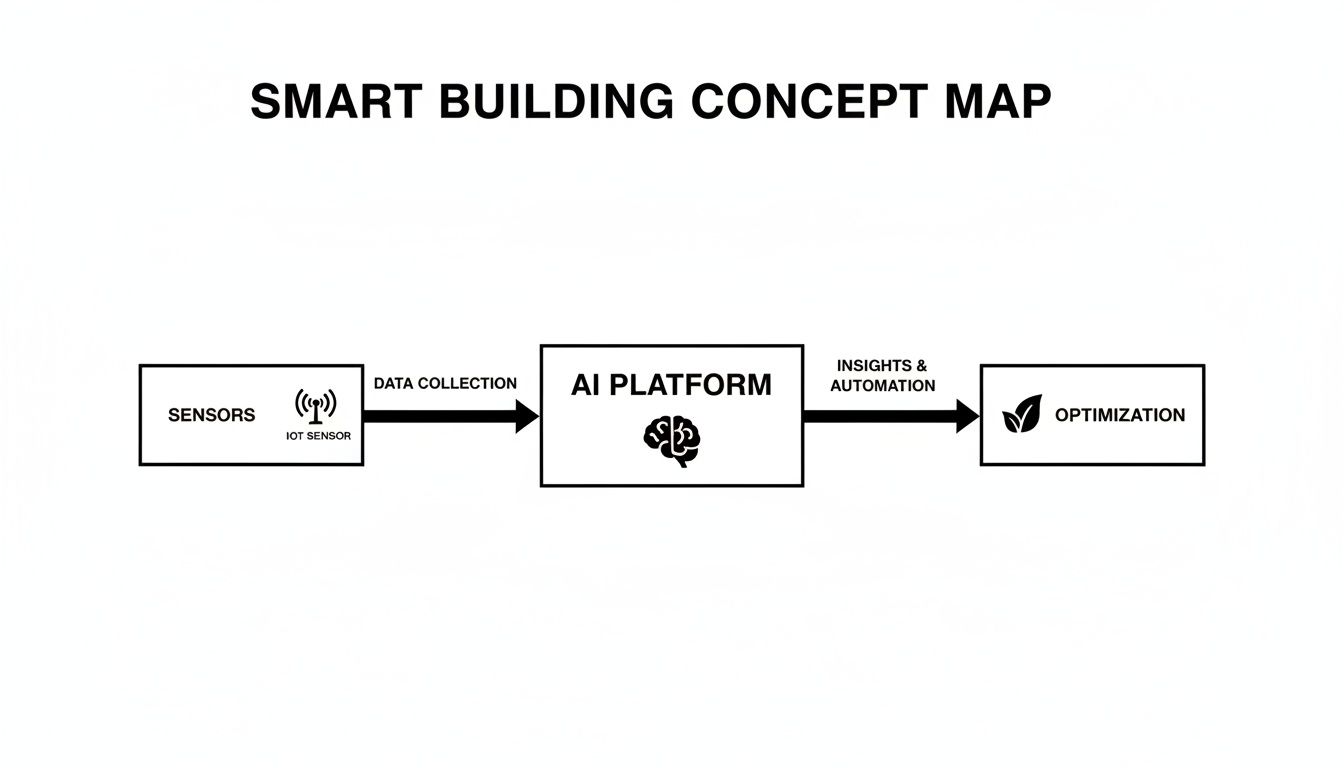
As you can see, this creates a continuous feedback loop. The system is always learning and always improving, turning raw data into real-world results.
Moving From Reactive to Proactive Management
The real value here is the shift away from a reactive management style—that is, fixing problems only after they happen. Think about it. Instead of waiting for an HVAC unit to fail on the hottest day of the year, the system can predict a potential breakdown based on performance data and alert your maintenance team well in advance.
Why run lights and air conditioning in empty conference rooms? A smart building automatically adjusts these systems based on real-time occupancy, saving energy without anyone lifting a finger.
This proactive approach isn't just a novelty; it's a massive business driver. The global smart building market was valued at USD 141.79 billion in 2025 and is on track to hit a staggering USD 554.02 billion by 2033. This explosive growth is fueled by the clear benefits of IoT-enabled systems that slash energy waste and operational costs.
For businesses here in Atlanta, this is more than just a trend. It's a strategic tool for gaining a competitive edge. By creating workplaces that are more efficient, comfortable, and sustainable, companies can boost their bottom line while hitting critical ESG goals.
How AI and IoT Create Intelligent Buildings
If you think of a smart building as having a "central nervous system," then the Internet of Things (IoT) and Artificial Intelligence (AI) are its nerves and brain. These two technologies are what give a building its intelligence, turning it from a passive structure into a responsive, living environment.
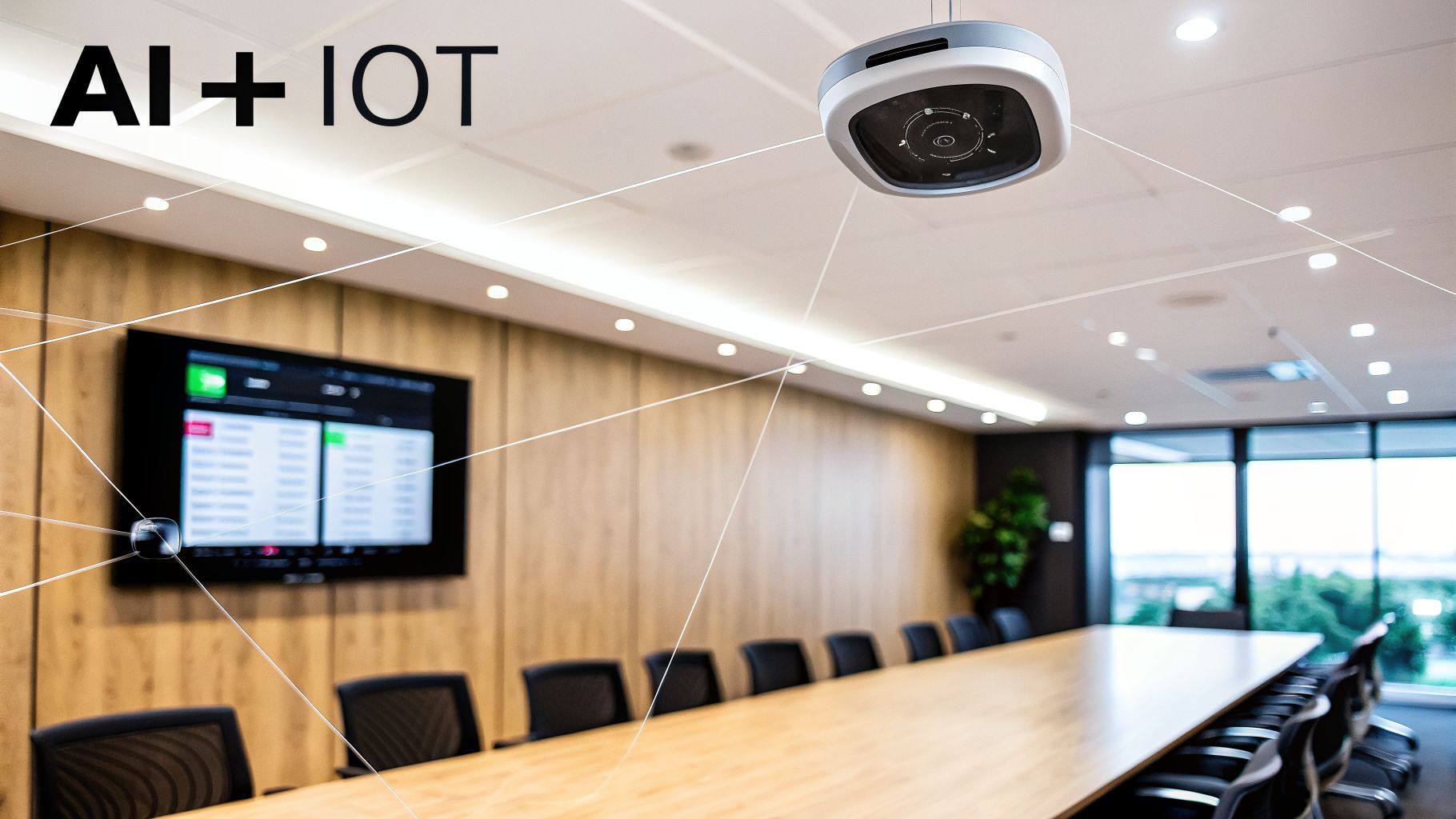
Think of IoT sensors as the building's five senses. They are constantly collecting mountains of data from every corner of the facility—temperature, light levels, motion, air quality, you name it. This raw information is the fuel for every smart function, giving you a live, detailed picture of exactly what’s happening at any moment.
AI, on the other hand, is the brain. It takes all that data streaming in from the IoT sensors and actually makes sense of it. AI isn't just seeing the information; it’s learning from it, spotting patterns, predicting what’s next, and triggering actions on its own. This is where simple automation grows into true intelligence.
IoT: The Senses and AI: The Brain
This partnership creates a powerful, continuous feedback loop. IoT sensors tell the system what is happening, and AI figures out so what—turning all that data into meaningful action.
-
IoT Sensors (The Senses): These are the eyes, ears, and nerve endings of the building. They capture millions of data points on everything from room occupancy and humidity to the vibrations of a specific piece of machinery.
-
AI (The Brain): The AI platform crunches all this data to understand how the building is being used. It learns trends, anticipates future needs, and automatically adjusts systems to create the perfect balance of comfort and efficiency.
The financial upside of this synergy is huge. AI integration is taking smart buildings to the next level, with the market for AI in this space projected to jump from USD 64.95 billion in 2026 to an incredible USD 476.96 billion by 2035. This explosive growth, highlighted by firms like Precedence Research, is all thanks to AI's ability to run predictive maintenance, slash energy use, and make buildings better places to be.
A Real-World Atlanta Scenario
Let's ground this in a real-world example. Picture a modern office tower in downtown Atlanta. The old way of doing things meant the HVAC system ran on a rigid schedule, pumping cold air into empty conference rooms and wasting a fortune on energy.
Now, let's inject smart building technologies.
The new AI-powered system pulls data from multiple sources. It analyzes historical meeting schedules from the company calendar, checks that against real-time occupancy data from IoT sensors, and even pulls in the day's weather forecast. With this complete picture, it starts to pre-cool specific rooms 15 minutes before a meeting is scheduled to start. Once the meeting's over and sensors confirm the room is empty, the system dials the temperature back to an energy-saving level.
This isn't just a minor tweak; it’s a total shift in how the building is managed. Instead of being reactive—fixing things when they break or responding to comfort complaints—the building becomes proactive and predictive.
The system anticipates needs before anyone even has to ask. It’s the same forward-thinking approach that underpins smart strategies for managing other business resources, like those covered in our guide on IT asset management best practices. This level of intelligent automation saves thousands in energy costs and frees up your facilities teams to focus on bigger-picture initiatives.
Achieving Real Business Wins in Atlanta
It's one thing to understand the mechanics of smart building technology, but for any Atlanta business, the real question is always "why?" How does this investment actually show up on the balance sheet? These aren't just abstract ideas; the benefits are concrete wins that support three critical pillars of your business: direct financial gains, smoother operations, and a massive boost to your ESG and CSR strategy.
When you integrate intelligent systems, your company shifts from just occupying a building to actively managing it for peak performance. This change creates a chain of positive results, from cutting overhead costs to building a stronger brand reputation in the competitive Atlanta market.
Slashing Costs and Boosting Efficiency
The most immediate and tangible benefit you'll see from smart building tech is the direct impact on your company's finances. These systems are engineered to find and eliminate waste while automating key processes, leading to some serious savings.
-
Intelligent Energy Management: Your building's HVAC and lighting are two of its biggest money pits. A smart system uses real-time data to make sure you're not paying to heat, cool, or light up empty rooms. By looking at occupancy patterns, weather forecasts, and even utility rate changes, the system makes constant tiny adjustments that can slash your utility bills.
-
Predictive Maintenance: Instead of waiting for a critical piece of equipment to break down—triggering costly downtime and emergency repair bills—smart sensors keep an eye on the health of your building’s machinery. The system can pick up on subtle performance changes that signal a future failure. This allows your facilities team to schedule maintenance proactively during off-hours, saving a ton of disruption and expense.
When you automate these core functions, your facility managers are freed up. They can stop putting out fires and start focusing on high-value, strategic tasks. Moving from reactive to proactive management is a game-changer for operational excellence.
Strengthening Your ESG and CSR Strategy
In today's business world, a strong Environmental, Social, and Governance (ESG) strategy isn't a "nice-to-have" anymore. Investors are demanding it, top talent expects it, and customers are choosing to do business with companies that show a real commitment to sustainability. This is where smart building technology gives you a serious leg up.
The data your smart building generates is its most powerful asset when it comes to ESG reporting. It provides the hard, verifiable proof you need to back up your sustainability claims.
Instead of working with estimates, you can show stakeholders hard data that proves a quantifiable reduction in energy consumption and a smaller carbon footprint. These are the kinds of powerful metrics that build trust and credibility. It transforms your building from a simple cost center into a core part of your corporate story.
Let's face it, buildings are a huge piece of the global environmental puzzle. They account for roughly 40% of global electricity consumption and a third of all greenhouse gas emissions. Adopting smart building technologies is one of the most effective steps you can take to address this. The market is projected to skyrocket to USD 691.56 billion by 2034, and for good reason. Optimized facilities can slash their emissions by up to 30%, making this tech a must-have for any company serious about its net-zero goals. You can see more on these market trends in this detailed report.
This focus on data-driven sustainability is a central piece of any modern corporate responsibility plan. By using technology to create a greener, more efficient workplace, Atlanta companies can cement their reputation as forward-thinking leaders. If you want to dive deeper into crafting your company's sustainability narrative, check out our guide on building a holistic business sustainability strategy. This approach ensures your efforts are both impactful and well-documented.
Planning Your Smart Building Integration
Rolling out smart technology isn't just about plugging in a few new gadgets. It’s a major strategic upgrade that demands a practical, well-thought-out roadmap. For IT and facilities leaders here in Atlanta, a successful project boils down to careful planning that tackles the big challenges from the very beginning. The real goal is to create a system that’s not just powerful on day one, but also secure, scalable, and successful for years to come.
The first step is to stop seeing your building as a collection of separate systems. Instead, think of it as a single, unified digital ecosystem. Every sensor, controller, and platform you introduce has to play nicely with the others. Without this groundwork, you're just creating a fragmented, inefficient mess that will never deliver on its potential.
Ensuring Seamless System Interoperability
One of the biggest hurdles you'll face is interoperability. This is simply the ability for different technologies, often from different manufacturers, to "talk" to each other. Imagine trying to run a team where nobody speaks the same language—that’s what happens when your HVAC system can't communicate with your occupancy sensors.
To get around this, you have to prioritize open standards and protocols from the start. When you're talking to vendors, ask them directly about their support for common frameworks like BACnet or Modbus. This simple step helps you avoid getting locked into one company's proprietary world, giving you the freedom to pick the best-in-class solutions for every function, from lighting to security.
A truly smart building is one where every component works in harmony. Your integration plan should focus on creating a single, cohesive "brain" for your building, not a collection of disconnected voices.
When everything is unified, data can flow freely. This is what unlocks the advanced automation and analytics that actually drive real business value.
Building a Robust and Scalable Network
A smart building runs on data. We're talking about thousands of IoT sensors generating a constant stream of information. Your network infrastructure absolutely must be tough enough to handle that massive load without breaking a sweat. A network that can't keep up will just lead to data bottlenecks, sluggish response times, and system failures.
Your plan needs to include a serious audit of your current network capabilities. Think about these points:
- Bandwidth Capacity: Will your existing setup support the flood of data from thousands of new devices? Always plan for future growth, not just what you need today.
- Connectivity: Figure out where you'll need wired connections versus wireless. Technologies like Wi-Fi 6 and 5G offer the high speeds and low latency you need for processing data in real time.
- Scalability: Make sure you're choosing network hardware and an architecture that can grow with you as you add more smart devices down the road.
For any organization taking on a big technology deployment, a detailed plan is non-negotiable. If your project involves moving a lot of hardware, our comprehensive data center migration checklist offers some great insights for managing these kinds of complex IT transitions.
Prioritizing Cybersecurity from Day One
The moment you connect your building's operational technology (OT)—the systems controlling physical gear like elevators and HVAC—to the internet, you're opening the door to serious new security risks. A breach could give a bad actor control over your building, expose sensitive data, or even shut down critical operations entirely.
Cybersecurity can't be an afterthought. It has to be baked into your plan from the very start. Some key strategies include:
- Network Segmentation: Keep your OT network separate from your corporate IT network. This creates a firewall so that a breach in one area can't easily spread to the other.
- Strict Access Control: Use multi-factor authentication and role-based access to make sure only authorized people can manage building systems.
- Vendor Vetting: Only partner with vendors who have a proven cybersecurity track record and can show you how their products are protected against known threats.
- End-of-Life Security: Have a plan for securely decommissioning devices. This means ensuring all sensitive data is professionally destroyed before any hardware is sent off for recycling.
Completing the Lifecycle with Responsible E-Waste Recycling
The journey of your smart building technology doesn't end when the new systems are up and running. In fact, a critical new phase begins. Every sensor you upgrade, every server you replace, and every control panel you decommission creates a challenge: what do you do with the old hardware?
For any Atlanta business running on smart building technologies, thinking about end-of-life management isn't just a "nice-to-have." It’s an essential part of a smart, secure, and responsible operational strategy. These devices are often full of sensitive data, making responsible electronics recycling for veterans and other causes a crucial final step.
Those same IoT sensors, network switches, and access panels that delivered so much value can quickly become major liabilities if you just toss them out. For one, they’re packed with materials that are hazardous to the environment. But more importantly for your business, they are often still full of sensitive data. Without certified data destruction, you’re leaving the door wide open for a potential data breach.
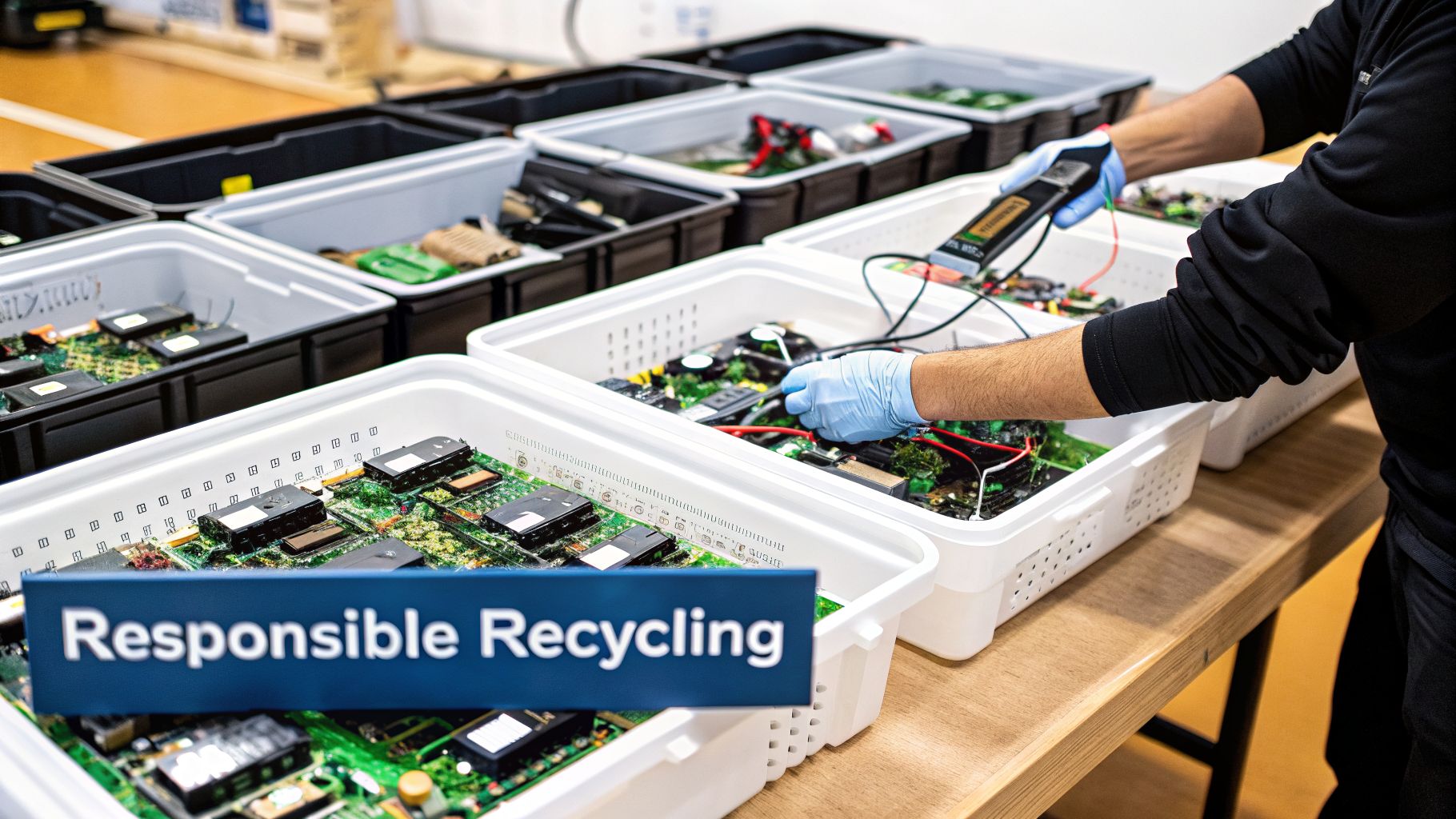
From High-Tech Operations to Responsible Disposal
The smartest companies think about the end of a device's life right from the very beginning. This means building a secure and compliant e-waste process directly into your IT asset management plan.
When you partner with a certified e-waste recycler, you're not just getting rid of old gear. You're securely closing the loop on your asset's lifecycle. Here’s what that process looks like:
- Secure Logistics and De-Installation: It starts on-site. Professionals come to your building to de-install and securely pack all retired assets, maintaining a clear chain of custody from your door to the recycling facility.
- DoD-Level Data Destruction: This is non-negotiable. Every device that holds data must be sanitized to Department of Defense (DoD) standards. For total peace of mind, physical shredding completely destroys the hardware, making data recovery absolutely impossible.
- Auditable Reporting: Once the job is done, you should get official paperwork, like Certificates of Data Destruction. This isn't just a receipt; it’s your proof of compliance for internal audits and data privacy regulations.
This clear, methodical approach transforms a huge potential risk into a documented and secure business process.
Turning E-Waste into a Powerful ESG Win
Here’s where it gets interesting. Proper electronics recycling is more than just managing risk; it’s a golden opportunity to boost your company’s ESG (Environmental, Social, and Governance) and CSR (Corporate Social Responsibility) efforts, especially with a cause-based approach.
When you choose a recycling partner with a genuine social mission, your old technology becomes a force for good. It’s a story that truly connects with your employees, your customers, and your investors.
Imagine this message: "Your old tech can house a veteran and grow a forest." This isn't just a catchy phrase—it’s a real, measurable outcome. By working with a recycler committed to this kind of dual-impact philanthropy, your decommissioned hardware can directly fund veteran support programs and reforestation projects. This is what we call "Recycling That Restores Lives and Landscapes."
This changes an everyday operational task into a powerful story about your company's values. You'll get tangible proof, like a Plant-A-Tree certificate or a Veteran Support Impact Report, that validates your commitment to the community. It’s the kind of authentic ESG win that builds a rock-solid brand reputation. If you want to dive deeper into the topic, it's worth learning more about how to reduce electronic waste as part of a wider sustainability strategy.
For companies right here in Atlanta, this creates a fantastic local advantage. You can partner with a hometown recycler that supports Georgia's veterans and helps restore our state's natural beauty. It shows a true, full-circle commitment to the community where you operate.
As you plan your next tech upgrade, remember to consider the entire lifecycle. A structured approach to professional electronic recycling in Atlanta doesn't just complete your smart building strategy—it turns obsolete equipment into a story of renewal.
Tying It All Together for a Greener Atlanta
Rolling out smart building technology is a fantastic move for any Atlanta business. It shows you’re serious about efficiency, innovation, and creating a great place to work. But what really separates the leaders from the pack is what happens at the end of the technology’s life.
True leadership means making sure today's progress doesn't become tomorrow's environmental headache. This is where you can turn a routine operational chore—getting rid of old equipment—into a powerful story about what your company truly stands for. It's about more than just recycling; it's about making a real, measurable difference for your community and your brand.
An Easy ESG Win with a Story to Tell
Bolstering your company's reputation as a sustainability leader doesn't have to be complicated. The trick is to partner with someone who can turn your retired assets into something genuinely positive, giving you a clear, compelling story to share.
Think about the power of this message for your employees, customers, and investors: “Our old tech helps house a veteran and grow a forest.” That’s an authentic narrative that transforms obsolete hardware into real-world hope.
We make this incredibly simple for Atlanta businesses. Schedule a free pickup for 50 or more devices, and we’ll handle the rest. In return, you get Plant-A-Tree certificates and Veteran Support Impact Reports—tangible proof of your commitment, ready-made for any ESG or CSR report.
Become a Partner in Purpose
Working with us gives you an easy way to showcase your commitment to doing good. We provide all our partners with a digital “Recycled with Purpose” badge to display proudly on your website, in marketing materials, or within your sustainability reports.
It's a straightforward, effective symbol of your role in the circular economy and your support for the local community.
Ultimately, combining smart building innovation with responsible recycling isn’t just about operating smarter—it’s about being a better business. It’s about building a more prosperous, sustainable Atlanta for all of us. Together, we can turn your company’s retired assets into a lasting legacy of restoration and renewal, one device at a time.
Frequently Asked Questions
Making the leap to a smart building is a big decision for any Atlanta business, and it's natural to have some questions. We hear a lot of the same concerns from facilities managers and IT leaders, so we've put together answers to the queries that come up most often as you weigh the practical side of this upgrade.
Can I Retrofit My Existing Atlanta Building?
That's one of the most common questions we get, and the answer is a resounding yes. You don't need a brand-new glass-and-steel skyscraper to take advantage of smart technology; a huge portion of the market is built around upgrading the buildings we already have.
Many of the most effective solutions are specifically designed for retrofitting. Think wireless IoT sensors for your HVAC and lighting, smart plugs, or modern access control systems—all of which can be installed with very little disruption to your daily operations. The best approach is to start with a full audit of your current systems. This helps pinpoint the upgrades, like energy management or occupancy monitoring, that will give you the quickest and most significant return on your investment.
What Are the Biggest Security Risks?
The moment you connect your building’s operational technology (OT)—the brains behind your physical equipment—to your IT network and the internet, you open up a new front for security risks. It's the trade-off for all that powerful connectivity.
The main threats you have to plan for are:
- Unauthorized Access: The risk of a bad actor getting their hands on the controls for your HVAC, lighting, or even your elevators.
- Data Breaches: Your building's operational data, and even information about who is in the building and when, could be prime targets for theft.
- System Shutdowns: A targeted attack could knock out essential functions, leading to massive operational headaches and safety concerns.
Defending against these threats demands a security plan with multiple layers. This means segmenting your OT network away from your main IT systems, using strong data encryption, and enforcing strict access rules. Just as important, though, is planning for a device's end-of-life. Secure data destruction ensures that sensitive information doesn't walk out the door when old hardware is decommissioned.
How Does This Technology Improve Our ESG Score?
Smart building tech gives a direct, measurable lift to every part of your ESG strategy—Environmental, Social, and Governance.
-
Environmental: This is the most obvious win. By seriously cutting down on energy use, you shrink your carbon footprint and get hard, auditable data that makes your sustainability reports shine.
-
Social: It’s all about creating a better human experience. Optimized lighting, better air quality, and smarter security systems contribute directly to the health, safety, and well-being of everyone in your building.
-
Governance: When you invest in these advanced systems, you're making a clear statement about your company's commitment to operational excellence, data security, and long-term sustainability.
And here’s how to bring it full circle. Partnering with a responsible recycler for your end-of-life hardware adds another powerful layer. When your old tech funds veteran aid and reforestation, you prove a full-circle commitment to social good and a circular economy, turning an operational task into a powerful ESG story. This is an easy ESG win for any forward-thinking company.
Ready to turn your retired IT assets into a force for good? Atlanta Green Recycling helps businesses responsibly recycle their old technology, turning e-waste into tangible support for veterans and reforestation efforts. Learn how your company can make an impact by visiting https://www.greenatlanta.com today.