Recycling That Restores Lives and Landscapes: Turn E-Waste into Hope

Recycling a circuit board is about more than just breaking down old tech—it's about carefully pulling out valuable metals like gold and silver while making sure the hazardous stuff is handled the right way. For Atlanta businesses, this process flips the script, turning obsolete electronics from a liability into a real strategic asset.
It’s a practical way to support environmental goals and give back to the community, transforming e-waste into tangible value for your brand. Our tagline says it all: "Recycling That Restores Lives and Landscapes."
From E-Waste to ESG Wins: An Introduction

Let's be honest—for businesses all over Atlanta, those closets and storage rooms overflowing with old computers, servers, and phones are a familiar sight. But these devices are more than just a storage headache. They're a hidden opportunity. This guide is here to reframe how you think about recycling circuit boards, moving it from a simple box-checking task to a powerful advantage for your brand.
We'll dig into how turning this outdated tech into recoverable resources isn't just good for the planet; it helps build a compelling story for your company. Responsible e-waste management is no longer just about keeping electronics out of landfills. It's about showing a real commitment to corporate social responsibility (CSR) that resonates with customers, investors, and your own team. We position our service as an easy ESG win for companies.
Turning Compliance into Community Impact
This guide offers a practical roadmap for Atlanta companies, showing how something as simple as scheduling an electronics pickup can spark a ripple effect of positive change. When you choose the right partner, your e-waste can directly fuel meaningful local causes.
Here’s a glimpse of the dual impact you can make:
- Supporting Veterans: Your old equipment can be converted into direct aid for veterans, helping them transition back to civilian life with dignity.
- Reforesting Landscapes: Donations can fund tree-planting initiatives right here in our community, contributing to a greener, healthier environment for everyone.
When you partner with a mission-driven recycler, you can turn your e-waste into a powerful and authentic story: “Your old tech can house a veteran and grow a forest.” That’s a straightforward and genuine Environmental, Social, and Governance (ESG) win.
Throughout this guide, we’ll lay out clear, actionable steps to help you navigate the process. You'll learn not just how to meet regulatory requirements, but how to amplify your efforts for maximum brand benefit. For a deeper look, you can learn more about how sustainable electronics recycling benefits your business and goes far beyond simple compliance. Consider this your roadmap to turning an operational task into a celebrated part of your company's legacy.
Why Circuit Board Recycling Is a Critical Business Move
Every single piece of office tech you retire—whether it's a server, a laptop, or a simple desk phone—has a circuit board inside. It’s easy to overlook, but that small green board is a complex and concentrated little mine. On one hand, it's packed with valuable materials that can be recovered, like gold, silver, copper, and palladium.
But on the other, it contains a cocktail of hazardous substances—lead, mercury, and cadmium—that can cause serious environmental and health problems if they aren't handled correctly.
This double-edged sword is the core challenge of modern e-waste. As technology moves faster and faster, the lifespan of our devices gets shorter, creating a massive, unending stream of obsolete electronics. For businesses here in Atlanta and across the country, figuring out what to do with it all isn't just an option anymore; it's a non-negotiable part of being a good corporate citizen.
The scale of this problem is staggering. Printed circuit boards (PCBs) account for roughly 3% of all electronic waste. With global e-waste projected to climb toward 60 million metric tons by 2025, that small percentage represents a mountain of hazardous potential and missed opportunity. Making matters worse, only about 34% of this waste is currently handled in environmentally sound facilities. You can dig deeper into the data with e-waste trend analysis from the Royal Society of Chemistry.
The Hidden Value Inside Every Circuit Board
To really grasp why professional recycling is so important, you have to understand what’s actually inside these boards. It’s a careful balancing act of recovering the good stuff while neutralizing the bad. This process turns what could be a huge liability into a real asset for your company’s sustainability mission.
Our table below breaks down the two sides of a PCB—the valuable resources waiting to be reclaimed and the dangerous materials that demand responsible management.
| Component Category | Examples of Materials | Why It Matters for Your Business |
|---|---|---|
| Precious Metals | Gold, Silver, Palladium, Copper | These materials have high market value, and recovering them reduces the need for destructive mining practices. This creates a circular economy and showcases resourcefulness. |
| Hazardous Materials | Lead, Mercury, Cadmium, BFRs | Improper disposal can lead to soil and water contamination, posing health risks and creating significant legal liabilities for your company under environmental regulations. |
| Base Metals | Aluminum, Iron, Tin | Recycling these common metals conserves energy and natural resources, contributing directly to a lower carbon footprint for your operational waste. |
| Other Components | Plastics, Fiberglass, Resins | These materials require specialized handling. Certified recyclers ensure they are processed correctly or disposed of safely, preventing them from ending up in landfills. |
This careful separation is precisely what professional, certified recycling offers over just tossing old equipment in a dumpster. It's a meticulous process, not a simple disposal task.
From Environmental Liability to Marketing Asset
Choosing the right recycling partner does more than just solve a disposal problem; it creates a powerful story for your brand. We live in an age where customers, partners, and even employees expect businesses to be sustainable. Your e-waste policy is a direct reflection of your company's values.
When you team up with a recycler that has a dual mission—like supporting veterans or reforesting our planet—a standard operational task becomes something much bigger.
Instead of just being an environmental footnote, recycling becomes a cornerstone of your CSR strategy. Your old tech can actively help house a veteran or plant a forest, an authentic and emotional story that resonates deeply with today's conscious consumers.
This approach transforms recycling a circuit board from a compliance chore into a proactive move that builds brand equity. It’s an opportunity to demonstrate real leadership, connect with your community, and prove that your company is committed to making a measurable, positive impact. By aligning your operational needs with a genuine cause, you generate an easy and authentic ESG win that truly sets your business apart.
How Are Circuit Boards Actually Recycled?
So, what really happens after we haul away your old electronics? The journey of recycling a circuit board is a detailed, multi-stage process designed to meticulously pull valuable materials away from the hazardous ones. It’s a whole lot more involved than just tossing things in a bin; think of it as a precise operation that blends skilled manual labor with some seriously advanced technology.
The first step, always, is dismantling. Our technicians manually take apart devices like computers, servers, and medical equipment. They carefully separate circuit boards from the plastic casings, power supplies, and all the other bits and pieces. This initial sorting is critical—it ensures different material streams head down the right processing path from the very beginning.
Once the boards are isolated, they’re ready for the main event: material recovery. This is where we unlock the real value, and it typically follows one of two primary routes—either mechanical processing or metallurgical refining.
The Mechanical Breakdown Process
You can think of mechanical processing as using an industrial-strength kitchen blender combined with a crazy-powerful magnet. The whole point is to physically break apart the different materials that make up the board so they can be sorted.
The process generally involves these key steps:
- Shredding: The boards are fed into massive shredders that chew them up into small, irregular pieces. This increases the surface area, making it far easier to separate the different materials later on.
- Granulating: Those smaller chunks are then ground down even further into a fine, almost sand-like mixture.
- Separation: Now the sorting begins. This granulated mix is run through a series of separation techniques. Powerful magnets pull out ferrous metals like iron and steel, while eddy currents are used to separate non-ferrous metals like aluminum and copper. More advanced systems even use air or density separation to isolate precious metal dust from the non-metallic fluff like fiberglass and resin.
This infographic really captures the transformation, showing how a single piece of e-waste holds both valuable resources and hazardous components that need careful handling.
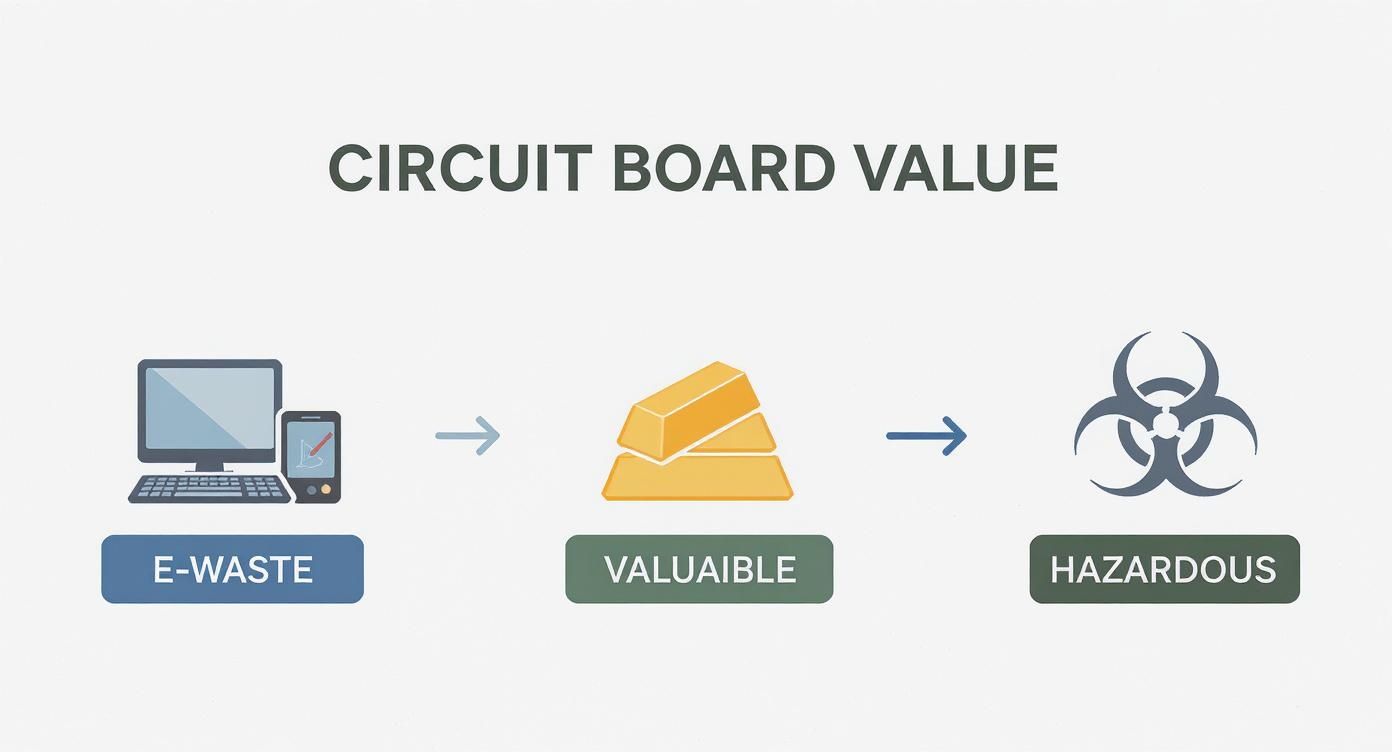
As you can see, every device represents both a financial opportunity in recoverable metals and a serious environmental responsibility in its hazardous elements.
Advanced Refining Methods
To get at the highest-value precious metals—we're talking gold, silver, and palladium—recyclers turn to more complex metallurgical processes. These methods use chemistry and high heat to achieve a much purer level of recovery.
Two common approaches are:
- Pyrometallurgy (Smelting): This is basically a high-temperature melting process. The shredded circuit boards are put into a massive furnace, where the plastic and resins actually burn off as fuel. The various metals melt and separate into layers based on their density, allowing them to be skimmed off and purified.
- Hydrometallurgy (Leaching): This method uses a liquid chemical process. Imagine trying to separate sugar from a pile of sand by dissolving it in water. It’s a similar idea—the shredded board material is bathed in a special chemical solution (a leachant) that dissolves specific metals, which can then be recovered from the liquid.
Choosing a partner with modern, environmentally sound technology is absolutely crucial. Older, cruder methods can release harmful toxins into the air and water, defeating the whole purpose of responsible recycling. A certified recycler invests in closed-loop systems that capture these byproducts safely.
Understanding these methods helps you ask the right questions when vetting a vendor. You're not just getting rid of old equipment; you're entrusting a partner with materials that have both significant value and potential environmental risk. To see how this fits into the bigger picture, check out our guide to the e-waste recycling process.
Ultimately, knowing how this all works empowers your business to make an informed choice—one that protects your brand, keeps you compliant, and makes a genuinely positive impact. It ensures your old tech doesn’t just disappear but is reborn as new resources, fueling a true circular economy.
Protecting Your Data and Ensuring Full Compliance
When it's time to recycle old circuit boards, two critical issues should jump to the top of any business's priority list: data security and legal compliance. Getting rid of old electronics isn't just about making room in the storage closet; it's about protecting sensitive information and navigating the complex web of environmental laws that govern hazardous waste.
A common mistake is thinking that deleting files or reformatting a hard drive is good enough. It isn't. Data can often be recovered from wiped drives, creating a massive liability you might not know about until it's too late. The only real way to guarantee peace of mind is through certified data destruction, where the data-bearing parts of a device are physically obliterated, making it impossible for anyone to retrieve the information.
Navigating Hazardous Waste Regulations
Here in Georgia, and across the U.S., many electronics fall under the category of hazardous waste, regulated by the Resource Conservation and Recovery Act (RCRA). This law introduces a concept called "cradle-to-grave" liability, which means your business is legally on the hook for that waste from the moment you create it until it's finally and properly disposed of.
Getting this wrong can lead to hefty fines and a public relations nightmare. This is exactly why partnering with a certified e-recycler is non-negotiable. They live and breathe these regulations and provide the official paperwork you need to prove you’ve done your part.
The single most important document you'll receive is the Certificate of Destruction. Think of this as your legal proof that every piece of data-bearing media was destroyed according to strict industry standards. It effectively closes the compliance loop and transfers liability off your books.
This documentation is not just for peace of mind; it's essential for internal audits and for any company serious about its ESG (Environmental, Social, and Governance) and CSR (Corporate Social Responsibility) reporting. It's tangible proof of your commitment to doing things the right way. For a better sense of how these principles apply in a day-to-day workspace, you can find helpful visuals on data protection and compliance in an office setting.
Your Assurance Policy: R2 and e-Stewards Certifications
So, how can you be absolutely sure your recycling partner is handling your sensitive materials correctly? The answer is third-party certifications. You want to look for recyclers who hold either R2 (Responsible Recycling) or e-Stewards certification—these are the undisputed gold standards in our industry.
- R2 Certification: This standard focuses on a comprehensive set of environmental, health, and safety protocols for the entire recycling process, including robust data security measures.
- e-Stewards Certification: Known for being exceptionally strict, e-Stewards completely bans the export of hazardous e-waste to developing nations and even uses GPS tracking to ensure materials are handled properly by downstream partners.
Think of these certifications as your insurance policy. They verify that a recycler has passed grueling independent audits and is committed to the highest standards for data destruction, environmental safety, and worker protection. This level of dedication is fundamental to how we operate; you can learn more about our specific processes for data security during electronics recycling in Atlanta.
The global push for responsible e-waste management is also driving major market expansion. The printed circuit board e-scrap recycling market was valued at about $699 million in 2024 and is expected to grow at a CAGR of roughly 8.78% through 2032. This growth is largely fueled by tough regulations like Europe's WEEE Directive, which demands high recycling rates and spurs innovation in the field. When you work with a certified recycler, you're not just protecting your business—you're aligning with global best practices.
Choosing the Right E-Waste Partner in Atlanta
Turning your company’s e-waste knowledge into concrete action begins with finding the right partner right here in Atlanta. Seeing certifications like R2 or e-Stewards is a fantastic start, but a real partnership goes much deeper. It’s about finding an organization whose mission aligns with your own, transforming a simple disposal service into a strategic piece of your company's social impact story.
This means you're looking for more than just a transactional relationship. A genuine partner doesn't just haul away your old equipment; they give you the tools and transparency needed to boost your ESG and CSR goals. They help you turn a routine operational task into a powerful narrative of community support and environmental stewardship.
Beyond the Basics: A Mission-Driven Approach
The best partners don’t just offer recycling; they offer a purpose. As you vet potential recyclers, keep an eye out for a dual-impact model that creates tangible social good. For instance, some forward-thinking organizations convert the value from your recycled electronics into direct aid for veterans or use it to fund local tree-planting initiatives.
This "Recycle for a Cause" approach creates an emotional and compelling story. It’s the difference between saying, "We recycled our old computers," and, "Our old tech helped house a veteran and grow a forest." This is powerful stuff that can be woven directly into your corporate sustainability reports, investor updates, and employee communications. A mission-driven partner should provide you with impact certificates that detail exactly how your contribution made a difference—for example, "You planted 3 trees and helped 1 veteran."
Choosing a partner with a clear social mission positions your company's recycling program as an easy and authentic ESG win. It demonstrates a commitment to community that resonates deeply with customers, employees, and stakeholders.
When you're talking to potential partners, ask them directly about their community initiatives. Inquire how they track and report on their social impact, and ask for examples of how other corporate clients have used their services to hit sustainability benchmarks. For a detailed comparison of local providers, our guide to Atlanta's electronic waste disposal companies is a great place to start.
Your Atlanta Recycling Partner Vetting Checklist
Finding a partner that ticks all the boxes for security, compliance, and social impact requires asking the right questions. This checklist will help guide your conversations and reveal a company’s true commitment to responsible and impactful recycling.
| Evaluation Criteria | Key Questions to Ask | Why It's a Non-Negotiable |
|---|---|---|
| Certifications & Compliance | Are you R2 or e-Stewards certified? Can you provide a Certificate of Destruction for all data-bearing devices? | This is your legal and reputational safeguard, ensuring adherence to the highest industry standards for data security and environmental protection. |
| Downstream Transparency | Who are your downstream partners? Can you provide a full chain-of-custody report showing where all materials end up? | This confirms that your e-waste isn't being improperly exported or sent to uncertified facilities, protecting you from cradle-to-grave liability. |
| Social Impact & Reporting | What is your social mission? How do you measure and report on the impact of our donation? Can you provide CSR documentation? | A true partner will provide detailed impact reports and even digital "Recycled with Purpose" badges you can use in your marketing to showcase your efforts. |
| Logistics & Safety | Do you offer free pickups for businesses? What safety protocols do you follow, especially for devices with batteries? | This ensures the process is convenient and safe. It's vital your partner follows stringent lithium battery storage safety protocols, mitigating the risks that come with these power sources. |
By asking these pointed questions, you can confidently select a partner who will not only handle your recycling circuit board needs responsibly but will also help turn your e-waste into a celebrated part of your company's positive impact in Atlanta.
Turning E-Waste into Hope in Atlanta

This is where the process of recycling circuit boards moves beyond shredders and smelters and gets to the heart of what really matters—the human and environmental impact of your company’s choices. That pallet of old IT equipment sitting in your storage closet isn't just waste; it’s a powerful catalyst for positive change.
Imagine your outdated servers being converted into real-world support for a veteran transitioning back to civilian life. Picture your old office phones helping reforest a piece of Georgia landscape. This is what mission-driven recycling looks like. It’s an approach that transforms e-waste into hope and turns a simple operational task into a cornerstone of your company’s social responsibility.
Partnering with a recycler that has this dual mission is an authentic, straightforward ESG win for any Atlanta business. You meet your compliance needs while generating a powerful, positive story that truly resonates with customers, employees, and stakeholders.
A “Recycle for a Cause” Campaign
A “Recycle for a Cause” campaign reframes the entire narrative around electronic disposal. Instead of being just another line item on an expense report, it becomes a celebrated part of your corporate identity.
This approach creates a clear, emotional connection between your actions and their outcomes.
- Veteran Aid: The value recovered from your electronics can provide direct support to veterans, helping with housing, job training, and other essential services.
- Tree Planting: Each donation contributes to planting trees right here in our community, fighting deforestation, and creating a greener, healthier Atlanta for future generations.
“Your old tech can house a veteran and grow a forest.” It’s a simple but powerful message that connects the act of recycling with tangible, measurable good, demonstrating a genuine commitment to the community.
This dual-impact model reinforces transparency and gives you the social proof to make your sustainability efforts both credible and compelling. You can see our impact in real-time with live website stats showing, for example, "1,245 veterans supported" and "3,700 trees planted.”
How Your Atlanta Business Can Make a Difference
Taking action is simple. If your business has 50 or more devices, scheduling a free pickup is the first step. Once we process your equipment, you’ll get more than just a standard Certificate of Destruction. You'll receive a detailed Veteran Support Impact Report and a Plant-A-Tree certificate for your company’s CSR documentation.
We also provide a digital “Recycled with Purpose” badge that you can display on your website and sustainability reports to proudly showcase your partnership. For a comprehensive look at what can be recycled, explore our services for IT equipment recycling.
The demand for responsible recycling is only getting bigger. The global circuit board recycling machine market is projected to hit approximately $2.23 billion by 2025, a direct response to the massive increase in e-waste. This growth highlights the urgent need for environmentally friendly solutions. By choosing a mission-driven partner, your company doesn't just participate in this circular economy—it leads with purpose, turning every recycled circuit board into a story of restoration.
Got Questions About Circuit Board Recycling? We've Got Answers.
When businesses in Atlanta first look into electronics recycling, a few practical questions always come up. Let's tackle them head-on so you can move forward with total confidence, knowing you're handling data security, compliance, and your environmental impact the right way.
What Kinds of Circuit Boards Can We Recycle?
Short answer: pretty much all of them.
Whether you're looking at motherboards from old servers and PCs, logic boards from smartphones and tablets, or even highly specialized PCBs from industrial machinery or medical equipment, they can all be recycled.
A certified, experienced recycler knows how to handle the whole spectrum. The specific device doesn't matter as much as the process—those valuable materials can and should be recovered responsibly.
How Can We Be Sure Our Sensitive Data Is Destroyed for Good?
This is a big one, and the answer is simple: physical destruction is the only way to be 100% sure. Just hitting "delete" on a file or reformatting a drive simply isn't enough to permanently erase data.
Your recycling partner absolutely must provide a formal Certificate of Destruction. Think of this as your official receipt and proof. It documents that every single data-bearing device—from old hard drives to SSDs—has been physically shredded or degaussed, making data recovery impossible. This is what protects your company from the nightmare of a data breach and the liability that comes with it.
Choosing a certified recycler is your assurance policy. It confirms that your partner adheres to the highest standards for both data security and environmental safety, providing the documentation needed for any compliance or ESG reporting.
What's the Cost for Business E-Waste Recycling in Atlanta?
This can vary based on who you work with and what kind of gear you have. But here's the good news: many mission-driven recyclers in Atlanta, including us, offer free pickups for businesses with a decent amount of equipment (usually 50 items or more).
How is that possible? The precious metals recovered from items like servers, networking equipment, and circuit boards often have enough value to offset the cost of pickup and processing. For many businesses, this makes responsible recycling of circuit boards a cost-neutral decision.
More importantly, it becomes a powerful part of your corporate social responsibility story. When you partner with us, your old tech can help house a veteran and grow a forest, turning a simple disposal task into a meaningful community contribution. After your donation, we automatically email you a personalized certificate stating something like, "You planted 3 trees and helped 1 veteran."
Ready to turn your e-waste into an ESG win? Atlanta Green Recycling offers secure, certified, and impactful electronics recycling solutions for businesses across the metro area. Schedule your free pickup today and join us in our mission to restore lives and landscapes. Visit us at https://www.greenatlanta.com to get started.