A Business Guide to E Scrap Recycling in Atlanta: Turning E-Waste into Hope


When you hear the term "e-scrap recycling," what comes to mind? It’s simply the process of taking old or broken electronics and recovering the valuable materials inside. Instead of letting old tech collect dust in a storage closet or end up in a landfill, this service turns potential e-waste into a resource, all while keeping your company’s data secure and ensuring you stay on the right side of environmental regulations. It's about "Recycling That Restores Lives and Landscapes."
What E-Scrap Recycling Means for Your Atlanta Business
Think of your office’s collection of retired IT gear not as a headache, but as a digital treasure chest. Every single retired laptop, server, and phone holds hidden value. Professional e-scrap recycling is the key that unlocks it, transforming a logistical chore into a smart, strategic move for Atlanta businesses.
This isn’t just about getting rid of old stuff; it’s an opportunity. Handling it the right way lets you recover value from your assets, protect sensitive company data, and polish your brand's reputation as a leader in corporate sustainability. When you partner with a certified, mission-driven specialist, a simple operational task becomes a powerful statement of corporate responsibility.
The Growing Need for Smart E-Waste Solutions
The need for responsible e-scrap recycling is exploding. The world generated a mind-boggling 62 million tonnes of e-waste in 2022 alone—that’s an 82% jump from 2010. Worse, that number is expected to climb to 82 million tonnes by 2030. Yet, only 22.3% of it was properly collected and recycled.
For Atlanta companies, these numbers represent a massive opportunity to lead by example. We can divert tons of this material from our local landfills through initiatives like a "Greener Atlanta" partnership.
Leaving this problem unaddressed comes with serious risks. A single discarded hard drive can become the source of a devastating data breach. At the same time, the hazardous materials inside electronics can leach into the soil and water if they're just dumped. A proper e-scrap program solves both problems in one go.
"Your old tech can house a veteran and grow a forest." This is the core idea behind our mission-driven recycling. It connects the practical act of "electronics recycling for veterans" with tangible, positive outcomes, restoring both lives and local landscapes.
E-Scrap Recycling At a Glance
Here’s a quick look at how a professionally managed e-scrap program breaks down and what it means for your business.
| Component | Business Benefit |
|---|---|
| Asset Auditing & Logistics | Provides a clear inventory of retired tech and manages pickup, freeing up your team and storage space. |
| Certified Data Destruction | Permanently erases all data, protecting you from breaches and ensuring regulatory compliance. |
| Responsible Recycling | Safely recovers valuable materials while properly managing hazardous components, meeting environmental standards. |
| Impact Reporting | Delivers clear documentation of your environmental and social contributions, perfect for CSR and ESG reporting. |
Ultimately, a structured program takes a liability—old electronics—and transforms it into a series of clear business wins, from security to brand reputation.
Turning E-Scrap into a Positive Impact
A modern take on e-scrap recycling goes way beyond basic disposal to create real, measurable good. It’s a chance to hit your company's Environmental, Social, and Governance (ESG) goals while staying fully compliant. A professional program delivers:
- Ironclad Data Security: Certified data destruction methods permanently wipe sensitive information, shielding your company, clients, and employees from costly breaches.
- Environmental Compliance: A responsible partner guarantees that all hazardous materials are handled safely, preventing pollution and keeping you compliant with regulations.
- Enhanced Brand Reputation: Showing a real commitment to sustainability and community support builds deep trust and goodwill with your customers and stakeholders.
By choosing a partner focused on making a positive impact, your business can turn e-waste into hope. You can see how our tailored services are making a difference for local Atlanta organizations. This guide will walk you through exactly how to build an e-scrap recycling program that locks down your data, meets every compliance standard, and creates a powerful story for your brand.
Protecting Your Data During E Scrap Disposal
Think about your old hard drives, servers, and company phones for a moment. They’re like digital vaults. Even after you’ve retired them from active duty, they can still hold a company’s most sensitive secrets—customer lists, financial records, intellectual property, you name it.
Simply hitting "delete" or doing a factory reset is like leaving the vault door wide open. It gives a false sense of security, but the truth is, that data is often still there and can be pulled up with some fairly basic software tools.
This is precisely why professional data destruction is an absolute must for any responsible e scrap recycling program. A data breach from an old, improperly handled piece of hardware can be catastrophic, leading to huge financial penalties, a damaged reputation, and serious legal trouble. For any business, but especially those in regulated fields like healthcare or finance, making sure that data is gone for good isn't just a good idea; it's a requirement.
Why Standard Deletion Is Not Enough
When you delete a file, you aren't actually erasing it. All you're really doing is telling the operating system to remove the signpost pointing to where that file lives. The space is now marked as "available," but the original information is still physically on the drive, waiting to be overwritten. Until that happens, it’s surprisingly easy for someone with the right tools to get it back.
A study by a leading data recovery firm found that they could successfully recover data from 40% of secondhand hard drives purchased online, even after the previous owners had attempted to wipe them. This highlights the critical gap between user-initiated deletion and certified data sanitization.
A factory reset isn't much better for corporate hardware. It might restore a device to its original settings, but it rarely overwrites the entire drive, leaving behind fragments of potentially sensitive data. For any business, that’s a gamble you just can't afford to take.
Certified Data Destruction Methods
To make sure your information is truly gone forever, certified e scrap recycling partners rely on specific, verifiable methods that meet strict government and industry standards. These processes are designed to destroy data so completely, either digitally or physically, that there's zero chance of recovery.
There are two primary ways to do this:
Data Sanitization (Wiping): This is a software-based method where the entire hard drive is overwritten with random data, not just once, but multiple times. The gold standard here is DoD 5220.22-M, a process that uses a three-pass overwrite to ensure nothing is left. This approach is perfect for newer, working drives that can be refurbished and given a second life.
Physical Destruction (Shredding): For devices that are broken, old, or contained extremely sensitive information, shredding is the ultimate solution. Industrial-grade shredders grind hard drives, solid-state drives, and other storage media into tiny, mangled pieces, making it physically impossible to recover a single byte of data.
These methods are especially vital for organizations that need to comply with regulations like HIPAA, which has strict rules about protecting patient health information. To get into the nitty-gritty, you can read our complete guide on how to properly wipe a hard drive for disposal.
The Role of a Certificate of Destruction
So, how do you prove your data was actually destroyed? That's where the official documentation comes in. After the wiping or shredding is complete, a reputable recycler will issue a Certificate of Destruction (CoD). This document is your official record and your legal proof of compliance.
A proper CoD will always include:
- A unique serial number for easy tracking.
- The exact date and method of destruction.
- A list of all the serialized assets that were destroyed.
- A statement that transfers all liability from you to the recycling partner.
This certificate isn't just for peace of mind. It’s critical evidence for any auditors, stakeholders, or regulatory agencies, confirming you took every necessary step to protect your sensitive information throughout the e scrap recycling process.
From Your Office to Recovery: A Step-by-Step Journey
Ever wonder what really happens to your company's old computers after they leave your office? It’s not just about tossing them in a bin. The journey from a dusty server room to becoming valuable, reusable materials is a precise, multi-stage process. Each device enters a secure system built for compliance, data security, and getting the most out of every component.
Let’s follow the path of a retired server through a professional e-scrap recycling workflow. We'll demystify each step, from pickup to final transformation, so you can see the level of professionalism required for enterprise-level IT asset disposal.
Step 1: Secure Logistics and On-Site Pickup
The process kicks off the moment your business decides to retire its IT assets. A certified recycling partner will schedule a pickup at your Atlanta-area location, typically using their own fleet of secure vehicles. For bigger jobs, like a full data center decommissioning or a corporate recycling drive, a specialized team can come on-site to handle everything—de-installing, palletizing, and packing the equipment for a smooth handover.
This first step is about more than just transport; it’s where a secure chain of custody is established. Every device gets inventoried, and serialized assets are logged before they even leave your building. This careful tracking ensures nothing gets lost and gives you a clear audit trail from start to finish.
Step 2: Detailed Asset Tracking and Auditing
Once your equipment arrives at the secure recycling facility, it goes through a detailed check-in. Every single item, from an individual laptop to an entire server rack, is scanned and its serial number is logged into an asset management system. This is how we confirm that every piece of hardware from the initial pickup is accounted for.
This audit accomplishes two critical things:
- Compliance: It creates an official record that your assets have been properly disposed of, which is essential for internal governance and any regulatory audits.
- Value Recovery: It helps identify any devices that might still have resale value, opening the door for remarketing and a potential financial return on your retired assets.
Step 3: Certified Data Destruction
This is, without a doubt, the most critical stage for protecting your business. As we've mentioned, simply dragging files to the trash bin isn't enough. All devices that hold data are separated for certified data destruction to guarantee every bit of information is gone for good.
This is why professional methods are non-negotiable.
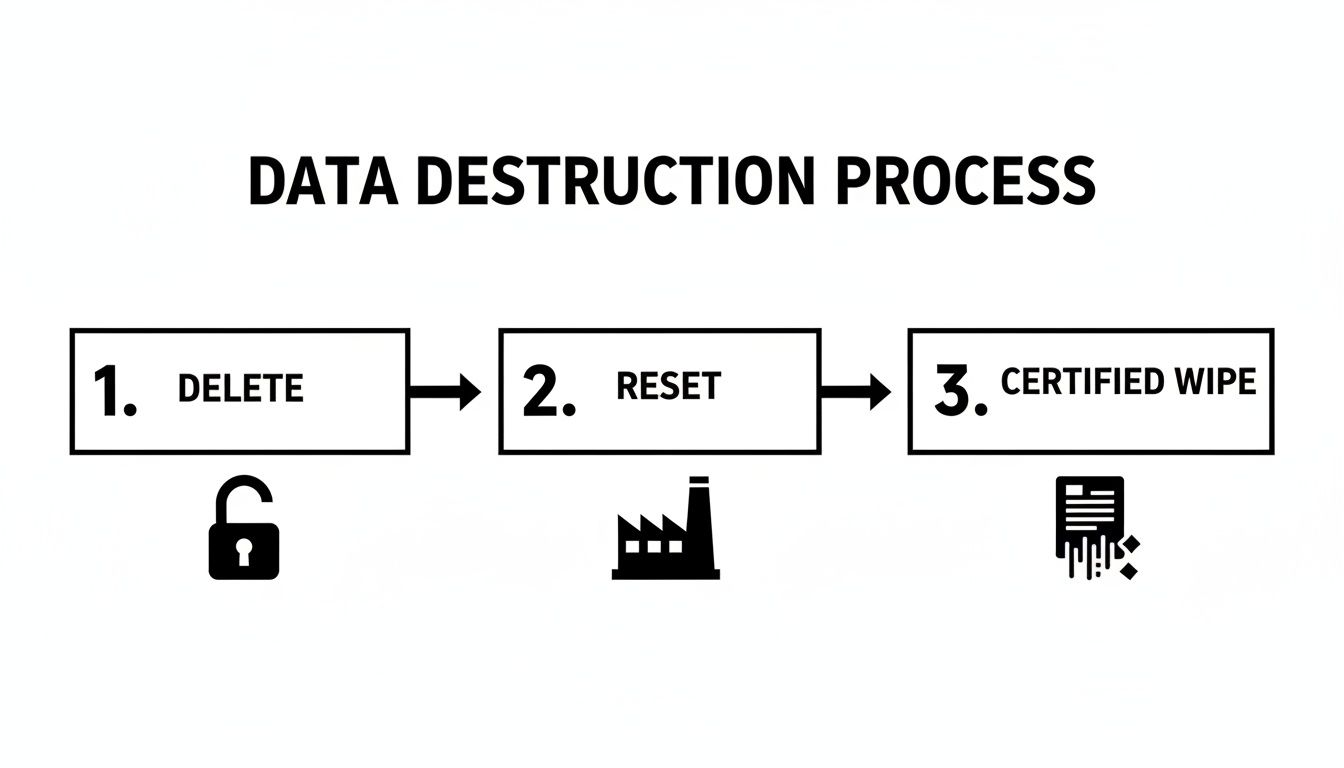
As you can see, only a certified wipe or physical destruction gives you the verifiable security needed to prove that data is completely unrecoverable. For devices that can't be wiped or that demand the highest level of security, physical shredding grinds them down into small, unreadable fragments.
After the process is complete, you’ll receive a Certificate of Destruction. This legal document is your proof that all data was irretrievably destroyed according to standards like DoD 5220.22-M and HIPAA, officially transferring all liability to your recycling partner.
Step 4: Manual Dismantling and Material Separation
With all data safely destroyed, the physical recycling can finally begin. Our skilled technicians get to work manually dismantling each device. This careful de-manufacturing is what allows us to properly separate components and isolate all the different materials inside.
Technicians will sort out items like:
- Circuit boards containing precious metals
- Plastic casings and housings
- Steel frames and aluminum heat sinks
- Power supplies and wiring
- Hazardous materials like batteries and the mercury-containing lamps found in older monitors
This meticulous sorting is key. It ensures that valuable commodities are cleanly separated for the next stage, while potentially harmful materials are safely contained and managed according to all environmental regulations. If you're interested in the specifics, you can learn more about how to properly recycle electronics in Atlanta on our service page.
Step 5: Commodity Recovery and Reintegration
The final step is all about transforming those sorted materials back into usable commodities. The separated streams—plastics, metals, and glass—are sent to specialized downstream processors. There, they get shredded, melted, or refined to create raw materials ready for new manufacturing.
Precious metals like gold and copper are recovered from circuit boards, aluminum is melted down into new ingots, and shredded plastics are prepped for use in new products. This stage truly closes the loop, turning your old e-scrap into the building blocks for the next generation of technology and returning them to the circular economy.
Turn Your E-Scrap Into a Tangible ESG Victory
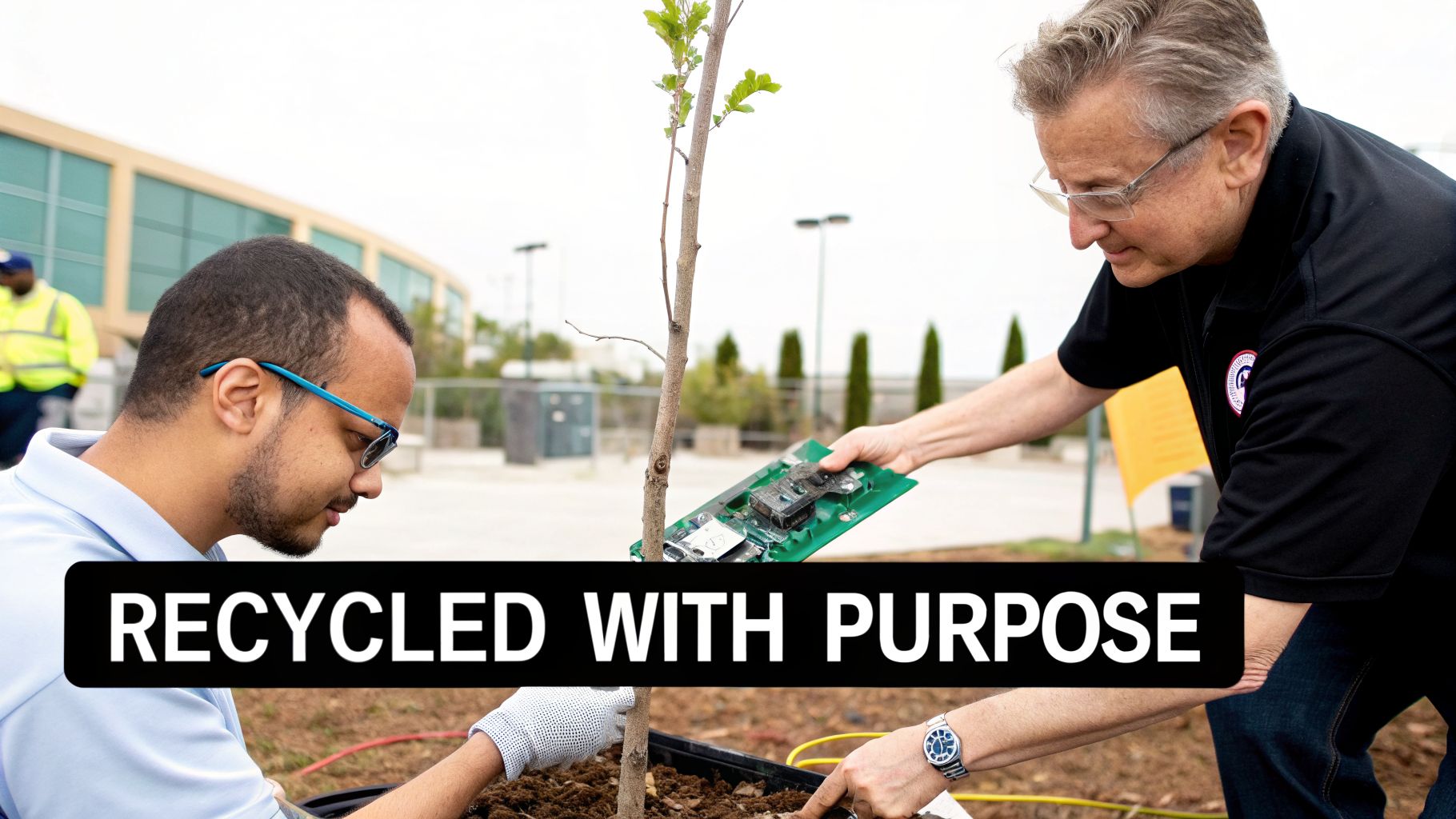
What if your company’s outdated tech could do more than just get recycled? What if it could help house a veteran or plant a new forest? For forward-thinking companies, responsible e-scrap recycling has moved far beyond a simple compliance checkbox. It’s now a powerful way to fuel your Environmental, Social, and Governance (ESG) strategy.
When you partner with a mission-driven recycler, you’re not just disposing of old assets. You’re turning a logistical chore into a compelling story that resonates with employees, customers, and investors. It’s about transforming a necessary task into a legacy of positive impact right here in the Atlanta community.
Beyond Compliance: Recycling That Builds Your Brand
In a crowded market, a strong Corporate Social Responsibility (CSR) program isn't just nice to have; it’s a genuine differentiator. A “Recycle for a Cause” campaign turns your retired electronics into a source of direct, measurable good.
Think about a message like, “Our old tech helps house veterans and grow forests.” This isn't just marketing fluff. It’s authentic storytelling that connects your day-to-day operations to real-world change, giving you an easy and verifiable win for your ESG goals. We even co-host community recycling drives with VFW chapters and environmental NGOs to maximize local impact.
Turn E-Scrap into Verifiable Impact
The heart of any successful ESG initiative is transparency. You need measurable results. When you work with us, you don't just get a receipt for a pile of electronics—you get a story backed by data, turning e-scrap recycling from a cost center into a value-add.
For instance, our corporate recycling drives in Atlanta offer businesses free pickup for 50+ devices. After we handle the secure processing, you receive tangible proof of your contribution.
“Recycling That Restores Lives and Landscapes.” This simple phrase captures the whole idea. It shifts the conversation from waste to restoration, making your company an active part of a much bigger mission.
We arm our partners with official documentation to showcase their commitment:
- Plant-A-Tree Certificates: Verifiable proof showing the exact number of trees planted in a national forest on your company's behalf.
- Veteran Support Impact Reports: Detailed summaries outlining how your recycled assets directly contributed to programs that aid local veterans.
- "Recycled with Purpose" Eco-Badge: A digital badge for your website and sustainability reports, signaling your role in our dual-impact model.
These tools make it incredibly simple to weave your recycling efforts directly into your "corporate sustainability electronics disposal" reporting. If you're looking to build this out further, our guide on a comprehensive business sustainability strategy is a great next step.
Here's a clearer look at how your actions translate into quantifiable results.
Your ESG Impact with Mission-Driven Recycling
By choosing to recycle with a purpose, you're not just clearing out old inventory. You're actively creating positive environmental and social outcomes that can be tracked, reported, and celebrated. This table breaks down the direct connection between your recycling choices and their real-world impact.
| Recycling Action | Environmental Impact | Social Impact |
|---|---|---|
| Partnering with an Eco-Certified Recycler | Prevents hazardous materials from entering landfills. Conserves natural resources by recovering metals. | Creates green jobs in the local Atlanta economy. Supports a sustainable, circular industry model. |
| Participating in a "Recycle for a Cause" Drive | Funds reforestation projects, contributing to carbon sequestration and restoring vital ecosystems. | A portion of recycling proceeds directly funds housing and support programs for homeless veterans. |
| Securely Destroying Data Onsite/Offsite | Ensures 100% of the device can be ethically recycled without data security compromises. | Protects community members and businesses from data breaches and identity theft. |
| Displaying Your "Recycled with Purpose" Badge | Promotes awareness of sustainable e-waste practices within your industry and community. | Inspires other businesses to adopt similar socially responsible practices, amplifying the effect. |
Ultimately, every device you recycle with us becomes part of a larger story of restoration and community support, providing clear, reportable metrics for your ESG goals.
Meeting a Growing Market Demand
The push for sustainable business isn't a passing trend—it's a major economic shift. The global electronics recycling market is expected to explode from USD 43.2 billion in 2025 to USD 147.9 billion by 2035, growing at an impressive 13.1% CAGR.
This growth is fueled by two things: the sheer volume of e-waste and increasing pressure from corporate sustainability mandates. As you can read in this detailed industry report, major industrial users like data centers and hospitals are driving a huge part of this demand. The timing couldn't be better to adopt a more forward-thinking recycling strategy.
By positioning your company as an ESG leader through mission-driven recycling, you’re not just doing the right thing. You're aligning with a powerful market current, showing foresight that strengthens your brand in an increasingly conscious world.
How to Choose an E Scrap Recycling Partner in Atlanta
Picking the right e scrap recycling partner is every bit as important as managing your live IT infrastructure. This isn't just about getting rid of old hardware. The company you choose becomes a direct extension of your team—a steward of your sensitive data, your environmental compliance, and even your brand's reputation.
For businesses here in Atlanta, this choice has its own local flavor, but the fundamentals are always the same: trust, transparency, and certified expertise.
A quality partner doesn’t just show up with a truck. They deliver a secure, fully documented, and compliant process that shields you from risk the moment your assets leave the building.
Vetting Core Competencies and Certifications
Before you even get to the services they offer, you need to do a foundational background check. Think of this as checking their licenses and insurance before letting them work on your house. It ensures they’re operating according to recognized industry best practices.
Start by asking these make-or-break questions:
- What certifications do you hold? You're looking for heavy-hitters like R2v3 (Responsible Recycling) and e-Stewards. These aren't just fancy logos; they're hard-earned proof that a recycler meets strict standards for environmental protection, worker safety, and data security.
- Are you insured? Don't be shy about this one. They absolutely must have adequate liability insurance that includes policies for data breaches and pollution. This is your financial safety net if something goes wrong during transit or processing.
- Can you provide references? A reputable provider will have no problem connecting you with other Atlanta businesses they’ve worked with, especially those in your own industry.
These credentials are the bedrock of a trustworthy relationship. Any hesitation or absence of these qualifications is a major red flag, pointing to potential risks you just can't afford to take.
Assessing Data Destruction and Security Protocols
Once you’ve confirmed their credentials, it's time to zero in on the most critical part of the process: how they handle your data. A vague answer here simply won’t cut it.
Your partner has to be able to walk you through a clear, auditable process for destroying data. This isn't a "nice-to-have" feature; it's a non-negotiable shield against a potentially devastating data breach from a forgotten hard drive.
Get into the nitty-gritty with specific questions:
- What are your data destruction methods? They should be able to offer a range of services that meet or exceed government standards like DoD 5220.22-M or NIST 800-88. This includes both sophisticated software-based wiping for drives that can be reused and physical shredding for devices that are broken or hold top-secret information.
- Do you provide a Certificate of Destruction? This document is your official proof that the job was done right. It needs to list every single serialized asset, the exact method used for destruction, and the date it happened. This is what formally transfers liability from you to them.
- How do you maintain chain of custody? The vendor must be able to show you how they keep your assets secure from your door to their facility. We're talking locked trucks, GPS tracking, and facilities with controlled access and surveillance.
A partner who can answer these questions with confidence and detail is one who takes your security seriously. If you’re looking to weigh your options, our guide to the top IT asset disposition companies can offer a broader view of the market.
Evaluating Downstream Transparency and Impact
Finally, a truly responsible partner won't be cagey about where your e-scrap goes after it leaves their facility. The word "recycling" can unfortunately be used to cover up some pretty irresponsible practices, like illegally shipping hazardous waste overseas. This is where the best providers really stand out.
Ask them about their downstream vendors—the specialists they work with to process the raw materials like plastics, glass, and precious metals. A certified recycler is required to audit this entire downstream chain, guaranteeing every component is managed legally and ethically.
For Atlanta businesses wanting to turn this obligation into an opportunity, ask about their social mission. A recycler with a cause-based model can transform a simple compliance task into a fantastic ESG (Environmental, Social, and Governance) win. At Atlanta Green Recycling, for instance, we provide our partners with Veteran Support Impact Reports and Plant-A-Tree Certificates. Your old equipment doesn't just disappear; it creates tangible support for veterans and helps reforest our planet.
This transforms your e-scrap program from a line item on a checklist into a powerful story about your company's positive impact on the community and the environment.
Answering Your Top E Scrap Recycling Questions
When Atlanta organizations start exploring responsible e scrap recycling, a few common questions always come up. It's easy to get bogged down by concerns over cost, logistics, or data security, but these hurdles are much smaller than they seem.
Let's walk through the most frequent questions we hear from local businesses, hospitals, and schools. Our aim is to clear up the confusion and show you just how straightforward and impactful this process can be.
What Kinds of Electronics Can You Recycle?
We can handle just about any piece of business or IT equipment you have. The goal is to be your single point of contact for corporate tech disposal, ensuring every item is processed securely and with respect for the environment.
Our accepted items list covers the usual suspects and then some:
- Computers & Laptops: Any desktop, tower, or portable computer you need to retire.
- Servers & Networking Gear: Rack-mounted servers, switches, routers, and firewalls.
- Data Center Hardware: Storage arrays (SANs), blade servers, and uninterruptible power supplies (UPS).
- Monitors & Displays: LCD, LED, and plasma screens (please note we cannot accept old CRT monitors).
- Mobile Devices: Company smartphones, tablets, and cell phones.
- Peripherals: Keyboards, mice, printers, scanners, and all those external drives piling up.
If you're dealing with specialized industrial machinery or other electronics not on this list, just give us a call. Our team is well-equipped to put together a custom plan for even the most complex disposal projects right here in the Atlanta area.
How Much Does E Scrap Recycling Cost for an Atlanta Business?
This is easily one of the most important questions we get, and the answer is often better than people expect. The cost really depends on what you have—the volume, the types of equipment, and any special services you need, like having us come on-site to destroy data or de-install servers.
In many situations, professional recycling can be surprisingly affordable, and sometimes, it's even free. Why? Because newer or higher-end IT assets contain valuable materials that can be recovered. This commodity value often offsets, or even completely covers, the cost of the entire service.
We offer a complimentary pickup service for businesses in the Atlanta metro area with 50 or more qualifying items. This makes it incredibly easy and budget-friendly to finally clear out those cluttered storage rooms.
We believe in total transparency. You'll always get a clear, itemized quote from us before we start, with no hidden fees to worry about. This way, you can budget with confidence while knowing you're keeping your organization secure and compliant. Reach out to our team for a free, no-obligation quote based on your inventory.
How Do We Know Our Company’s Sensitive Data Is Gone for Good?
For us, data security isn't just a feature—it's the bedrock of everything we do. We know that a single data breach from a supposedly "dead" asset can cause devastating financial and reputational damage. That's why our data destruction methods meet and exceed the toughest standards set by government and industry.
Our go-to method is multi-pass data wiping. This is a software-based process that overwrites your hard drives and SSDs with random data, making the original information impossible to recover. This approach aligns with strict protocols like DoD 5220.22-M and NIST 800-88 and has the added benefit of allowing the drive to be safely reused—the best environmental outcome.
For devices that are damaged or for clients who need that absolute, physical guarantee, we provide industrial shredding. This process literally grinds your hard drives, phones, and other media into tiny, mangled fragments. There's no coming back from that.
Once the job is done, we issue a formal Certificate of Destruction. This isn't just a piece of paper; it's your official audit trail. It includes:
- A unique serial number for every single asset we process.
- The exact date and method of destruction (wiping or shredding).
- A formal transfer of liability, confirming we've taken legal responsibility for the assets.
This certificate gives you the concrete proof you need for internal audits, HIPAA compliance, and any other reporting requirements.
How Does Recycling Our E-Scrap Actually Help Veterans and the Environment?
Our "Recycle for a Cause" program is what drives us. It’s the core of our mission and what makes us different. We genuinely believe that e-scrap recycling should do more than just prevent harm—it should actively create good in the world. When you choose to work with us, your old electronics become a powerful tool for change.
Our tagline, “Recycling That Restores Lives and Landscapes,” isn’t just a nice phrase. It’s our operational promise.
A portion of the revenue we generate from your old equipment goes directly to two causes we care deeply about:
Supporting Veterans: We partner with vetted, high-impact nonprofit organizations that provide housing, job training, and critical support to homeless and at-risk veterans in our community. Your old servers and laptops can directly help a veteran get back on their feet.
Reforesting Landscapes: We also fund tree-planting initiatives through incredible environmental partners like the National Forest Foundation. These projects restore vital habitats, fight climate change, and improve our air and water quality for years to come.
This dual-impact model transforms a routine task—getting rid of old tech—into a meaningful act of corporate social responsibility. After your service, we’ll provide you with a detailed Impact Report and a Plant-A-Tree Certificate.
These documents quantify your contribution, giving you verifiable metrics for your ESG reports and compelling content to share with your employees and customers. It’s a simple, authentic way to show that your company is committed to making a real-world difference.
Ready to turn your retired IT assets into a force for good? At Atlanta Green Recycling, we make e-scrap recycling secure, compliant, and impactful. Partner with us to protect your data, meet your sustainability goals, and support our nation's heroes and natural landscapes. Schedule your free pickup today and start recycling with purpose.