
Data Destruction Sandy Springs | Your Guide to Secure & Mission-Driven Disposal

For any business in a bustling area like Sandy Springs, thinking about secure data destruction isn't just about IT cleanup—it's a core part of managing risk and protecting your hard-earned reputation. It’s the professional process of either sanitizing or physically obliterating old hard drives, servers, and other media to make absolutely certain that sensitive information can never be recovered. This isn't just about ticking a box; it's about preventing data breaches, safeguarding your brand, and staying compliant with privacy laws.
Why Data Security Is a Big Deal for Sandy Springs Businesses
In a place like Sandy Springs, one misplaced hard drive or an improperly wiped server can spiral into a full-blown crisis. These aren't just hypothetical scenarios; they are real-world risks with staggering financial penalties and long-lasting damage to your company's good name. When old hardware is simply tossed out or given to an uncertified recycler, you're essentially leaving the front door unlocked for a data breach that could cost you millions.
Think about a local healthcare clinic getting rid of old computers without certified data destruction. If patient records are pulled from those drives, the HIPAA violations alone could trigger fines in the hundreds of thousands. And that doesn't even touch on the complete erosion of patient trust. Or imagine a financial advisory firm here in town facing lawsuits and regulatory heat because client investment data was lifted from discarded office equipment. It happens.
The Unique Challenges Facing Local Industries
Different businesses in Sandy Springs handle different kinds of data, which means they face very different security challenges. Knowing what you're up against is the first step in creating a solid data protection plan.
- Healthcare and HIPAA Compliance: Medical centers, clinics, and private practices are guardians of Protected Health Information (PHI). Securely destroying data from patient monitors, servers, and office computers isn't just a good idea—it's a non-negotiable requirement under HIPAA.
- Finance and Regulatory Oversight: Banks, wealth managers, and accounting firms manage highly sensitive financial data regulated by laws like GLBA and SOX. A slip-up in destroying this information can lead to severe penalties and angry clients.
- Tech and Intellectual Property: For the tech companies popping up around the area, old hard drives can be a goldmine of source code, trade secrets, and proprietary R&D. A leak could hand your biggest competitive advantage right over to a rival.
And it’s not just about end-of-life hardware. Businesses also need to think about data security and privacy during phone repair, since these devices often hold sensitive information long before they're retired.
Beyond Compliance: An Opportunity to Make an Impact
While staying on the right side of the law is crucial, responsible IT asset disposition is also a chance to double down on your company's commitment to corporate social responsibility (CSR). When you choose a partner for data destruction in Sandy Springs that shares your values, a simple compliance task becomes something much more meaningful. This is where strategic e-waste recycling turns into a powerful tool for supporting our community and environment, offering an easy win for your company's ESG goals.
By partnering with a mission-driven provider, your old tech can do more than just be safely discarded. It can be repurposed to support vital community causes, turning a routine operational cost into a tangible investment in social good with the tagline: “Recycling That Restores Lives and Landscapes.”
This approach really hits home in our local context. For example, in 2023, Sandy Springs lost over 80 acres of tree canopy due to major projects like the Transform 285/400 improvements. The city's latest Tree Canopy Study Update showed how this development has accelerated environmental strain. For local businesses, this highlights an urgent need for sustainable practices—like choosing an e-waste partner that includes tree planting initiatives—to help offset these local impacts.
Ultimately, the right partner helps you protect your data, stay compliant, and make a positive contribution. It’s a dual-impact model that turns a business necessity into a powerful story of corporate responsibility. You can learn more about how our secure services integrate with community support in our comprehensive guide to https://www.greenatlanta.com/data-destruction-atlanta/.
Choosing the Right Data Destruction Method
Once you know the risks, the next big question is how to permanently wipe your data for good. Not all methods are the same, and the best choice for your Sandy Springs business really boils down to your specific situation—what kind of device is it? How sensitive is the data? And what do you plan to do with the hardware afterward?
Let's walk through the main options without getting bogged down in technical jargon.
Making the wrong call here isn't just a minor slip-up. It can open the door to huge financial penalties, damage your brand's reputation, and land you in hot water with regulators.
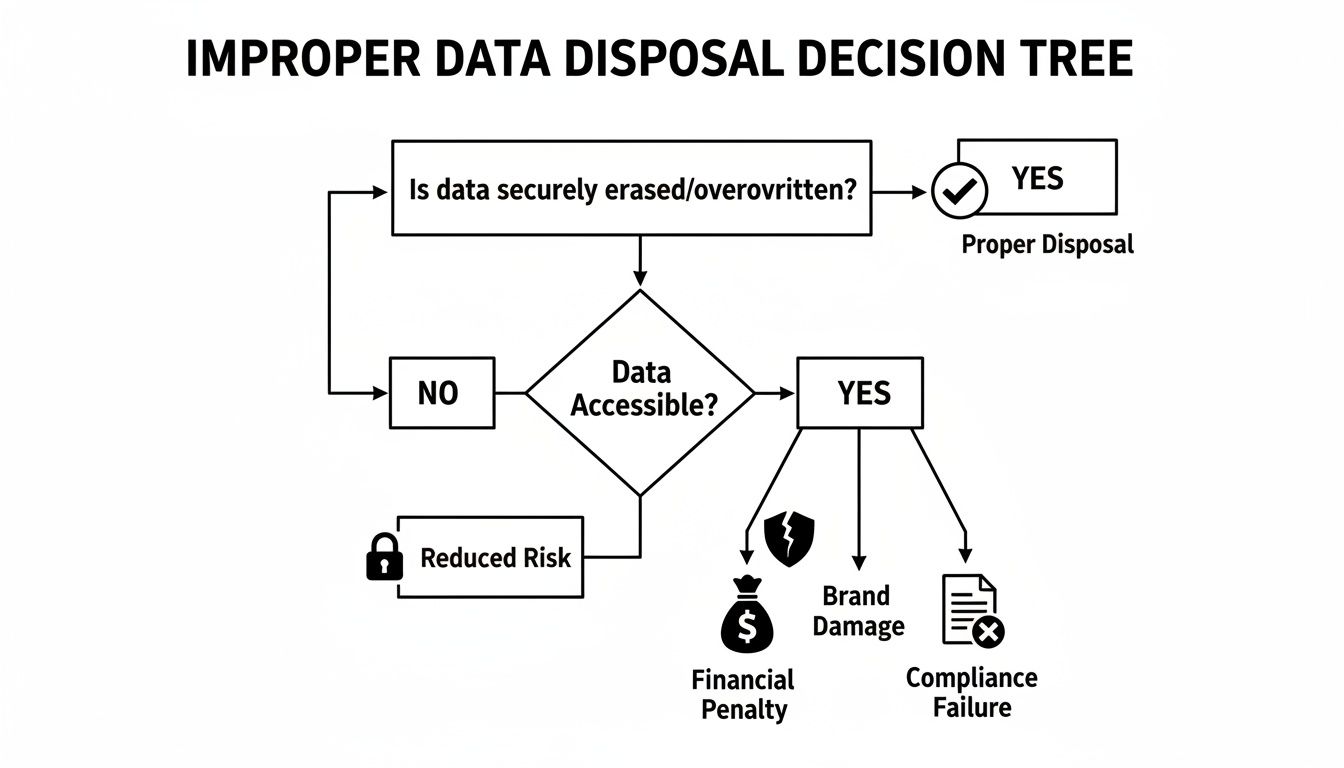
As you can see, every path of improper disposal leads to a painful business outcome. This is exactly why picking a certified, professional method is non-negotiable.
Data Wiping and Sanitization
Data wiping, which you'll also hear called sanitization, is a software-based approach. It works by overwriting every bit of existing data on a hard drive with random, meaningless characters. Think of it like scribbling over a sensitive document with a permanent marker so thoroughly that the original text is completely unreadable.
This isn't just a simple delete command; it's a methodical process that follows strict protocols to ensure no data is left behind.
Two of the most common standards you'll encounter are:
- DoD 5220.22-M: This is the classic three-pass overwrite method once used by the U.S. Department of Defense. While it's an older standard, it's still more than enough for most commercial data destruction needs.
- NIST 800-88: This is the current gold standard. Recommended by the National Institute of Standards and Technology, it offers several levels of "purging" data, making it impossible to recover even with forensic tools.
This is the perfect route to take for devices you want to reuse, sell, or donate. For example, if your company is upgrading laptops for the sales team, wiping the old drives to NIST 800-88 standards means you can safely donate them to a local school, giving the hardware a second life.
Physical Shredding and Crushing
When you have devices that are broken, ancient, or held the company's most guarded secrets, nothing beats physical destruction. There's no room for doubt here—the storage media is literally pulverized, making data recovery an absolute impossibility.
We're talking about industrial-grade shredders that chew up hard drives, solid-state drives (SSDs), backup tapes, and even phones into tiny, mangled pieces of metal and plastic. It is the ultimate guarantee of security.
Physical shredding is the go-to for healthcare providers retiring old servers packed with patient records or law firms getting rid of drives that hold confidential case files. When the tolerance for risk is zero, this is the only answer.
This method delivers total peace of mind, especially when you can see it happen with your own eyes. Lots of businesses seeking data destruction in Sandy Springs specifically ask for onsite shredding for this reason. A mobile shredding truck can pull right up to your office, and you can watch your assets get destroyed before they ever leave your property. You can learn more about our process by reading our guide to the secure destruction of data.
A Quick Comparison of Methods
To make the choice clearer, here’s a simple breakdown of how these methods stack up against each other. Each has its place, depending on your end goal.
Comparing Data Destruction Methods
| Method | Security Level | Best For | Allows Reuse? |
|---|---|---|---|
| Data Wiping (NIST 800-88) | Very High | Laptops, desktops, servers, and functional hard drives you plan to resell or donate. | Yes |
| Physical Shredding | Absolute | Old, broken, or end-of-life devices. Essential for highly sensitive data (PII, PHI, financial records). | No |
| Degaussing | High (for magnetic media) | Magnetic tapes, older hard disk drives (HDDs). | No |
Ultimately, whether you choose software-based wiping or physical obliteration, the goal is the same: ensuring your data never falls into the wrong hands.
Degaussing for Magnetic Media
Degaussing is a bit more specialized. It uses an incredibly powerful magnetic field to instantly scramble the data on magnetic storage, like old-school backup tapes and certain hard disk drives (HDDs). The intense magnetic force neutralizes the drive's platters where the data lives, wiping it clean in a second.
It's crucial to know, however, that degaussing is completely ineffective on modern solid-state drives (SSDs), USB flash drives, and smartphones, since they don't store data magnetically. It also renders the degaussed hard drive totally useless afterward. You'll mostly see this method used in data centers or archives with large libraries of magnetic backup tapes.
Navigating Data Privacy and Compliance Laws
For any business in Sandy Springs, picking a data destruction method is only half the story. The other, more critical half—the part that keeps you out of legal hot water—is making sure your process lines up with a tangled web of data privacy laws. These aren't just friendly suggestions; they're strict rules with hefty fines attached.
Simply tossing old hard drives in a dumpster isn't just lazy—it can be downright illegal. It only takes one forgotten device loaded with personal data to kick off a chain reaction of audits, fines, and lawsuits that could cripple a small business or stain a large company's reputation. Getting a handle on these rules is non-negotiable.
Key Regulations That Impact Your Business
While the list of data protection laws feels a mile long, a few big ones directly affect how local businesses must handle their old electronics. Each law targets different kinds of sensitive info, but they all have one thing in common: they make you responsible for protecting consumer and patient data.
- HIPAA (Health Insurance Portability and Accountability Act): This is the heavyweight for anyone in healthcare, from major hospitals to solo dental practices. HIPAA demands that all Protected Health Information (PHI) is rendered completely unreadable and impossible to piece back together before a device is discarded. Dragging a file to the trash bin doesn't even come close.
- FACTA (Fair and Accurate Credit Transactions Act): If you handle any kind of consumer report—think credit checks, background screenings, or insurance claims—FACTA is on your radar. The law includes a Disposal Rule that requires you to take "reasonable measures" to destroy this information, which is why physical shredding is such a common and effective approach.
- GDPR (General Data Protection Regulation): It might be a European law, but GDPR can easily apply to Sandy Springs companies that process data for EU residents. It sets an incredibly high standard for data protection, including the "right to be forgotten," which often requires undeniable proof that the data is gone for good.
At the end of the day, the principle is simple: if you collect sensitive data, you are legally on the hook for its secure destruction when it's no longer needed. Claiming you didn't know the rules won't hold up in an audit or a courtroom.
Failing to comply can be a financial nightmare. HIPAA penalties alone can soar to $1.5 million per violation category, per year. This is exactly why bringing in a certified data destruction partner isn't a luxury—it’s a core part of modern risk management. A professional creates a paper trail that proves you did your due diligence.
The Critical Role of Documentation
In the world of compliance, proof is everything. If you can't prove your data was destroyed securely, you might as well have not done it at all. This is where two key documents become your legal shield.
1. Chain-of-Custody Logs: This document acts like a passport for your IT assets, tracking them from the moment they leave your facility to their final destruction. A proper log will always include:
* Serial numbers for every single device.
* The exact date and time of pickup.
* The name of the technician handling the assets.
* Confirmation of secure transport.
* The final date and method of destruction.
This detailed tracking leaves no room for error or questions about where a device might have gone. It provides a completely transparent and auditable history.
2. Certificate of Destruction: After the job is done, you should receive a formal Certificate of Destruction. This is a legally binding document that acts as your official receipt, proving the data was permanently destroyed according to all relevant federal and state laws. It's the final, crucial piece of the compliance puzzle. For a deeper dive, you can learn more about what makes a great hard drive certificate of destruction.
Think of these documents as your get-out-of-jail-free card. When an auditor eventually asks what you did with those old company laptops, you can hand over a complete file that shows a secure, documented, and fully compliant process. This proactive step doesn't just reduce risk; it strengthens the trust your customers have in your brand.
How to Vet a Data Destruction Provider in Atlanta
Choosing a partner for data destruction in Sandy Springs is a big deal. This decision directly impacts your company’s security, its reputation, and even your bottom line. With so much on the line, you need a solid way to separate the true professionals from the risky operators.
A great provider doesn't just haul away old equipment. They become a trusted extension of your own risk management strategy. This means you need to ask sharp, specific questions that go far beyond a simple price quote. You're looking for concrete proof of their security protocols, their compliance expertise, and their commitment to a transparent process. The right questions will tell you everything you need to know.
Start with Certifications and Security Protocols
Before you even get into the services they offer, the very first question should be about their industry certifications. These aren't just fancy badges for their website; they're proof that a neutral third party has rigorously inspected their facility and processes.
You'll want to look for these key credentials:
- R2 (Responsible Recycling): This certification is a big one. It ensures the provider adheres to the highest standards for environmental safety, worker health, and data security through the entire lifecycle of the electronics.
- NAID AAA Certification: Specifically for data destruction, this is the gold standard. It verifies everything from secure operational processes to employee background checks, giving you serious peace of mind.
Once you’ve confirmed their certifications, it's time to dig into their physical and digital security. How do they secure their facility? Ask about surveillance cameras, controlled access points, and locked-down storage areas. You should also ask how they vet the employees who will be handling your most sensitive assets. A professional, trustworthy provider will have clear, confident answers ready.
Scrutinize the Chain-of-Custody Process
An unbroken chain of custody is your absolute best defense against data loss while your assets are in transit. This is a common point of failure where breaches happen, so you need to understand their process from the moment they arrive at your door to the final destruction. Any vague or sloppy answers here are a major red flag.
Ask them to walk you through their entire process, step-by-step:
- Onsite Verification: Do they scan and log the serial numbers of every single asset before it leaves your office? This initial log is critical for accountability.
- Secure Transportation: Are their trucks locked and tracked with GPS? Do they use their own trained employees, or do they outsource to third-party couriers?
- Facility Check-in: What’s the procedure for receiving and logging assets once they arrive at their secure facility?
- Final Documentation: What, exactly, will their Certificate of Destruction include? It should list every serial number you provided at the start.
A provider who can't offer a detailed, asset-by-asset tracking report from pickup to destruction is leaving a gaping hole in your security posture. Don't settle for anything less than complete transparency.
This level of detail is also essential for corporate citizenship. Sandy Springs' environmental challenges have grown as capital assets increased by 3.60% to $540.96 million by mid-2023, largely due to new infrastructure. While great for the city, this progress has unfortunately contributed to the loss of over 80 acres of tree canopy. This context makes secure, responsible e-waste disposal a vital part of being a good corporate citizen.
Inquire About Service Flexibility and Impact
Finally, a truly great partner should be able to meet your specific operational needs and, ideally, align with your company's values. Do they offer both onsite and offsite destruction? For highly sensitive data, onsite shredding can be invaluable, as it allows you and your team to witness the destruction firsthand.
You should also ask about their social and environmental mission. Choosing a partner like Atlanta Green Recycling transforms a simple compliance task into a positive action. Our unique model ensures that your retired assets are not only securely destroyed but also contribute to veteran support programs and local reforestation efforts. We even offer a referral program where we plant an extra tree in your name for every new customer you send our way.
When vetting any provider, ask if they can offer a similar dual impact. You can see how we stack up against other IT asset disposition companies in the area and decide for yourself.
Turn Your E-Waste Into a Force for Good
Secure data destruction is an absolute must for any Sandy Springs business. It’s a critical, non-negotiable step. But what if that routine task could do more? What if retiring old IT assets could create a positive ripple effect right here in our community?
This is where a simple compliance task becomes a powerful story of corporate social responsibility.
At Atlanta Green Recycling, we've built our services around a simple but powerful idea: your old tech can house a veteran and grow a forest. It's a mission woven into every single pickup, every data wipe, and every shredded hard drive, turning a standard business process into a meaningful contribution.
Recycling That Restores Lives and Landscapes
Our approach is built on two core pillars of giving back. First, we partner directly with organizations dedicated to supporting our nation's veterans, helping provide crucial resources to those who have served. Alongside that, we’re committed to reforesting our local landscapes by planting trees for the equipment we recycle.
This isn’t just some vague promise; it’s a tangible, real-world outcome. When your company partners with us for data destruction in Sandy Springs, you’re not just getting a Certificate of Destruction. You're directly fueling a cycle of restoration for both people and the planet.
We call this our "Recycle for a Cause" campaign. It’s an emotional and practical connection between your retired IT assets and the real-world impact they can have. This initiative turns e-waste from a liability into a source of hope.
For our corporate partners, this creates a compelling narrative for your ESG (Environmental, Social, and Governance) and CSR (Corporate Social Responsibility) initiatives. It’s an authentic way to demonstrate your company’s commitment to making a genuine difference.
Making Your Corporate Impact Tangible
We get it. For businesses, showing your social responsibility requires clear, documented proof. That’s why we provide our partners with detailed impact reporting that goes far beyond a standard service confirmation, making it easy to track and share the good you’re doing.
When you work with us, you’ll receive:
- Veteran Support Impact Reports: These documents quantify how your e-waste contribution has supported veteran aid programs—perfect for your annual CSR reporting.
- Plant-A-Tree Certificates: For every qualifying pickup, you’ll get a personalized certificate detailing the number of trees planted in your company’s name to showcase your environmental stewardship.
To help you share your commitment, we also offer a digital "Recycled with Purpose" eco-badge. Partners can display this badge on their websites and in sustainability reports, signaling to customers and stakeholders that their e-waste is handled responsibly and with a mission.
A corporate recycling drive for 50 or more devices, for example, not only includes free pickup but also comes with these valuable documents. It turns a simple office cleanout into a documented ESG win. To see how it works, you can explore our full range of services for e-waste recycling in Sandy Springs.
Engaging the Community for Greater Good
Our mission doesn't stop with individual business partnerships. We actively engage with the community to maximize our impact, building a network of support that amplifies everyone's efforts.
We do this by co-hosting recycling drives with veteran organizations, like local VFW chapters, and environmental nonprofits. These collaborations build grassroots awareness and create accessible opportunities for everyone to contribute.
We also partner with schools, universities, and municipal bodies under our broader "Greener Atlanta" initiative, collecting devices and planting trees to foster a more sustainable future. This community-first approach builds credibility and ensures the benefits of responsible recycling are felt right here at home.
Answering Your Data Destruction Questions
Even with a solid plan, you're bound to have a few questions when it's time to schedule a data destruction Sandy Springs service. Getting clear answers is the final step to ensuring the whole process is buttoned-up, secure, and smooth. We hear the same questions from local businesses all the time, so we've put together the answers you need.
This is about more than just logistics. Knowing the ins and outs helps you budget correctly, manage expectations with your team, and make sure no device—and no data—gets left behind.
How Is Data Destruction Priced?
Pricing isn't one-size-fits-all, but most professional services fall into a few common models. Once you understand them, it's much easier to compare quotes and find a solution that fits your budget without cutting corners on security.
Here are the most common ways you'll see pricing structured:
- Per Hard Drive: This is as straightforward as it gets. You pay a set fee for every single drive that's wiped or shredded. It’s a great option for smaller batches or when you need a precise device count for your internal records.
- Per Pound: When you're dealing with a massive cleanout—think thousands of devices from an office move or tech refresh—pricing by weight is usually the way to go. The vendor weighs all the material in bulk and charges a flat rate per pound.
- Flat Fee or Project-Based: For big, complex jobs like a full data center decommissioning, a provider will often quote a single project fee. This all-inclusive price covers the labor, logistics, transportation, and destruction for the entire scope of work.
No matter the model, always ask for a detailed, itemized quote. That’s the best way to avoid any surprise charges down the line.
Onsite vs. Offsite: Which Is Better?
The debate between onsite and offsite destruction really boils down to your company's risk tolerance and specific security policies. There’s no single "better" choice; each has its own clear advantages.
Onsite destruction is exactly what it sounds like: a mobile shredding truck comes right to your Sandy Springs office. You can literally stand there and watch your hard drives get turned into tiny pieces before they ever leave your property. This offers the ultimate chain-of-custody control and is often the required method for organizations handling data governed by HIPAA or FACTA.
Offsite destruction, on the other hand, involves having your assets picked up by a secure, GPS-tracked vehicle and transported to a certified destruction facility. The entire process is tracked with a rigorous chain-of-custody log from start to finish. For larger volumes, this is often the more cost-effective and efficient route, and it's every bit as secure when you're working with a NAID AAA Certified provider.
What Other Devices Need Data Wiped?
Hard drives get all the glory, but they are far from the only place sensitive data is hiding in your office. A truly comprehensive data destruction plan has to account for every piece of electronics with a memory chip. Forgetting just one can leave a massive security hole.
A common mistake we see is businesses focusing only on computers and servers. Any device with internal memory—from an office printer to a company smartphone—can hold residual data that poses a security risk if not properly sanitized or destroyed.
Make sure your IT asset disposal checklist includes these often-overlooked items:
- Printers and Scanners: Those big office machines have internal hard drives that store a ghost image of every document you've ever scanned, copied, or printed on them.
- Smartphones and Tablets: Company phones are loaded with emails, client contact lists, financial apps, and all sorts of confidential business data.
- USB Drives and Memory Cards: They're small, easy to lose, and can hold an incredible amount of sensitive information.
- Networking Equipment: Old routers and switches can store network configurations and access credentials, giving a potential bad actor a map to your network.
Ready to turn your IT asset disposal into a secure, compliant, and impactful process? At Atlanta Green Recycling, we offer certified data destruction services that protect your business while supporting veterans and reforestation. Schedule your secure pickup today.