A Business Guide to Electronics Recycling in the City of Atlanta


If you’re running a business in the City of Atlanta, you know the city is booming. But with that growth comes a challenge that often piles up in a storage closet or a corner of the warehouse: old electronics. This isn't just about being compliant—it's about turning a logistical headache into a real opportunity for your company.
Your Guide to Business E-Waste in the City of Atlanta
When Atlanta businesses hear "e-waste," the first things that come to mind are usually old desktop computers and monitors. But the reality is so much bigger. It includes everything from the specialized diagnostic tools in a Midtown healthcare clinic to the massive server racks powering our city's thriving tech hubs.
As Atlanta’s corporate footprint expands, so does the mountain of outdated, broken, and retired electronics.
The Growing E-Waste Challenge
The Atlanta metro area is one of the fastest-growing regions in the country. Between April 2025 and April 2026 alone, the area welcomed 64,400 new residents, bringing our total population to nearly 5.3 million.
This incredible growth directly fuels a surge in business-to-business e-waste. New corporate headquarters are built, hospitals upgrade equipment that holds sensitive HIPAA data, and universities constantly refresh their technology. For any organization, this boom presents three distinct hurdles:
- Securing Sensitive Data: Every single device slated for disposal, from a company smartphone to a server hard drive, is a potential data breach waiting to happen. If not handled correctly, the risk is enormous.
- Complying with Regulations: A web of federal and industry-specific rules dictates how hazardous materials and private data must be managed. Getting it wrong can lead to steep fines and serious legal consequences.
- Managing Logistics: For most IT departments and office managers, the sheer work of inventorying, storing, and transporting dozens or hundreds of devices is a logistical nightmare.
A New Model for Recycling
This guide is designed to be your strategic roadmap. We’re laying out actionable strategies for IT managers, compliance officers, and business owners across the City of Atlanta. The goal is to show you that responsible e-waste management is far more than just a box to check.
It's an opportunity to enhance your brand's reputation, protect your organization from risk, and contribute to a greater cause.
We believe in a model that transforms this operational chore into an impactful story. When you partner with Atlanta Green Recycling, your obsolete tech becomes a powerful tool for good. For instance, our "Recycle for a Cause" campaign directly connects your e-waste to real-world outcomes, allowing you to tell a story like, "Your old tech can house a veteran and grow a forest."
This approach turns a simple pickup into a powerful narrative of community support and environmental stewardship. You can find more details in our guide on how to get started with City of Atlanta recycling for your business. It creates value that extends far beyond your balance sheet.
Navigating Atlanta's E-Waste Rules and Regulations
Trying to get a handle on the legal side of e-waste in the City of Atlanta can feel like untangling a knot, but it’s absolutely essential for avoiding some serious business risks. It often comes as a surprise to business owners that even though Georgia doesn't have a statewide ban on landfilling electronics, their organization is far from being off the hook.
The real teeth come from federal laws, especially the Resource Conservation and Recovery Act (RCRA), which holds your business directly accountable. This law governs how both solid and hazardous waste gets thrown away. Since many common electronics—think old CRT monitors, circuit boards, and batteries—are loaded with hazardous materials like lead, mercury, and cadmium, just tossing them in the trash can trigger massive fines and liability that sticks with you for years.
Here’s a simple way to think about it: You wouldn't throw a stack of sensitive financial documents into a public dumpster because of the obvious privacy risks. In the same way, you can't just discard old devices filled with hazardous materials or confidential data. The potential for steep penalties and a damaged reputation is just too high.
Why Municipal Programs Fall Short for Businesses
You've probably seen the signs around town for e-waste collection days or local recycling centers. While these are fantastic programs for Atlanta residents, they are completely unequipped to handle the needs of businesses, schools, or hospitals.
There are three big reasons why they just don't work for organizations:
- Volume Limitations: City programs are set up for household quantities—a single old TV or a couple of laptops. They simply can’t manage the bulk disposal that happens when a company decommissions a few dozen computers or a data center clears out old servers.
- Lack of Data Security: These public drop-off points offer zero guarantees that your data will be securely destroyed. Leaving a company hard drive at a residential collection event is a major security gamble, putting sensitive corporate, employee, or customer data at risk.
- No Compliance Documentation: Businesses need a paper trail. You require a clear chain of custody and official paperwork to prove you’ve met your legal obligations. Residential programs don't issue the Certificates of Data Destruction or Recycling that are critical for passing audits and maintaining compliance records.
Overlooking these differences puts your organization in a tight spot, leaving you wide open to data breaches and environmental penalties. You can take a closer look into this topic by exploring the full legal landscape of electronics recycling in Atlanta and how it directly affects your operations.
The Real Cost of Non-Compliance
Failing to follow these regulations isn't a small mistake; it's a major business risk. For companies in heavily regulated fields like healthcare (HIPAA) or finance (GLBA), the fallout is even more dramatic. A single data breach from an improperly discarded device can lead to seven-figure fines, legally mandated public disclosures, and a loss of customer trust that could take a decade to earn back.
The core principle is straightforward: your business is responsible for its electronic assets from cradle to grave. This responsibility doesn't end when a device is no longer useful; it ends when it has been securely and responsibly destroyed or recycled by a certified partner who provides auditable proof.
At the end of the day, relying on city residential programs or an uncertified vendor is a bet that no responsible Atlanta business can afford to make. The only way to guarantee complete protection is by partnering with a professional e-waste recycler who gets the specific security, logistical, and documentation requirements of a corporate environment. This turns a compliance headache into a secure, straightforward process that protects your organization from every angle.
Protecting Your Business From Data Security Risks
For most Atlanta businesses, the biggest risk that comes with old electronics isn't about the environment—it's about the data left on them. Think about it. A single forgotten hard drive, an old company phone, or a decommissioned server can be a ticking time bomb. If it falls into the wrong hands, it’s a direct gateway to a catastrophic data breach, exposing your company’s trade secrets, employee records, or customer information.
This isn’t just a vague warning; it’s about very specific, legally binding rules that businesses have to follow.
Atlanta is a hub for all kinds of industries, and many have to comply with strict data protection laws. A healthcare provider in Buckhead, for instance, lives by the Health Insurance Portability and Accountability Act (HIPAA). A financial firm downtown must answer to the Gramm-Leach-Bliley Act (GLBA), and an institution like Georgia State University is bound by the Family Educational Rights and Privacy Act (FERPA).
These aren't just suggestions. They're laws with heavy penalties for anyone who fails to comply.
What True Compliance Demands
Getting this right involves a lot more than just calling a junk hauler. True compliance means having a secure, documented process that proves your data has been permanently destroyed. It all starts with a clear chain of custody—a paper trail that tracks your IT assets from the moment they leave your facility to the moment they are destroyed.
This documentation is your shield. Without it, you’re left wide open to liability if your data surfaces somewhere it shouldn't. Whether you're recycling or reselling, understanding the critical data security steps when selling used electronics is a non-negotiable first step in protecting your organization.
Think of certified data destruction like digitally shredding a document so completely that not even the world's best forensic expert can piece it back together. It renders the data permanently unrecoverable, which is the only way to ensure 100% security.
To make that happen, professional e-waste recyclers use a few different methods. Knowing how they work is key to choosing the right one for your needs.
Methods of Certified Data Destruction
Not all data destruction is created equal. The best method really depends on the device, whether it can be reused, and your company's own security policies. Here are the three main approaches used to protect your business.
1. Data Wiping (Sanitization)
This is a software-based approach where the entire hard drive is overwritten with random data, usually in multiple passes. This process follows strict standards like DoD 5220.22-M, ensuring the original data is gone for good and can't be recovered even with forensic tools.
- Best For: Newer, working hard drives and SSDs that can be refurbished and given a second life.
- Outcome: The drive is wiped completely clean and can be put back on the market, supporting the circular economy.
2. Degaussing
This technique uses an incredibly powerful magnetic field to instantly scramble the magnetic coating on a hard drive or tape where data is stored. The process effectively destroys the data, making the media unreadable and completely useless.
- Best For: Older or broken hard drives and magnetic media like backup tapes.
- Outcome: The drive is rendered inoperable and is then sent for physical recycling.
3. Physical Shredding
This is exactly what it sounds like. The hard drive, phone, or other device is fed into an industrial-grade shredder that grinds it into tiny pieces of metal and plastic. There’s zero chance of data recovery because the device literally doesn't exist anymore.
- Best For: Outdated, non-functional, or extremely sensitive devices where absolute, final destruction is the only option.
- Outcome: The shredded material is securely recycled as commodity scrap.
Partnering with a recycler who can provide these certified services is the only way to guarantee your company’s sensitive data stays out of the wrong hands. For a closer look at how these processes work, check out our complete guide on certified data destruction in Atlanta. At the end of the day, protecting your business means making sure your old electronics are handled with security as the top priority.
Putting Your Corporate E-Waste Program into Action
Okay, we've covered the risks and the city-specific rules. Now for the practical part: how do you build a responsible e-waste recycling program that protects your business and actually simplifies your operations?
Turning this complex challenge into a smooth, manageable process is easier than you think. It all comes down to having a clear framework. Let's walk through the steps to get it right here in the City of Atlanta. It starts with a simple inventory, moves to secure collection, and ends with a partnership that delivers total peace of mind.
Step 1: Know What You Have with an IT Asset Inventory
Before you can recycle anything, you need a clear picture of what you’re dealing with. This is the foundational step—you can't manage what you haven't measured.
- List Everything: Create a detailed spreadsheet documenting every single electronic asset you plan to retire. This includes desktops, laptops, servers, printers, and mobile phones. Make sure to log details like serial numbers, internal asset tags, and the general condition of each device.
- Flag Data-Bearing Devices: This is critical. Go through your list and highlight every asset capable of storing sensitive information. These items will need certified data destruction, no exceptions.
- Assess for Value: Does anything have resale potential? Newer, functional equipment might be refurbished, which can often generate a return on your initial investment.
Getting this inventory right from the start establishes a clear chain of custody, which is non-negotiable for the rest of the process.
Step 2: Set Up a Secure Collection System
Once your inventory is complete, the next move is to designate a secure, centralized collection point inside your facility. This single step prevents valuable (and data-heavy) devices from getting lost, stolen, or thrown in a dumpster by mistake.
Make sure your team is trained on the new protocol. They are your first line of defense against an accidental data breach or compliance failure.
The need for organized, secure systems like this is becoming more urgent as the City of Atlanta continues its rapid expansion. The city’s population jumped from 429,414 in 2010 to nearly 500,000 by 2020. More recently, Atlanta welcomed another 10,600 new residents in just one year, bringing the total to 542,715. This boom means more offices, more hospitals, and more data centers—all generating a constant stream of e-waste that needs professional, secure handling.
Step 3: Choose Your Certified Recycling Partner
This is the most important decision you'll make. Not all electronics recyclers are the same, and the wrong choice can expose you to significant risk. Your partner must be fully certified and equipped to handle your specific security and compliance needs.
A professional recycling partnership is an "easy win" for your company's ESG goals. It transforms a logistical headache into a positive story for your annual corporate social responsibility report and builds trust with stakeholders.
Here’s what to look for in a partner:
- Certified Data Destruction: They must offer multiple levels of security, including software wiping, degaussing, and physical shredding. Always ask for a Certificate of Data Destruction to prove it was done.
- Turnkey Logistics: The right partner handles everything—from coming onsite for de-installation and packing to secure transport. This is especially important for bulk pickups of 50+ devices.
- Comprehensive Documentation: A complete audit trail is essential. This includes serialized inventory reports that match your initial list and official recycling certificates.
The infographic below shows the core methods a certified partner uses to ensure your data is gone for good.
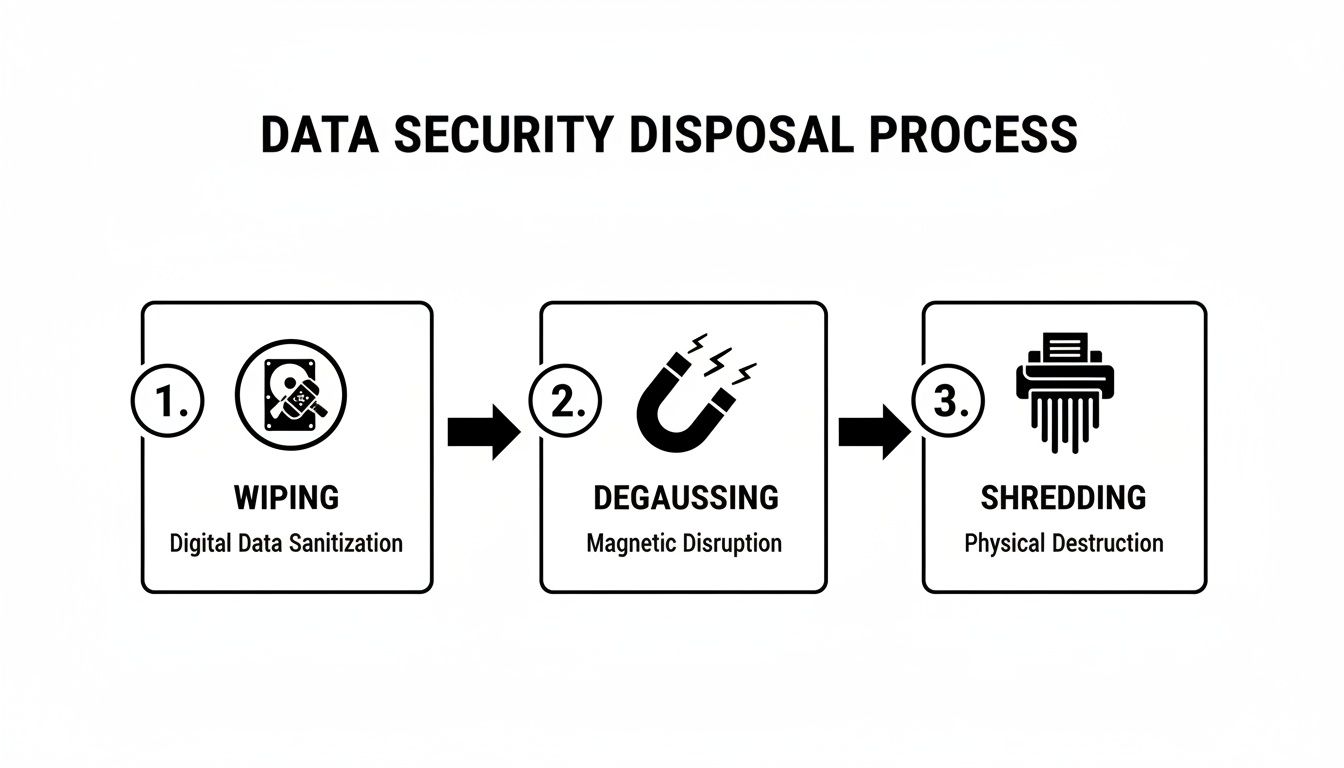
This process shows the flexibility needed to handle different assets correctly—from hard drives that can be wiped and reused to old media that requires complete physical destruction.
Step 4: Schedule the Pickup and Document Your Impact
With a trusted partner selected, scheduling your pickup is straightforward. Just coordinate a time that minimizes disruption for your team, and let the experts take care of the heavy lifting.
After the job is done, you'll receive all the documentation you need for your compliance records.
When you work with Atlanta Green Recycling, you also get something more: tangible assets to showcase your commitment to sustainability. Our partners receive a “Recycled with Purpose” digital badge for their website and ESG reports. It’s a simple but powerful way to turn a compliance task into a public-facing win.
Recycling That Restores Lives and Landscapes

Managing e-waste in the City of Atlanta is about so much more than just checking a compliance box. Of course, following regulations and protecting your data are non-negotiable. But what if that routine task could become a powerful statement about your company's values? This is where we see compliance transform into connection.
We truly believe that your old technology can be a catalyst for good. It’s about shifting the focus from the “how” of recycling to the “why.” When you do that, your company can turn a pile of obsolete equipment into a genuine story of hope and renewal. This is a model where your e-waste does more than just protect the environment—it actively helps restore lives and landscapes.
Turning E-Waste into Hope for Veterans and Forests
Through our “Recycle for a Cause” campaign, we tie the simple act of recycling to profound, real-world outcomes. We don’t just process electronics; we use authentic storytelling to bridge the gap between your decommissioned servers and tangible impact.
Our message is simple: “Your old tech can house a veteran and grow a forest.”
This isn't just a catchy phrase; it's our operational promise. A portion of the value we recover from your electronics goes directly to vetted non-profits that provide housing, employment, and critical support services to veterans. At the same time, we partner with the National Forest Foundation to plant trees in vital ecosystems, turning every qualifying pickup into a direct contribution to reforestation.
The economic and logistical engine of our city only amplifies this need. With Hartsfield-Jackson Atlanta International Airport—the world's busiest—at our core, Atlanta has become a global powerhouse. This has attracted a dense network of data centers, hospitals, and corporate headquarters. While the constant churn of technology creates a massive stream of e-waste, it also presents an incredible opportunity for companies to meet ESG goals by diverting tons of material from landfills to support veteran aid and tree planting.
Your Impact Documented and Certified
We think that when you do good, you should absolutely get the credit for it. Your company’s commitment deserves to be seen, celebrated, and shared with everyone. That’s why we provide a complete documentation package that goes way beyond standard compliance paperwork.
Once your Atlanta electronics recycling is complete, we deliver tangible proof of your dual impact, perfect for your ESG and CSR reports:
- Plant-A-Tree Certificates: Official documentation showing the exact number of trees planted in your company’s name.
- Veteran Support Impact Reports: A clear summary detailing how your contribution helped support local veteran-focused initiatives.
- “Recycled with Purpose” Eco-Badge: A digital certification for your website and sustainability reports, showcasing your deep commitment to both community and environment.
This transforms a standard operational task into a powerful extension of your corporate values. It creates a compelling story that resonates with employees, customers, and stakeholders, proving that your business is dedicated to building a better, greener City of Atlanta. It’s more than just recycling; it’s recycling that restores.
Frequently Asked Questions About Atlanta E-Waste Disposal
When it comes to getting rid of old electronics, we know IT managers and compliance officers in the City of Atlanta have a lot on their plates. You need clear, direct answers. We’ve put together this FAQ to address the most common concerns we hear, giving you the confidence to manage your company's e-waste responsibly.
Are Atlanta Businesses Legally Required to Recycle Electronics?
This is a common point of confusion. While Georgia doesn't have a blanket state law forcing every business to recycle electronics, you're absolutely on the hook for federal regulations. The big one is the Resource Conservation and Recovery Act (RCRA), which holds you responsible for any hazardous materials found in your old equipment.
On top of that, data security laws like HIPAA and GLBA aren't optional. They legally require you to destroy sensitive information before a device leaves your control. Failing to do so can result in some serious penalties. This is why partnering with a certified e-waste recycler isn't just a "nice-to-have"—it's the only practical way to cover your bases and ensure full compliance.
What Documentation Proves Our Equipment Was Handled Responsibly?
Any professional e-waste partner should provide a rock-solid documentation package. This isn't just paperwork; it's your proof of compliance for any future audit.
You should always expect to receive:
- A Certificate of Data Destruction, which verifies that all data was sanitized according to rigorous standards like DoD 5220.22-M.
- A Certificate of Recycling, confirming that all materials were managed in an environmentally sound way.
- A Serialized Inventory List, giving you a detailed, item-by-item record of every asset we process.
For our partners who participate in our cause-based programs, we also provide a Veteran Support Impact Report and a Plant-A-Tree Certificate for your ESG and CSR reporting.
This documentation transforms a routine service into a powerful asset. It not only proves compliance but also quantifies your company's positive impact on the community and environment, strengthening your brand's story.
How Do You Handle Bulk Pickups for Large Offices?
We make large-scale pickups straightforward and secure. For businesses with 50 or more devices, our insured team offers a complete, turnkey service designed to cause minimal disruption.
Our crew can come directly to your Atlanta office to handle everything from on-site de-installation to secure packing and transport in our own fleet. All you have to do is show us the equipment, and we take it from there. You can explore our guide for more information on where to recycle electronics in the city.
How Does Recycling with You Actually Help Veterans and Plant Trees?
Our "Recycling That Restores Lives and Landscapes" model isn't just a slogan—it's built directly into how we operate. It's how we turn old technology into a source of hope.
A portion of the value we recover from recycling your electronics is donated directly to vetted non-profits that provide veterans with essential services, from housing to employment support. We also partner with the National Forest Foundation to plant trees for every qualifying pickup. When you work with us, your obsolete equipment becomes a tangible force for good.
Ready to turn your e-waste into a powerful story of compliance, security, and social impact? Partner with Atlanta Green Recycling and see how simple it can be to protect your business while making a real difference. Schedule your secure, convenient pickup today at https://www.greenatlanta.com.