A Guide to Atlanta Hartsfield Jackson Atlanta International Airport


If you've ever flown, you've almost certainly heard of—or passed through—Hartsfield-Jackson Atlanta International Airport. Known simply as ATL to travelers and industry pros alike, it consistently holds the title of the world's busiest airport. But it's more than just a place to catch a flight; it's a massive economic driver for Atlanta and a critical junction for global commerce.
Welcome to the World's Busiest Airport Hub
To call Hartsfield-Jackson big is an understatement. It’s a city within a city, a sprawling complex that acts as the nerve center for a huge slice of global air traffic. Its scale is something you have to see to believe, connecting hundreds of destinations and serving as a vital piece of the world's commercial infrastructure.
This immense scale is most obvious in its passenger numbers. The airport solidified its top spot in 2026 by serving an incredible 108.1 million passengers. That figure wasn't just a number—it was the second-highest in the airport's history and a 3% jump from the year before, signaling a powerful rebound in air travel. You can dig into the details of this growth over on AirportChamber.com.
Before we dive deeper, here’s a quick overview of ATL's key statistics.
Hartsfield-Jackson Atlanta International Airport at a Glance
| Feature | Details |
|---|---|
| IATA Code | ATL |
| Location | Atlanta, Georgia, USA |
| Annual Passengers (2026) | 108.1 million |
| Terminals | 2 (Domestic & International) |
| Concourses | 7 (T, A, B, C, D, E, F) |
| Airlines Served | Serves as a major hub for Delta Air Lines |
| Destinations | Connects to over 150 domestic and 70 international destinations |
This table just scratches the surface, but it gives you a sense of the sheer magnitude of operations at Hartsfield-Jackson every single day.
A Look at the Airport's Layout
Getting around this giant space is surprisingly straightforward once you understand its basic design. The airport is built around two main terminals, which are connected by one of the most efficient transit systems you'll ever encounter.
- Domestic Terminal: This is your starting point for any flight within the United States. It’s split into North and South sides, where different airlines handle their ticketing and baggage claims. Simple.
- Maynard H. Jackson Jr. International Terminal: This sleek, modern terminal handles all international arrivals and departures, giving global travelers their own dedicated, streamlined space.
These two terminals are the front doors to seven parallel concourses, which are the long hallways where the gates are located. They're labeled T, A, B, C, D, E, and F. The easiest way to get between them is the underground Plane Train, an automated people mover that works like a subway, zipping you from one concourse to the next in just a few minutes.
At its heart, ATL is a machine, one finely tuned for mind-boggling scale and efficiency. Its purpose goes far beyond just moving people; it's a critical hub for global cargo and the very foundation of Atlanta's business ecosystem.
The constant hum of activity is a testament to its importance. For the thousands of businesses that rely on the airport—from logistics companies and hotels to airline maintenance crews and corporate headquarters—knowing ATL isn't just helpful, it's essential for business. This non-stop motion is what fuels Atlanta’s economy, driving a cycle of growth, innovation, and, of course, the need for smart, responsible operational solutions. This guide is here to help you make sense of it all.
Navigating Terminals and Concourses Like a Pro
Stepping into Hartsfield-Jackson can feel like entering a small city. But don't let its massive scale intimidate you; the airport's design is incredibly straightforward once you understand the basic flow.
Everything boils down to two main buildings that act as the front doors for every passenger. You'll start your trip at either the Domestic Terminal or the Maynard H. Jackson Jr. International Terminal. The Domestic Terminal is further divided into North and South sides, which just helps organize ticketing and baggage claim for different airlines. The International Terminal is a separate, modern building that handles all flights coming from or going to other countries.
The Plane Train: The Airport's Subway
The secret to getting around ATL with ease is the Plane Train. It’s a remarkably efficient underground people mover—basically the airport's own private subway system, and it runs 24/7. It's your connection between the terminals and all seven concourses (T, A, B, C, D, E, and F), making what could be a long walk a quick, painless ride. A trip between any two concourses usually takes just a couple of minutes.
The infographic below shows how ATL's role as the world's busiest airport is deeply connected to its function as a massive economic driver and a critical global hub.
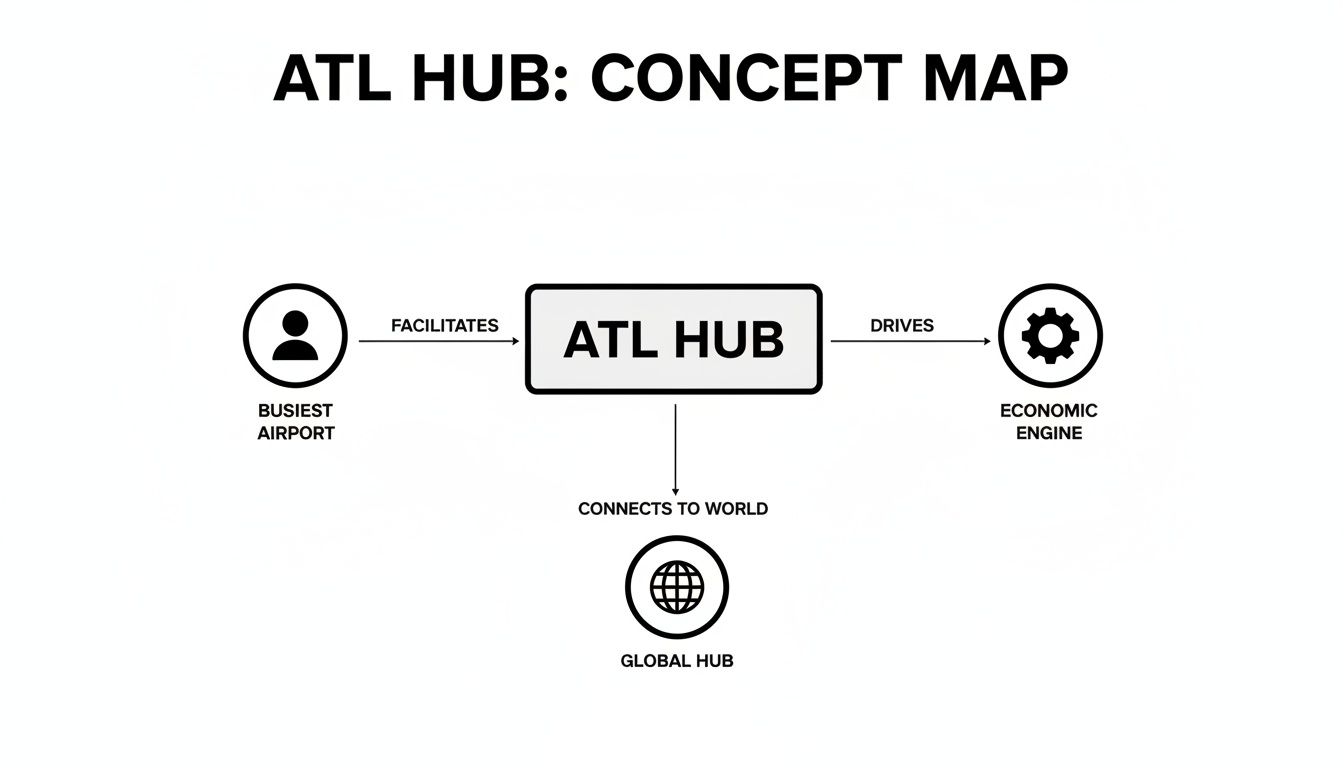
This visual helps explain how these core functions feed into one another, creating the foundation for the airport’s enormous operational scale.
A Quick Guide to the Concourses
After you’ve cleared security, you’ll emerge into one of the concourses. Think of each one as a long hallway filled with gates, shops, and restaurants. Knowing where your airline operates can save you a lot of time and stress. For a deeper look at the terminals and their services, you can explore our full guide on the Hartsfield-Jackson Atlanta International Airport location.
Pro Tip: Your boarding pass is your map. The gate number will always start with the concourse letter (like A12, C34, or F8). As soon as you’re through security, look for the overhead signs and hop on the Plane Train to get headed in the right direction.
Here’s a general rundown of which airlines you can expect to find on each concourse:
- Concourse T: This one is directly attached to the Domestic Terminal, making it walkable. It serves airlines like American, Spirit, and United.
- Concourses A, B, C, & D: Welcome to Delta country. As ATL's biggest carrier, Delta Air Lines dominates these four central concourses for its domestic operations.
- Concourses E & F: These handle the bulk of international travel. Concourse F connects directly to the International Terminal and is the home base for most international airlines, along with many of Delta's own international flights.
Mastering Ground Transportation and Parking at ATL
Getting in and out of Hartsfield-Jackson Atlanta International Airport can feel like its own journey, but it doesn't have to be a complicated one. Once you know the lay of the land, you'll find plenty of ways to get where you're going, whether your top priority is speed, cost, or pure convenience.
Let's break down your options so you can navigate ATL like a local, ensuring a smooth start or finish to your trip.

Public Transit and Shared Rides
If you want to bypass Atlanta's notorious traffic entirely, the MARTA train is your best bet. The station is located right inside the Domestic Terminal, making it incredibly easy to hop on and head straight for downtown, midtown, and other key city hubs. You can get a deeper look at this smart travel option in our article on the MARTA system.
Rideshare services like Uber and Lyft are, of course, everywhere. You'll find clearly marked, dedicated pickup zones to meet your driver. For domestic flights, head downstairs from baggage claim. International arrivals have their own designated pickup areas just outside the arrivals level, keeping things orderly. You’ll also find traditional taxis and hotel shuttles right there, giving you plenty of choices.
Key Takeaway: Choosing the right ground transport depends on your destination and budget. MARTA is unbeatable for avoiding traffic and reaching central Atlanta, while rideshares offer door-to-door convenience.
Parking Options for Every Traveler
For those driving to the airport, ATL has a massive parking infrastructure with different lots designed for every kind of trip and budget. All official lots are connected to the terminals by walkways or a fast, free shuttle service, so you're never too far from your gate.
- Hourly Parking: Situated right across from each terminal, this is the perfect solution for quick drop-offs or pickups. You're paying for maximum convenience, so it’s the priciest option.
- Daily Parking: A great middle-ground for overnight trips or weekend travel. These covered decks offer a good balance between cost and proximity to the terminals.
- Economy Lots: Planning a longer trip? This is your most wallet-friendly on-site choice. A free shuttle runs 24/7 to ferry you between your car and the terminals, making it a reliable and cost-effective option for extended stays.
The Economic Engine Fueling Atlanta's Growth
Hartsfield-Jackson Atlanta International Airport is so much more than just a place to catch a flight. Think of it as the thumping economic heart of Georgia. This isn't just an airport; it’s a self-contained city that pumps over $66 billion into the metro Atlanta economy, creating an entire ecosystem where global business, logistics, and corporate HQs all meet.
You can see the airport's ripple effect across the entire local business landscape. Major corporations plant their headquarters nearby, all wanting a piece of the direct global access that only ATL can offer. This has built a bustling business corridor packed with freight forwarders, logistics giants, and countless other companies whose very survival depends on the airport's daily rhythm.
The Scale of Commercial Activity
If you want to grasp its true economic might, you have to look at the activity. The sheer number of takeoffs, landings, and the tons of cargo moving through tells the story of the commercial beehive that is Hartsfield-Jackson Atlanta International Airport. With hundreds of thousands of aircraft movements annually, it's a non-negotiable hub for supply chains across the globe.
This constant motion drives a never-ending cycle of upgrades and tech adoption. To keep up, airlines, cargo handlers, and all the businesses in the airport's orbit are perpetually updating their systems. This, in turn, creates a massive and consistent need for smart business solutions, especially when it comes to managing the technology and IT hardware that gets left behind.
The airport isn't just helping people travel. It's pushing a continuous flow of goods, data, and money that supports thousands of jobs and pulls investment into the entire region. Every single plane that lands and every box of cargo that gets scanned is a beat in Atlanta’s economic pulse.
You could really see the strength of this economic engine in its post-pandemic comeback. Passenger traffic, which is a great thermometer for economic health, shot back up with incredible speed after the 2020 slump. The airport saw 93.7 million passengers in 2022 and is on track for an estimated 104.65 million in 2025—that's a staggering 11.7% jump in just a couple of years. You can dig into the numbers behind this impressive recovery and growth on RoadGenius.com.
All this growth and high-speed operation means the businesses that keep the airport running—from hotels upgrading reservation software to logistics firms swapping out tracking devices—are constantly producing electronic waste. Every tech refresh cycle at and around this hub is both a challenge and a real opportunity for responsible corporate citizenship. This constant churn is exactly what makes the airport area such a unique place for specialized business services.
Smart IT Recycling for Businesses in the Airport Corridor
The sheer energy around Hartsfield-Jackson Atlanta International Airport is a magnet for business. That constant buzz of growth means airlines, logistics hubs, hotels, and countless support companies are always upgrading their technology to stay sharp. But what happens to the old tech? It quickly becomes a mountain of electronic waste (e-waste).
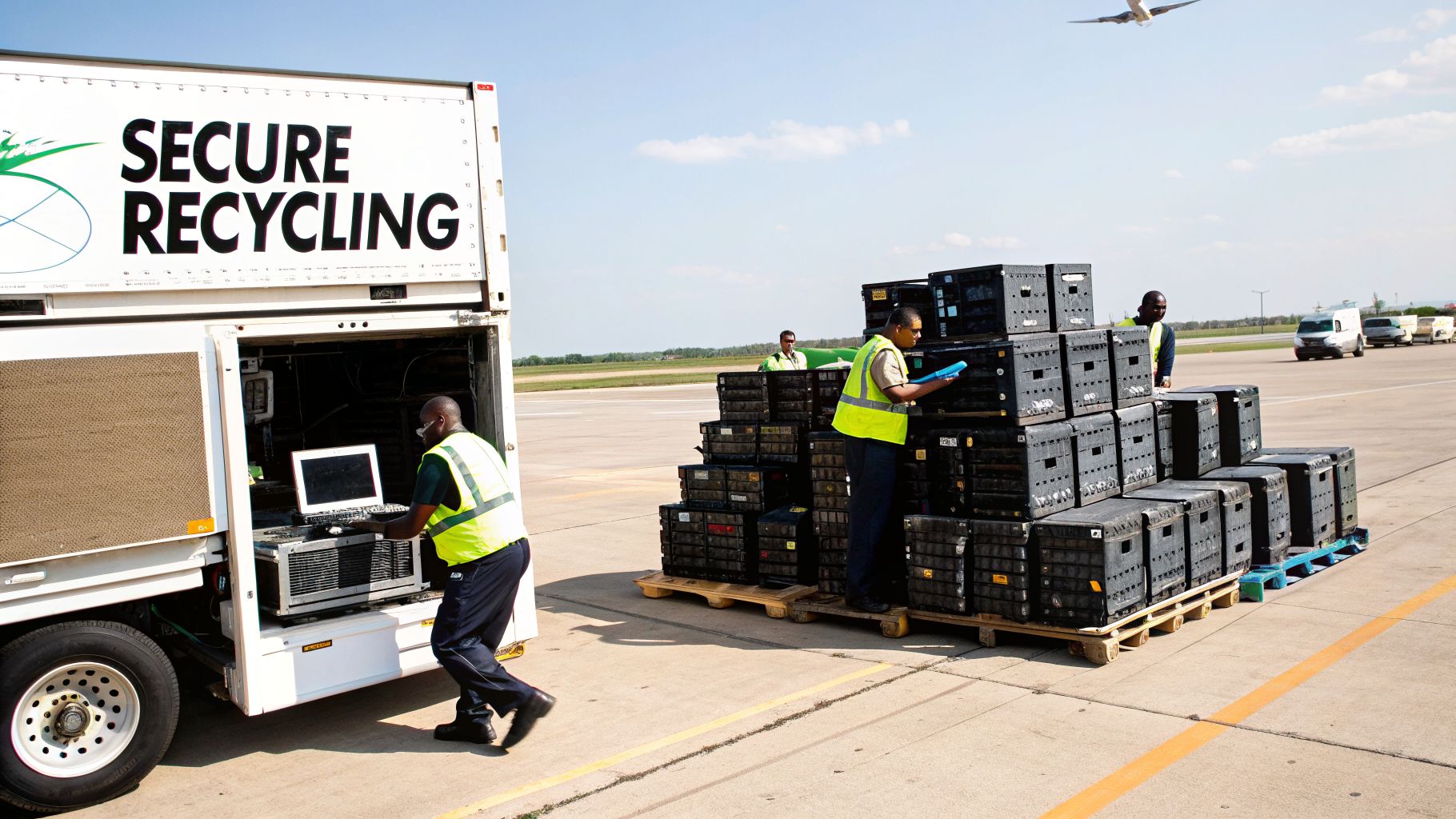
This isn't just a matter of tossing out old computers. We're talking about thousands of servers, point-of-sale systems, and monitors packed with sensitive corporate and customer data. That's precisely why a dedicated strategy for IT Asset Disposition (ITAD) isn't just a good idea—it's absolutely critical for businesses focused on corporate sustainability electronics disposal.
Turn Your E-Waste Headache into an ESG Win
Think of ITAD as more than just recycling. It's a structured, secure process for retiring your company's technology. It covers everything from wiping data permanently to making sure every component is disposed of in an environmentally sound way. For any business operating at the fast pace of ATL, this process is a must-have.
The airport's scale tells the story. With 796,224 takeoffs and landings in 2026 and over 730,000 metric tons of cargo moving through annually, the technology infrastructure required is staggering. Every upgrade cycle for an airline or a freight forwarder produces a massive wave of old IT hardware that needs to be retired securely. You can get a sense of this massive scale from ATL's recent traffic reports.
This constant turnover is actually a golden opportunity. It’s a chance to transform an operational chore into a powerful statement for your Environmental, Social, and Governance (ESG) profile. When you partner with a certified ITAD provider, you ensure your e-waste is handled with the security and sustainability your stakeholders expect.
A formal ITAD program is how you turn retired assets into a story of security and sustainability. It protects your data, keeps you compliant, and proves your commitment to corporate responsibility.
Imagine a logistics firm near the airport scheduling a single pickup for a room full of outdated servers and tracking devices. A professional ITAD partner doesn't just haul it away; they provide certified proof that all sensitive shipping manifests and client data have been completely destroyed.
IT Asset Disposition Checklist for ATL-Area Businesses
Getting started with ITAD might feel overwhelming, but it boils down to a few key checks. We've put together this checklist to help IT managers and business owners around the airport ensure they're covering all their bases.
This table will guide you through the essentials, from data security to final documentation. For a deeper dive, explore our specialized services for Atlanta-area business recycling to see how we can build a custom plan for you.
| Compliance Check | Key Action | Why It Matters |
|---|---|---|
| Data Security | Confirm the vendor offers certified data destruction (shredding or multipass wiping). | This is your first line of defense against costly data breaches and the reputational fallout that follows. |
| Environmental Compliance | Ask for proof of R2 or e-Stewards certification from your recycler. | It's the only way to guarantee that toxic materials are managed responsibly and stay out of landfills, protecting your brand. |
| Logistics & Pickup | Choose a partner who provides secure, on-site logistics and handles bulk pickups. | This minimizes disruption to your daily operations and ensures your assets are transported safely and securely. |
| Documentation | Always request Certificates of Destruction and detailed recycling reports. | This creates a clean, auditable trail for your ESG reports and proves you've met all internal compliance standards. |
By following this checklist, you can confidently manage your old technology, knowing that your data is secure and your company is contributing to a more sustainable business environment.
Turn E-Waste into Hope and Reforestation
What if your company’s old electronics could do more than just get ticked off a compliance checklist? For businesses operating in and around Hartsfield-Jackson Atlanta International Airport, retiring your IT assets is a genuine chance to make a powerful, positive impact—one that goes far beyond simple recycling. It's an opportunity to turn old equipment into real social and environmental good. With "Recycling That Restores Lives and Landscapes," your Atlanta tech recycling becomes a tool for transformation.
Think about it this way: the old logistics servers from a freight forwarder near ATL are retired. The value recovered from those machines helps provide transitional housing for a local veteran. At the same time, a portion of the proceeds is used to plant trees, restoring a national forest. This is what we call "Recycling for a Cause"—a dual-mission approach that turns a routine task into a compelling story of community support.
Making Corporate Responsibility Tangible
For companies focused on their Environmental, Social, and Governance (ESG) goals, this model offers a direct and measurable win. It pulls corporate social responsibility out of the abstract and turns it into a concrete, reportable outcome. This is where messaging like, “Your old tech can house a veteran and grow a forest,” makes a tangible difference.
This narrative isn't just a feel-good story; it's backed by clear, transparent reporting. We can even provide live stats on our website, such as "1,245 veterans supported" and "3,700 trees planted," to showcase the real-time impact.
We make this process straightforward for businesses in the airport area. We even offer free corporate recycling drives for 50 or more devices. After your assets are collected, your company receives two key documents for your CSR and ESG files:
- Veteran Support Impact Reports: These reports detail the specific, direct aid your recycled electronics have funded.
- Plant-A-Tree Certificates: This certifies the number of trees planted in your company’s name and provides details on the reforestation project you’ve supported.
This documentation turns e-waste disposal into an auditable and celebrated part of your company's sustainability journey. By partnering on electronics recycling for veterans, you can demonstrate how even discarded technology like recycled circuit boards is a powerful force for good.
Your Questions About ATL and Atlanta E-Waste Answered
Trying to navigate a hub as massive as Hartsfield-Jackson while also managing corporate duties in the area can feel like a balancing act. We get a lot of questions, so we’ve put together answers to the most common ones, covering everything from travel logistics to B2B electronics recycling.
How Early Should I Arrive at ATL for a Domestic Flight?
For any domestic flight out of Hartsfield-Jackson Atlanta International Airport, the golden rule is to arrive at least two hours before your scheduled departure. Given ATL's sheer size and the unpredictability of security lines, especially during peak travel times, that two-hour buffer is your best bet for a stress-free trip to the gate.
What Is the Most Cost-Effective Way to Park at Hartsfield-Jackson?
If you're parking on-site for a trip that's longer than a day, the ATL Economy lots are your most budget-friendly choice. But for the absolute best long-term parking rates, it pays to look at the many off-site lots nearby. They offer some seriously competitive prices and run convenient shuttle services that take you right to the terminals.
How Can My Business Schedule a Bulk Electronics Pickup Near the Airport?
It's actually quite simple. For any business in the airport corridor, we offer a free corporate recycling drive. If you have 50 or more devices ready for disposal, we provide a complimentary pickup service to handle your old IT assets securely and responsibly.
We provide comprehensive documentation for your ESG and CSR needs, including Certificates of Destruction for data security and detailed Impact Reports. These reports quantify the social and environmental benefits of your donation, such as the number of trees planted and the veteran support funded.
Just get in touch to schedule a pickup, and our team will handle all the logistics from there. If you're not sure what kind of equipment we accept, you can find a complete rundown in our guide on where to recycle electronics in Atlanta. It’s the easiest way to turn your company's e-waste into a documented ESG win.
Ready to transform your company's e-waste into a force for good? Partner with Atlanta Green Recycling for secure, compliant, and impactful IT asset disposition. Schedule your free corporate pickup and start making a difference today at https://www.greenatlanta.com.