
Electronic Recycling at Staples: Protect Your Data

Old office tech rarely leaves all at once. It piles up.
A few retired laptops sit in a cabinet after a hardware refresh. An old multifunction printer gets parked in the copy room. Someone drops off a box of phones from the last mobile upgrade, then nobody wants to touch it because every device might still hold company data.
For an Atlanta IT manager, that creates a familiar temptation. Search for electronic recycling at Staples, load the gear into a few cars, and get it out of the building fast. For households and one-off consumer drop-offs, that instinct makes sense. For a business, it can create security, documentation, and compliance problems that don't show up until much later.
The Familiar Dilemma of Old Office Tech
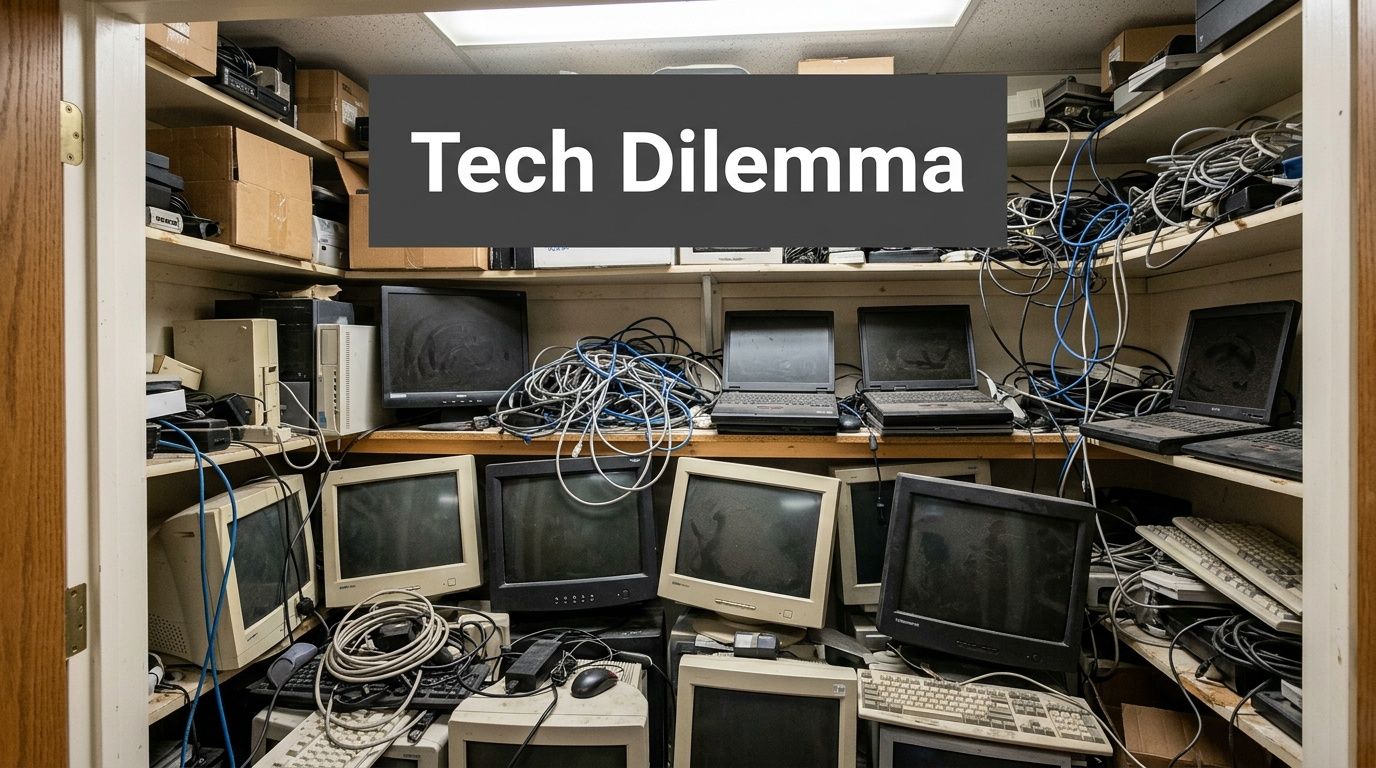
The scene is always the same. A storage closet starts as a temporary holding area, then turns into a graveyard for decommissioned desktops, tangled power cords, broken monitors, label printers, docking stations, and phones nobody can confidently clear for disposal.
In many offices, the first proposed solution is retail drop-off. It feels efficient. Staples is familiar, the trip is easy to understand, and consumer recycling programs are visible in a way downstream processing rarely is.
That logic works well enough when an employee wants to recycle a dead keyboard from home. It gets shakier when the pile includes company laptops, retired network gear, or desktops that once held HR files, patient information, contracts, or internal finance records.
What the closet is really holding
Most businesses don't just have scrap. They have a mix of asset classes with different risk profiles.
- End-user devices often carry cached credentials, local files, browser history, and saved tokens.
- Printers and copiers may contain stored jobs, address books, or internal drive storage.
- Phones and tablets can hold email, MFA apps, and corporate chat history.
- Infrastructure gear may contain configuration files, VPN settings, and customer environment details.
That changes the question. The issue isn't only where to recycle. It's whether the disposal path matches the kind of data and accountability attached to the equipment.
Old electronics become a governance problem long before they become a hauling problem.
Why convenience can mislead decision-makers
Retail programs solve for access. Business IT disposition solves for control.
Those are different goals. If you're trying to decide what to do with an aging tower or monitor inventory, this practical guide on what to do with an old desktop computer is a useful starting point. The bigger issue for organizations is that convenience can hide unanswered questions about custody, sanitization, and proof.
The hard part isn't getting devices out of the office. The hard part is being able to explain, months later, exactly what happened to them.
How Electronic Recycling at Staples Works for Consumers
A homeowner with one aging laptop, a tangle of cords, and a dead keyboard needs convenience more than process. That is the lane Staples serves well.
Staples runs a retail drop-off program that lets consumers bring in many common electronics and small accessories for recycling through participating stores. As noted earlier in the article, the program has earned EPA recognition and relies on certified downstream recycling partners. For personal devices, that gives people an accessible option that is far better than letting old electronics sit in a drawer or end up in the trash.
What consumers can typically bring
For household users, the appeal is simple. Bring the item to the store, confirm it is accepted, and hand it over at the counter.
Accepted categories generally include common consumer electronics such as laptops, desktop accessories, printers, keyboards, mice, phones, cameras, chargers, and other small tech items. Staples has also expanded battery collection through its retail footprint, which makes the program more useful for people clearing out mixed household e-waste. The exact list can change by store and by item type, so checking ahead still matters.
That setup works well for light-volume cleanup. It is built for a few items at a time, not for an office decommissioning project.
What it costs and what to expect
The consumer model is straightforward, but it is not always free. Some smaller items may be accepted at no charge, while certain larger devices can carry a per-item recycling fee. Store-level limits can also apply.
For a resident cleaning out a home office, that is usually manageable. For a business with 40 laptops, retired network gear, and three multifunction printers, it becomes inefficient fast.
A practical checklist for consumer drop-off looks like this:
- Verify the item is accepted. Policies can vary by category and location.
- Check for fees before you go. Larger equipment may cost more to recycle.
- Package batteries separately if the store requests it. That helps avoid intake issues.
- Wipe personal data before drop-off. The retail program places that responsibility on the customer.
That last point is the line business leaders should pay attention to.
Why the program earns respect for household use
Staples deserves credit for making electronics recycling easier to access. Retail collection points help keep devices and batteries out of general waste streams, and the company has put real effort into building a visible national program.
For consumers, that is usually enough. The main goal is responsible disposal with minimal hassle, and Staples meets that need.
Anyone comparing general public drop-off options can review this guide on where to recycle electronics in Atlanta. For personal electronics, retail recycling is often a reasonable choice if the owner can confirm the device has been cleared and the item count is low.
The trade-off is control. Consumer programs are designed around convenience at the front counter, not around serialized asset tracking, pickup logistics, data destruction records, or audit support. That distinction matters a lot once the equipment belongs to a business.
Why Staples Is the Wrong Choice for Business E-Waste
The problem for businesses isn't whether Staples recycles responsibly. The problem is that the service model is built for consumers, and consumer convenience leaves important business controls undefined.
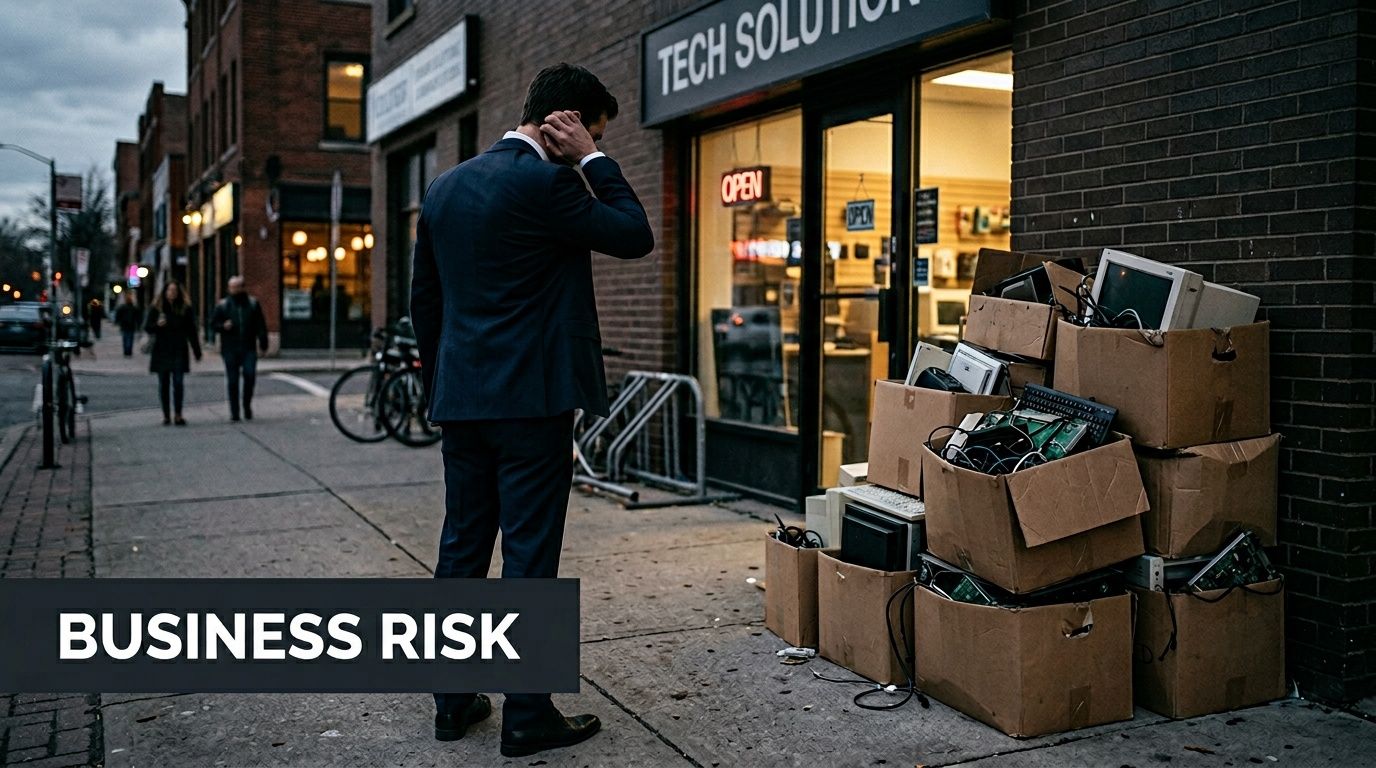
That distinction matters most when the devices came from a business network, a medical office, a school district, a law firm, or a government department.
The data security gap
Staples' public-facing recycling guidance stresses that customers should remove their own data before drop-off. For households, that's a reasonable instruction. For businesses, it's a red flag.
A company shouldn't depend on a hurried employee to decide whether a laptop was fully wiped, whether a copier hard drive was cleared, or whether an old server still contains client records. Businesses need a defined sanitization process, and they need evidence that it happened.
The gap is explicitly noted in Recycling Today's discussion of the Staples program, which states that the consumer-focused model lacks specifics on secure sanitization to standards like NIST 800-88, chain-of-custody tracking, or documentation for ESG reporting.
The compliance problem nobody sees until audit time
Retail drop-off doesn't usually generate the paperwork a business needs later.
A regulated organization may need to answer basic but serious questions:
- Which assets left the building
- Who handled them
- When custody changed
- What data destruction standard was used
- What proof exists if legal, audit, or insurance teams ask
Those aren't theoretical concerns. Healthcare groups, financial firms, education systems, and public agencies often need records that tie a specific asset disposition event to internal controls.
If your team is comparing vendors, this overview of IT asset disposition companies highlights what proper business workflows typically include.
No real chain of custody
A business chain of custody starts at your facility, not at the front counter of a retail store.
When an employee loads devices into a personal vehicle, drives them across town, and drops them into a consumer program, your organization may lose visibility before processing even begins. That creates unnecessary exposure. It also makes internal sign-off harder because facilities, IT, legal, and compliance teams may all have a different view of what "disposed" means.
A stronger process documents movement from pickup through downstream handling.
If you can't show who controlled the asset at each handoff, you don't have a business-grade disposal record.
Logistics break down fast
Retail drop-off also wastes internal labor when volumes rise.
One laptop is easy. A room full of workstations isn't. Add monitors, cables, printers, and battery backups, and the hidden cost becomes staff time, transport coordination, lifting risk, and location-level acceptance limits.
For office moves, lease returns, refresh cycles, and branch consolidations, consumer workflows often fail in ordinary ways. The store can't intake the volume quickly. The equipment isn't packed correctly. Devices sit longer than planned because nobody owns the project.
The business case against consumer disposal
A simple comparison makes the issue clear:
| Business requirement | Consumer drop-off reality |
|---|---|
| Secure data destruction standard | Customer is told to wipe devices |
| Asset-level documentation | Often limited or absent |
| Pickup from office | Not the default model |
| Bulk project handling | Awkward and inconsistent |
| ESG reporting support | Not designed around business reporting |
Staples can be the right answer for a resident recycling a home printer. It becomes the wrong answer when an Atlanta organization needs a defensible process.
The Professional Alternative for Atlanta Businesses
Business e-waste disposal should work like risk management, not errands.
A proper program starts at the point of control inside your building. Assets are identified, removed in an organized way, packaged for transport, tracked through handoff, sanitized under a defined standard, and documented so the organization can prove what happened later.
What a business-grade process includes
For Atlanta companies, the professional alternative usually begins with onsite coordination. That matters because many high-risk assets aren't sitting in neat boxes near the loading dock.
They may still be under desks, in IDF closets, in nurse stations, on production floors, or inside storage rooms that operations staff want cleared without disrupting the workday.
A solid B2B process typically includes:
- Onsite pickup using a dedicated fleet so employees aren't improvising transport
- De-installation and packing for offices, server rooms, and branch locations
- Asset tracking from collection through final disposition
- Documented chain of custody that supports internal review
- Formal data destruction options based on device type and risk level
This isn't overkill. It's the minimum standard when devices once touched sensitive data or regulated workflows.
Wiping isn't the same as verified sanitization
Many businesses use the word "wipe" loosely. That causes trouble.
There is a major difference between an employee deleting files, running a quick reset, or checking a box that says "erase device," and a documented sanitization workflow aligned to recognized standards such as NIST 800-88. Some organizations also require or prefer physical destruction for obsolete or failed drives because the device can't be reliably sanitized through software.
The processing side matters too. Professional recyclers use a disassembly-based recovery methodology, with trained technicians separating circuit boards, plastics, and metals for different downstream paths, and the cost structure reflects the labor and compliance overhead involved in meeting certifications like e-Stewards or R2, according to this technical overview of electronics recycling practices.
That same article notes why audited erasure and zero-export controls matter to enterprise buyers. Responsible recycling isn't just hauling. It's controlled processing with compliance obligations built in.
What works better for regulated industries
Healthcare, finance, legal, education, and government all face versions of the same challenge. They don't just need removal. They need evidence.
A stronger service model supports that with records such as:
| Need | Business-grade response |
|---|---|
| Sensitive drive media | Verified sanitization or physical shredding |
| Audit preparation | Certificates and asset-level records |
| Office relocation | Managed pickup and de-installation |
| Data center cleanup | Project-based coordination and packing |
| Sustainability review | Clear downstream handling documentation |
That documentation becomes useful in ordinary situations. Internal audits. Cyber insurance questionnaires. Vendor reviews. Client security assessments. Lease-end true-ups. Board-level ESG discussions.
Why Atlanta organizations should stay local
Local execution matters more than many buyers expect.
An Atlanta-based team can schedule around loading dock access, building management windows, school calendars, hospital constraints, and branch closures. They know the difference between a small office pickup and a phased decommissioning. They can also respond when a project changes halfway through, which happens often.
This guide to electronic recycling in Atlanta is useful if you're evaluating what local service coverage should look like.
The best recycling partner isn't the one with the nearest storefront. It's the one that can document the handoff, protect the data, and keep your internal team out of the transport business.
What doesn't work
Several shortcuts routinely create headaches:
- Relying on employee memory to identify which devices were cleared
- Using personal vehicles for transport of business assets
- Mixing personal and company electronics in the same load
- Dropping off bulk gear without serialized records
- Treating all devices as low-risk scrap
Those mistakes usually happen because the disposal plan started too late. Once old tech starts blocking space, teams rush. The right process slows down the risky parts and speeds up everything else.
Recycling With Purpose Your Easy ESG Win
Secure disposal solves one problem. It can also support a broader business objective if the recycling program connects operational cleanup to visible social impact.
That is where many Atlanta organizations leave value on the table. They treat end-of-life electronics as a back-office task when it can also become a clean, credible CSR and ESG initiative employees understand immediately.

Why purpose changes participation
Most staff don't get excited about disposition policy. They do respond to mission.
A recycling campaign framed only around risk sounds like housekeeping. A campaign framed around impact gives employees a reason to participate, talk about it internally, and support repeat collection events.
One message works especially well because it links the action to something tangible: Your old tech can house a veteran and grow a forest.
That kind of cause-based positioning does two things at once. It makes disposal emotionally legible for employees, and it gives leadership a simple story for sustainability communications.
What meaningful ESG support looks like
For a company, the easy win isn't the recycling event itself. It's the ability to turn a necessary operational activity into documentation, employee engagement, and community value.
Strong ESG-aligned recycling partnerships can include outputs such as:
- Plant-a-tree certificates that teams can reference in internal sustainability updates
- Veteran support impact reports that make community benefit visible
- Digital recognition assets like a "Recycled with Purpose" badge for websites or reports
- Seasonal drives tied to Veterans Day, Earth Day, and Arbor Day
- Co-branded community events with schools, nonprofits, shelters, or veteran groups
None of that replaces secure processing. It builds on top of it.
A better story for Atlanta companies
Atlanta businesses face constant pressure to show practical community engagement, not just polished mission statements.
Electronics recycling offers a clean fit because the need is already there. Offices refresh laptops. Schools retire desktops. Hospitals replace workstations and peripherals. Municipal departments rotate equipment. The material will move either way.
The smarter move is to make that movement count for something beyond clearance.
Companies remember recycling vendors for a week. Employees remember purpose-driven campaigns much longer.
Internal campaigns that work
The most effective recycling drives are simple enough for operations teams to run and meaningful enough for marketing or HR to support.
A practical model looks like this:
Recycle for a Cause
Frame the collection around dual impact. Old electronics support veteran aid and tree planting. That gives the campaign a clear human and environmental outcome.
Department collection days
Set pickup windows by floor, department, or facility. That reduces clutter and creates accountability without forcing one big chaotic cleanout.
Leadership visibility
Ask an operations lead, IT manager, or sustainability contact to explain why responsible disposal matters. Keep it brief and concrete.
Follow-up proof
After the collection, share impact certificates, downstream documentation, and a short recap employees can trust.
Why this matters for CSR teams
CSR teams need programs that are easy to activate and easy to explain. Electronic waste is unusually strong on both counts.
It touches procurement, operations, sustainability, facilities, and community relations. It also avoids a common CSR problem. Many social initiatives are abstract to employees. Old tech sitting in the office is not abstract.
That makes it useful for:
| Business function | Value from purpose-driven recycling |
|---|---|
| HR and culture | Employee participation in visible local impact |
| Marketing | Credible sustainability storytelling |
| ESG reporting | Clear activity tied to environmental handling |
| Facilities | Space recovery and organized cleanouts |
| IT | Controlled retirement of obsolete assets |
The brand advantage of visible impact
A business doesn't need grand claims to make this work. It needs consistency.
A recurring campaign, recognizable messaging, and visible documentation can turn e-waste into one of the easiest sustainability actions an office can take. It also gives sales and recruiting teams something specific to point to when prospects or candidates ask what the company does locally.
The strongest programs don't oversell. They show that necessary operational work was handled responsibly and connected to a mission people care about.
That is often enough to separate a serious sustainability effort from performative language.
Staples vs Atlanta Green Recycling for Businesses
If you're deciding between retail drop-off and a business recycling partner, compare the service models against the controls your organization needs. For companies, this isn't a debate about convenience. It's a decision about custody, proof, and operational fit.

Feature comparison
| Feature | Staples (Consumer Drop-Off) | Atlanta Green Recycling (B2B Service) |
|---|---|---|
| Data security | Customer-led device wiping | Managed sanitization and destruction options |
| Documentation | Limited consumer-style records | Business-focused audit documentation |
| Chain of custody | Begins at store drop-off | Begins at pickup from your site |
| Logistics | Employee transport to retail location | Pickup, packing, and project support |
| Bulk handling | Not ideal for office cleanouts | Designed for volume and recurring programs |
| ESG support | Consumer recycling convenience | Business-ready impact and reporting support |
Where the difference is most obvious
A retail program asks your staff to adapt to the retailer's workflow. A business service adapts to your facility, timing, and documentation requirements.
That difference shows up in daily operations:
- Office moves need organized removal, not multiple car trips.
- Lease expirations need asset records that reconcile what left.
- Healthcare and legal environments need stronger data handling discipline.
- Large refresh cycles need project management, not checkout-counter logic.
Which option fits which user
The practical split is simple.
Staples fits best when:
- a resident has a few personal items
- the devices are already cleared
- no formal destruction record is needed
- convenience matters more than enterprise controls
A B2B recycler fits best when:
- the devices belong to an organization
- sensitive or regulated data may be present
- an audit trail matters
- the quantity is too large for informal drop-off
- the company wants disposal to support ESG and community goals
Retail recycling is a convenience service. Business IT disposition is a control function.
For Atlanta organizations, that distinction should drive the decision. If the devices came from a company environment, they should leave through a company-grade process.
Making the Right Choice for Your Atlanta Organization
Your Atlanta IT team is clearing out a storage room before an office move. Laptops from the last refresh, a few dead UPS batteries, old phones from departed staff, and a stack of mystery peripherals are all mixed together. That pile is not a retail errand. It is a business disposal event with security, documentation, and policy exposure attached.
Staples can still make sense for a resident dropping off a personal cable box or an old keyboard. An organization has a different burden. Business equipment may hold regulated data, licensed software, asset tags, or records your finance and compliance teams may need to reconcile later. If your process cannot show who handled the equipment, how data was destroyed, and what left the building, you are relying on memory instead of controls.
That is the gap many companies miss.
A consumer drop-off model puts the burden on your staff to sort devices, transport them, wipe data correctly, and hope the paperwork question never comes up later. A professional ITAD and electronics recycling partner handles pickup, chain of custody, documented destruction, and downstream processing built for business use. If your team needs proof that drives an audit file instead of a verbal assurance, review what a certificate of destruction is.
For Atlanta organizations, the right choice is the one that protects data, satisfies internal policy, and supports ESG goals without creating more work for your employees. Atlanta Green Recycling does that with business-grade workflows, secure data destruction, pickup logistics, and a mission-driven model that turns retired equipment into measurable community benefit. If your equipment came from a company environment, route it through a company-grade process and contact Atlanta Green Recycling before the next cleanout becomes a compliance problem.