
Your Guide to the Hartsfield Jackson Atlanta International Airport Location


Before you can even think about navigating the world's busiest airport, you need to know where to find it. The official address for Hartsfield-Jackson Atlanta International Airport is 6000 North Terminal Parkway, Atlanta, GA 30320. This sprawling hub sits just south of the city, perfectly positioned at a crossroads of major travel and commercial routes.
Pinpointing ATL's Exact Location

Getting a handle on the airport’s location is the first step to a stress-free trip. It’s not smack in the middle of Downtown or Midtown, but rather strategically placed to be easily reached from any direction.
Hartsfield-Jackson is located in Clayton County, about 10 miles south of Downtown Atlanta. This prime placement, which began on an old, abandoned racetrack back in 1925, has been a massive factor in its incredible growth. If you’re using GPS, the coordinates you’ll need are 33°38′12″N 84°25′41″W.
ATL Airport Location At a Glance
For those who just need the facts, here's a quick rundown of the key location details for the Hartsfield Jackson Atlanta International Airport location. This is a great reference for business travelers or anyone coordinating logistics.
| Attribute | Detail |
|---|---|
| Physical Address | 6000 North Terminal Parkway, Atlanta, GA, 30320 |
| County | Clayton County |
| GPS Coordinates | 33°38′12″N 84°25′41″W |
| Key Transit Link | MARTA Red/Gold Lines (Direct to Domestic Terminal) |
| Distance from Downtown | Approximately 10 miles (16 km) south |
These details should give you a solid foundation for your travel plans. For an even deeper dive into the airport's layout and amenities, you can explore our complete guide to the Atlanta Hartsfield Jackson Atlanta International Airport.
Driving to ATL: Navigating Atlanta's Highways
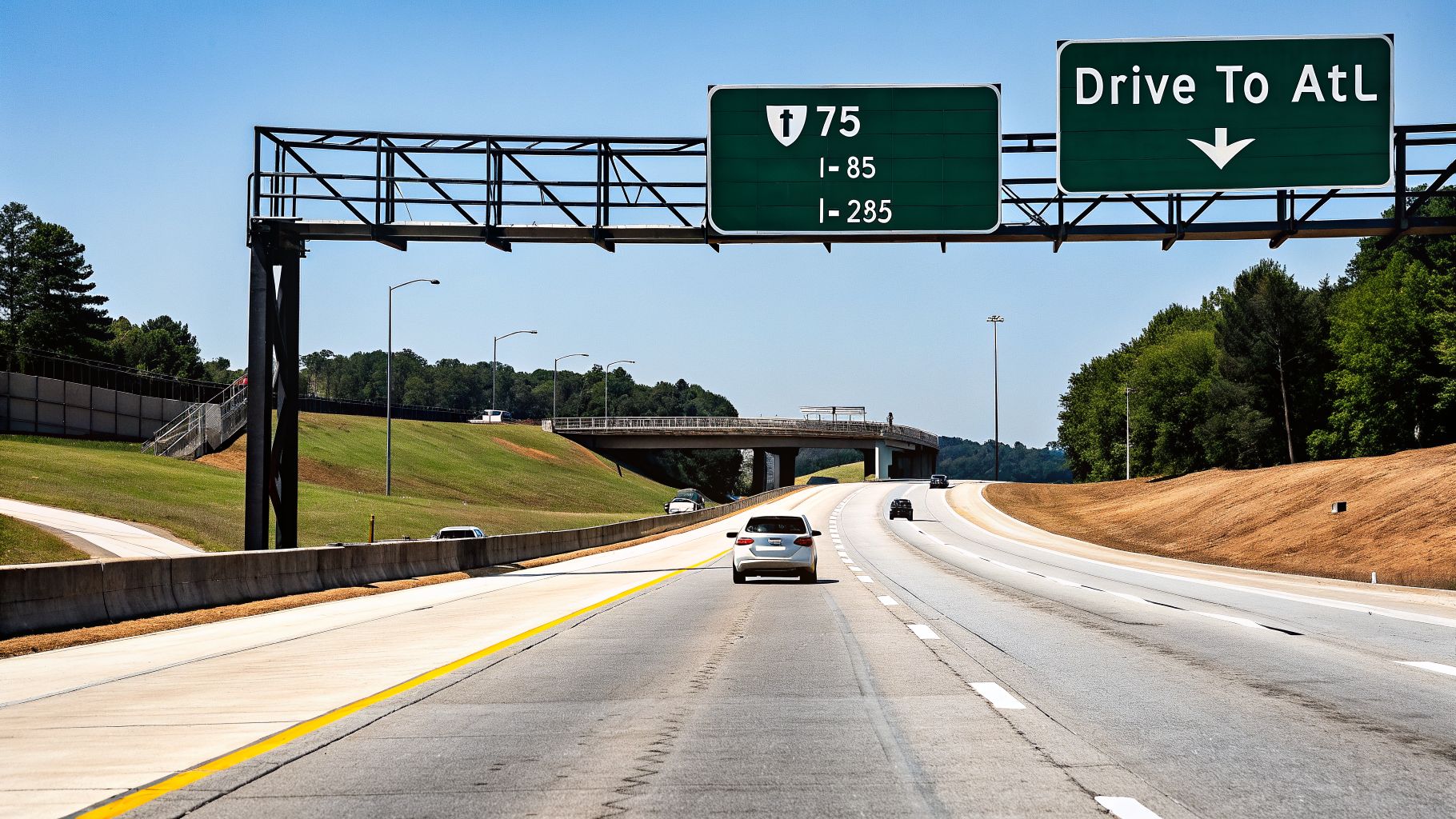
If you're driving to Hartsfield-Jackson, you'll be navigating a serious web of major interstates. The main arteries feeding into the airport are I-75, I-85, and the I-285 perimeter loop. Getting a handle on how these highways connect is the secret to a stress-free trip, whether you're catching a flight or managing corporate transport.
For anyone heading south from neighborhoods like Midtown or Buckhead, your main route will be the I-75/I-85 Connector. Pay close attention as you get closer to the airport—this major highway splits, and you don't want to be caught in the wrong lane.
Pro Tip: Atlanta traffic is legendary for a reason. Rush hour is intense, typically from 7-9 AM and 4-7 PM. If you can, plan your drive outside these windows. It’s always a good idea to check a live traffic app before you hit the road.
Key Routes and Exits
Here’s the most important thing to know: the Domestic and International terminals have completely different exits and are not connected by road. You have to pick the right path from the get-go.
For the Domestic Terminal: If you're on I-85 South, you’ll need Exit 72 for Camp Creek Parkway. If you're coming down I-75 South, you'll merge onto I-85 South first and then just follow the airport signs.
For the International Terminal: Stay on I-75 South and take Exit 239 for C.W. Grant Parkway. This exit is a direct shot to the Maynard H. Jackson Jr. International Terminal. You'll also see clear signs if you’re approaching from I-285.
For businesses managing fleet movements, the airport’s prime highway access is a huge logistical plus. This proximity makes it easy to route cargo and shuttle corporate travelers efficiently. To learn more about how the airport's location is a cornerstone of regional commerce, check out our articles on Atlanta logistics. Knowing these routes inside and out can streamline your operations and guarantee your team arrives on time.
Riding MARTA: A Stress-Free Trip to the Airport
If you want to bypass Atlanta's notorious traffic entirely, the MARTA train system is your best bet. It’s the most efficient and budget-friendly way to get to the Hartsfield-Jackson Atlanta International Airport, offering a direct and surprisingly calm alternative to driving, especially for business travelers on a tight schedule.
Both the Red and Gold lines travel directly to the airport, ending at a station conveniently located right inside the Domestic Terminal. This means no waiting for shuttles or making a long trek from some distant parking lot; you’re delivered right into the heart of the action. From the station, it’s just a short walk to baggage claim and the security checkpoints.
It's always helpful to see the bigger picture. If you're interested in how cities are upgrading their transportation networks, this look into the emerging trends in urban mobility provides some great context on systems just like MARTA.
Your Guide to Using the System
The journey itself is incredibly straightforward. To ride, you’ll need a Breeze Card or Breeze Ticket, which you can buy from the kiosks at any station. A one-way fare is just $2.50, making it a fantastic economical choice.
One of the biggest advantages over driving is how predictable the travel times are.
- From North Springs (Red Line): Approximately 45 minutes
- From Doraville (Gold Line): Approximately 40 minutes
- From Midtown Station: Approximately 20 minutes
- From Five Points Station (Downtown): Approximately 15 minutes
Once you pull into the Airport Station, just follow the signs for the terminal. You’ll ride an escalator straight up into the main atrium, right between the North and South baggage claims. This seamless connection shows that taking MARTA isn't just about saving money—it's a smart logistical move. For a deeper dive into Atlanta's public transit, be sure to read our detailed article on using MARTA.
Getting Around the Airport: Terminals and Transportation
Once you’re on the ground at Hartsfield-Jackson, the key to a stress-free experience is knowing the lay of the land. This place is massive—we're talking a 4,700-acre campus. The first thing to know is that it’s split into two completely separate hubs: the Domestic Terminal and the Maynard H. Jackson Jr. International Terminal.
Think of them as two different airports connected by a train. They each have their own parking, check-in counters, and ground transportation. So, figuring out which one you need before you leave for the airport is absolutely critical to starting your trip on the right foot.
The Domestic Terminal sits on the west side of the airport and is your gateway for any flight within the United States. It’s further divided into North and South sides, where different airlines handle check-in and baggage claim. On the flip side, the International Terminal is on the east side, handling nearly all international departures and, importantly, all international arrivals.
Connecting the Dots: Terminals and Concourses
Getting between the two main terminals and the seven concourses (T, A, B, C, D, E, and F) is actually one of the easiest parts of the ATL experience, all thanks to the Plane Train.
This is the airport’s dedicated underground subway. It's fully automated, runs 24/7, and a train pulls up every two minutes. You can get from the Domestic Terminal all the way to Concourse F and the International Terminal in just a little over five minutes. It’s incredibly efficient.
The visual below shows just how well public transit is integrated, especially with MARTA dropping you right inside the Domestic Terminal.
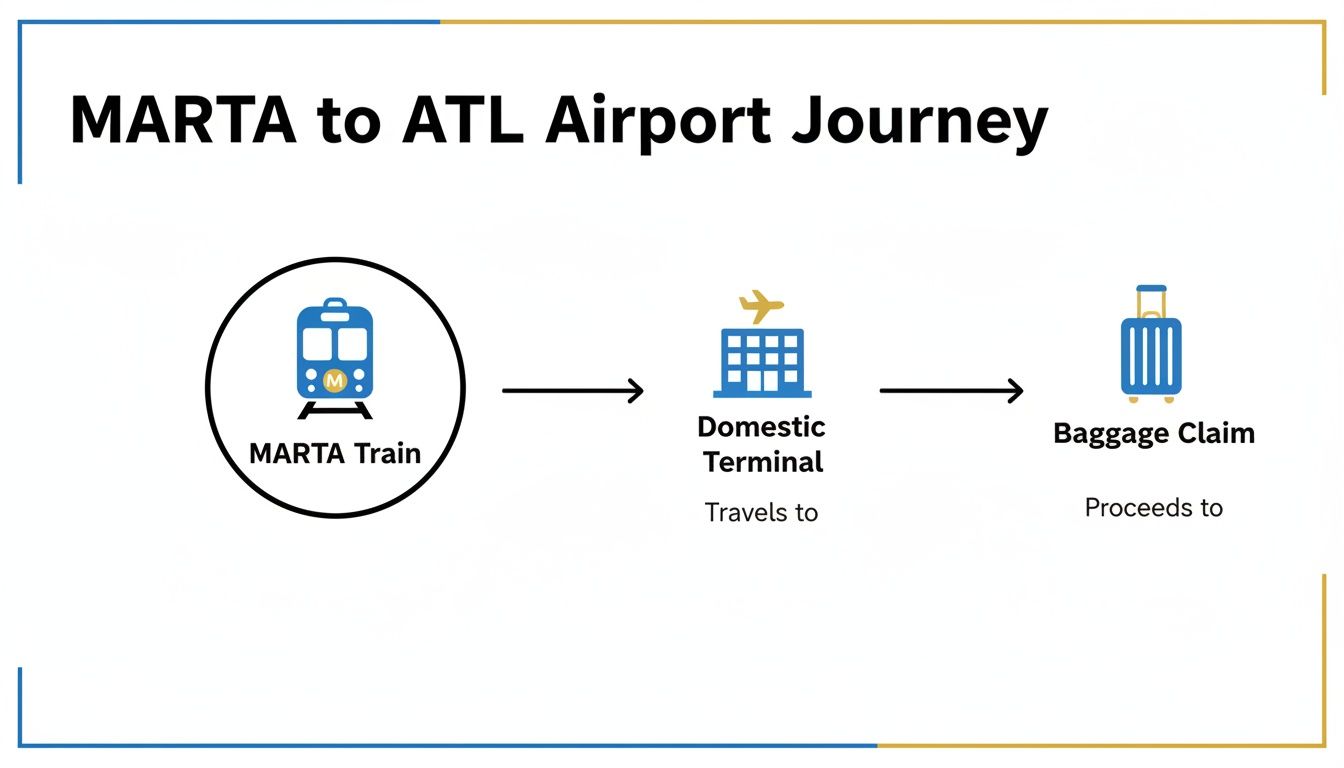
As you can see, you can walk directly from the train into the terminal without ever needing to step outside or wait for a shuttle. It’s a seamless connection.
Your Guide to Parking
Hartsfield-Jackson has a parking solution for pretty much every scenario and budget. Picking the right one ahead of time can save you from a long walk or a surprisingly high bill.
The airport’s location is a huge part of its success. Sitting on 4,700 acres in Clayton County, just 10 miles south of Downtown Atlanta, it was perfectly positioned for growth. Massive infrastructure projects, like the original 2.5-million-square-foot terminal designed for 55 million passengers a year, paved the way for it to handle 108.1 million travelers by 2026.
Here’s a quick breakdown of your main options:
- Hourly Parking: This is your best bet for quick trips, like picking someone up or dropping them off. The lots are located right next to both the Domestic and International terminals.
- Daily Parking: If you're heading out for a weekend or a few days, the covered daily decks are a solid choice. They're situated just across from the terminals.
- Economy Lots & Park-Ride: For longer trips, these lots offer the best value. Free shuttles run on a continuous loop to get you to and from the terminals without a hassle.
Getting a handle on these layout and transportation basics will make navigating ATL feel like second nature. For even more travel hacks, be sure to check out our complete ATL Airport Guide for all our insider tips and tricks.
Why the Airport's Location Powers Atlanta's Economy
The strategic location of Hartsfield-Jackson Atlanta International Airport isn't just a matter of convenience; it’s the very engine that drives Atlanta's economic machine. Think of it as the heart of the city's commercial body, pumping people and goods through its arteries and creating a vibrant ecosystem that supports everything from massive logistics firms to local startups.
This constant flow is more than just traffic—it’s a powerful signal of Atlanta's dynamic business environment. The sheer volume reinforces our city's status as a top-tier destination for corporate headquarters and innovation. Of course, an operation of this magnitude relies on a vast network of specialized services, including those that provide essential airport industry solutions.
A Hub on an Unmatched Scale
Since reclaiming its title as the world's busiest airport, the Hartsfield Jackson Atlanta International Airport location has become synonymous with record-breaking traffic. The facility’s ability to handle 108.1 million passengers each year speaks volumes about its massive capacity, with projections showing even more growth ahead.
For companies operating anywhere near this bustling nexus, this level of activity creates a unique set of challenges and responsibilities. It’s why positioning your business as an easy ESG win is so critical. We believe in turning e-waste into hope, helping local companies meet sustainability benchmarks through initiatives like corporate recycling drives and our "Recycled with Purpose" eco-badge certification.
The sheer volume of business travel and cargo that moves through ATL highlights just how critical robust corporate sustainability programs are. This includes things like responsible IT asset management and electronics recycling, which are now key considerations for any company looking to meet modern ESG (Environmental, Social, and Governance) standards.
All this economic activity points to a clear demand for partners who can help manage the lifecycle of corporate assets in a responsible way. For any business in this major economic zone, finding sustainable solutions isn't just good practice—it's just smart business.
To get a better sense of the airport's layout and its role, you can find a deeper dive in our complete guide to the Hartsfield-Jackson Atlanta International Airport.
Your Hartsfield-Jackson Questions Answered
Got questions about getting to, from, or through ATL? You're not alone. Hartsfield-Jackson is a massive place, and even seasoned travelers can use a few pointers. Here are the quick, no-nonsense answers to the questions we hear most often.
Which Terminal Do I Need for My Flight?
This is the big one, and getting it right from the start is half the battle. Your terminal is determined by your destination.
As a general rule, it breaks down like this:
- Domestic Flights: Head to the Domestic Terminal for check-in and security.
- International Flights: You'll need the Maynard H. Jackson Jr. International Terminal for check-in and security.
The most important thing you can do is check your ticket. Some domestic flights that connect to international routes actually depart from the International Terminal (Concourse F). Knowing where you’re going before you even leave for the airport is the single best way to ensure a smooth start to your trip.
How Long Does It Take to Get Between Concourses?
Getting around the airport is surprisingly quick, all thanks to the Plane Train. This automated train is the backbone of the airport, running underground and connecting all seven concourses.
The Plane Train is incredibly efficient, arriving at each station every two minutes. A trip between any two adjacent concourses takes only about 60 to 90 seconds.
Even if you have to travel the entire length of the airport—from the Domestic Terminal side near Concourse T all the way to the International Terminal's Concourse F—the whole journey usually takes just 5 to 7 minutes. This makes even seemingly tight connections very manageable.
What Is the Best Way to Get to the Airport from Downtown?
For most people coming from the heart of the city, the MARTA train is easily the best option. It’s a straight shot.
The Red and Gold lines run directly from downtown stations like Five Points right into the airport's Domestic Terminal station. This route completely bypasses Atlanta's notorious road traffic, making your arrival time predictable and your fare affordable.
While a taxi or rideshare gives you a door-to-door trip, you’re at the mercy of traffic, especially during rush hour. If you value reliability and speed over a direct curb-to-curb drop-off, MARTA wins every time.
Is There a Cell Phone Lot at ATL?
Yes, Hartsfield-Jackson has a free Cell Phone Lot for anyone waiting to pick up an arriving passenger. It’s located just a few minutes from the terminal arrival areas.
Using the lot is the smart way to wait. It saves you from endlessly circling the terminals, helps keep the curbside pickup area clear, and makes the whole pickup process far less stressful for everyone involved.
Managing the logistics for a large corporate footprint near a major hub like Hartsfield-Jackson also means handling asset management responsibly. For Atlanta-area businesses looking to put secure and sustainable electronics recycling programs in place, Green Atlanta offers comprehensive e-waste and IT asset disposal services, turning your old tech into hope for veterans and new trees for our forests. Visit us at https://www.greenatlanta.com to see how we can help your organization meet its ESG goals with recycling that restores lives and landscapes.